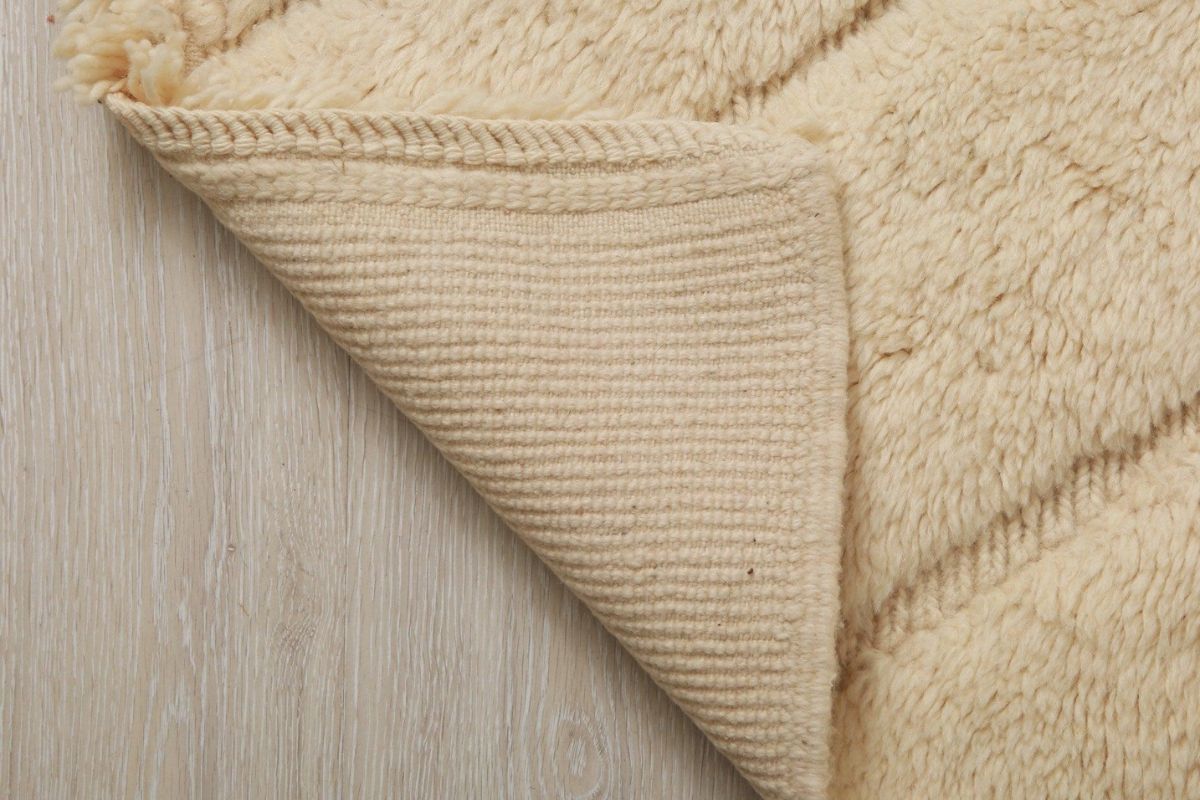
A Beni Mrirt rug is a hand-knotted wool rug from the Middle Atlas region of Morocco, sold in the market as a denser, more tightly woven, and generally more expensive counterpart to the better-known Beni Ourain. Where Beni Ourain is loose and shaggy, Beni Mrirt is described as tighter and more velvet-like underfoot. Rug sellers commonly attach specific knot-count and washing figures to that comparison. Those figures are repeated across seller sites with no named source and no independent verification, so this guide states the underlying idea (denser weave, more labor, generally higher price) without adopting any seller's numbers as settled fact.
Atlas Rug Guide sells no rugs and carries no commission on this or any style, so nothing below is written to move you toward the pricier option.
Where the name comes from
"Mrirt" is a real, checkable place name: Mrirt is a town in Khenifra Province, in the Béni Mellal-Khénifra region of the Middle Atlas. Rug-seller sites commonly describe the style as woven by a "Mrirt tribe," but none of the pages sampled for this guide cite a source for that specific tribal claim, and this guide will not repeat it as settled. What can be stated plainly is the geography: the name points to a Middle Atlas weaving area, the same broad mountain region that produces Beni Ourain rugs, and the market uses "Beni Mrirt" as a style name for wool rugs associated with that area and its denser weaving tradition. Beyond that, treat any specific tribal attribution you see in a listing as a seller's claim, not a verified fact.
What to expect: pile, weight, feel
Where a Beni Ourain reads as open, fluffy, and cloud-like, a Beni Mrirt is described consistently across the market as denser and more compact, with a surface closer to velvet than to loose fur. That comes from a tighter weave and, sellers say, a double-knotting technique rather than a single knot per point. A denser weave uses more wool and more labor per square foot of finished rug, which is the honest, non-numeric version of why Beni Mrirt pieces tend to sell for more than a comparable Beni Ourain.
The palette stays in the same neutral family as Beni Ourain: creamy whites, warm taupes, and soft grays, often with the same sparse dark geometric line work. If you are looking at a rug loaded with saturated color, you are looking at a different Moroccan style, whatever the listing calls it. This neutral palette is what both Middle Atlas wool styles have in common.
Beni Mrirt vs. Beni Ourain, at a glance
| Feature | Beni Ourain | Beni Mrirt |
|---|---|---|
| Pile | Higher, shaggier, more open | Lower, denser, closer to velvet |
| Feel | Loose, fluffy, cloud-like | Compact, plush, tightly packed |
| Knotting | Single knot, looser weave | Described by sellers as double-knotted, tighter weave |
| Palette | Undyed cream with dark marks | Similar neutrals, sometimes richer taupe/gray |
| Market position | The familiar, widely available classic | Marketed as the denser, pricier upgrade |
Neither pile type is objectively "better." A tighter weave generally means more labor went into the rug, which tends to track with price, but the looser, shaggier Beni Ourain pile is exactly what a lot of buyers are actually shopping for. For the full breakdown of the Beni Ourain side of this comparison, see our Beni Ourain rug guide.
The numbers you'll see quoted, and why this guide won't repeat them
Search for Beni Mrirt and you will quickly run into a specific pair of claims, repeated almost word for word across multiple seller sites: a knot-per-square-inch figure for each style (commonly given as roughly 6-8 KPSI for Beni Ourain against 15-18 KPSI for Beni Mrirt), and a claim that Beni Mrirt wool is "washed several times" against Beni Ourain's "washed once."
Here is the problem: not one of the pages making these claims names where the figures came from, and the exact numbers are not consistent from site to site even when two pages are making the same general point. That pattern, an identical-sounding claim with no shared source and no agreement on the specific number, is exactly what this guide's editorial standard treats as unverified rather than fact. A dedicated comparison article, Beni Ourain vs. Beni Mrirt: what the knot-count claims actually rest on, works through this specific claim in more depth, including why the wash-count story doesn't hold up as stated either. The short version for this page: treat "denser weave, more labor, generally more expensive" as the honest takeaway, and treat any specific KPSI number you see in a listing as a claim to ask about, not a spec to shop against.
What actually helps you judge one in front of you
Since the numbers themselves are not reliably sourced, the more useful approach is what you can check directly:
- Feel the density with your hand. Press your fingers into the pile near the base. A denser weave resists more and shows less visible backing between tufts than a looser one.
- Turn it over. A hand-knotted rug, whichever style, shows individual knots and small irregularities on the back. A uniform, machine-neat back or a glued backing is not a hand-knotted Middle Atlas rug at all, regardless of what name is on the listing.
- Compare weight for size. A denser weave carries more wool per square foot, so two rugs of the same dimensions should feel noticeably different in hand.
- Ask the seller directly where the wool came from, whether the rug is hand-knotted, and what specifically they mean by the knot-count figure they are quoting. A vague or evasive answer to a specific question is worth more than the number itself.
One honest limit worth repeating: this is a reference guide, not an appraisal service, and no article can authenticate a specific rug from a photo or a listing description. For a significant purchase, weigh these signals alongside your own judgment of the seller, not instead of it.
Where a Beni Mrirt fits in a room
Because the palette and general look sit close to Beni Ourain, the styling logic is similar: a neutral base that reads as warm and textural without fighting the rest of the room. The denser pile holds its shape a little better in higher-traffic spots than a looser, shaggier weave, which is one practical (not aesthetic) reason it sometimes gets recommended for busier rooms.
For how this style relates to the other named Middle Atlas and Atlas traditions, see the complete guide to Moroccan rug styles.
FAQ
What is a Beni Mrirt rug?
A hand-knotted wool rug associated with the Mrirt area of Khenifra Province in Morocco's Middle Atlas, sold in the market as a denser, tighter-woven, and generally pricier counterpart to Beni Ourain.
Is a Beni Mrirt rug better than a Beni Ourain rug?
Not objectively. Beni Mrirt is typically denser and more compact, which generally reflects more labor and a higher price, while Beni Ourain's looser, shaggier pile is exactly what many buyers prefer. It comes down to the feel and look you want, not a fixed hierarchy.
Are the knot-count figures for Beni Mrirt accurate?
The specific KPSI numbers circulating online (commonly cited as 15-18 for Beni Mrirt versus 6-8 for Beni Ourain) are not sourced on any seller page sampled for this guide, and the exact figures are not consistent between sites. Treat the general idea, a denser weave takes more labor, as reasonable, and treat any specific number as an unverified claim.
Is "Beni Mrirt" a specific tribe?
Sellers commonly describe it that way, but none of the pages checked for this guide cite a source for that attribution. What is verifiable is the geography: Mrirt is a town in Khenifra Province in the Middle Atlas. Treat the tribal claim as a seller assertion, not a confirmed fact.
How can I tell if a Beni Mrirt rug is genuinely hand-knotted?
Turn it over. A hand-knotted rug shows individual knots and small irregularities on the back, regardless of style name. A perfectly uniform back or a glued backing is a sign of a machine-made piece, not a genuine Middle Atlas weave.
Leave a Reply