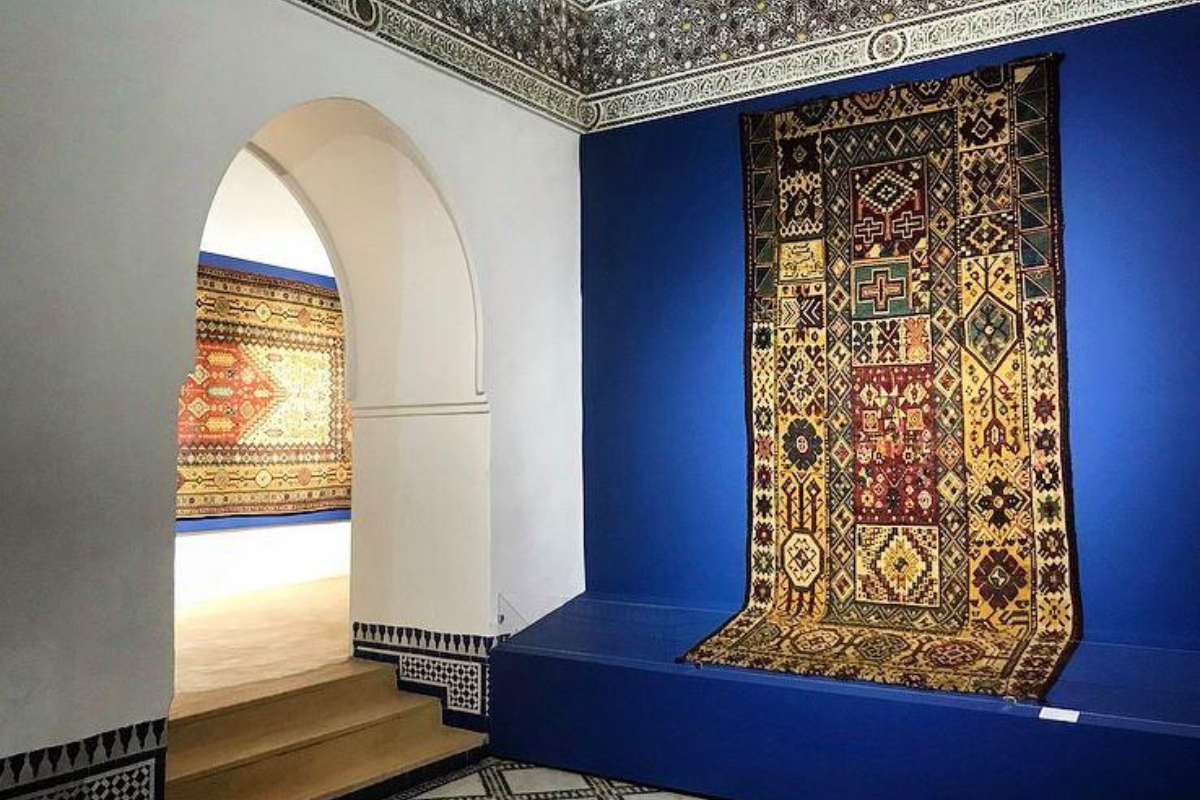
Short answer: Nobody can put a single documented age on Berber weaving. The figures you will read, from "since the Paleolithic" to "2,000 years" to "several millennia," are mostly uncited, or they rest on reading ancient symbols rather than on surviving cloth. The firmest date is far more recent: the oldest carpet known in Morocco carries a woven inscription for the year 1202 of the Islamic calendar, which is 1787. Amazigh weaving is certainly older than that carpet. How much older is an open question.
That gap between confident claims and thin evidence is the whole story, and it is worth understanding before you believe a listing that calls a rug part of an "ancient, unbroken tradition."
A note on words first. "Berber" is the older outside name for the Amazigh peoples of North Africa, and some communities reject it. We use Amazigh as our main term and Berber alongside it because that is what most readers search for. Our guide to what the word Berber rug actually means covers the naming history in more detail.
How old is Berber weaving? Four answers and what each rests on
Most of the confusion goes away once you sort the claims by the kind of evidence behind them. They are not four estimates of the same thing. They are answers to slightly different questions, backed by very different material.
| Claim you will read | Where it usually appears | What it rests on | What it can actually show |
|---|---|---|---|
| "Since the Paleolithic" | Seller blogs; one uncited line in a popular encyclopedia entry | Resemblance between rug motifs and prehistoric rock art | That shapes look alike, not that a woven object existed |
| "Several millennia" or "2,000+ years" | Seller blogs, travel sites, a museum exhibition catalogue | General reasoning about herding life and wool; rarely a named find | A plausible range, not a measurement |
| "Older than the Arab arrival" | Seller and culture blogs | The long presence of Amazigh peoples in North Africa | That the people are old, not that the pile rug is |
| 1787 | A 2025 peer-reviewed study | A date woven into a surviving carpet | The age of one carpet, and a floor for the tradition |
Read the table from the bottom up and the confidence drops as the claimed age rises. That is not a coincidence. The older the claim, the less physical evidence stands behind it.
Where each number comes from
"Since the Paleolithic"
This is the most repeated big claim, and it has an unexpected source. When we read Wikipedia's "Moroccan rugs" article on 2026-09-23, it stated that rugs have been woven by the indigenous people of Morocco since the Paleolithic Era. That sentence carried no citation, and the article as a whole carried a notice that its sources were unclear for lack of inline citations. Many seller pages say the same thing in nearly the same words.
The Paleolithic is the Old Stone Age, the long era before farming. No surviving Moroccan textile from that period is cited anywhere we looked. When the claim is defended at all, it is defended through symbols, which we come to below.
"Several millennia" and "2,000 years"
Wikipedia's separate "Berber carpet" article, read the same day, says carpet weaving by Berber populations goes back several millennia. Unlike the Paleolithic line, this one is cited: to a catalogue essay by Gebhart Blazek for an exhibition held from July 2005 to April 2006 at the L.A. Mayer Museum for Islamic Art in Jerusalem. We have not been able to read that catalogue, so we cannot tell you what evidence the essay gives. "Several millennia" is also a range, not a date.
"2,000 years" and "2,200 years" appear across seller and travel pages. In the live search results we reviewed on 2026-09-23, none of those pages named the find, text or study the figure came from.
"Older than the Arab arrival"
Arab armies reached North Africa in the seventh century, and Amazigh peoples had lived there long before that. Both statements are standard history. What they do not establish is that the knotted pile rug, the thing most buyers mean by "Berber rug," existed in that earlier period. The claim quietly moves from the age of a people to the age of a particular object.
1787: the one hard date
The strongest evidence comes from a single carpet. In July 2025, The European Physical Journal Plus published a peer-reviewed study of the Chiadma carpet by Bensalem El Jeddaoui, Imane Fikri, Yacine Oubelkacem and colleagues, which we read on 2026-09-23. The authors describe it as the most ancient carpet known in Morocco. It carries Arabic script giving the year 1202 of the Hegira, which corresponds to 1787, and it is on display at the Dar Si Said Museum in Marrakech.
The same study tested the dyes without damaging the rug. It identified cochineal in the pinkish reds, weld or Daphne gnidium in the yellows, and natural indigo in the blues, with mixtures for oranges and greens. If you want to know what those plant and insect sources are, our piece on what the sources say about Moroccan natural dyes goes through them.
Two cautions keep this date honest. "Most ancient known" means the oldest surviving and identified carpet, not the first one ever made. And this is a single carpet, not a representative sample of Middle Atlas tribal rugs. We have not found a published, dated Middle Atlas pile rug older than it.
Why the evidence runs out: wool does not keep
Wool is organic. Moths, damp, sunlight and ordinary use destroy it, and a rug that is slept on, sat on and walked on for decades wears out long before anyone thinks to preserve it. Old textiles survive mainly in unusual conditions: frozen, very dry, or sealed away.
The best-known example makes the point. A 2021 paper in Scientific Reports by Andreas Späth and colleagues, an X-ray microscopy study of the Pazyryk carpet's dyes that we read on 2026-09-23, describes it as the oldest known pile carpet, dated to about 400 BC, and exceeding the next dated specimens by at least six centuries. It was found in a burial mound in the Altai mountains of Siberia and is held by the State Hermitage Museum in Saint Petersburg.
The Pazyryk carpet is not Moroccan and tells us nothing directly about Amazigh weaving. What it does show is how the record works everywhere: one lucky survival, then a gap of centuries. A missing ancient rug is not evidence that none existed. It is also not evidence that one did.
North Africa has an extra problem. Archaeologist Andrew Wilson, in a paper on textile production and dyeing in Roman North Africa, notes that small finds such as spindle whorls, loom weights and needles from North African sites have been rarely and poorly published. The indirect evidence that would help, the tools rather than the cloth, has had comparatively little attention. One seller blog we read cites a 2010 journal article on early Maghreb fiber production to support a Neolithic date. We could not locate that article, so we do not repeat its claims here.
Three questions hiding inside one
"How old is Berber weaving" bundles three separate questions. Pulling them apart explains most of the disagreement.
- How old is weaving in North Africa? Making cloth from spun fiber is ancient across the Mediterranean world, and it would be surprising if North Africa were an exception. But the specific published evidence for Morocco is thin, for the reasons above.
- How old is knotted pile weaving in Morocco? This is a narrower technique, and the dated physical evidence begins with the 1787 carpet. Written references earlier than that circulate on seller blogs; one widely repeated line attributes an account of carpets as wedding gifts in Fez to the sixteenth-century writer known as Leo Africanus. We have not checked that line against his text, so treat it as unverified.
- How old are the regional styles sold today? Beni Ourain, Azilal and the rest are named traditions with their own histories. Their ages depend on dated examples in collections, which is its own subject, and should not be borrowed from claims about weaving in general.
The loom itself also shapes what can be made and how, which is covered in our piece on the Moroccan vertical loom and what it decides.
The word "Berber" adds a fourth layer. Historian Ramzi Rouighi, in Inventing the Berbers (University of Pennsylvania Press, 2019), argues that "Berber" as a single category took shape in medieval Arabic writing. Whatever you conclude from that argument, it is a good reason to be careful when a modern label is projected back into prehistory.
What the symbol argument can and cannot prove
The case for very deep roots is usually made through motifs. The fullest version is Bruno Barbatti's book Berber Carpets of Morocco: The Symbols, Origin and Meaning, translated from German by Alan J. Bridgeman. Barbatti compares rug motifs such as lozenges, chevrons and zigzags with signs in Stone Age cave art, rock carvings and early Anatolian sites, and reads them as a very old system of meaning.
It is a serious, heavily illustrated argument, and some collectors treat it as foundational. It is also an argument from resemblance. Simple geometric shapes, such as diamonds, triangles and zigzags, turn up in many unrelated cultures, partly because a grid of knots or wefts makes them easy to produce. Two shapes looking alike across thousands of years is a hypothesis about continuity. It is not a dated textile.
So the fair summary is this. Barbatti and writers who follow him argue for Neolithic or older origins of the visual language. Physical, dated evidence for Moroccan pile rugs begins much later. Both statements can be true at the same time, and neither settles the other.
What this means if you own a rug or are about to buy one
The age of a tradition and the age of your rug are two different facts, and listings often blur them.
- "Ancient tradition" describes the craft, not the object. A new rug woven last year can honestly belong to an old tradition. That phrase says nothing about when your rug was made.
- A motif cannot date a rug. The same shapes are woven today. Treat any claim that a symbol proves age as a sales line.
- Ask what the seller's age claim rests on. A provenance record, a collection history, or a dated reference is evidence. "It looks old" is not. Our list of questions worth asking any rug seller includes the ones that matter here.
What we cannot do is date or authenticate an individual rug. That takes hands-on examination by someone qualified: a textile conservator, a museum textile department, or an independent appraiser who is not selling the piece. Scientific dye analysis of the kind used on the 1787 carpet is laboratory work, not something a photo can replace.
How we treat age claims on Atlas Rug Guide
We give a date only when we can name where it comes from and when we checked it. Where scholars and sources disagree, we show the disagreement instead of picking a winner. On this question, the honest position is short: Amazigh weaving is old, the oldest dated Moroccan carpet is from 1787, and every larger number you see is either a range, an argument from symbols, or uncited.
FAQ
Is Berber weaving really from the Paleolithic?
No surviving textile supports that claim. The "Paleolithic" line appears in an uncited encyclopedia sentence and on many seller pages. Where it is argued, it rests on similarities between rug motifs and prehistoric art, which is a hypothesis about shapes, not proof of weaving.
What is the oldest known Moroccan rug?
A 2025 peer-reviewed study describes the Chiadma carpet, dated by its woven inscription to 1787, as the most ancient carpet known in Morocco. It is on display at the Dar Si Said Museum in Marrakech.
Did Amazigh people weave before the Arab arrival in North Africa?
Amazigh peoples lived in North Africa long before the seventh-century Arab arrival, and weaving cloth is an ancient craft across the region. What is not documented is the existence of knotted pile rugs like today's in that earlier period. The published dated evidence for Moroccan pile carpets starts much later.
Can the symbols on a rug tell me how old it is?
No. The same motifs are woven today, and resemblance to ancient art does not date a textile. To learn a specific rug's age, you need a provenance record or examination by a textile conservator or independent appraiser.
Leave a Reply