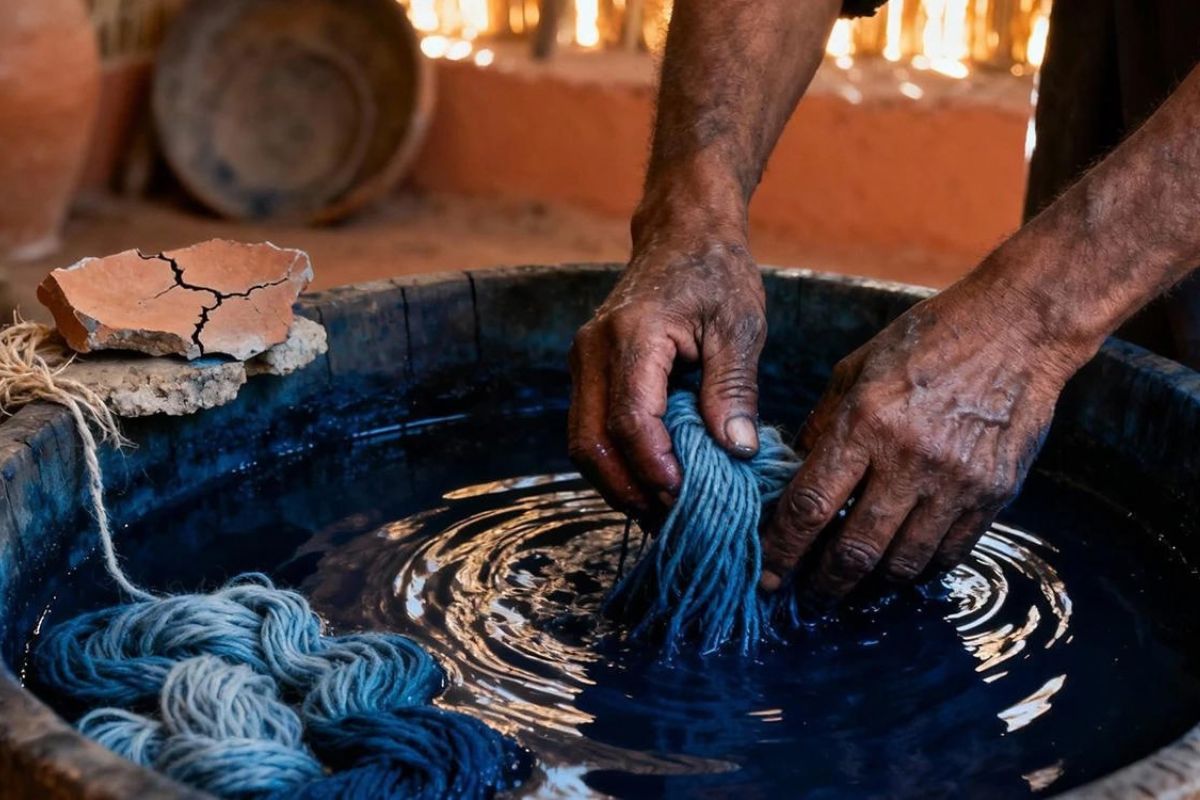
Some Moroccan rugs are colored with plant dyes, and the plants are on record: Africanews reported in July 2025 that weavers at Taznakht dye their wool with henna, pomegranate peel, saffron and indigo leaves. AFP, reporting from the same town in December 2024, added that industrial dyes have replaced natural ones for most weavers because they are cheaper. So the honest answer to "are the colors really from plants?" is this: sometimes, in named places, and never safely assumed from a listing.
This guide covers where those four plant names come from, what each is recorded as doing to wool, where claims about natural dye go further than the evidence, and what a buyer can actually establish.
Where the four plant names come from
The four names in this article's title were not assembled from seller pages. They come from specific reporting.
Africanews, in a report dated 2 July 2025 and read on 11 September 2026, describes women in Taznakht who "wash the wool, spin it then dye with colours extracted from local plant materials such as henna, pomegranate peels, saffron or indigo leaves." The same report says the wool is collected from sheep in the region, including the Sirwa mountains.
AFP's reporting of 18 December 2024, as carried by Business Recorder and read on the same date, names henna, pomegranate peels and indigo as natural pigments. Then it adds the sentence most seller pages leave out: industrial dyes have replaced natural ones for most weavers, because they are cheaper.
The two reports do not contradict each other. Natural dyeing exists and is practiced, most visibly in cooperative settings. It is also not the norm. The Taznakht rug guide covers what the rugs from that area look like.
What each plant is recorded as giving wool
The table below separates what the reporting names from what general dyeing practice attributes. The color families are the ones this site sets out in its guide to where the Moroccan rug palette comes from. They describe what a dye material is generally used for. They say nothing about the dye in any particular rug.
| Plant | Named in | Color family generally attributed | How firm this is |
|---|---|---|---|
| Henna (Lawsonia inermis) | Africanews 2025, AFP 2024 | Reddish browns | Chemistry documented in dye research (below) |
| Indigo, from leaves | Africanews 2025, AFP 2024 | Blues | Named twice; neither report names the plant species used |
| Pomegranate peel | Africanews 2025, AFP 2024 | Yellows, golds, tans | Named twice |
| Saffron (Crocus sativus) | Africanews 2025 only | Yellows | Named once; volume of use not reported anywhere this guide read |
Two things are missing from this table on purpose.
Madder root appears on many seller pages as the source of Moroccan reds. It may well be used. It does not appear in either news report from Taznakht, and this guide found no non-commercial source today that documents it for a specific Moroccan weaving area, so it is left out rather than asserted.
Symbolic meanings are also missing. One seller page in the results for this topic states that saffron yellow was "reserved for special pieces linked to fertility and fortune," with no source given. This site does not repeat claims like that as fact. Where a color or motif meaning is recorded by a named source, the site attributes it. Where it is not, the site says so.
What the dye chemistry adds
Most pages on Moroccan rug natural dyes stop at a list of plants. The chemistry matters, because it explains why "natural" does not guarantee how a color will behave.
A review in Frontiers in Sustainability published on 18 August 2026 by Maha Hassain Eid Almsaudi and Luqman Jameel Rather, read on 11 September 2026, covers henna and saffron among four plant dyes for wool. Three points from it are useful here.
Henna bonds with wool through a specific molecule. The review identifies lawsone as "the principal chromophore responsible for henna's coloring properties" and says it "readily forms coordination complexes with metallic mordants while simultaneously interacting strongly with amino acid residues present within wool keratin." Wool is a protein fiber, and henna is chemically suited to it.
Saffron is scarce as a dye. The review notes that saffron dyeing "is constrained by limited pigment availability and high production costs," and cites approximately 85,000 flowers to produce 1 kg of fresh saffron. That does not mean saffron is never used on wool. It does mean a seller describing a whole stock of yellow rugs as saffron-dyed is making a claim worth asking about.
The mordant often decides durability. The review states that "mordant selection remains particularly influential" for how durable a color is, and that metallic mordants "generally improve wash and light fastness." A mordant is the substance used to fix a dye to the fiber. Two rugs dyed with the same plant can behave very differently depending on how they were mordanted, which the word "natural" on a label does not tell you.
The "natural dyes never bleed" claim
The same Africanews report quotes Naima Akhraze saying that natural dyes "remain fixed onto the rug and do not bleed or mix with one another during washing." That is a real statement from someone working in the craft, and it may describe her cooperative's dyeing well. As a general rule it goes too far.
Whether any dye bleeds depends on how the dyeing was done, what mordant was used, how thoroughly the yarn was rinsed, and what the rug is later exposed to. The Frontiers review's point about mordants is exactly this. This site's guides to why natural dyes can bleed too and to what a bleed test does and does not prove cover the practical side. The short version: bleeding does not prove a dye is synthetic, and not bleeding does not prove it is natural.
The reverse problem is documented as well. The Anou Cooperative, a weaver-owned organization in Morocco, wrote on its blog on 14 December 2020, read on 11 September 2026, that the dyes available for purchase by artisans "are not of much quality" and "are not light fast." That is a statement about cheap purchased dye, and it is one reason some newer rugs fade quickly. Fading from light is a separate issue from bleeding in water, and the guide to rug fading in sunlight covers what can and cannot be undone.
Where natural dyeing is being revived
The documented revival is cooperative work, not a marketing category.
Anou's post of 3 September 2021, read on 11 September 2026, describes Cooperative Lfarah developing rugs with "full exhaust dyes, sustainable mordants, and no chemicals," and washing techniques that cut water use by roughly half compared with standard middleman practice. Full exhaust means the dye bath is used up rather than discarded with color still in it. The same post contrasts this with conventional processing that pours harsh chemicals into rivers and streams.
The Taznakht reporting points the same way. The Africanews piece presents plant dyeing as part of what the Women's Centre for the Promotion of the Taznakht Carpet does, while AFP's wider picture is that most weavers use industrial dye. Both can be true: natural dye survives where an organization makes it economically possible.
What a buyer can and cannot establish
There is no reliable way to confirm a plant dye by looking at a rug in a photograph, or at home. Museums and conservators identify dyes with laboratory analysis of fiber samples, which is not something a buyer can do at the point of sale.
What a buyer can do is ask, and judge the answer.
- Which dyes, specifically? "Natural dyes" is a category. "Henna and pomegranate peel, dyed by the cooperative" is an answer.
- Who did the dyeing? Yarn dyed by the weaver or her cooperative is a different story from yarn bought already colored.
- Is every rug in the shop natural-dyed? Given AFP's report that most weavers now use industrial dye, a seller claiming plant dye across an entire stock is claiming something unusual.
- Does the price depend on the dye claim? If it does, the claim should come with detail.
None of this makes synthetic dye a defect. Synthetic-dyed rugs can be well made, hand-knotted by the same weavers, and colorfast. The dye question is about what you are being sold, not about whether the rug is good.
FAQ
Do Moroccan rugs use natural dyes?
Some do. Africanews reported in July 2025 that weavers at Taznakht use henna, pomegranate peel, saffron and indigo leaves. AFP reported in December 2024 that industrial dyes have replaced natural ones for most weavers because they are cheaper. A natural-dye claim on a specific rug should be asked about, not assumed.
What colors do henna, indigo, pomegranate and saffron give wool?
In general dyeing practice, henna gives reddish browns, indigo gives blues, and pomegranate peel and saffron give yellows and golds. The final shade depends on the plant material, the mordant and the dyeing process, so these are color families rather than exact results.
Do natural dyes bleed?
They can. How fast a color is depends heavily on the mordant and the process, as dye research on wool notes. Bleeding does not prove a dye is synthetic, and a rug that does not bleed has not been proven natural.
Can I tell if my rug is natural-dyed by looking at it?
No. Dye identification on textiles is done with laboratory analysis. At the point of sale, the useful evidence is a specific, detailed answer from the seller about which dyes were used and who did the dyeing.
Leave a Reply