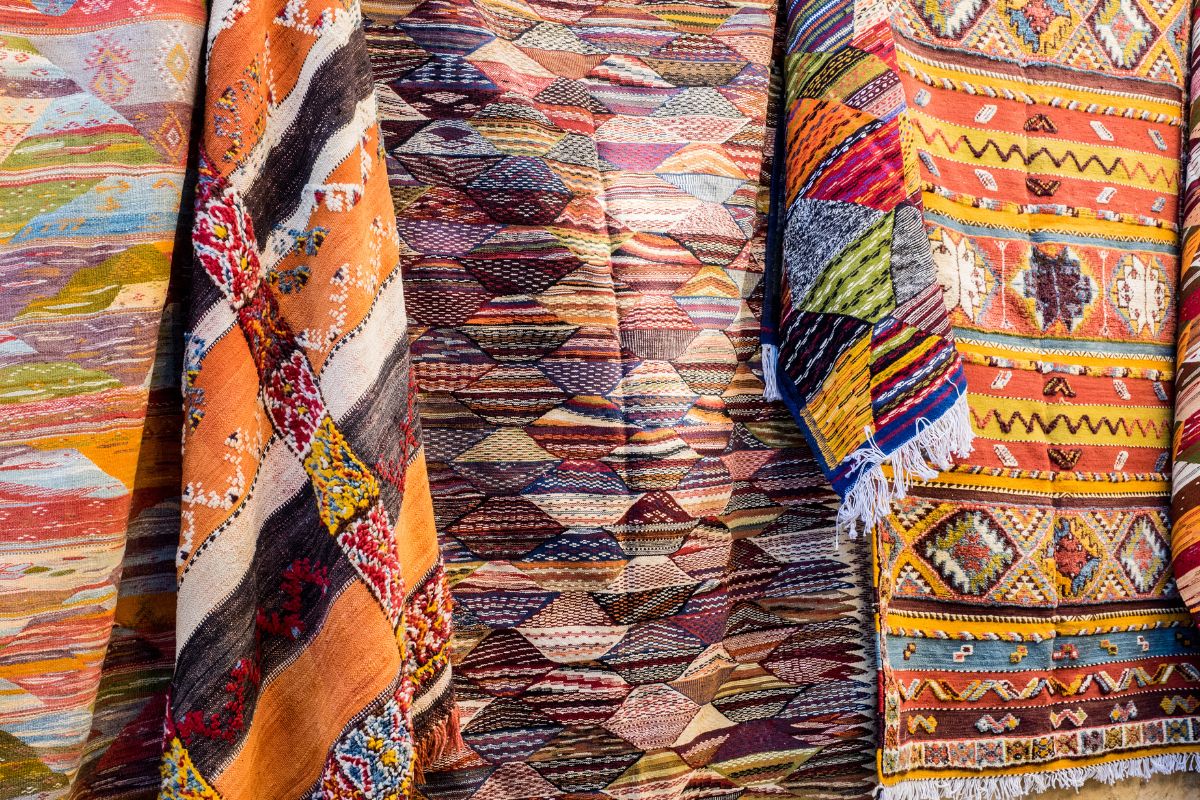
"Kilim," "hanbel," and "flatweave" all describe the same thing in the Moroccan rug market: a rug woven flat, with no knotted pile standing up from the base. "Hanbel" is the Moroccan-Arabic name for this construction, and "kilim" is the international term used more widely across the rug trade. They are not two different products; they are two names for one technique, and understanding that clears up most of the confusion buyers run into when a listing uses one word and a competing listing uses the other.
How a flatweave is actually made
A knotted rug, like a Beni Ourain or Beni Mrirt, is built by tying individual knots of wool into a woven foundation, which is what creates a raised pile you can sink your fingers into. A flatweave skips the knots entirely. The pattern and color come from interlacing weft threads directly through the warp, the same basic principle as a woven textile or a tapestry, with nothing standing proud of the surface.
That construction difference explains two things buyers notice immediately: a flatweave is thinner and flatter than a pile rug of the same size, and because there is no pile with a distinct "right side," the pattern often shows through to both faces, which is why genuine flatweaves, including named styles like Zanafi, are frequently reversible.
What you gain, and what you give up
No sampled listing frames this honestly as a trade-off rather than a pure sales pitch, so here it is plainly:
What you gain:
- Less weight and a lower profile, which clears doors and furniture more easily than a thick pile
- Easier cleaning and moving, since there is no deep pile to trap debris
- Often a lower price than a comparably sized knotted pile rug, reflecting less material and, in some cases, less labor time
- Reversibility on genuine pieces, which can extend how long a rug looks presentable before wear shows
What you give up:
- Cushioning underfoot. A flatweave will never feel as soft or insulating as a thick wool pile, which matters if you're covering a cold floor or want a plush feel
- Some visual weight. A flatweave reads as flatter and more graphic; if you want the deep, textured look of Beni Ourain or Beni Mguild, a flatweave will not deliver it regardless of pattern
Neither is objectively better. It depends on whether you want warmth and texture (a pile rug) or a lighter, more graphic, easier-care piece (a flatweave).
Named flatweave traditions within Morocco
"Kilim" and "hanbel" describe the technique broadly, but specific regional and stylistic traditions exist within that broader family, the same way "pile rug" covers Beni Ourain, Beni Mrirt, and Beni Mguild as distinct named styles. Zanafi is one such tradition, associated by rug specialists with the High Atlas and known for bold two-tone geometric patterns. Other flatweaves in the market carry regional names of their own; where this guide cannot independently verify a specific attribution, it says so rather than presenting every name as an equally confirmed fact.
Sizing and placement notes
Because a flatweave sits lower and lighter than a pile rug, it behaves differently underfoot and in a room. It won't anchor a space with the same visual and physical weight as a thick Beni Ourain, so in a large open room it can read as thinner or less substantial than the space calls for, unless layered over a larger neutral rug or paired with heavier furniture to balance it. In smaller rooms, hallways, and transitional spaces, that same lightness is an advantage: a flatweave doesn't compete for visual or physical space the way a deep pile does, and its lower profile is genuinely practical under doors that swing close to the floor.
What to look for when buying one
- Check both sides. A genuine flatweave should show a coherent pattern on both faces, since there is no pile hiding a rough or unfinished back. A rug that looks flat on top but has a distinctly different, machine-backed reverse is worth questioning.
- Feel for density. A well-made flatweave, despite being thin, should feel tightly woven and firm rather than loose or gappy.
- Ask what "kilim" or "hanbel" means on that specific listing. Since the terms are used interchangeably and loosely, they don't by themselves tell you which region or tradition a piece comes from; ask the seller directly if a specific origin matters to you.
- Match it to the room, not just the price. A lower price than a pile rug isn't automatically a better deal if what you actually wanted was thickness and warmth underfoot.
For the broader family of named Moroccan styles, including the thick-pile traditions this construction contrasts with, see the complete guide to Moroccan rug styles.
FAQ
What is the difference between a kilim and a hanbel?
There isn't a meaningful difference in construction. "Hanbel" is the Moroccan-Arabic name for a flatwoven rug, and "kilim" is the international term for the same technique. Listings may use either word for the same type of rug.
Are Moroccan kilim rugs the same as flatweave rugs?
Yes. "Flatweave" describes the construction, no knotted pile, and "kilim" (or "hanbel") is the name for that category of rug within the Moroccan and broader rug trade.
Is a kilim rug less durable than a pile rug?
Not necessarily less durable, but different. A well-made flatweave holds up well in high-traffic areas because there's no pile to crush, though it offers less cushioning and insulation than a thick knotted rug.
Why are kilim rugs usually cheaper than pile rugs?
Generally less material and, in many cases, less labor time go into a flatweave compared with a densely knotted pile rug of the same size, which tends to be reflected in price. This varies by specific piece and seller, so treat it as a general pattern rather than a fixed rule.
Is Zanafi a type of kilim?
Yes. Zanafi is a specific named flatweave tradition, associated by rug specialists with the High Atlas, known for bold two-tone geometric patterns and genuine reversibility. See our Zanafi rug guide for the details.
Can a Moroccan kilim replace a pile rug in a living room?
It can, but it changes what the room feels like underfoot. A kilim gives a lighter, flatter, more graphic look and is easier to clean and move, but it won't provide the same cushioning, insulation, or visual bulk as a thick pile rug like Beni Ourain. Choose based on whether warmth and texture or a lighter, easier-care floor covering matters more for that specific room.
Leave a Reply