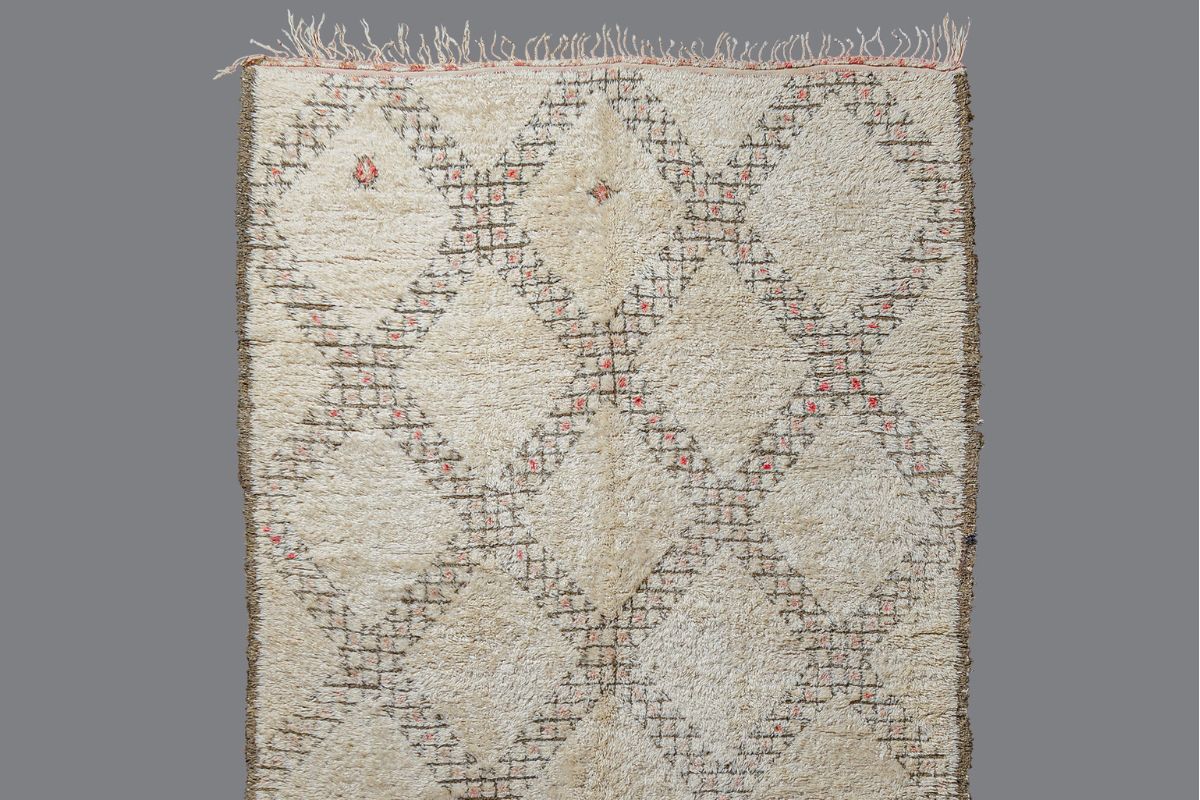
A Marmoucha rug is a lighter, thinner, and generally smaller relative of Beni Ourain, woven in the Eastern Middle Atlas near Fes, south of Beni Ouarain territory. If you've found a listing for one and struggled to find much written about it, that's not an accident: it is one of the least commercially prominent named Middle Atlas styles, overshadowed by its heavier, far more widely marketed neighbor.
Where the name and territory sit
Rug specialists place Marmoucha weaving in the Eastern Middle Atlas, close to Fes and south of the territory associated with Beni Ouarain. That puts it in the same broad mountain region as the other Middle Atlas styles covered on this site, but at its eastern edge rather than the areas typically associated with Beni Ourain, Beni Mrirt, or Beni Mguild.
The look: freedom within apparent symmetry
Visually, a Marmoucha sits close to Beni Ourain's family: a beige or white ground with bright pattern work rather than Beni Ourain's typically sparser, darker line work. Specialists describe the weaving as having real freedom, motifs are placed without rigid precision, yet the overall effect still reads as loosely symmetrical rather than as scattered as Azilal's freehand style. The construction is described as directly influenced by Beni Ouarain's style, but the finished rugs tend to be lighter in weight, smaller in size, and thinner than a typical Beni Ourain.
That combination, Beni-Ourain-adjacent construction and palette, but lighter and less bulky, is the most useful thing to know if you're trying to place an unfamiliar "Marmoucha" listing: think of it as Beni Ourain's quieter, more modestly scaled cousin rather than an entirely different visual tradition.
| Feature | Beni Ourain | Marmoucha |
|---|---|---|
| Ground | Undyed cream | Beige or white |
| Pattern | Sparse dark lines, diamonds | Brighter, freer motifs, loosely symmetrical |
| Weight | Heavy, high pile | Lighter, thinner |
| Typical size | Often larger | Generally smaller |
| Market presence | Widely marketed, easy to find | Underdocumented, fewer listings |
Nothing in that table should be read as a strict rule; it describes a general tendency reported across the sources this guide checked, not a fixed specification for every piece sold under either name.
A wool claim this guide won't confirm
One source describes Marmoucha wool as coming from the first shearing of a specific local sheep breed associated with the region. This guide could not find a second, independent source corroborating that specific claim, so it is noted here as something you may see stated in a listing, not as a confirmed fact. If wool provenance matters to your decision, ask the seller directly what they can document about where the wool came from, rather than relying on a breed name you can't independently verify.
Why being underdocumented can actually help a buyer
There is a practical upside to a style with less marketing behind it. Names that sell in high volume, Beni Ourain above all, attract more copies, more inflated claims, and more competing "upgrade" narratives, simply because there is more money moving through that name. A less commercially prominent style like Marmoucha has less incentive behind it to dress up a plain wool rug with invented provenance or an inflated price story. That is not a guarantee of honesty from any individual seller, but it is a reasonable, checkable observation about where commercial pressure to embellish is strongest.
The trade-off is real too: fewer listings means less to compare against, and less written material anywhere, including here, to check a specific claim against. Ask more questions of a Marmoucha seller than you might for a heavily documented style, precisely because there is less independent material available to catch an inconsistency for you.
Where a Marmoucha fits in a room
Because it shares Beni Ourain's palette family but in a lighter, thinner build, a Marmoucha suits similar settings without quite the same bulk: a bedroom or a living room where you want a soft, pale, textured base but don't need the deep insulating pile of a full Beni Ourain. Its lighter weight also makes it easier to reposition or rotate than a heavier equivalent, a small practical advantage in a room where wear needs to be spread evenly over time.
What to look for
- Compare weight against a Beni Ourain you've seen or handled. A genuine Marmoucha should feel noticeably lighter and thinner, which is one of its most consistently reported traits.
- Look at the pattern for freehand irregularity. The motifs should show real freedom rather than a rigid repeating grid, while still reading as roughly balanced across the field.
- Check the back, as with any hand-knotted rug. Individual knots and small irregularities indicate genuine hand construction; a mechanically uniform back suggests a machine-made copy regardless of the name on the listing.
- Treat unfamiliar specifics with the same caution as any other style here. Because this is a less commercially documented name, listings may lean harder on specific-sounding claims (breed names, precise origins) precisely because there's less competing information to check them against.
- Compare price against a Beni Ourain of similar size, and ask what accounts for any difference. A lighter, thinner rug using less wool is a reasonable basis for a lower price; an unexplained premium is worth a direct question.
For the style it sits closest to, see our Beni Ourain rug guide, and for how it fits among the rest of the named Moroccan traditions, see the complete guide to Moroccan rug styles.
FAQ
What is a Marmoucha rug?
A lighter, thinner, generally smaller relative of Beni Ourain, woven in the Eastern Middle Atlas near Fes, south of Beni Ouarain territory.
How is a Marmoucha rug different from a Beni Ourain rug?
Both share a similar beige-to-white ground and Middle Atlas construction style, but Marmoucha rugs are consistently described as lighter, thinner, and smaller than typical Beni Ourain pieces.
Where are Marmoucha rugs from?
The Eastern Middle Atlas region of Morocco, near Fes, placed by specialists south of the territory associated with Beni Ouarain weaving.
Is it true Marmoucha wool comes from a specific local sheep breed?
That claim appears in one source this guide checked, but it could not be independently corroborated, so it is presented here as an unverified claim rather than a confirmed fact.
Why is there so little written about Marmoucha rugs online?
It is one of the least commercially prominent named Middle Atlas styles, overshadowed by the much more widely marketed Beni Ourain, which is likely why detailed, independent information is harder to find for this style than for its neighbors.
Leave a Reply