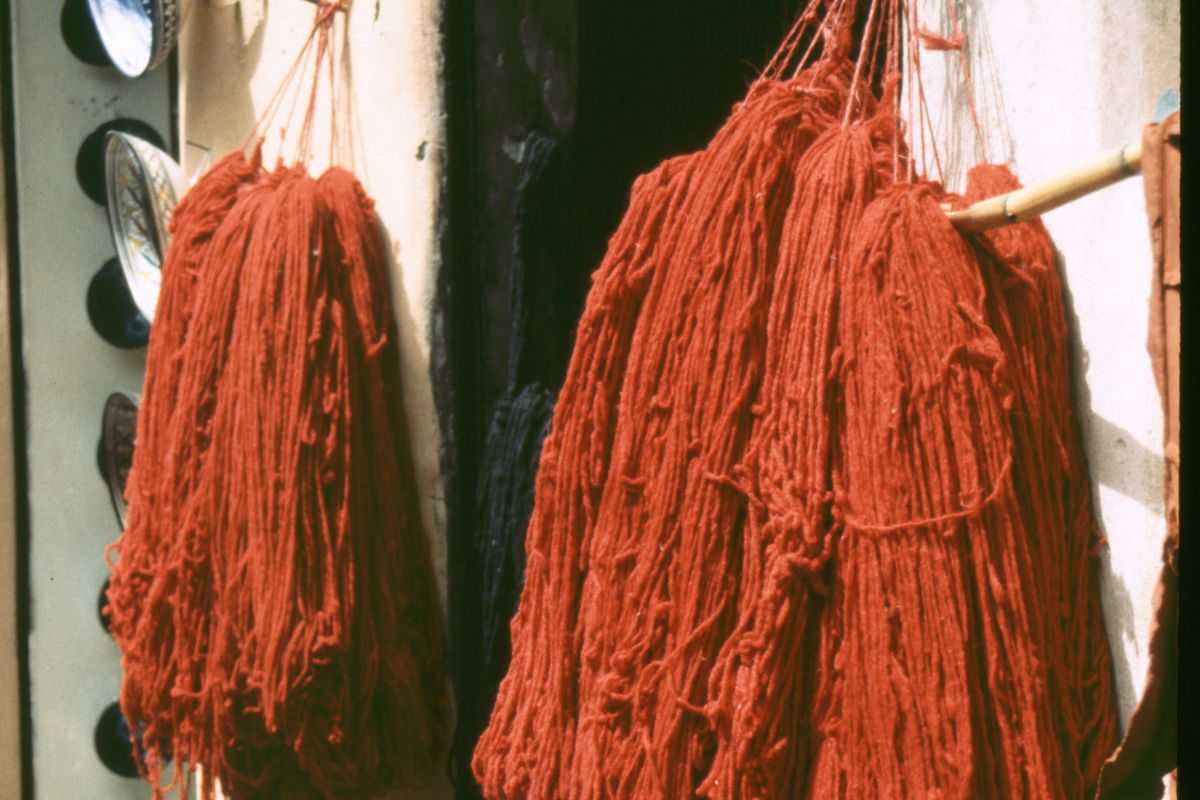
Moroccan rug color comes from three things: the natural tone of undyed wool, plant-based natural dyes, and, increasingly in modern production, synthetic dyes, not from a fixed symbolic code where a given color always "means" something specific. Across the styles already covered on this site, you'll have seen the undyed cream of a Beni Ourain, the deep indigo of a Beni Mguild, the warm magenta of a Boujad, and the plant-dyed range documented at Taznakht. This page pulls that pattern together in one place, and explains what determines it.
The undyed base: cream, ivory, brown, black
Sheep's wool in its natural, undyed state already spans a real range: cream, ivory, light brown, darker grey-brown, and black, depending on the specific fleece. Several Middle Atlas styles, most famously Beni Ourain, lean heavily on this undyed range, using dark natural wool sparingly for outline motifs against a light, undyed field rather than relying on any dye process at all. This is the simplest, most direct source of a Moroccan rug's color: no dye, just the wool itself, sorted and used as it comes off the animal.
Natural dyes and what they actually produce
Where color is added, historical and traditional practice draws on a specific, recurring set of plant materials, documented consistently across multiple independent sources: madder root, producing reds and terracottas; indigo, producing blues; saffron and pomegranate rind, producing yellows and golds; henna, producing reddish-browns; and walnut shell or hull, producing dark browns and blacks. This is the same palette named directly, with sources attributed, in this site's own Taznakht guide, where Africanews's reporting specifically named henna, pomegranate peel, saffron, and indigo leaves as the cooperative's dye materials.
Natural dyes produce color with real variation built in: no two dye batches land on exactly the same shade, since the result depends on the specific plant material, water, mordant, and even the season it was prepared in. That's part of why natural-dyed pieces develop the muted, complex, slightly uneven color character collectors associate with older or traditionally made rugs, as opposed to the flatter uniformity of a modern synthetic-dye batch.
Synthetic dyes and why modern production leans on them
Modern Moroccan rug production increasingly uses synthetic dyes, which produce brighter, more saturated, and more consistent color than natural dyeing allows, a real practical advantage for a producer trying to match a specific shade reliably across a production run. Some of the brighter, more electric colors seen in contemporary Azilal and Boujad production reflect this shift toward synthetic dye availability, alongside older natural-dye traditions that continue in parallel rather than having been fully replaced by it.
Neither natural nor synthetic dye is inherently "more authentic" on its own. Synthetic dyes have been in use in various forms for well over a century in many textile traditions worldwide, and a rug's genuine hand-knotted or handwoven construction is a separate question from which dye technology colored its yarn. Treating synthetic dye as automatic proof of a fake, or natural dye as automatic proof of authenticity, is exactly the kind of oversimplified claim this site avoids making.
Quick reference: common natural dye sources
| Dye source | Color produced |
|---|---|
| Madder root | Red, terracotta |
| Indigo | Blue |
| Saffron | Yellow, gold |
| Pomegranate rind | Yellow, gold, tan |
| Henna | Reddish-brown |
| Walnut shell/hull | Dark brown, black |
This table reflects what plant material is documented to produce which color family in traditional dyeing practice generally. It is not a claim about the specific dye used on any individual rug, which would require asking the seller or, ideally, having documentation from the maker.
Color also changes over time, and that's not a defect
A rug's color the day it's finished is not necessarily its color a decade later. Natural dyes in particular are more light-reactive than most synthetic equivalents, and gradual fading or mellowing with sun exposure and handling is part of how a natural-dyed piece is expected to age, contributing to the muted "vintage" look collectors often prize. That's a genuinely different situation from a colorfastness defect or damage, though telling the two apart in a specific piece is a hands-on question this guide won't attempt to settle from a description alone.
Why this guide won't tell you what a color "means"
You will find plenty of content elsewhere asserting that a specific color carries a fixed symbolic meaning, that yellow "symbolizes joy," or red "symbolizes life," stated as settled fact with no source attached. This guide won't repeat those claims here. Symbol and color meaning in Amazigh weaving is a genuinely contested area: the same seller pages that assert confident color meanings are, in this site's own research for its symbolism cluster, often the only pages making the claim at all, with no museum, academic, or named cultural source behind it.
Where a specific source can support a specific claim, as with the akhnif's documented motif, discussed in the akhnif guide, this site states it and names the source. For general color-in-rugs claims of the kind repeated across seller sites, no comparable sourcing was found in this guide's research, so none is asserted here as settled fact. If you've read elsewhere that a color in your rug "means" something specific, treat that as a claim from whoever told you, not a documented fact this site can confirm.
How color connects to the styles already covered on this site
Color is one of the fastest ways to narrow down which named style you're looking at, alongside pattern and density covered in how to identify a Moroccan rug from a photo. An undyed cream-and-black field points toward the Middle Atlas pile styles; warm plant-dyed reds and golds point toward southern traditions like Taznakht; bright, saturated color in a dense field points toward Azilal or Boujad; and an unusual palette of aubergine, mauve, and ochre points toward the underserved Aït Bou Ichaouen / Talsint tradition. Color alone won't settle an identification, but combined with pattern and construction, it's a genuinely useful signal.
FAQ
What determines a Moroccan rug's color?
Three things: the natural tone of undyed wool, traditional plant-based dyes, and modern synthetic dyes. There's no single fixed factor, and no fixed symbolic code behind it.
What plant materials were traditionally used to dye Moroccan rugs?
Documented sources name madder root (red/terracotta), indigo (blue), saffron and pomegranate rind (yellow/gold), henna (reddish-brown), and walnut shell (dark brown/black).
Does a specific color mean something in Moroccan rug weaving?
This guide could not find a credible, named non-commercial source confirming fixed color meanings and will not repeat unsourced claims found on seller sites as settled fact. Where a specific documented meaning exists, as with the akhnif's motif, it is attributed to its actual source.
Are natural-dyed rugs more authentic than synthetic-dyed ones?
No. Dye type is a separate question from whether a rug is genuinely hand-knotted or handwoven. Both natural and synthetic dyes appear in genuine traditional production, and neither one alone proves or disproves authenticity.
Can I tell which named style a rug is just from its color?
Color is a useful clue, especially combined with pattern density and construction, but it isn't decisive on its own. See how to identify a Moroccan rug from a photo for the fuller identification approach.
Leave a Reply