Tag: natural dyes

  • Taznakht Rugs: The Cooperatives Behind the Name

    Taznakht Rugs: The Cooperatives Behind the Name

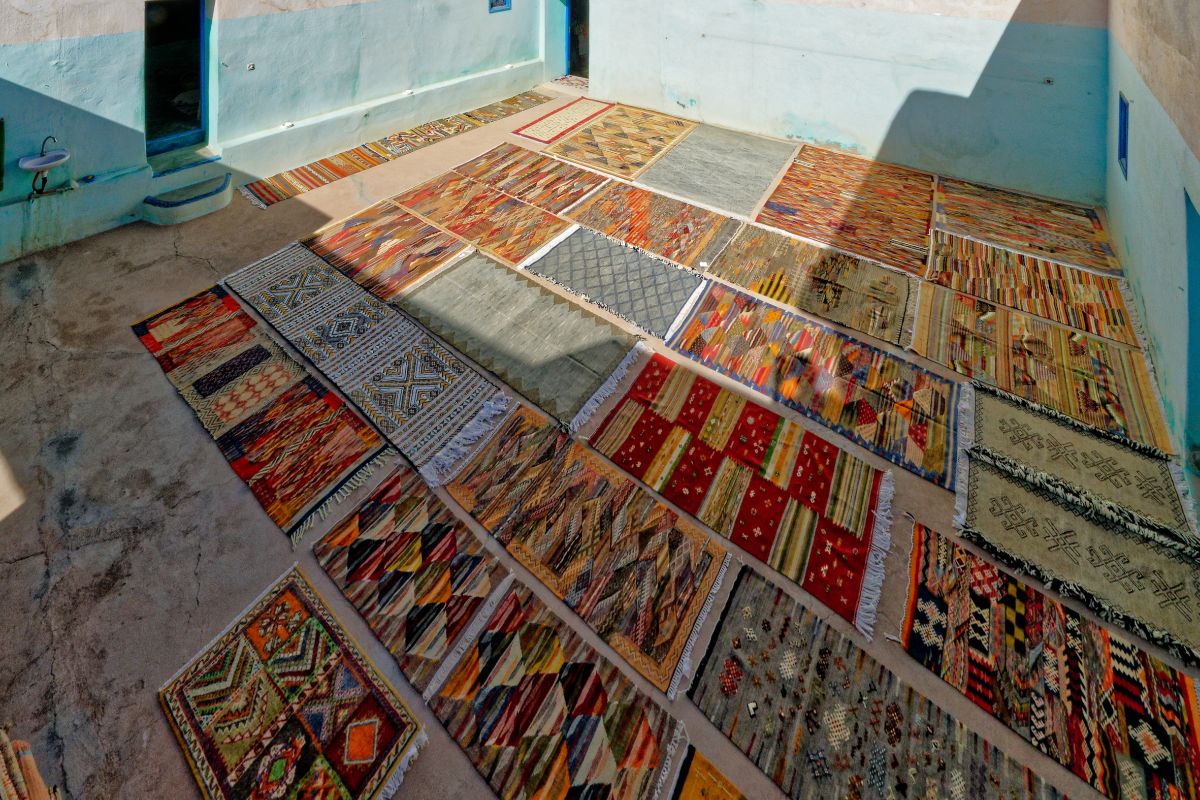
    Taznakht is a town in southeastern Morocco, and rugs sold under its name, sometimes also labeled "Ouaouzguit," come from one of the best-documented weaving traditions in the country. Unlike most of the styles on this site, where the only accounts available are seller marketing copy, Taznakht's cooperatives have been reported on directly by international journalists, which means this page can name real organizations, a real number of weavers, and a real person, rather than repeating unsourced tribal lore.

    Who actually makes these rugs

    According to Africanews (July 2025), the town of Taznakht is home to a genuine, organized weaving economy built around women's cooperatives. The most prominent is the Women's Centre for the Promotion of the Taznakht Carpet, established in 2016, which brings together 35 cooperatives and roughly 3,500 women weavers. The centre is reported to produce up to 300 carpets a month. Abderrahmane Janah, who manages the centre, is quoted describing the rugs as a way weavers "expressed their creativity" and "used it as a medium to convey their emotions."

    This is a genuinely different kind of evidence than most Moroccan-rug content online, which tends to describe an unnamed, anonymous "tribal craft." Taznakht's weavers are not anonymous: they work through named, dated, sourced organizations, at a documented scale.

    The same reporting notes that a new exhibition space in Taznakht now lets some weavers sell their work directly to buyers, alongside training in digital marketing, both aimed at cutting out the middlemen who have traditionally set prices at the region's markets. That detail matters for anyone buying a Taznakht rug who wants their money to reach the person who made it, not just the person selling it.

    Materials and process

    Africanews's reporting describes the process in specific, checkable terms: wool is sourced from sheep in the region, including animals from the nearby Sirwa mountains. Weavers wash the wool, spin it, and dye it using colors drawn from plant materials: henna, pomegranate peel, saffron, and indigo leaves. The rugs are woven on a traditional wooden loom, and a single piece is reported to take several weeks to several months to complete, depending on its size and the complexity of the design.

    That plant-based dye list is worth noting on its own: it means at least some Taznakht production carries the same natural-dye character found in other named Moroccan traditions, rather than relying purely on modern synthetic dyes.

    The tribal-name question

    You will see "Taznakht rugs" also referred to as "Ouaouzguit" rugs, and several rug-trade sources attribute this second name to the Ait Ouaouzguite, described as an Amazigh (Berber) tribal grouping associated with the mountain villages around Taznakht. This guide could not confirm that specific tribal attribution against the journalism sources used above, which discuss the cooperatives and the town but do not name this tribal grouping directly. Treat the "Ait Ouaouzguite" name as a claim made by rug specialists and sellers, useful context, but not independently verified here the way the cooperative numbers above are.

    You may also see these rugs described in listings as traditionally part of a bride's dowry, exchanged as a way of marking a marriage. That is a claim reported by rug-trade sources rather than the journalism used elsewhere on this page, so it is noted here as an attributed detail rather than a confirmed fact about the tradition as a whole.

    How this differs from the Middle Atlas styles

    Everything covered so far in this Cluster (Beni Ourain, Beni Mrirt, Beni Mguild) comes from the Middle Atlas, in the country's north-central mountains. Taznakht sits much further south, near the edge of the Anti-Atlas and Sirwa ranges, and its rugs are generally more colorful and pattern-dense than the restrained, largely undyed Middle Atlas wool styles. If you are trying to place a rug geographically from a listing, "Taznakht" or "Ouaouzguit" on the label should point you south, not to the Beni Ourain / Beni Mrirt / Beni Mguild family covered in our complete guide to Moroccan rug styles.

    What to look for

    • Ask who made it, specifically. Given how well-documented Taznakht's cooperative network is, a seller who cannot say which cooperative a rug came from, or whether it passed through the Women's Centre network, is giving you less information than is actually available for this style.
    • Look for the plant-dye palette. Henna, pomegranate, saffron, and indigo produce a warmer, earthier range than purely synthetic dyes. A flat, uniform, highly saturated color across the whole piece is worth a second look.
    • Don't assume every "Ouaouzguit" claim is verified. The cooperative facts above are journalism-sourced; the specific tribal name and the dowry tradition are not, and this guide treats them accordingly.

    One honest limit: this page describes a documented weaving economy, not a specific rug you may be looking at. It cannot authenticate an individual piece or confirm which cooperative made it from a photo alone; that requires asking the seller directly.

    FAQ

    What is a Taznakht rug?
    A rug produced in or attributed to Taznakht, a town in southeastern Morocco, home to a documented network of women's weaving cooperatives, including the Women's Centre for the Promotion of the Taznakht Carpet, established in 2016.

    What does "Ouaouzguit" mean?
    It is an alternate name used for Taznakht-area rugs. Rug-trade sources attribute it to the Ait Ouaouzguite, described as an Amazigh tribal grouping in the region, though this guide could not independently confirm that attribution against available journalism.

    How many weavers are involved in Taznakht rug production?
    Africanews reported in 2025 that the Women's Centre for the Promotion of the Taznakht Carpet alone includes 35 cooperatives and roughly 3,500 women weavers, producing up to 300 carpets a month.

    What materials go into a Taznakht rug?
    Wool from sheep in the region, including the nearby Sirwa mountains, washed, spun, and dyed with plant materials such as henna, pomegranate peel, saffron, and indigo leaves, then woven on a traditional wooden loom.

    Is it true Taznakht rugs were traditionally part of a bride's dowry?
    That claim appears in rug-trade sources but was not confirmed in the journalism used for this guide. Treat it as an attributed detail from sellers and regional specialists rather than an independently verified fact.
  • Boujad Rug Guide: Colors, Patterns & How to Buy

    Boujad Rug Guide: Colors, Patterns & How to Buy

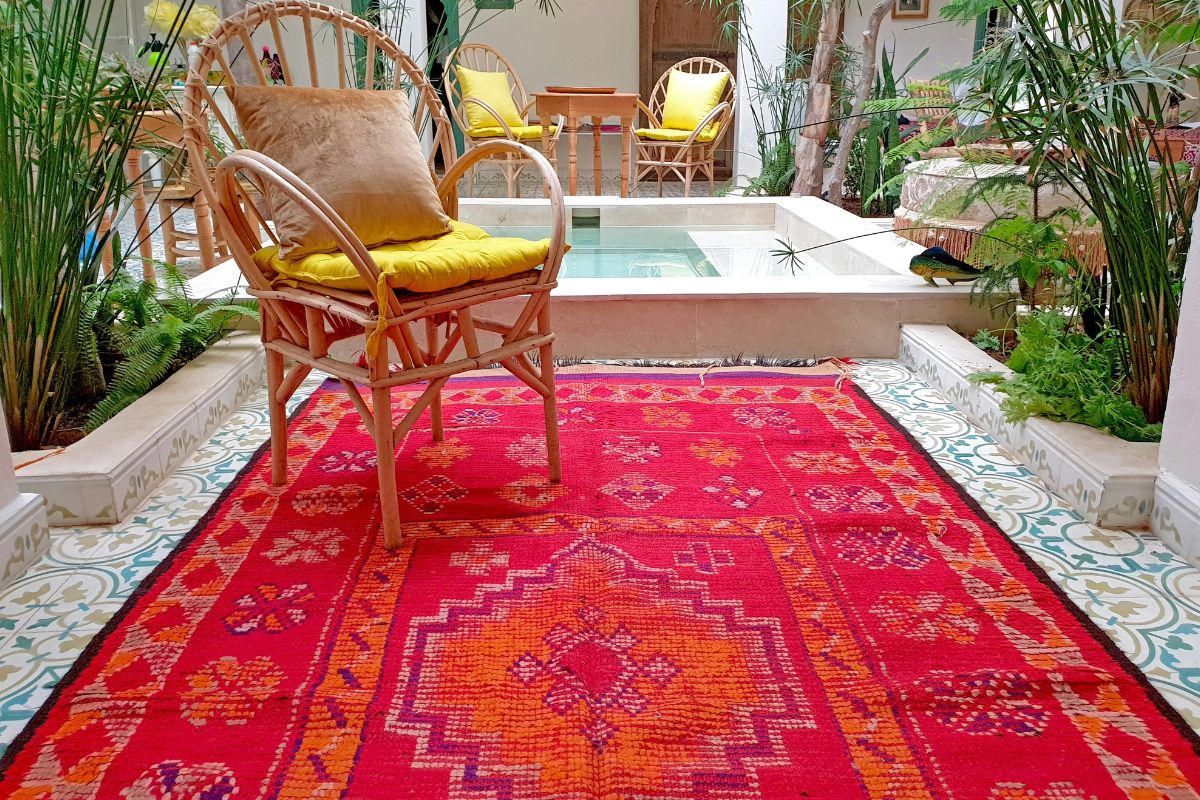
    A Boujad rug (also spelled Boujaad or Bejaad) is a handwoven Berber rug from central Morocco, best known for its warm palette of pinks, oranges, reds, and purples arranged in free, improvised abstract patterns. It comes from the plains around the market town of Boujaad, not the mountains, and it is woven in wool by Amazigh (Berber) women who design as they go rather than following a fixed grid. If you found a rug that glows in sunset colors with loose diamonds and zigzags floating across it, you are very likely looking at a Boujad.

    This guide covers where Boujad rugs come from, why their colors look the way they do, how they are made, how they differ from Beni Ourain and Azilal rugs, and what to actually check before you buy one. Where a fact is genuinely contested or unverifiable for an individual rug, we say so instead of guessing.

    What makes a rug a "Boujad"

    The name comes from the town of Boujaad in Khouribga Province, in Morocco's Beni Mellal-Khenifra region, roughly 90 kilometers southeast of Rabat. This is central Morocco, on the plains between the Atlantic coast and the Middle Atlas, not the high mountain country that many rug listings imply. You will often see Boujad described online as a "Haouz region" or "Atlas mountain" rug. That placement is inconsistent with the town's actual location, and it is one of the most repeated errors in Boujad descriptions.

    Boujaad functioned historically as a market hub. Surrounding tribes brought surplus rugs into town to trade, which is how a whole family of rugs from the wider area came to carry the single trade name "Boujad." So the label describes a regional weaving style and a market of origin more than one narrow tribe. The town still holds a moussem (a seasonal festival) that celebrates both horses and rugs, a sign of how central weaving is to local life.

    The short version: a Boujad is a central-Moroccan, plains-region Berber wool rug in warm colors with a loose, expressive design. Hold onto those three traits, warm palette, wool, and improvised pattern, because together they are what separate a Boujad from its more famous cousins.

    The warm color palette, and where the color comes from

    Color is the reason most people fall for a Boujad. The signature run of tones is pink, magenta, red, orange, and purple, frequently layered together in the same rug so the field reads like a faded sunset. Some pieces also work in warm neutrals, saffron yellows, or the occasional turquoise accent, but the warm reds-to-pinks range is the family signature.

    Here the honest part matters. Sources consistently say the colors come from natural, plant and vegetable-based dyes, and locally documented Berber dye plants include henna and indigo among others. The specific dye behind any one rug's pink or red is rarely recorded, however. Madder root, a classic red-yielding dye used widely across Moroccan and North African weaving, is often named as the source of these warm reds, but that attribution is applied loosely and is more firmly documented for other Moroccan rug types than for Boujad specifically. So it is fair to say Boujad's warm tones are traditionally natural-dyed, and fair to name madder as a likely red source in the broader tradition, but it is not fair to promise that a given rug's magenta is "madder root" unless the seller can actually show that.

    Two more things affect the color you see:

    • Age and light. Natural dyes soften over decades. A vintage Boujad's dusty, gone-to-seed pink is often faded color, not the shade it left the loom.
    • Modern production. Newer Boujad and "Boujad-style" pieces may use synthetic dyes, which can read brighter and more uniform. Synthetic dye does not make a rug fake, but it is a different thing from the natural-dye tradition, and it should be described accurately rather than sold as always-natural.

    Wool, weave, and pile

    Boujad rugs are woven in wool, typically hand-spun sheep's wool from the region's flocks. The pile is usually medium to plush and soft underfoot, warmer and denser than a flatweave kilim but generally not as deep and shaggy as a classic high-pile Beni Ourain.

    Because the weaver works freehand, the knotting and the pile height can vary within a single rug, and the shape itself is often slightly irregular rather than perfectly rectangular. Those small inconsistencies are normal for a genuine handwoven piece and are part of what a machine-made reproduction cannot convincingly fake.

    Pattern and motif: the free abstract aesthetic

    If Beni Ourain is minimalism, Boujad is improvisation. The motifs are geometric and abstract: diamonds and lozenges, triangles, zigzags, chevrons, and freely drawn borders. Many of these shapes are commonly described as drawing on Amazigh (Berber) visual language, including tattoo and architectural motifs. You will also see them assigned fixed meanings tied to protection, fertility, and daily life. Treat that as interpretation rather than settled fact. This guide could not trace those readings to a named source, meanings vary by weaver, family, and region, and a great deal of it is undocumented or read into the rug after the fact.

    The key word is freely. A Boujad weaver typically works without a fixed cartoon or repeated template, letting the pattern evolve as the rug grows. That is why two Boujads are rarely alike and why the composition can shift partway up the rug, with a motif appearing once and never returning. Collectors read that spontaneity as the style's charm rather than a flaw.

    Boujad vs Beni Ourain vs Azilal

    Boujad is one of several Berber styles, and it is easy to mix them up from a photo. Here is the quick contrast:

    Style Colors Pattern Feel
    Boujad Warm pinks, reds, oranges, purples Free, all-over abstract; diamonds, zigzags Cozy, expressive, color-forward
    Beni Ourain Neutral cream or ivory with black or brown lines Sparse, minimal geometric Calm, modern, understated
    Azilal Bright colors (reds, blues, yellows) on an ivory or natural ground Storytelling; single motifs on open field Playful, graphic

    The simplest way to tell them apart: Beni Ourain is neutral and quiet, Azilal is bright color on a pale background, and Boujad is warm color across the whole field. For a deeper look at the two color-forward styles, see our Azilal rug guide, and for the neutral end of the spectrum, our Beni Ourain rug guide. All of these sit inside the wider family covered in our complete guide to Moroccan rug styles.

    What "vintage Boujad" actually means

    "Vintage" is one of the most-used words in Boujad listings, and it is worth being clear-eyed about it. Vintage is not a regulated or certified term in the rug trade. When a seller calls a Boujad vintage, they usually mean it is an older, used piece, often implied to be several decades old, but the label on its own does not verify an exact age, and it is not a guarantee of natural dyes, hand-spinning, or any particular quality.

    That does not mean vintage is meaningless. Genuine older Boujads do tend to show softened colors, gentle wear, and the wool sheen that comes from years of use. But those are things you assess by looking at the rug, not by trusting the word in the title. Treat "vintage" as a starting description to verify, not as proof. The same caution applies to the other unregulated trade words that surround these rugs, including authentic and tribal.

    It is also worth naming that "Boujad style" reproductions exist. Some rugs are woven or manufactured elsewhere to imitate the Boujad look. A Boujad-inspired piece can be a perfectly nice rug, but it is a different thing from a rug woven in the Boujaad region tradition, and the two should not be described as if they were the same.

    What to check before buying one

    Atlas Rug Guide is a reference, not an appraisal service, so nothing here replaces hands-on inspection by a specialist for a high-value purchase. With that said, a few practical checks apply:

    • Ask about fiber. Confirm it is wool, and ask whether the wool is hand-spun. A quick, careful feel and a look at the yarn tells you more than the listing does.
    • Ask about dye. If a rug is described as naturally dyed, ask the seller how they know. An honest answer ("older piece, dyes look natural, but not lab-tested") is more trustworthy than a flat guarantee with no basis.
    • Read the shape and back. Handwoven Boujads are usually slightly irregular, and the back should show the pattern and hand-tied knots, not a printed or glued backing.
    • Take "vintage" as a claim to check. Look for the actual signs of age rather than relying on the word.
    • Match it to your room honestly. Boujad's warm tones are strong. They are a feature, not a neutral, so buy the color you genuinely want to live with.

    Where a Boujad fits in a home

    Because the palette is warm and the pattern is busy, a Boujad tends to act as the anchor of a room rather than a quiet backdrop. It sits comfortably against neutral walls, natural wood, and simple furniture that lets the color lead. In lower-traffic, cozy spaces like bedrooms, reading corners, and living rooms, the plush wool pile is part of the appeal.

    Frequently asked questions

    What is a Boujad rug?
    A Boujad rug is a handwoven Berber wool rug from the plains around Boujaad in central Morocco, known for warm pink, red, orange, and purple tones and free, improvised abstract patterns.

    Where do Boujad rugs come from?
    From the region around the town of Boujaad (also spelled Boujad or Bejaad) in Khouribga Province, central Morocco, roughly 90 kilometers southeast of Rabat. Despite common listings, it is a plains market region, not a high-mountain area.

    Why are Boujad rugs pink and red?
    The warm tones traditionally come from natural plant and vegetable dyes. Madder root is often named as a red source in the broader Moroccan tradition, but the exact dye in a specific rug is rarely documented, and newer pieces may use synthetic dyes.

    What is the difference between a Boujad and a Beni Ourain rug?
    Beni Ourain rugs are neutral, usually cream or ivory with sparse black or brown geometric lines. Boujad rugs are warm and color-forward, with pinks, reds, and oranges across the whole field and busier abstract patterns.

    Does "vintage Boujad" guarantee the rug is old or natural-dyed?
    No. Vintage is not a regulated term. It usually signals an older, used rug, but it does not by itself verify a specific age, natural dyes, or hand-spinning. Check the rug itself rather than relying on the label.

  • Azilal Rugs: The Colorful Berber Rug Explained

    Azilal Rugs: The Colorful Berber Rug Explained

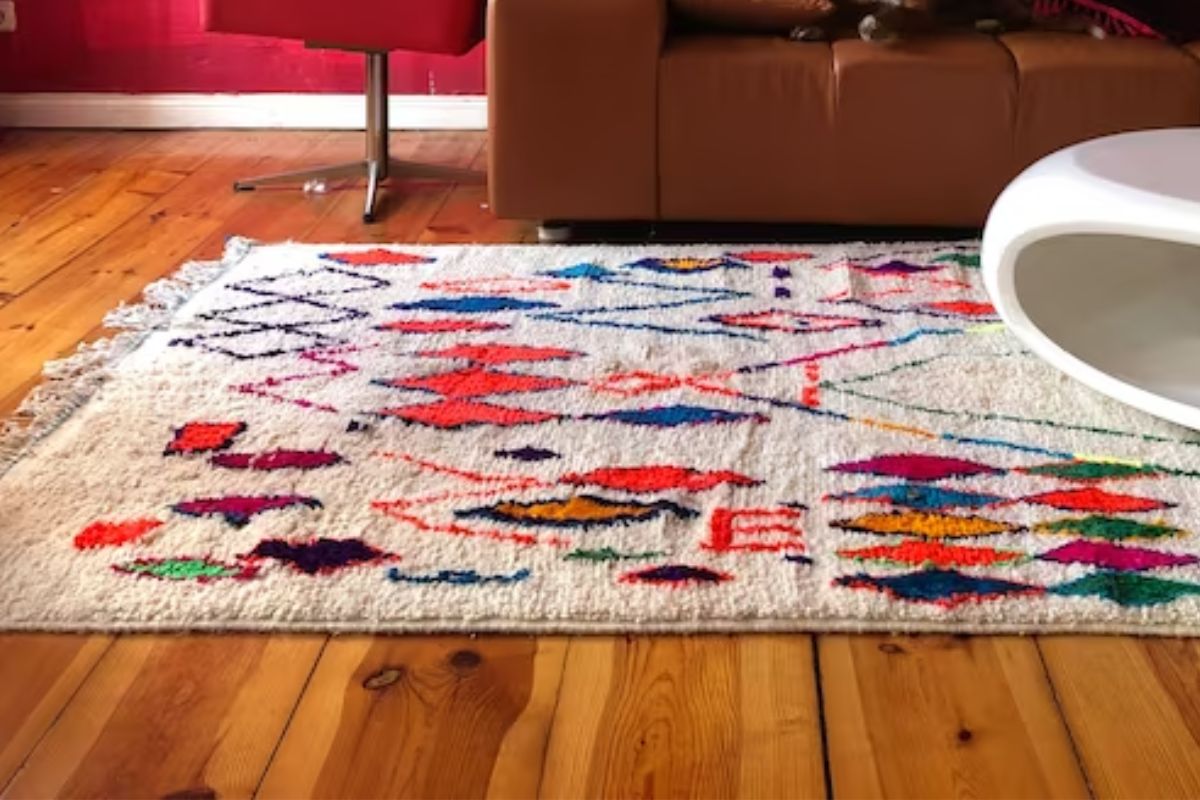
    An Azilal rug is a hand-knotted Berber rug from the Azilal province in Morocco's High Atlas Mountains, built on a natural, undyed cream or ivory wool base and covered with vivid, freeform, abstract patterns. It is the colorful, expressive counterpart to the neutral Beni Ourain: thinner in pile, brighter in palette, and far less bound by fixed tribal templates. Each Azilal is essentially a one-off, improvised by the weaver, so no two are truly alike. If you found a bright, loosely drawn Moroccan rug floating on a cream ground and wondered what it was, it is almost certainly an Azilal.

    The rest of this guide covers where the style comes from, why the designs never repeat, what the rugs are made of, how they differ from the two styles they are most often confused with (Beni Ourain and Boujad), and the honest parts most rug listings leave out. For the wider family this style belongs to, see our complete guide to Moroccan rug styles.

    Where Azilal rugs come from

    Azilal is both a rug style and a real place. The province and town of Azilal sit in the High Atlas Mountains, roughly 100 miles from Marrakech, and the rugs take their name from that region. They are woven by Azilali Berber (Amazigh) communities, and by long tradition the weaving is done by women, with techniques passed down within families.

    Beyond that, the deep history gets murky, and this is a good moment to be honest about it. You will see origin dates for Azilal weaving stated confidently across the web, from a few centuries to "ancient," but there is no firmly documented, agreed-upon start date. What is clear is that the style stayed local and largely unknown to outside collectors until the late twentieth century, when Moroccan tribal rugs found a Western design audience. So the safe, accurate statement is this: Azilal is a regional High Atlas weaving tradition that became internationally collected fairly recently. Precise founding dates are not settled, and any single source that pins one should be read with caution.

    Why no two Azilal rugs match

    This is the trait that defines the style, and it is the one most worth understanding before you buy. Where a Beni Ourain follows a fairly restrained visual template, the Azilal weaver works freehand. The motifs (lines, diamonds, chevrons, ladders, and looser figurative shapes) are arranged from the maker's own imagination rather than a set pattern book. The results are personal, improvised, and often asymmetric.

    The practical consequence: you cannot shop for "the Azilal design," because there isn't one. Two rugs from the same village, the same year, even the same weaver, will not match. Irregular spacing, a color that appears once and never again, a motif that drifts off-center: these are features of the tradition, not flaws or signs of a mistake. If you want a rug that reads as a single artistic object rather than a repeating textile, that improvised quality is the whole appeal. If you want two matching runners, this is the wrong style to hunt for.

    What Azilal rugs are made of

    The ground of an Azilal is typically natural, undyed sheep's wool in cream, ivory, or soft beige. The colored motifs are worked in dyed wool, and often cotton, laid over that light base. Some newer pieces incorporate recycled cotton or mixed fibers for the bright accents, which is part of why modern Azilals can look more saturated than older ones.

    Construction-wise, Azilal rugs are single-knotted, commonly with a cotton warp and wool knots and weft. The pile tends to be lower and the rug lighter and thinner than a plush Beni Ourain. That makes them easier to layer and move, though it also means they feel less cushioned underfoot.

    Azilal vs Beni Ourain: the honest comparison

    These two are the styles buyers most often weigh against each other, because they sit at opposite ends of the same shelf: one neutral, one colorful. Neither is "better." They solve different problems in a room.

    Feature Azilal Beni Ourain
    Region Azilal province, High Atlas Beni Ourain tribes, Middle Atlas
    Palette Cream base with bright, multicolor motifs Cream or ivory base with brown or black lines
    Design Freeform, abstract, improvised Minimalist, geometric, restrained
    Pile Lower and thinner Thick, plush, high pile
    Materials Wool plus cotton, sometimes recycled fiber Typically all wool
    Feeling in a room Playful, artistic, a focal point Calm, neutral, a backdrop

    The short version: choose an Azilal when you want the rug to be the color story in the room, and a Beni Ourain when you want the rug to disappear into a neutral scheme and let everything else stand out. For the full breakdown of the neutral option, see our Beni Ourain rug guide.

    Azilal vs Boujad: the other easy mix-up

    Boujad is the style most often confused with Azilal once color enters the picture, and telling them apart comes down to one word: space. Boujad rugs are woven in the Middle Atlas near the town of Boujad, by Arab and Arabised Berber communities, and they tend to flood the entire field with saturated color, especially pinks, reds, oranges, and purples. The color fills the rug edge to edge.

    An Azilal does the opposite. It keeps a lot of open cream ground showing, with bright motifs floating on top of it. So a quick tell: if most of the rug is cream with color drawn onto it, you are likely looking at an Azilal; if the whole surface is soaked in warm color, it leans Boujad. Our Boujad rug guide covers that saturated style on its own terms.

    Older Azilal vs newer production

    "Azilal" is not one static look, and the difference between older and newer pieces is real enough to explain rather than blur. Older Azilal rugs lean on natural undyed wool and plant-based dyes, with sparser designs and a more muted, earthy set of accent colors. Many newer pieces are brighter, use more cotton, and may rely on synthetic dyes to hit those electric blues, pinks, and yellows.

    This matters because natural and synthetic dyes age differently. Natural dyes tend to mellow and harmonize over years, softening into the wool. Synthetic dyes are generally stable in a good modern rug, but some can fade or shift over time rather than settle. Neither is automatically "better," but they are not the same thing, and price and expectation should follow the reality of the piece.

    One caution: "vintage" is not a regulated term in the rug trade, and the age of a specific rug is hard to verify from a photo or a listing alone. Treat an age claim as a claim, not a certified fact, and ask what it is based on.

    What the motifs might mean, and why "might" is the right word

    You will find blogs that hand you a tidy dictionary of Azilal symbols, assigning fixed meanings to diamonds, zigzags, and figures. Read those with care. The motifs are commonly described as touching on rural life, motherhood, birth, and protection, and many weavers do work personal or symbolic content into their rugs. But there is no single, universal, decoded code. Meanings vary by weaver, family, and region, and a great deal of it is undocumented or interpreted after the fact.

    So the accurate framing is that Azilal motifs may carry meaning, often personal to the maker, and that specific "this shape always means X" claims should be treated as interpretation rather than settled fact. When a source states a precise symbolic meaning, look for what it is sourced to.

    The part most rug listings leave out

    Here is the honest section a seller has little reason to write. Because the defining traits of an Azilal are loose ("colorful abstract motifs on a light ground"), the label gets applied broadly in the market. A colorful High or Middle Atlas rug that is arguably Boujad-adjacent or a regional blend may still be listed as "Azilal," simply because that name sells. And the words that surround these rugs, including Azilal, vintage, authentic, tribal, and Berber, are not regulated or certified by anyone. The label on a listing is a description, not a guarantee of origin.

    That is not a reason to distrust every rug. It is a reason to buy the rug in front of you rather than the word attached to it: judge the wool, the ground, the knotting, and the look you actually want. Atlas Rug Guide is a reference, not an appraisal or authentication service, and we will not tell you a specific rug is genuine from afar. For a high-stakes purchase, an in-person expert who can handle the piece is the right authority.

    Before you buy or live with one

    A few grounded checks, in plain terms:

    • Feel the wool. Real sheep's wool has a slightly greasy, springy hand and recovers when you press it. A flat, squeaky, or plasticky feel is worth questioning.
    • Look at the ground. A classic Azilal shows a natural, undyed cream or ivory base with color drawn on top, not color everywhere.
    • Check the back. Hand-knotting shows on the reverse. Ask whether the piece is knotted rather than machine-made or tufted.
    • Ask about dyes and age. A confident seller can tell you natural versus synthetic dye and roughly how old the piece is, and will not oversell what they cannot prove.
    • Expect asymmetry. Irregularity is normal here. Do not treat an off-center motif as a defect.

    In a room, an Azilal earns its keep as a color anchor over neutral floors, and its thinner pile makes it easy to layer over a larger natural rug or a flatweave. Because the palette is already doing the work, it usually looks best with fairly restrained furniture around it.

    FAQ

    Are Azilal rugs handmade?
    Yes. Azilal rugs are hand-knotted, traditionally by women in the Azilal region of the High Atlas, using wool and often cotton. Handwork is why each one is slightly irregular and one of a kind.

    Is an Azilal rug better than a Beni Ourain?
    Neither is better; they are built for different rooms. An Azilal brings color and acts as a focal point, while a Beni Ourain is neutral and recedes into the background. Choose based on whether you want the rug to be the color story or a quiet backdrop.

    Why are Azilal rugs so colorful?
    The style is defined by expressive, improvised design. Weavers work freehand rather than to a fixed template, laying bright dyed wool and cotton over a natural cream base. Newer pieces often look more saturated because they use more cotton and, in some cases, synthetic dyes.

    What are Azilal rugs made of?
    A natural undyed wool ground, with motifs in dyed wool and often cotton. Some newer pieces use recycled cotton or mixed fibers for the bright accents. They are usually knotted with a cotton warp and wool knots.

    How can I tell a real Azilal rug?
    Look for real wool, a natural cream ground with color drawn on top, visible hand-knotting on the back, and honest answers about dyes and age. Keep in mind that "Azilal" is an unregulated market label, so for an important purchase, a hands-on expert appraisal is the only reliable way to confirm origin.