Tag: rug identification

  • Moroccan vs Persian vs Turkish Rugs Compared

    Moroccan vs Persian vs Turkish Rugs Compared

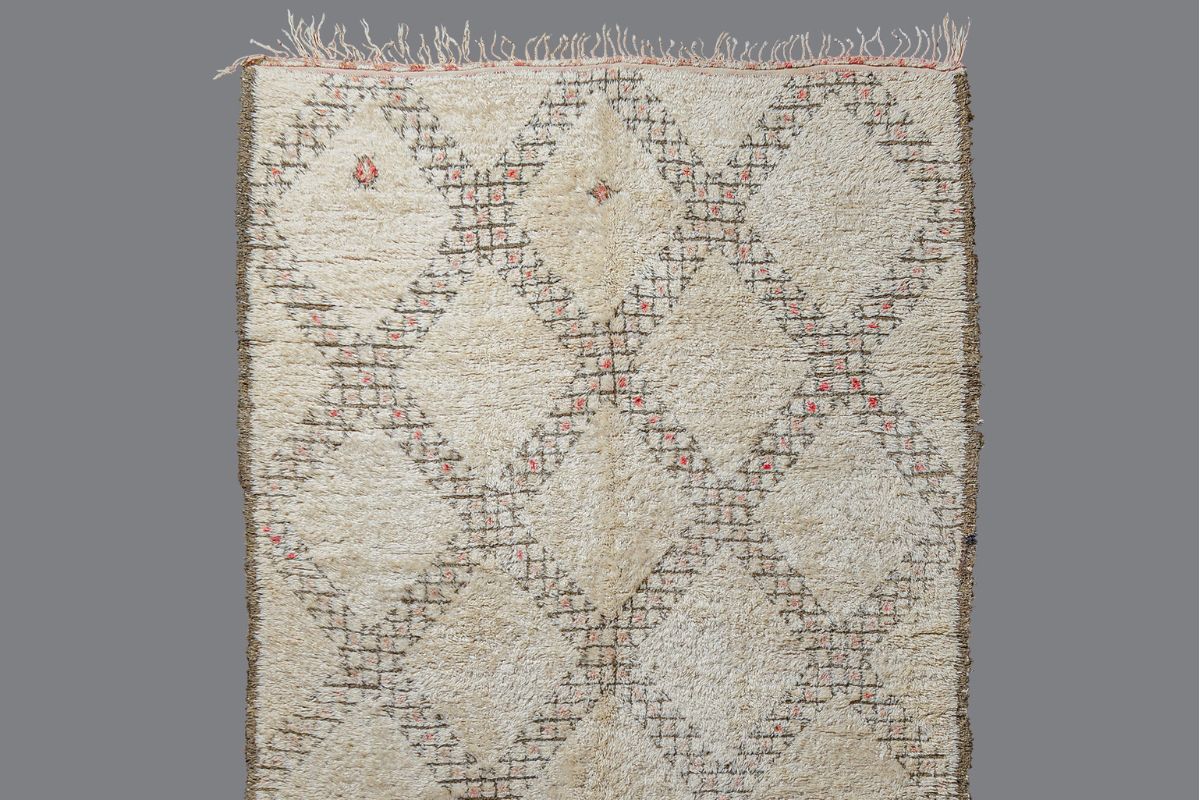
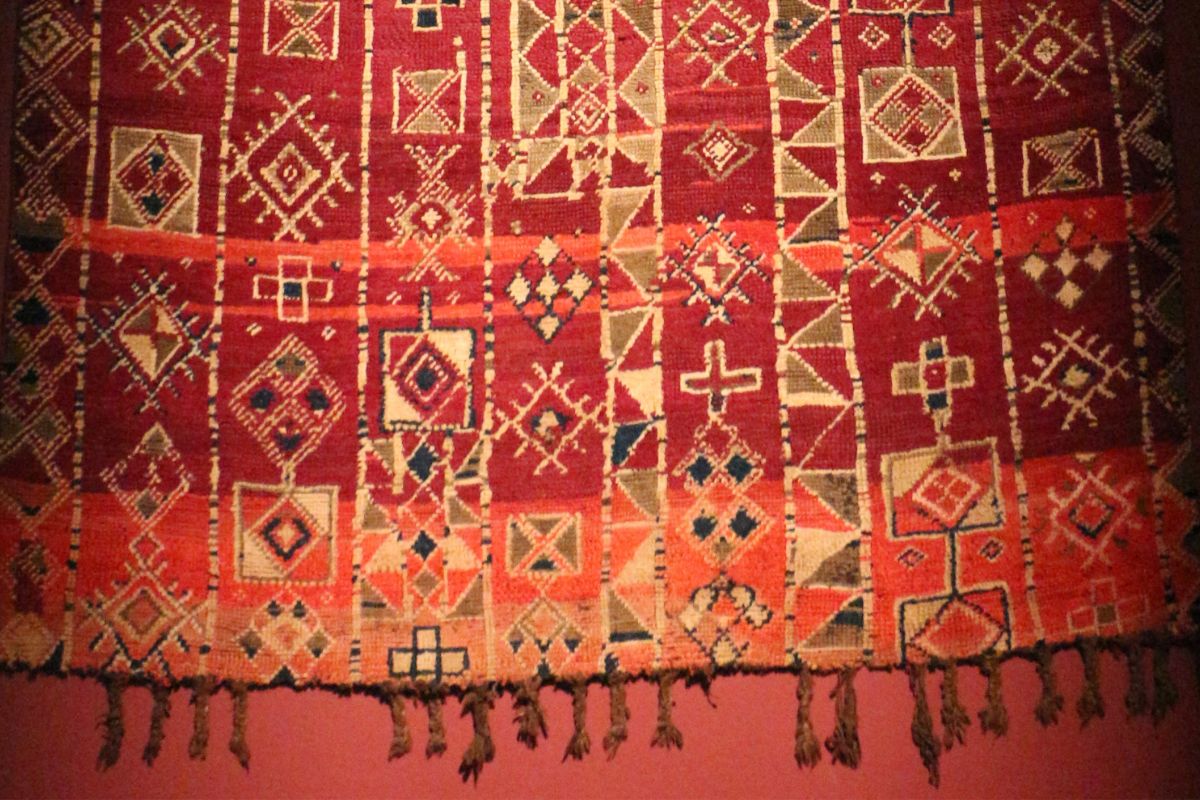
    Browsing a general "oriental rug" or "vintage rug" category and can't tell which broad tradition you're looking at? As a rough, non-absolute test: Moroccan rugs tend toward abstract or geometric motifs with a looser, more relaxed knot structure and an organic, slightly rustic texture; Persian rugs favor curvilinear, floral, or medallion-based designs with dense, small asymmetrical knots; Turkish rugs favor geometric medallions and repeating patterns using a symmetrical, double-wrapped knot. These are trade generalizations about three enormously varied traditions, not fixed rules every individual piece follows, but they're a genuinely useful starting orientation.

    Design: geometric vs. floral vs. medallion

    Moroccan rugs, the family this site covers in depth, from minimalist Beni Ourain to colorful Azilal and Boujad, lean toward abstract, geometric, or freehand tribal motifs, often with visible asymmetry that reads as intentional rather than a flaw. Persian rugs are generally associated with more intricate, curvilinear design work: florals, vines, and central medallions rendered with fine detail. Turkish rugs sit somewhere in between stylistically, more likely than Persian work to foreground geometric shapes (diamonds, stars, hexagons) but still frequently built around a central medallion or repeating floral border, rather than the freer, more abstract fields typical of Moroccan tribal weaving.

    None of these design tendencies are absolute. Persian weaving traditions include plenty of tribal, geometric work (Gabbeh and various nomadic Persian traditions, for instance, look far more abstract than a fine Isfahan or Tabriz piece), and Moroccan weaving includes some more structured, symmetrical traditions alongside its freer tribal styles. Treat "geometric means Moroccan" as a starting heuristic, not a rule that overrides everything else you can see in a piece.

    Knot technique: three different structures

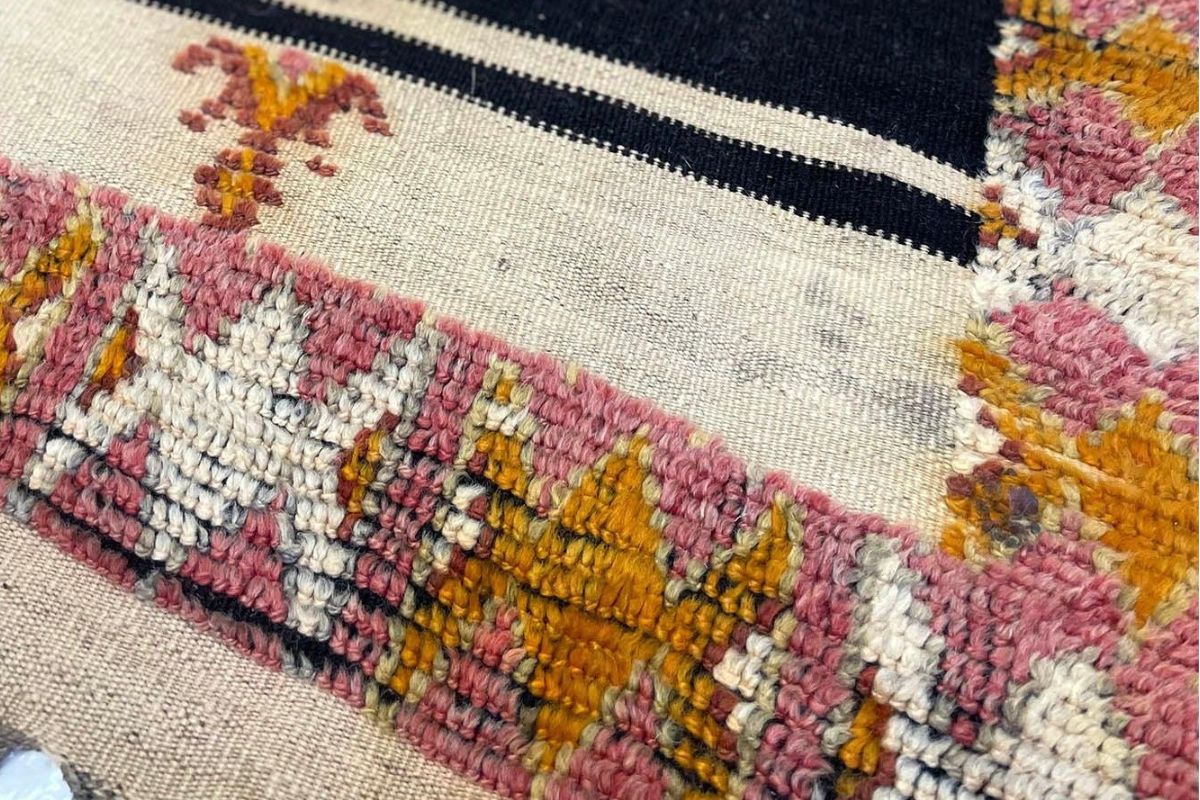
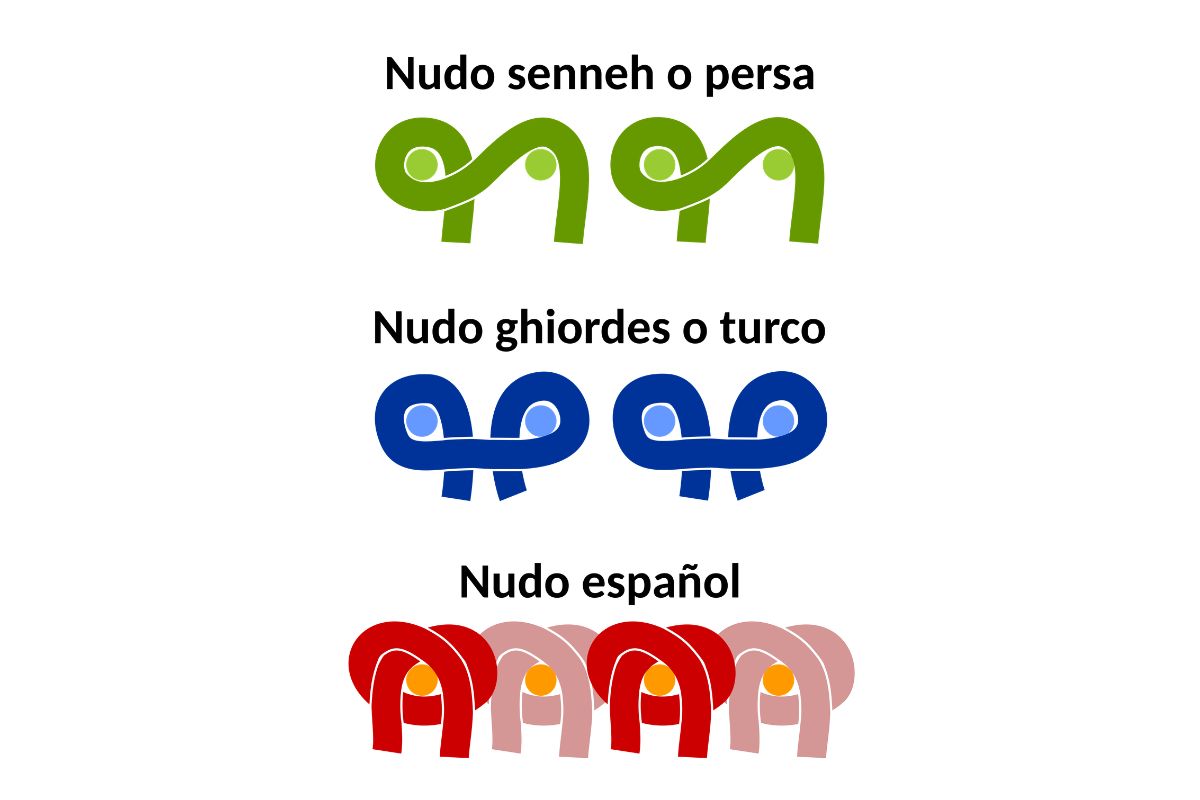
    This is where the traditions genuinely diverge on a technical level, not just a stylistic one. Persian weaving is closely associated with the asymmetrical knot, sometimes called the Persian or Senneh knot, which wraps around one warp thread and loops loosely around the adjacent one, allowing weavers to pack knots more densely and produce finer detail. Turkish weaving is associated with the symmetrical, double-wrapped knot, the Turkish or Ghiordes knot, where the yarn wraps fully around two adjacent warp threads, producing a slightly bulkier, more secure knot. Moroccan tribal weaving, by contrast, is generally described as using a looser, less rigidly uniform knotting structure than either of those two traditions, which is part of what gives finished Moroccan rugs their characteristic soft, organic, slightly irregular texture rather than the tight uniformity of a fine Persian or Turkish piece.

    None of this is something you can reliably verify from a listing photo alone. Knot structure is a back-of-the-rug, hands-on question, closer to what's covered in how to identify a Moroccan rug from a photo, but it's useful to know these are real, named, technically distinct construction methods, not just marketing language for three interchangeable products.

    Material: correcting a claim that gets repeated wrong

    Here's a specific inaccuracy worth naming directly, because it shows up across a lot of general rug-comparison content: several sources describe Persian rugs as "typically made from silk." That's not accurate. The overwhelming majority of Persian rugs, historically and today, are wool; silk is used in a specific minority of fine, high-end production (some Qum and Isfahan pieces, for example), not as the material baseline for the tradition as a whole. A buyer who assumes "Persian equals silk" is liable to either overpay for a wool piece expecting silk-level delicacy, or underestimate the fineness of a genuinely well-made wool Persian rug because it "isn't silk."

    Turkish rugs are similarly primarily wool, with silk used in specific fine production. Moroccan tribal rugs, the family this site covers, are essentially always wool. This site has not found silk used as a base material in any of the named Moroccan traditions covered here, which is one more reason "which one is silk" is the wrong question to be asking when sorting these three broad traditions apart.

    Why the general "oriental rug" label tells you less than it sounds like it does

    "Oriental rug" is a retail catch-all covering Persian, Turkish, Caucasian, Central Asian, and various other hand-knotted traditions, in the same loose way that "Berber rug" is a catch-all for several distinct Moroccan and Amazigh traditions (see what "Berber rug" actually means for that specific confusion). A listing that says only "vintage oriental rug" is telling you almost nothing about the actual origin, technique, or material of the piece. If a Moroccan rug ends up filed under a general "oriental rug" category, which happens on some marketplaces, the design and knot-structure signals above are what will actually help you sort it out, more than the category label itself.

    What to check on the specific listing in front of you

    • Design first. Abstract/geometric with visible asymmetry points toward Moroccan; fine curvilinear floral or medallion work points toward Persian; geometric medallion work with repeating borders points toward Turkish, as a starting orientation, not a verdict.
    • Ask about material specifically, rather than assuming from the region named. Don't assume "Persian" means silk, or that a wool Persian rug is somehow lesser for being wool.
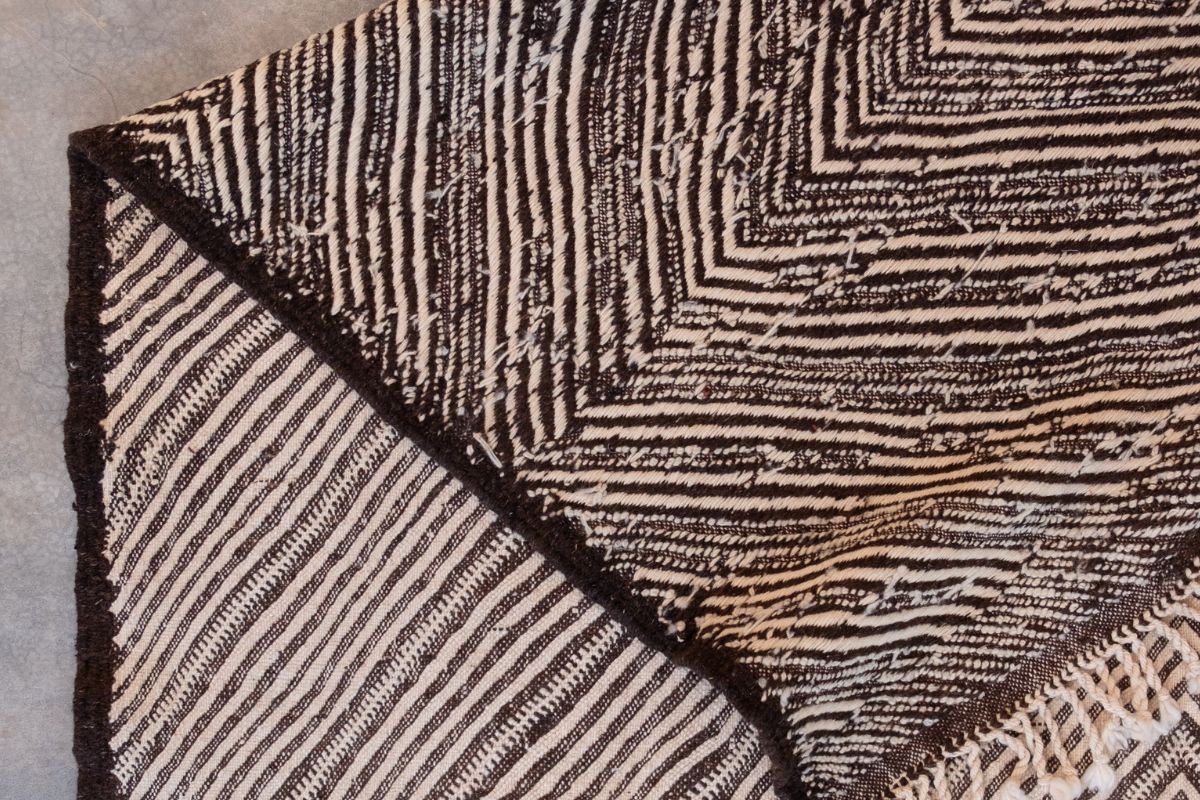
    • Ask for a photo of the back, if construction detail matters to your decision: that's the more reliable way to assess knot density and structure than a front-facing listing photo alone.
    • Treat regional and tradition names as a starting point, not a certainty, especially on older or unlabeled pieces where several traditions' visual and technical features can genuinely overlap.

    FAQ

    What's the main visual difference between Moroccan, Persian, and Turkish rugs?
    Moroccan rugs generally favor abstract, geometric tribal motifs; Persian rugs favor curvilinear floral and medallion designs; Turkish rugs favor geometric medallions and repeating patterns. These are general tendencies, not fixed rules for every piece.

    Are Persian rugs made of silk?
    Mostly no. The large majority of Persian rugs are wool. Silk is used in a specific minority of fine, high-end production and should be treated as a premium exception, not the material baseline for the tradition.

    What's the knot difference between Persian and Turkish rugs?
    Persian weaving is generally associated with the asymmetrical (Senneh) knot, which allows denser packing and finer detail. Turkish weaving is generally associated with the symmetrical, double-wrapped (Ghiordes) knot, which is slightly bulkier and more secure.

    Are Moroccan rugs the same as "oriental rugs"?
    "Oriental rug" is a broad retail category that can include Moroccan pieces alongside Persian, Turkish, Caucasian, and other traditions. It isn't a specific style, in the same way "Berber rug" isn't one specific Moroccan style either.

    Can I tell these three traditions apart from a listing photo alone?
    Design tendency is often visible in a photo. Knot structure generally isn't, without a clear photo of the rug's back. Neither check substitutes for asking the seller directly about origin and material.

    Is one of these three traditions better quality than the others?
    Not as a blanket rule. Each tradition spans a wide range of quality, from coarse everyday pieces to museum-grade work. A fine Persian rug and a well-made Moroccan tribal rug are excellent in different, tradition-specific ways rather than ranked against a single quality scale, and this guide won't manufacture a ranking that doesn't reflect that variation.
  • What Is a Berber Rug? The Word, and Its History

    What Is a Berber Rug? The Word, and Its History

    "Berber rug" is not one style. In a rug listing, it usually means one of several distinct named traditions grouped under a single, loosely used retail label: Beni Ourain, Azilal, Boujad, and others already covered on this site. The word "Berber" itself also has a contested history: it comes from an ancient exonym with roots meaning "foreigner" or "barbarian," and many Amazigh people and scholars reject it for that reason, preferring their own name for themselves, Amazigh. This guide uses both terms, and explains why.

    Where the word "Berber" comes from, and why it's contested

    "Berber" traces back to the Latin barbarus, itself from the Greek bárbaros, a term Greeks and Romans originally applied broadly to foreigners whose speech sounded unintelligible to them, later extended by Romans specifically to North African peoples encountered during Roman expansion into Numidia and Mauretania. That origin is documented in linguistic-anthropology sources including the Society for Linguistic Anthropology and Britannica's own entry on the Berber people.

    The word's baggage doesn't stop in antiquity. Its root is widely noted to overlap with, and sometimes be treated as equivalent to, the Arabic word for "barbarian," which is a live reason many Amazigh scholars and activists reject "Berber" as a pejorative label rather than a neutral ethnonym. There's also a more recent political layer: French colonial administration in 20th-century North Africa institutionalized "Berber" as an official administrative category, part of a broader colonial strategy that treated Amazigh and Arab populations as separate groups to be managed differently. That history is one more reason the term carries weight beyond its dictionary definition.

    Amazigh: the term the people use for themselves

    The people commonly labeled "Berber" from the outside use their own name for themselves: Imazighen (singular Amazigh). Linguistic sources gloss the term's root as meaning something close to "free people" or "noble free people", a self-description that stands in direct contrast to an exonym rooted in "foreigner" or "barbarian." Respecting that self-chosen name, rather than defaulting only to the externally imposed one, is a small but real editorial choice, and it's the reason every style page on this site introduces its subject as Amazigh weaving alongside the more commercially familiar "Berber" label.

    None of this means "Berber" is a slur that must never appear. It's the term most buyers will search and most sellers will use, which is exactly why a guide that only ever said "Amazigh" would be less useful to an actual shopper trying to make sense of a listing. The goal here isn't to police vocabulary; it's to explain what the word is actually doing so a reader isn't left assuming it's a neutral technical term with a single fixed meaning.

    What "Berber rug" means in a rug listing, in practice

    Walk into any rug retailer's site and "Berber rug" functions as a broad category header, not a specific product description. Underneath that heading you'll typically find named traditions this site treats as genuinely distinct: the minimalist, mostly-undyed Beni Ourain; the colorful, freehand Azilal; the pink-and-magenta Boujad; flatweaves like Zanafi or Moroccan kilim and hanbel; and others. These traditions differ in region, material, technique, and look. Collapsing all of them into one umbrella term is convenient for a retailer's navigation menu, but it hides real distinctions a buyer benefits from knowing.

    There's a parallel worth naming: the same collapsing happens with the word "Amazigh" itself in some usage, since it also refers to an enormously diverse set of peoples and languages across North Africa, not one homogenous group. "Berber rug" and "Amazigh weaving" both function, in casual use, as umbrella terms over real internal diversity. The difference is that one term's origin is external and contested, and the other is the term the people themselves use.

    What "Berber" doesn't tell you

    Because "Berber rug" is a retail catch-all, the word alone tells you almost nothing about region, era, dye type, or construction, the exact information a buyer usually actually wants. A listing that says only "vintage Berber rug" with no named style, no stated region, and no material detail is giving you less information than the trade actually has available for most of these traditions, several of which, like Taznakht, have real, citable, documented cooperative histories behind them. If a seller can't or won't go beyond "Berber rug" as a description, that's worth noting, not necessarily as a red flag, but as a prompt to ask for more.

    A different confusion: "Berber carpet" in flooring

    If you searched "Berber rug" and ended up reading about wall-to-wall carpet installation, you've run into a completely separate use of the word. In the US flooring trade, "Berber carpet" refers to a specific machine-made, loop-pile broadloom carpet style, sold by the roll for wall-to-wall installation, that took its name from a resemblance to the coarser texture of some Amazigh weaving but has no other connection to it. It's manufactured on entirely different equipment, sold through entirely different retail channels, and has nothing to do with an actual hand-knotted or handwoven Moroccan rug. This site covers hand-knotted wool rugs only, never wall-to-wall carpet of any kind. A loop-pile broadloom product and a hand-knotted rug are different objects with different care needs, a distinction worth keeping in mind if you ever compare cleaning advice between the two.

    If a search result or a home-improvement forum is discussing carpet padding, stretching, or wall-to-wall installation under the word "Berber," that's this unrelated flooring product, not anything covered on this site.

    How this site uses the two terms

    This site uses "Amazigh" as the primary term for the people and the weaving tradition, and uses "Berber" where it reflects how the trade and search terms actually work, because a reader searching "Berber rug" deserves an answer, not a lecture. Where a specific named style, region, or cooperative is known, this site uses that specific name rather than resting on either umbrella term. That's the same discipline applied across every style page here: name what's actually known, and say plainly when a broader label is standing in for something more specific.

    FAQ

    Is "Berber rug" a real rug style?
    No. It's a retail umbrella term covering multiple distinct named Moroccan and Amazigh weaving traditions, not a single defined style with consistent construction or origin.

    Why do some people object to the word "Berber"?
    Because it derives from an ancient exonym rooted in "foreigner" or "barbarian," and its root overlaps with the Arabic word for "barbarian." Many Amazigh scholars and activists consider it a pejorative label imposed from outside rather than a neutral name.

    What does "Amazigh" mean?
    It's the term the people themselves use, commonly glossed as "free people" or "noble free people," and is generally the preferred term over "Berber" in scholarly and activist usage.

    Should I stop using the word "Berber rug" when shopping?
    Not necessarily. It's the term most listings and search results actually use. This guide uses both terms for that reason, while being clear about the word's contested history and preferring named, specific styles over the umbrella label wherever possible.

    If a listing just says "Berber rug" with nothing else, what should I do?
    Ask the seller which specific tradition or region the piece is attributed to. See how to identify a Moroccan rug from a photo for what else to check before relying on a generic label alone.

  • Ait Bou Ichaouen Rug: Morocco’s Eastern Outlier

    Ait Bou Ichaouen Rug: Morocco’s Eastern Outlier

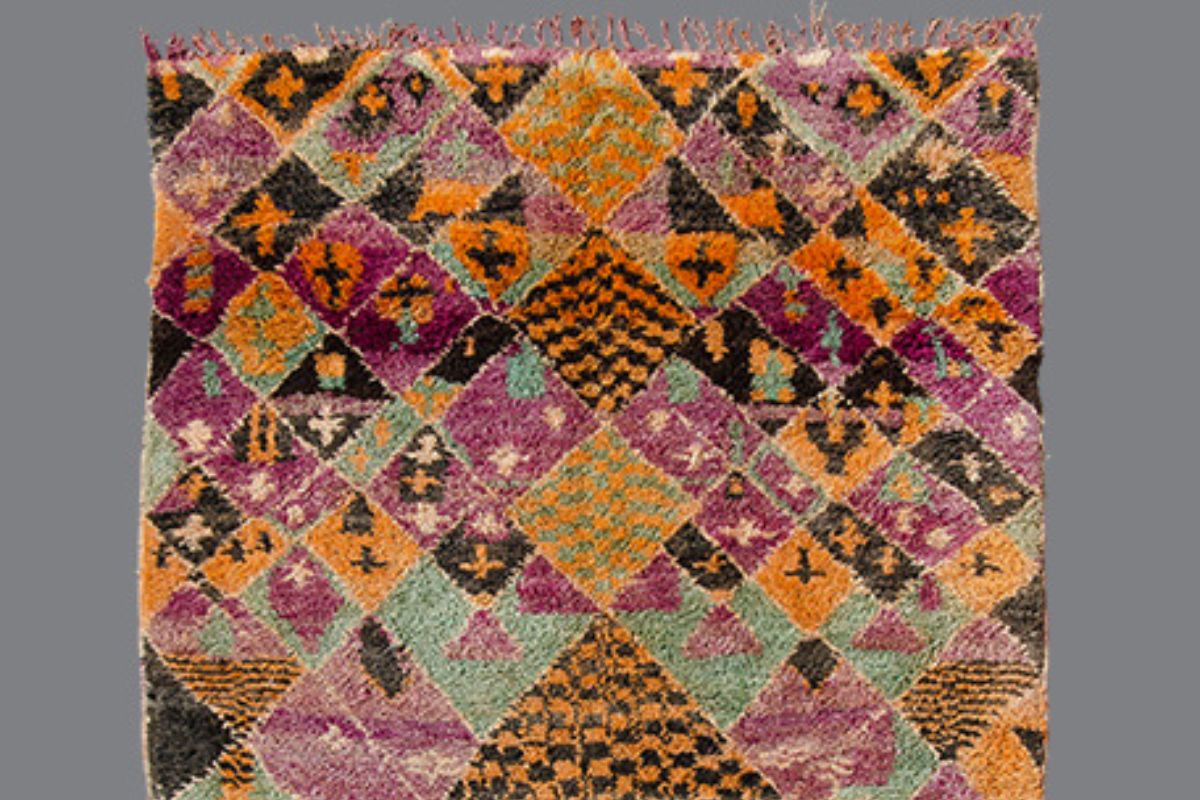
    An Aït Bou Ichaouen rug, sometimes labeled a Talsint rug after the nearby town, comes from the far eastern edge of Morocco's High Atlas, near the Algerian border. It looks different from almost everything else covered on this site: instead of the undyed ivory of a Beni Ourain or the sketchy brightness of an Azilal, expect a dense, saturated palette of aubergine, mauve, tangerine, sage, and ochre worked into bold, tightly packed geometric motifs. If a rug you're looking at doesn't fit the Middle Atlas or High Atlas families already covered here, this is one of the styles worth checking against.

    Where the name and territory sit

    Rug dealers place the Aït Bou Ichaouen in the far eastern High Atlas, in the Figuig province, close to the Algerian frontier. Several vintage-rug dealers and collectors describe this area as geographically isolated enough that it remained largely outside the international rug trade until sometime in the 1990s, when a wider audience of collectors began acknowledging pieces from the region. That specific timeline is a dealer claim, repeated across several rug-trade sites, not something this guide found in independent journalism or academic sourcing. Treat it as the trade's own account of how these rugs entered the market, not a verified historical date.

    The nearby town of Talsint gives the weaving its alternate market name, and you will see "Ait Bou Ichaouen" and "Talsint" used more or less interchangeably in listings for the same tradition.

    This is one of the least-documented styles in this site's own Cluster 1 map, and that is worth saying up front rather than glossing over. Compare it with Taznakht, where independent journalism names an actual women's cooperative and a manager by name, or with Beni Ourain, a style so commercially dominant that dozens of sellers describe it in overlapping detail. Aït Bou Ichaouen sits at the opposite end: a real weaving tradition that entered the international collector market comparatively recently and late, according to the dealers who sell it, and about which comparatively little independent material exists in English.

    What the rugs look like

    Where this differs from most of what this site has already covered is the color. Rug dealers consistently describe an aubergine-and-mauve base, often combined with tangerine, sage green, and ochre, arranged into dense, geometric, knotted-pile patterns. That knotted-pile construction is itself notable: it is described in dealer sourcing as an unusual survival of an older North African weaving approach in a region where other eastern traditions lean more toward flatweave. The motifs tend to be packed closer together than the open, sparse fields common on some High Atlas styles, giving the rugs a busier, more saturated look overall.

    If you're trying to place a rug from a photo, the combination of aubergine/mauve tones with tangerine and ochre accents, in a dense pattern, is the strongest visual signal for this style specifically, a very different read from the cream-ground minimalism of a Beni Ourain.

    Quick comparison

    Aït Bou Ichaouen / Talsint Beni Ourain Taznakht
    Region Far eastern High Atlas, near Algeria Middle Atlas Southeastern Morocco, Anti-Atlas edge
    Ground color Aubergine, mauve base Undyed ivory/cream Colorful, plant-dyed
    Pattern density Dense, tightly packed Sparse, minimal Dense, geometric
    Independent sourcing found Dealer accounts only Extensive dealer coverage Named journalism (Africanews)

    This table reflects what dealer sources describe and what this guide could verify independently, not a scientific classification, and not a claim that every individual rug sold under these names will match the pattern exactly. Hand-woven work varies piece to piece even within one named tradition.

    What this guide could and could not source

    This is worth stating plainly, because it's a real difference from some of the other style pages on this site. For a row like Taznakht, independent journalism, Africanews and reporting picked up by The Arab Weekly, named actual cooperatives, a specific manager, and reported weaver counts. For Aït Bou Ichaouen, every source found in this guide's research is a rug dealer, auction house, or collector site: 1stDibs listings, an auction description from a private collector, and vintage-rug retailers. No museum record, academic paper, or independent news report turned up in this guide's research to corroborate the tribal name, the isolation date, or the specific palette description beyond what dealers themselves state.

    That doesn't mean the dealer account is wrong. It means this guide cannot independently verify it the way it can for better-documented traditions, and says so rather than presenting dealer marketing copy with the same confidence as sourced journalism. No age, knot count, or production date should be taken as settled fact from a dealer listing alone, and this guide will not manufacture one.

    This gap also matters for a practical reason. A style with thin independent documentation is easier for a seller to describe however suits a sale, since there is less published material a buyer can check a claim against. That is not a reason to avoid a genuinely interesting, underserved tradition; it is a reason to ask more questions of the specific seller, not fewer, before treating any dealer's account of origin, age, or rarity as settled.

    Why this style shows up in decor searches at all

    Aït Bou Ichaouen and Talsint rugs turn up in general "eclectic," "boho," or "colorful vintage rug" decor searches more often than in dedicated Morocco-style searches, largely because their saturated, jewel-toned palette photographs well against neutral modern interiors, a different appeal than the muted, minimalist look that made Beni Ourain a design-world staple. If you found one this way rather than by searching for the tradition by name, that is consistent with how dealers say these pieces circulate: as standout color pieces first, named tradition second.

    What to look for

    • The palette first. Aubergine, mauve, tangerine, sage, and ochre together, in a dense pattern, is the strongest identifying signal dealers describe for this style.
    • Ask where the sourcing comes from. If a seller states a specific age, weaving date, or tribal attribution with certainty, ask what that's based on. Given how thin the independent sourcing is for this style, a confident-sounding claim deserves a follow-up question, not automatic trust.
    • Compare construction, not just color. The knotted-pile structure described for this tradition is a different construction than a flatweave like a Moroccan kilim or hanbel, even where colors might look superficially similar in a photo.
    • Don't expect this guide, or any photo-based guide, to authenticate a specific piece. As with every style on this site, an actual purchase decision on an individual rug should involve direct questions to the seller, not a checklist alone.

    FAQ

    What is an Aït Bou Ichaouen rug?
    A knotted-pile rug tradition attributed to the Aït Bou Ichaouen people of Morocco's far eastern High Atlas, near the Algerian border, known in the rug trade for a distinctive aubergine, mauve, tangerine, sage, and ochre palette in dense geometric patterns.

    Is Talsint the same thing as Aït Bou Ichaouen?
    In the rug trade, yes, "Talsint" is used as an alternate market name, referring to a nearby town, for rugs attributed to the same tradition.

    How old are Aït Bou Ichaouen rugs typically?
    This guide could not find an independently sourced age figure for this tradition and will not state one. Dealer listings sometimes describe specific pieces as vintage or antique, but those are claims about the individual item for sale, not a verified fact about the tradition as a whole.

    How is this different from a Beni Ourain rug?
    Visually, almost entirely opposite: a Beni Ourain is built around undyed ivory wool with sparse dark motifs, while an Aït Bou Ichaouen rug is densely patterned in saturated purple, orange, and green tones. See the Beni Ourain guide for the contrast in detail.

    Why is there less written about this style than about Taznakht or Beni Ourain?
    Based on this guide's own research, the sourcing available is thinner. Taznakht has independent journalism naming cooperatives and weaver numbers; for Aït Bou Ichaouen, only dealer and collector sources were found. That gap is stated here rather than papered over.

  • Marmoucha Rug: Beni Ourain’s Quieter Relative

    Marmoucha Rug: Beni Ourain’s Quieter Relative

    A Marmoucha rug is a lighter, thinner, and generally smaller relative of Beni Ourain, woven in the Eastern Middle Atlas near Fes, south of Beni Ouarain territory. If you've found a listing for one and struggled to find much written about it, that's not an accident: it is one of the least commercially prominent named Middle Atlas styles, overshadowed by its heavier, far more widely marketed neighbor.

    Where the name and territory sit

    Rug specialists place Marmoucha weaving in the Eastern Middle Atlas, close to Fes and south of the territory associated with Beni Ouarain. That puts it in the same broad mountain region as the other Middle Atlas styles covered on this site, but at its eastern edge rather than the areas typically associated with Beni Ourain, Beni Mrirt, or Beni Mguild.

    The look: freedom within apparent symmetry

    Visually, a Marmoucha sits close to Beni Ourain's family: a beige or white ground with bright pattern work rather than Beni Ourain's typically sparser, darker line work. Specialists describe the weaving as having real freedom, motifs are placed without rigid precision, yet the overall effect still reads as loosely symmetrical rather than as scattered as Azilal's freehand style. The construction is described as directly influenced by Beni Ouarain's style, but the finished rugs tend to be lighter in weight, smaller in size, and thinner than a typical Beni Ourain.

    That combination, Beni-Ourain-adjacent construction and palette, but lighter and less bulky, is the most useful thing to know if you're trying to place an unfamiliar "Marmoucha" listing: think of it as Beni Ourain's quieter, more modestly scaled cousin rather than an entirely different visual tradition.

    Feature Beni Ourain Marmoucha
    Ground Undyed cream Beige or white
    Pattern Sparse dark lines, diamonds Brighter, freer motifs, loosely symmetrical
    Weight Heavy, high pile Lighter, thinner
    Typical size Often larger Generally smaller
    Market presence Widely marketed, easy to find Underdocumented, fewer listings

    Nothing in that table should be read as a strict rule; it describes a general tendency reported across the sources this guide checked, not a fixed specification for every piece sold under either name.

    A wool claim this guide won't confirm

    One source describes Marmoucha wool as coming from the first shearing of a specific local sheep breed associated with the region. This guide could not find a second, independent source corroborating that specific claim, so it is noted here as something you may see stated in a listing, not as a confirmed fact. If wool provenance matters to your decision, ask the seller directly what they can document about where the wool came from, rather than relying on a breed name you can't independently verify.

    Why being underdocumented can actually help a buyer

    There is a practical upside to a style with less marketing behind it. Names that sell in high volume, Beni Ourain above all, attract more copies, more inflated claims, and more competing "upgrade" narratives, simply because there is more money moving through that name. A less commercially prominent style like Marmoucha has less incentive behind it to dress up a plain wool rug with invented provenance or an inflated price story. That is not a guarantee of honesty from any individual seller, but it is a reasonable, checkable observation about where commercial pressure to embellish is strongest.

    The trade-off is real too: fewer listings means less to compare against, and less written material anywhere, including here, to check a specific claim against. Ask more questions of a Marmoucha seller than you might for a heavily documented style, precisely because there is less independent material available to catch an inconsistency for you.

    Where a Marmoucha fits in a room

    Because it shares Beni Ourain's palette family but in a lighter, thinner build, a Marmoucha suits similar settings without quite the same bulk: a bedroom or a living room where you want a soft, pale, textured base but don't need the deep insulating pile of a full Beni Ourain. Its lighter weight also makes it easier to reposition or rotate than a heavier equivalent, a small practical advantage in a room where wear needs to be spread evenly over time.

    What to look for

    • Compare weight against a Beni Ourain you've seen or handled. A genuine Marmoucha should feel noticeably lighter and thinner, which is one of its most consistently reported traits.
    • Look at the pattern for freehand irregularity. The motifs should show real freedom rather than a rigid repeating grid, while still reading as roughly balanced across the field.
    • Check the back, as with any hand-knotted rug. Individual knots and small irregularities indicate genuine hand construction; a mechanically uniform back suggests a machine-made copy regardless of the name on the listing.
    • Treat unfamiliar specifics with the same caution as any other style here. Because this is a less commercially documented name, listings may lean harder on specific-sounding claims (breed names, precise origins) precisely because there's less competing information to check them against.
    • Compare price against a Beni Ourain of similar size, and ask what accounts for any difference. A lighter, thinner rug using less wool is a reasonable basis for a lower price; an unexplained premium is worth a direct question.

    For the style it sits closest to, see our Beni Ourain rug guide, and for how it fits among the rest of the named Moroccan traditions, see the complete guide to Moroccan rug styles.

    FAQ

    What is a Marmoucha rug?
    A lighter, thinner, generally smaller relative of Beni Ourain, woven in the Eastern Middle Atlas near Fes, south of Beni Ouarain territory.

    How is a Marmoucha rug different from a Beni Ourain rug?
    Both share a similar beige-to-white ground and Middle Atlas construction style, but Marmoucha rugs are consistently described as lighter, thinner, and smaller than typical Beni Ourain pieces.

    Where are Marmoucha rugs from?
    The Eastern Middle Atlas region of Morocco, near Fes, placed by specialists south of the territory associated with Beni Ouarain weaving.

    Is it true Marmoucha wool comes from a specific local sheep breed?
    That claim appears in one source this guide checked, but it could not be independently corroborated, so it is presented here as an unverified claim rather than a confirmed fact.

    Why is there so little written about Marmoucha rugs online?
    It is one of the least commercially prominent named Middle Atlas styles, overshadowed by the much more widely marketed Beni Ourain, which is likely why detailed, independent information is harder to find for this style than for its neighbors.

  • Zemmour Rug: The Red Berber Flatweave Explained

    Zemmour Rug: The Red Berber Flatweave Explained

    A Zemmour rug (also spelled Azmour or Azemmour) is known in the rug trade primarily as a dense, red-dominant flatweave, patterned with geometric bands, chessboard arrangements, and diamond or triangular motifs worked in vertical and horizontal rows. The name is associated with a Berber tribal confederation whose historical territory rug specialists place between Rabat and Meknès, further north than most of the Middle Atlas styles covered elsewhere on this site.

    Where the name and territory sit

    The Zemmour are described by rug and textile specialists as a confederation of tribes whose territory historically sat between Rabat and Meknès, a more northerly stretch of the Middle Atlas region than Beni Ourain, Beni Mrirt, or Beni Mguild territory. This guide presents that geography as reported by specialists rather than as independently verified from a primary historical source, consistent with how every regional and tribal attribution is handled on this site.

    The look: red grounds and geometric bands

    The defining visual feature is color: a dominant, dense red ground, worked with geometric motifs arranged in vertical and horizontal bands rather than scattered loosely across the field. Chessboard-style arrangements are common, along with diamond and triangular shapes, often set off with white or lighter-toned line work that stands out sharply against the red. The overall effect reads as more structured and banded than the sparse, asymmetric lines of Beni Ourain or the scattered motifs of Azilal.

    A note on construction: flatweave, mostly

    Most retail descriptions of Zemmour rugs treat them as a flatweave, kilim-style tradition, without a knotted pile, and that is the more commonly stated construction across the sources this guide checked. A smaller number of sources also describe piled rugs attributed to the same tribal name. This guide did not find a way to resolve that inconsistency cleanly, so it is stated here as an open point rather than settled either way: if you are shopping for a specific construction, ask the seller directly whether the individual piece in front of you is flatwoven or knotted, rather than assuming from the name alone.

    If you want the general mechanics of how a flatweave is built and why it behaves differently from a pile rug, see our guide to Moroccan kilim and hanbel rugs.

    How it compares to Rehamna

    Zemmour is not the only red-dominant Moroccan style; Rehamna rugs also run warm and red-toned. The distinguishing features are geography and construction detail: Rehamna comes from the Haouz plains north of Marrakech and is typically described with a goat-hair warp and a sawtooth-edge border, while Zemmour is placed further north, between Rabat and Meknès, and is more consistently described as a banded, geometric flatweave without the sawtooth border. If you're trying to tell the two apart in a listing, check for the sawtooth edge and goat-hair warp first; their absence points toward Zemmour rather than Rehamna.

    Where a Zemmour suits a room

    A dense red ground with organized geometric banding reads as a strong, graphic statement rather than a quiet neutral base, closer in role to Boujad or Rehamna than to Beni Ourain. Because the pattern runs in structured bands rather than scattered motifs, a Zemmour tends to look more formal and considered on the floor than the looser, more improvised styles in this cluster, which can make it a good fit for a room that wants boldness without visual chaos. Its smaller reported sizing, where accurate, also makes it a reasonable candidate for an accent placement, a hallway, or layering over a larger neutral rug, rather than as a single large-room anchor.

    What to look for

    • Confirm construction directly. Given the flatweave/piled ambiguity in available sources, ask the seller plainly whether the specific rug is a flatweave or a knotted pile rather than assuming from the style name.
    • Look for banded, not scattered, patterning. Zemmour's geometric motifs typically run in organized vertical and horizontal rows, which is a more structured look than Azilal's freehand scattering or Boucherouite's improvisation.
    • Check the red for depth and variation. A genuine hand-dyed red ground often shows some natural variation in tone rather than a single flat, uniform shade.
    • Ask about size expectations. Some sources describe Zemmour pieces as running smaller than typical Middle Atlas rugs; treat this as a general tendency to ask about, not a fixed rule, since no dimension figures are verified here.
    • Ask what materials were used. Specialists describe Zemmour weaving as combining wool with cotton in some pieces; confirm the specific material mix for the rug you're considering rather than assuming an all-wool construction.

    One honest limit that applies here as on every page in this guide: description and reported tendencies are not the same as authentication. This guide can tell you what a Zemmour rug is generally reported to look like and how it is generally constructed; it cannot confirm the origin of a specific piece from a photograph.

    For how Zemmour fits alongside the rest of the region's named traditions, see the complete guide to Moroccan rug styles.

    FAQ

    What is a Zemmour rug?
    A red-dominant geometric rug, most commonly described as a flatweave, associated with a Berber tribal confederation whose historical territory specialists place between Rabat and Meknès in Morocco.

    Is a Zemmour rug flatwoven or knotted?
    Most retail sources describe it as a flatweave (kilim-style), but a smaller number of sources also mention piled production under the same name. This guide could not resolve that inconsistency, so ask the seller directly which construction a specific piece uses.

    How is a Zemmour rug different from a Rehamna rug?
    Both run warm and red-toned, but Rehamna comes from the Haouz plains near Marrakech and typically has a goat-hair warp and sawtooth-edge border, while Zemmour is placed further north, between Rabat and Meknès, and is described more as a banded geometric flatweave without that sawtooth border.

    What patterns appear on Zemmour rugs?
    Geometric motifs arranged in organized vertical and horizontal bands, including chessboard arrangements, diamonds, and triangles, often in white or light line work against a dense red ground.

    Are Zemmour rugs small?
    Some sources describe them as tending to run smaller than typical Middle Atlas rugs, though this guide has no verified dimension data and treats it as a general tendency rather than a fixed rule.

    What materials are used in a Zemmour rug?
    Specialists describe the tradition as using both wool and cotton, alongside notably skilled use of red dye. Confirm the specific material mix directly with a seller for any individual piece rather than assuming a single standard construction.

  • Rehamna Rug: The Marrakech Plains Style Explained

    Rehamna Rug: The Marrakech Plains Style Explained

    A Rehamna rug comes from the Haouz plains north of Marrakech, and it looks different from anything else covered so far in this guide: a dominant red or orange ground, often with natural color variation across the field, framed by a distinctive sawtooth-edge border, rather than the neutral cream or saturated pastel palettes of the Atlas Mountain styles.

    Where the name and region sit

    Rehamna refers to a region on the Haouz plains, extending north of Marrakech and bordered by the Oum Er-Rbia river. Rug specialists commonly attribute the tradition to the Rehamna, described as an Arab Maqil tribal group alongside Arabised Berber communities in the area, a reminder, consistent with what our Boujad guide already notes, that Moroccan weaving is not a single uniform Amazigh tradition but includes Arab and Arabised Berber groups as well. This guide treats that specific tribal attribution as reported by rug specialists rather than as independently confirmed, in keeping with how it treats every tribal-name claim across this site.

    Two recognized looks

    Rug dealers and specialists generally describe Rehamna production as falling into two recognizable types:

    1. Monochromatic red or orange ground. A dominant single-color field, often showing abrash, natural variation in tone caused by dye lots or hand-spinning, sometimes with a few sparsely scattered motifs rather than a dense pattern.
    2. A more abstract, scattered-motif style. Directional lines and chess-board-style elements arranged across the field, said by some specialists to draw influence from the urban carpet tradition of Rabat, further north.

    Both types typically share a red or orange ground framed by a sawtooth-edge border. Which type a specific rug falls into is mostly a matter of what a weaver chose for a given piece rather than a strict rule tied to age or sub-region, so treat the two descriptions as a useful way to recognize what you're looking at, not as two separate named styles you need to choose between. On the monochromatic type especially, the abrash is often the main source of visual texture, since the pattern itself is otherwise minimal.

    Construction details

    A few construction features show up consistently across multiple independent rug-dealer descriptions, which gives them more weight than a single seller's claim:

    • Goat-hair warp, sometimes blended with wool, rather than the all-wool construction of the Atlas Mountain styles
    • Sawtooth-edge framing around the field, a distinctive zigzag border rather than a plain edge
    • Striped kilim bands woven at both ends of the rug, a flatwoven finish bracketing the main knotted or patterned field

    These are useful, checkable identification points: if you're looking at a rug with a warm monochrome or sparsely scattered field, a zigzag border, and flatwoven striped bands at each end, Rehamna is a reasonable style to consider before assuming it's simply "a red Moroccan rug."

    How this differs from the Atlas Mountain styles

    Everything else covered in this cluster so far, Beni Ourain, Beni Mrirt, Beni Mguild, Azilal, Boujad, Zanafi, comes from the Middle or High Atlas mountain regions. Rehamna sits on the plains, closer to Marrakech itself, which shows up directly in the look: a plains rug tends toward a bolder, more saturated single-color field rather than the mountain styles' either neutral-and-restrained (Beni Ourain) or scattered-and-painterly (Azilal) approach to color. If you're trying to place a red or orange rug geographically, Rehamna and its plains neighbors are a more likely starting point than the Atlas styles covered in our complete guide to Moroccan rug styles.

    Where a Rehamna suits a room

    Because the field runs bold and warm rather than neutral, a Rehamna tends to work as a statement piece rather than a background rug, closer in role to Boujad than to the quieter Beni Ourain or Beni Mrirt. A monochromatic red-ground piece with abrash reads as a single strong block of color, useful for anchoring a room that otherwise stays neutral. The more abstract, scattered-motif type carries more visual activity and suits a space that can take a busier floor without feeling crowded. Either type tends to compete with, rather than sit quietly beside, other strongly patterned or brightly colored elements in a room.

    What to look for

    • Check the warp material. A goat-hair or goat-hair-blend warp, visible at the fringe or edges, is a specific, checkable detail distinguishing this style's construction from the all-wool Atlas styles.
    • Look at the border, not just the field. The sawtooth edge is one of the more distinctive and consistent identification markers across sources for this style.
    • Don't assume every red Moroccan rug is Rehamna. Boujad also runs warm and red-toned, but on a fully dyed wool ground without the sawtooth border or goat-hair warp. Compare construction, not just color.
    • Ask about the region directly, since the tribal attribution here, as with most named styles on this site, is reported by specialists rather than something this guide can independently verify from a listing.
    • Check the end-bands specifically. The striped kilim bands at each end are a flatwoven finish distinct from the main field's construction; their presence and condition are a useful, checkable quality signal separate from the field itself.

    One honest limit worth repeating here as on every style page: this guide can describe the tradition and its typical markers, but it cannot authenticate a specific rug from a photo, and no checklist substitutes for a seller who can answer direct questions about where a specific piece came from.

    FAQ

    What is a Rehamna rug?
    A rug from the Rehamna region on the Haouz plains north of Marrakech, typically featuring a red or orange ground, a sawtooth-edge border, a goat-hair or goat-hair-blend warp, and striped kilim bands at both ends.

    Where do Rehamna rugs come from?
    The Haouz plains, extending north of Marrakech and bordered by the Oum Er-Rbia river, distinct from the Middle and High Atlas mountain regions that produce styles like Beni Ourain and Azilal.

    What's the difference between a Rehamna rug and a Boujad rug?
    Both run warm and red-toned, but Boujad is a fully dyed wool ground without a sawtooth border, while Rehamna typically shows a goat-hair warp and a distinctive zigzag sawtooth edge, sometimes with abrash color variation in a largely monochromatic field.

    Are Rehamna rugs made by a specific tribe?
    Rug specialists commonly attribute the tradition to the Rehamna, described as an Arab Maqil tribal group alongside Arabised Berber communities in the area. This guide treats that as a reported attribution rather than an independently verified fact.

    What does "abrash" mean on a Rehamna rug?
    Natural variation in color tone across a single-color field, typically caused by different dye lots or hand-spun wool. It's a normal feature of handmade rugs, not a flaw.

  • Glaoui Rug: The Three-Technique Moroccan Weave

    Glaoui Rug: The Three-Technique Moroccan Weave

    A Glaoui rug is not one weaving technique but three, combined in a single piece: sections of hand-knotted pile, sections of flat weave, and passages of black-and-white embroidery called chedwi, often alongside narrow, tufted flatweave bands similar to those found on Zanafi rugs. If a rug you're looking at seems to switch construction partway across its surface, thicker and plush in one band, flat and graphic in the next, that is very likely a Glaoui, and it is a deliberate, technically demanding choice rather than an inconsistency.

    Where the name comes from

    The name is associated with the Glaoua, a real and well-documented Berber tribal confederation of the High Atlas, historically seated at the Kasbah of Telouet. Their leadership rose to significant regional power in the 20th century: Thami El Glaoui served as Pasha of Marrakesh from 1912 to 1956, and the family's history is covered in detail in Gavin Maxwell's book "Lords of the Atlas" and by outlets including Arab America. That makes the Glaoua one of the better-documented named groups referenced anywhere in this cluster.

    Worth being precise about, though: the historical record documents the Glaoua as a tribal confederation and a powerful political dynasty. It does not, on its own, confirm that every rug sold under the "Glaoui" name today was woven by identified members of that lineage, and this guide has no independent source connecting a specific piece to a specific weaver's tribal identity. Treat the name as pointing to a High Atlas regional and historical association, real and citable, rather than as a guarantee about who wove any individual rug in front of you.

    The three techniques, explained

    • Hand-knotted pile sections. Built the same way as a Beni Ourain or Beni Mrirt: individual knots tied into a foundation, producing a raised, textured surface.
    • Flat-woven sections. Built like a kilim or hanbel, with no knots and no raised pile, giving a thinner, flatter passage within the same rug.
    • Chedwi embroidery. A specific embroidery technique pairing black and white wool to create diagonal lines, curves, and figures, worked as a distinct decorative passage rather than as part of the base weave.
    • Zanafi-style tufted bands. Narrow flatwoven strips that run through the rug and tuft out from either side, the same construction found in dedicated Zanafi rugs.

    Combining all of this in one piece is genuinely more technically demanding than any single technique alone, since the weaver has to manage transitions between construction methods without weakening the structure at each seam.

    Why this matters for a buyer

    A rug built from multiple techniques gives you more places to check quality, and more places something can go wrong in a lower-quality copy:

    • Check each section separately. Run your hand across the knotted, flat, and embroidered passages individually. A genuine piece should feel intentional and consistent within each section, not just uniformly "busy."
    • Look at the transitions. Where one technique meets another is the most structurally demanding part of the weave. Loose threads, obvious gaps, or a poorly finished seam at a transition point are a sign of lower-quality construction.
    • Don't expect a single, simple description. Because a Glaoui rug is inherently mixed, "what pile height" or "what construction" doesn't have one answer for the whole piece the way it would for a Beni Ourain. Ask a seller to describe each section if that level of detail matters to your decision.
    • Compare pattern legibility. The chedwi embroidery's diagonals and curves should read clearly rather than looking muddy or rushed, since this passage is entirely decorative rather than structural.

    Where it fits

    Because a Glaoui rug visually mixes a plush knotted texture with a flat, graphic embroidered passage, it tends to work as a statement piece rather than a quiet neutral base, more comparable in spirit to Boujad or Azilal than to the restrained Beni Ourain. Its combination of textures also means it reads differently depending on the light and the angle you view it from, a genuine visual complexity that a single-technique rug doesn't offer. That can make it a strong focal point in a room that otherwise stays simple, since the rug itself supplies enough visual interest that it doesn't need much competition from patterned furniture or wall treatments around it.

    What a genuine piece should not look like

    Because a Glaoui rug is more technically demanding to produce than a single-technique piece, it is also more expensive to fake convincingly, and cheaper imitations tend to cut corners in specific, checkable ways. A machine-made or simplified copy will often print or embroider a pattern that only mimics the chedwi look on the surface, without the actual black-and-white embroidery passage standing proud of the base weave, or will use a printed pattern across the whole rug rather than genuinely switching construction technique section to section. Running a hand across the surface should reveal real, physical differences in texture between the knotted, flat, and embroidered passages; a rug that feels uniform all over despite looking visually mixed is worth a closer look before you assume it is a genuine multi-technique piece.

    For how it sits alongside the rest of the named Moroccan styles, see the complete guide to Moroccan rug styles, and for the flatweave-only construction it partly shares, see Moroccan kilim and hanbel rugs.

    FAQ

    What is a Glaoui rug?
    A Moroccan rug that combines three weaving techniques in one piece: hand-knotted pile, flatweave, and black-and-white chedwi embroidery, often with narrow tufted flatweave bands as well.

    Where does the name "Glaoui" come from?
    It is associated with the Glaoua, a documented Berber tribal confederation of the High Atlas whose leadership, including Thami El Glaoui, held significant political power in 20th-century Marrakesh. This is a real, citable historical association, though it does not by itself confirm the specific origin of any individual rug sold under the name today.

    What is chedwi?
    An embroidery technique used on Glaoui rugs, pairing black and white wool to create diagonal lines, curves, and decorative figures as a distinct passage within the rug.

    Is a Glaoui rug the same as a Zanafi rug?
    No, though they share one element: the narrow tufted flatweave bands. A Zanafi rug is a flatweave throughout; a Glaoui rug mixes flatweave with knotted pile and embroidered sections in a single piece.

    Are Glaoui rugs harder to make than single-technique rugs?
    Generally yes. Combining knotted, flat, and embroidered construction in one piece, and managing the transitions between them, is more technically demanding than weaving a single consistent technique across the whole rug.

  • Moroccan Kilim Rugs: Kilim, Hanbel, Flatweave Explained

    Moroccan Kilim Rugs: Kilim, Hanbel, Flatweave Explained

    "Kilim," "hanbel," and "flatweave" all describe the same thing in the Moroccan rug market: a rug woven flat, with no knotted pile standing up from the base. "Hanbel" is the Moroccan-Arabic name for this construction, and "kilim" is the international term used more widely across the rug trade. They are not two different products; they are two names for one technique, and understanding that clears up most of the confusion buyers run into when a listing uses one word and a competing listing uses the other.

    How a flatweave is actually made

    A knotted rug, like a Beni Ourain or Beni Mrirt, is built by tying individual knots of wool into a woven foundation, which is what creates a raised pile you can sink your fingers into. A flatweave skips the knots entirely. The pattern and color come from interlacing weft threads directly through the warp, the same basic principle as a woven textile or a tapestry, with nothing standing proud of the surface.

    That construction difference explains two things buyers notice immediately: a flatweave is thinner and flatter than a pile rug of the same size, and because there is no pile with a distinct "right side," the pattern often shows through to both faces, which is why genuine flatweaves, including named styles like Zanafi, are frequently reversible.

    What you gain, and what you give up

    No sampled listing frames this honestly as a trade-off rather than a pure sales pitch, so here it is plainly:

    What you gain:

    • Less weight and a lower profile, which clears doors and furniture more easily than a thick pile
    • Easier cleaning and moving, since there is no deep pile to trap debris
    • Often a lower price than a comparably sized knotted pile rug, reflecting less material and, in some cases, less labor time
    • Reversibility on genuine pieces, which can extend how long a rug looks presentable before wear shows

    What you give up:

    • Cushioning underfoot. A flatweave will never feel as soft or insulating as a thick wool pile, which matters if you're covering a cold floor or want a plush feel
    • Some visual weight. A flatweave reads as flatter and more graphic; if you want the deep, textured look of Beni Ourain or Beni Mguild, a flatweave will not deliver it regardless of pattern

    Neither is objectively better. It depends on whether you want warmth and texture (a pile rug) or a lighter, more graphic, easier-care piece (a flatweave).

    Named flatweave traditions within Morocco

    "Kilim" and "hanbel" describe the technique broadly, but specific regional and stylistic traditions exist within that broader family, the same way "pile rug" covers Beni Ourain, Beni Mrirt, and Beni Mguild as distinct named styles. Zanafi is one such tradition, associated by rug specialists with the High Atlas and known for bold two-tone geometric patterns. Other flatweaves in the market carry regional names of their own; where this guide cannot independently verify a specific attribution, it says so rather than presenting every name as an equally confirmed fact.

    Sizing and placement notes

    Because a flatweave sits lower and lighter than a pile rug, it behaves differently underfoot and in a room. It won't anchor a space with the same visual and physical weight as a thick Beni Ourain, so in a large open room it can read as thinner or less substantial than the space calls for, unless layered over a larger neutral rug or paired with heavier furniture to balance it. In smaller rooms, hallways, and transitional spaces, that same lightness is an advantage: a flatweave doesn't compete for visual or physical space the way a deep pile does, and its lower profile is genuinely practical under doors that swing close to the floor.

    What to look for when buying one

    • Check both sides. A genuine flatweave should show a coherent pattern on both faces, since there is no pile hiding a rough or unfinished back. A rug that looks flat on top but has a distinctly different, machine-backed reverse is worth questioning.
    • Feel for density. A well-made flatweave, despite being thin, should feel tightly woven and firm rather than loose or gappy.
    • Ask what "kilim" or "hanbel" means on that specific listing. Since the terms are used interchangeably and loosely, they don't by themselves tell you which region or tradition a piece comes from; ask the seller directly if a specific origin matters to you.
    • Match it to the room, not just the price. A lower price than a pile rug isn't automatically a better deal if what you actually wanted was thickness and warmth underfoot.

    For the broader family of named Moroccan styles, including the thick-pile traditions this construction contrasts with, see the complete guide to Moroccan rug styles.

    FAQ

    What is the difference between a kilim and a hanbel?
    There isn't a meaningful difference in construction. "Hanbel" is the Moroccan-Arabic name for a flatwoven rug, and "kilim" is the international term for the same technique. Listings may use either word for the same type of rug.

    Are Moroccan kilim rugs the same as flatweave rugs?
    Yes. "Flatweave" describes the construction, no knotted pile, and "kilim" (or "hanbel") is the name for that category of rug within the Moroccan and broader rug trade.

    Is a kilim rug less durable than a pile rug?
    Not necessarily less durable, but different. A well-made flatweave holds up well in high-traffic areas because there's no pile to crush, though it offers less cushioning and insulation than a thick knotted rug.

    Why are kilim rugs usually cheaper than pile rugs?
    Generally less material and, in many cases, less labor time go into a flatweave compared with a densely knotted pile rug of the same size, which tends to be reflected in price. This varies by specific piece and seller, so treat it as a general pattern rather than a fixed rule.

    Is Zanafi a type of kilim?
    Yes. Zanafi is a specific named flatweave tradition, associated by rug specialists with the High Atlas, known for bold two-tone geometric patterns and genuine reversibility. See our Zanafi rug guide for the details.

    Can a Moroccan kilim replace a pile rug in a living room?
    It can, but it changes what the room feels like underfoot. A kilim gives a lighter, flatter, more graphic look and is easier to clean and move, but it won't provide the same cushioning, insulation, or visual bulk as a thick pile rug like Beni Ourain. Choose based on whether warmth and texture or a lighter, easier-care floor covering matters more for that specific room.

  • Zanafi Rug: The Reversible Moroccan Flatweave

    Zanafi Rug: The Reversible Moroccan Flatweave

    A Zanafi rug is a Moroccan flatweave, woven in the kilim style rather than knotted with a pile, and it is genuinely reversible: both faces are finished and usable, not just one side dressed up to look that way. Bold, symmetrical geometric patterns in contrasting two-tone colors, often black and white or cream and deep brown, are the style's signature look, along with fringe finished along the vertical sides. It is one of several named traditions within the wider family of Moroccan rug styles.

    Where the name is associated

    Rug specialists commonly associate the Zanafi name with weaving communities in the High Atlas, around the Ouarzazat area. This guide did not find an independent, non-commercial source confirming that specific attribution, so it is presented here as what rug-trade sources report, not as a confirmed regional or tribal fact. What can be said plainly is the construction and look, which is consistent and checkable across the pieces sold under this name.

    Why a flatweave can genuinely be reversible

    This is the part worth understanding before anything else, because "reversible" sounds like a marketing word and here it is actually a structural fact. A knotted, pile rug (like Beni Ourain or Beni Mrirt) is built by tying individual knots into a foundation, which means one face carries the pile and the back shows the knot structure. There is a clear right side and wrong side, and only one of them is meant to be walked on.

    A flatweave, by contrast, is woven by interlacing weft threads directly through the warp, the same basic technique as a kilim, with no knots and no pile standing up from a base. Because the pattern is created by the weave itself rather than by tufts sitting on top of a foundation, the design typically shows through to both faces, sometimes as a mirror image, sometimes nearly identical. That is the real, physical reason a genuine flatweave like a Zanafi can be flipped and used on either side, and it is worth knowing because it means the "reversible" claim is a consequence of construction, not a special extra technique unique to this one style name.

    The look: pattern, palette, and fringe

    Zanafi designs lean toward bold, symmetrical geometry: diamonds, chevrons, and tribal-style motifs worked in strong, contrasting two-tone combinations, most often black against white or cream against a deep brown. The effect reads graphic and confident rather than busy, closer in spirit to the restrained lines of Beni Ourain than to the color-saturated Boujad or Azilal styles. Fringe is typically finished along the vertical sides of the piece, a detail worth checking on a genuine hand-woven example versus a machine-made copy, where fringe is often a separately sewn-on strip rather than part of the weave itself.

    Practical fit: where a flatweave earns its keep

    Because there is no pile standing up from the foundation, a flatweave like a Zanafi is lighter and flatter than a knotted rug of the same size, which has real practical consequences:

    • Easier under doors. A low-profile flatweave clears door swings and furniture that a thick pile rug can catch on.
    • Simpler to clean and move. Without a deep pile trapping dust and debris, a flatweave is generally easier to shake out, vacuum, or reposition.
    • Doubled wear life, in principle. Because both faces are finished, a worn or faded piece can in theory be flipped to present the less-worn side, extending how long it stays presentable, though heavy fading or a stain that has soaked through will still show on both sides.
    • A good fit for high-traffic, low-fuss spots. Hallways, kitchens, and entryways suit a flatweave's lighter, flatter profile better than a thick, shaggy pile that can bunch or trip underfoot in a narrow space.

    Checking whether a "reversible" claim is genuine

    Because "reversible" is a real selling point, it is also a claim worth verifying rather than taking on faith from a listing photo of one side only. On a genuine flatweave, both faces should show the interlaced weave structure directly, with the pattern visible (even if slightly softer or mirrored) on the back. A rug that shows a clean woven pattern on the front but a fuzzy, felted, or backed reverse is not a true reversible flatweave, whatever the listing calls it; that kind of construction, a pile or tufted rug with a separate backing material glued or stitched on, cannot be flipped and used on the other side no matter how the fringe or edges are finished. If a seller advertises reversibility, ask to see or describe both faces specifically before assuming the claim holds.

    How this compares to other Moroccan flatweaves

    Zanafi is not the only Moroccan flatweave on the market; kilims and hanbels made across other regions share the same basic no-pile construction with different regional patterns and palettes. See our guide to Moroccan kilim and hanbel rugs for how the wider flatweave family relates. For a contrast with the thick, high-pile end of the spectrum, our Beni Ourain guide covers the opposite construction entirely.

    FAQ

    What is a Zanafi rug?
    A Moroccan flatweave rug, woven kilim-style without a knotted pile, known for bold two-tone geometric patterns and genuine reversibility, meaning both faces are finished and usable.

    Why is a Zanafi rug reversible?
    Because it is a flatweave. The pattern is created by interlacing threads directly, without knots or a raised pile, so the design typically shows through to both sides of the fabric. That is a structural consequence of the weave, not a special added feature.

    Is a Zanafi rug the same as a kilim?
    It shares the same basic flatweave construction as a kilim. "Zanafi" refers to a specific regional style and pattern tradition within that broader flatweave family rather than a separate construction technique.

    Where are Zanafi rugs from?
    Rug-trade sources commonly associate the name with weaving communities in the High Atlas, around the Ouarzazat area. This guide could not independently confirm that specific attribution, so it is presented as reported by rug specialists rather than as a settled fact.

    Are flatweave rugs like Zanafi durable?
    Yes, generally. They are lightweight and hold up well in high-traffic areas because there is no pile to crush or wear unevenly, though the trade-off is less cushioning underfoot than a thick knotted pile rug.

  • Taznakht Rugs: The Cooperatives Behind the Name

    Taznakht Rugs: The Cooperatives Behind the Name

    Taznakht is a town in southeastern Morocco, and rugs sold under its name, sometimes also labeled "Ouaouzguit," come from one of the best-documented weaving traditions in the country. Unlike most of the styles on this site, where the only accounts available are seller marketing copy, Taznakht's cooperatives have been reported on directly by international journalists, which means this page can name real organizations, a real number of weavers, and a real person, rather than repeating unsourced tribal lore.

    Who actually makes these rugs

    According to Africanews (July 2025), the town of Taznakht is home to a genuine, organized weaving economy built around women's cooperatives. The most prominent is the Women's Centre for the Promotion of the Taznakht Carpet, established in 2016, which brings together 35 cooperatives and roughly 3,500 women weavers. The centre is reported to produce up to 300 carpets a month. Abderrahmane Janah, who manages the centre, is quoted describing the rugs as a way weavers "expressed their creativity" and "used it as a medium to convey their emotions."

    This is a genuinely different kind of evidence than most Moroccan-rug content online, which tends to describe an unnamed, anonymous "tribal craft." Taznakht's weavers are not anonymous: they work through named, dated, sourced organizations, at a documented scale.

    The same reporting notes that a new exhibition space in Taznakht now lets some weavers sell their work directly to buyers, alongside training in digital marketing, both aimed at cutting out the middlemen who have traditionally set prices at the region's markets. That detail matters for anyone buying a Taznakht rug who wants their money to reach the person who made it, not just the person selling it.

    Materials and process

    Africanews's reporting describes the process in specific, checkable terms: wool is sourced from sheep in the region, including animals from the nearby Sirwa mountains. Weavers wash the wool, spin it, and dye it using colors drawn from plant materials: henna, pomegranate peel, saffron, and indigo leaves. The rugs are woven on a traditional wooden loom, and a single piece is reported to take several weeks to several months to complete, depending on its size and the complexity of the design.

    That plant-based dye list is worth noting on its own: it means at least some Taznakht production carries the same natural-dye character found in other named Moroccan traditions, rather than relying purely on modern synthetic dyes.

    The tribal-name question

    You will see "Taznakht rugs" also referred to as "Ouaouzguit" rugs, and several rug-trade sources attribute this second name to the Ait Ouaouzguite, described as an Amazigh (Berber) tribal grouping associated with the mountain villages around Taznakht. This guide could not confirm that specific tribal attribution against the journalism sources used above, which discuss the cooperatives and the town but do not name this tribal grouping directly. Treat the "Ait Ouaouzguite" name as a claim made by rug specialists and sellers, useful context, but not independently verified here the way the cooperative numbers above are.

    You may also see these rugs described in listings as traditionally part of a bride's dowry, exchanged as a way of marking a marriage. That is a claim reported by rug-trade sources rather than the journalism used elsewhere on this page, so it is noted here as an attributed detail rather than a confirmed fact about the tradition as a whole.

    How this differs from the Middle Atlas styles

    Everything covered so far in this Cluster (Beni Ourain, Beni Mrirt, Beni Mguild) comes from the Middle Atlas, in the country's north-central mountains. Taznakht sits much further south, near the edge of the Anti-Atlas and Sirwa ranges, and its rugs are generally more colorful and pattern-dense than the restrained, largely undyed Middle Atlas wool styles. If you are trying to place a rug geographically from a listing, "Taznakht" or "Ouaouzguit" on the label should point you south, not to the Beni Ourain / Beni Mrirt / Beni Mguild family covered in our complete guide to Moroccan rug styles.

    What to look for

    • Ask who made it, specifically. Given how well-documented Taznakht's cooperative network is, a seller who cannot say which cooperative a rug came from, or whether it passed through the Women's Centre network, is giving you less information than is actually available for this style.
    • Look for the plant-dye palette. Henna, pomegranate, saffron, and indigo produce a warmer, earthier range than purely synthetic dyes. A flat, uniform, highly saturated color across the whole piece is worth a second look.
    • Don't assume every "Ouaouzguit" claim is verified. The cooperative facts above are journalism-sourced; the specific tribal name and the dowry tradition are not, and this guide treats them accordingly.

    One honest limit: this page describes a documented weaving economy, not a specific rug you may be looking at. It cannot authenticate an individual piece or confirm which cooperative made it from a photo alone; that requires asking the seller directly.

    FAQ

    What is a Taznakht rug?
    A rug produced in or attributed to Taznakht, a town in southeastern Morocco, home to a documented network of women's weaving cooperatives, including the Women's Centre for the Promotion of the Taznakht Carpet, established in 2016.

    What does "Ouaouzguit" mean?
    It is an alternate name used for Taznakht-area rugs. Rug-trade sources attribute it to the Ait Ouaouzguite, described as an Amazigh tribal grouping in the region, though this guide could not independently confirm that attribution against available journalism.

    How many weavers are involved in Taznakht rug production?
    Africanews reported in 2025 that the Women's Centre for the Promotion of the Taznakht Carpet alone includes 35 cooperatives and roughly 3,500 women weavers, producing up to 300 carpets a month.

    What materials go into a Taznakht rug?
    Wool from sheep in the region, including the nearby Sirwa mountains, washed, spun, and dyed with plant materials such as henna, pomegranate peel, saffron, and indigo leaves, then woven on a traditional wooden loom.

    Is it true Taznakht rugs were traditionally part of a bride's dowry?
    That claim appears in rug-trade sources but was not confirmed in the journalism used for this guide. Treat it as an attributed detail from sellers and regional specialists rather than an independently verified fact.