Tag: rug identification

  • Is My Moroccan Rug Authentic? The Four Questions

    Is My Moroccan Rug Authentic? The Four Questions

    "Authentic" is doing the work of four different questions, and they do not have the same answer. Is it wool or synthetic? Is it hand-knotted, hand-tufted or machine-made? Was it made in Morocco? And is it as old, and from the tribe or region, the seller says? The second question you can settle yourself, reliably, by looking at the back. The first you can partly settle. The third is a documentation question. The fourth, the one buyers care about most, generally cannot be answered by eye at all, and this guide will not pretend otherwise.

    Why the word needs splitting up

    Every result on page one for this question in August 2026 was a rug seller, and they mostly answer it as one question with a checklist: irregular weave, knots visible on the back, wool feel, a label saying Morocco. Run that checklist and you get a yes or a no, which feels satisfying and is misleading.

    The trouble is that a rug can pass every item on that list and still not be what the listing says. A hand-knotted wool rug woven in Morocco last year is authentic by all four checks except the one that carried the price, which was the claim that it is a fifty-year-old Beni Ourain. Splitting the word into its four questions is the only way to see which one you are actually asking.

    Question one: is it wool?

    Real wool has a particular feel: warm, slightly uneven, with a springiness that comes back when you press it. Synthetic pile tends to feel more uniform and can have a faint slickness. Wool also holds dirt differently and does not shine under direct light the way many synthetics do.

    None of that is proof. Good synthetics imitate wool well, and blends exist specifically to complicate this. The test most often recommended, holding a flame to a fiber, is less conclusive than its reputation suggests and is covered separately in the burn test and other tests that prove less than claimed.

    If the fiber content genuinely matters to your purchase, the honest answer is that a laboratory fiber test settles it and nothing you do in a shop does. That is a small cost against a four-figure rug, and no seller will object to it if their description is accurate.

    Question two: how was it made? This is the reliable one

    This is the one check on this site that does not depend on trusting anybody, and it is worth learning properly.

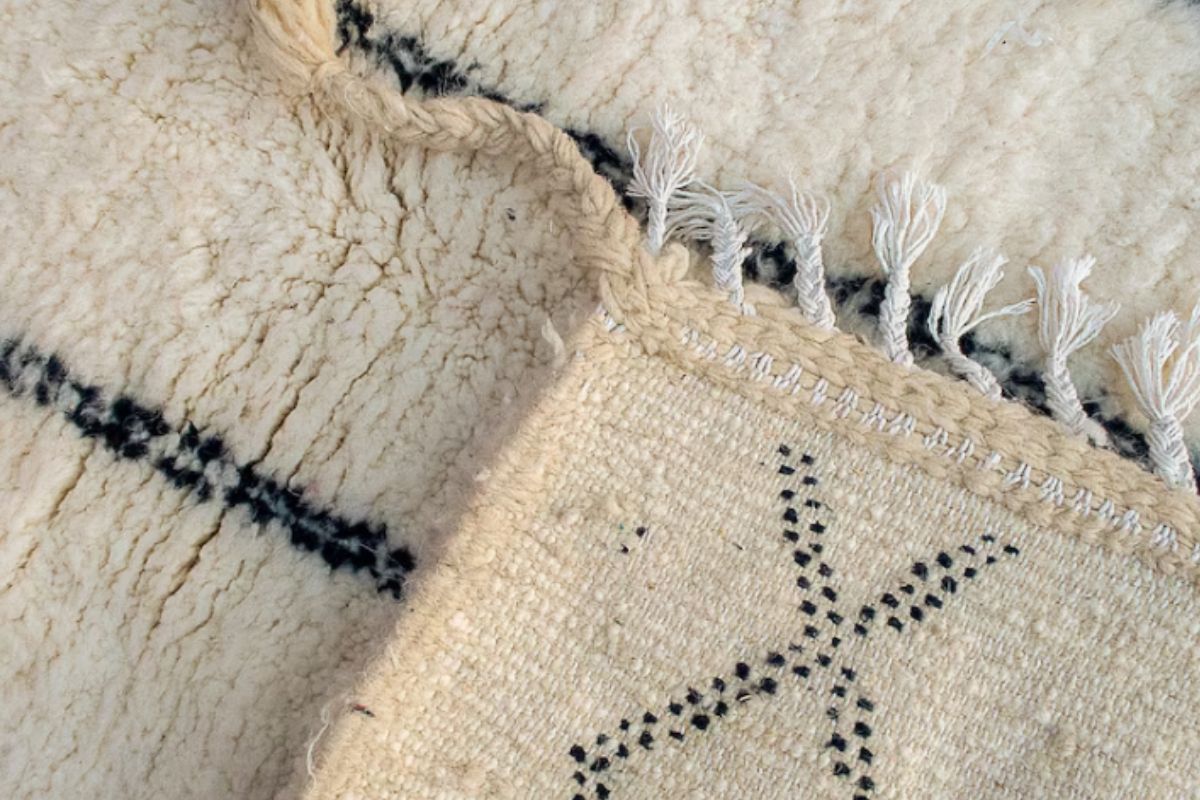
    Turn the rug over. A hand-knotted rug shows its pattern on the back in individual knots, with visible small irregularities in the rows, because a person tied every one of them. A machine-made rug shows a flat, uniform, almost printed-looking back, usually with a serged edge and a fringe attached as a separate stitched flap. A hand-tufted rug shows neither: it shows a canvas or scrim backing glued over the whole underside, hiding the structure entirely.

    That third category is the one that catches people. Hand-tufted rugs are genuinely made by hand, sold at prices close to hand-knotted, and are a different product with a different lifespan. What the back of the rug shows walks through each of the three.

    Question three: was it made in Morocco?

    This is mostly a paperwork question, and it is weaker than sellers present it.

    A label saying "Made in Morocco" is a claim printed by whoever printed the label. Several seller pages found in this research treat the label as decisive, and one asserts that rugs certified by the Moroccan government must be handmade, knotted and one hundred percent sheep's wool. That page names no certification scheme, no issuing authority and no document, and this guide could not verify it. Treat it as a seller's claim rather than a fact about Moroccan law.

    What is more useful than a label is specificity. A seller who can name the region, the town or the cooperative, and who answers follow-up questions consistently, is telling you something. A seller whose provenance story is a general appeal to tribal tradition is telling you very little. Named cooperatives with public accounts of their work do exist, and Taznakht rugs and the cooperatives behind the name is an example of what documented provenance actually looks like.

    Question four: is it as old, and as tribal, as the listing says?

    This is where the money is and where the evidence runs out.

    Age cannot be read off a rug by eye. Fading, softness, and wear all look like time, and all of them can be produced deliberately in weeks. The processes are documented by the Anou Cooperative, a weaver-owned organization in Morocco, which described in a post of 14 December 2020 how new rugs are covered in dirt and walked on, laid in the sun, washed in a one-to-one water and bleach solution, and in some cases blow torched to force color fading. Their summary of the market was blunt: "Moroccan vintage rugs don't really exist." How new rugs are made to look old covers that account in detail.

    Tribal attribution has a related problem. Style names in this trade describe recognizable weaving conventions from real places, but a confident claim that one specific rug was woven by one specific group, at one specific time, is normally an inference from the rug's appearance rather than a documented fact about its history. When a seller states it as certainty, that certainty is theirs, not the evidence's.

    So the honest position: a seller can prove very little about age or origin, and the fact that they sound sure is not evidence.

    What a certificate of authenticity is worth

    It is worth exactly the reputation of whoever signed it, and no more. There is no independent registry of Moroccan rugs, no serial numbering, and no third-party body that verifies a shop's claim about a piece it is selling.

    A certificate issued by the seller certifies that the seller says so. That is not worthless, because a written claim is easier to act on than a verbal one if the rug turns out to be misdescribed, but it is not verification. Read it as a warranty rather than as evidence, and check what it actually commits the seller to.

    What this site cannot do, and who can

    Atlas Rug Guide does not authenticate individual rugs. It cannot, and it will not try. This site has handled none of the pieces it writes about, and a photograph cannot carry the information the question needs. Anybody offering to authenticate your rug from an image is selling you confidence rather than a finding.

    For a specific object there are people who can help, and the useful ones have no stake in the sale: an independent appraiser, a textile conservator, a museum textile department for a genuinely old piece, or a rug-cleaning professional who does not deal in rugs. If you are still working out what style you are looking at rather than whether it is genuine, start with how to identify a Moroccan rug from a photo or the complete guide to Moroccan rug styles, and see how to buy a Moroccan rug without getting taken for the wider set of risks.

    FAQ

    Can you tell me if my rug is authentic from a photo?
    No. This site does not authenticate individual rugs and no photograph carries enough information to do it. For a specific piece, use an independent appraiser or a textile conservator who does not sell rugs.

    Does a "Made in Morocco" label prove a rug is authentic?
    It proves a label was printed. It is worth more when the seller can also name a region, town or cooperative and answer follow-up questions consistently.

    What is the most reliable check I can do myself?
    Look at the back. Hand-knotted shows individual knots and small irregularities, machine-made looks uniform with a stitched-on fringe, and hand-tufted has a glued canvas backing covering the structure.

    Is a certificate of authenticity meaningful?
    It is a written claim by the seller, not independent verification. There is no third-party registry for Moroccan rugs. Treat it as a warranty and read what it commits them to.

    Can anyone prove how old a Moroccan rug is?
    Rarely, and not by eye. Fading and wear can be produced deliberately in weeks, and the processes are documented. Age claims in this market should be treated as claims unless there is real provenance behind them.
  • Handmade vs Machine-Made Rug: Read the Back

    Handmade vs Machine-Made Rug: Read the Back

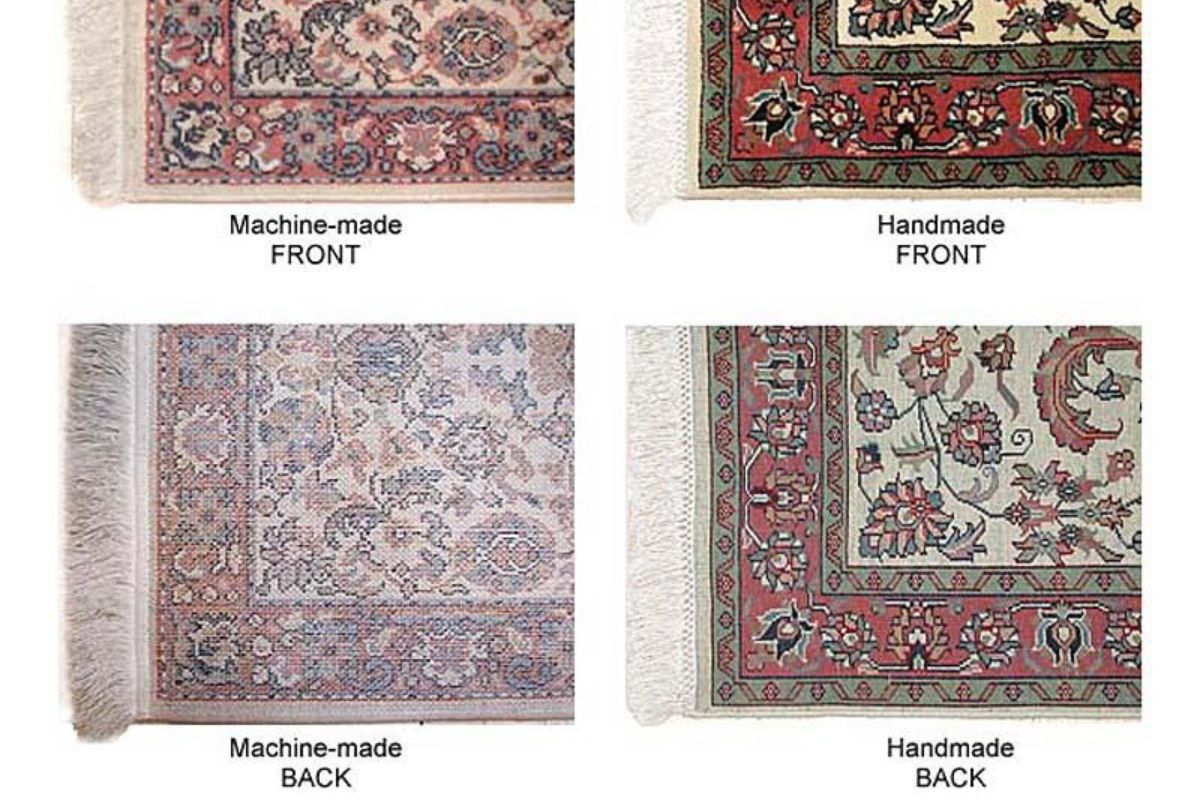
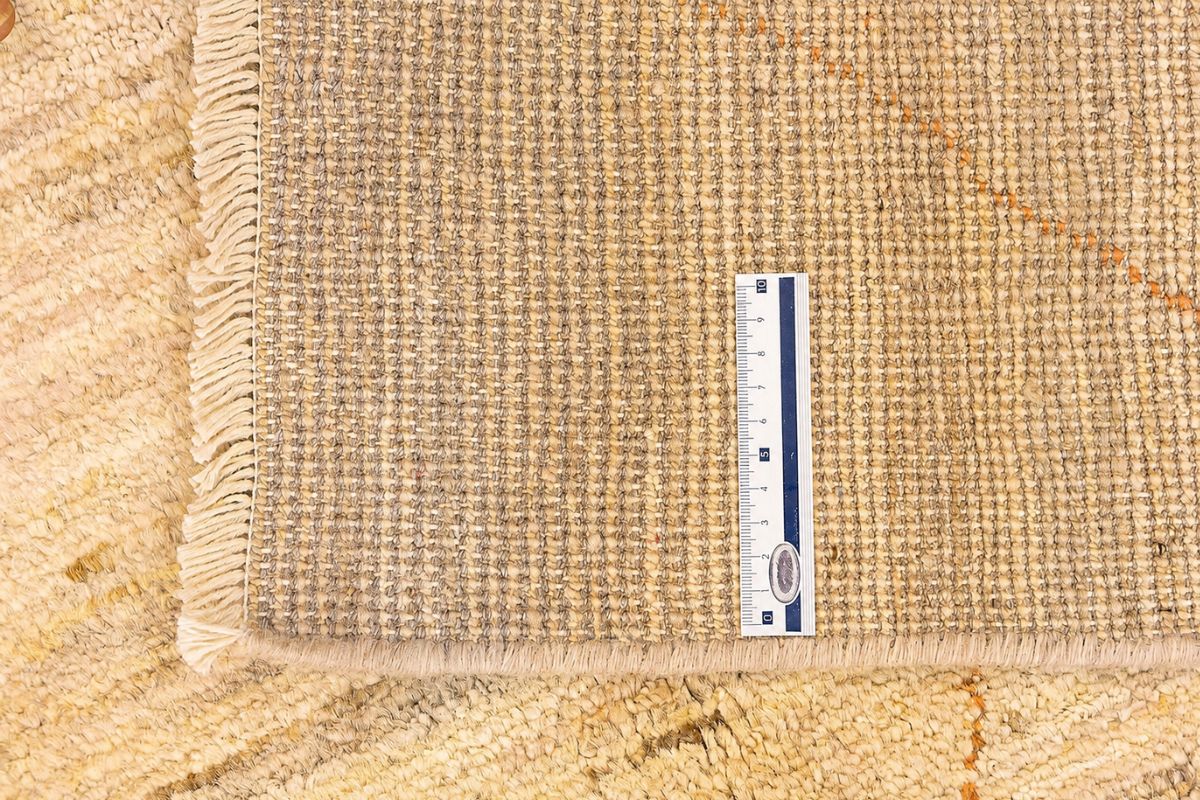
    Turn the rug over and you are looking for one thing: whether you can see the structure. A hand-knotted rug shows its pattern on the back in individual tied knots with small irregularities in the rows. A machine-made rug shows a flat, uniform, printed-looking back, usually with a serged edge and a fringe stitched on as a separate flap. A hand-tufted rug shows neither, because a glued canvas backing covers the underside completely. Three categories, not two, and the third is the one most buyers have never heard of.

    Why this is the one check worth learning

    Almost every question about a Moroccan rug ends in somebody's word against nobody's evidence. Age, tribe, region, wool grade: all of them depend on a seller's claim or on an inference from appearance.

    Construction is different. It is a physical fact about the object, it is visible, and it does not require trusting the person selling it. That makes it the highest-value check a buyer can learn, and it takes about ten seconds once you know what you are looking at.

    It is also the check with the clearest financial consequence. The gap between a hand-knotted rug and a hand-tufted one is substantial, both in what it cost to make and in how long it will last, and the two are routinely sold in the same shops to the same buyers.

    Hand-knotted: the structure is the rug

    In a hand-knotted rug, the pile is tied onto the warp threads knot by knot. There is no adhesive anywhere. The knots are the thing holding the rug together, which is why the back of a hand-knotted rug is a legible object rather than a covering.

    What you should see: the design repeated on the back, slightly softer and less crisp than on the front, made up of individual points of color. Look closely and each of those points is a knot. Look along a row and you will see it wander a little, because the rows were tied by a person over weeks or months and no person is a machine.

    That irregularity is the signal. Not damage, not sloppiness, just the evidence of hand work. In Moroccan pile rugs the knotting is often relatively open and the pile relatively high, which can make the back look sparse compared with a fine Persian weave. That is normal for the category and not a defect. What KPSI does and does not tell you explains why density means something different here.

    Hand-tufted: the category most buyers do not know exists

    A hand-tufted rug is made by punching yarn through a fabric backing with a tufting gun. It is hand work, genuinely, and it is skilled. But the loops are not knotted to anything. They are held in place by a layer of latex adhesive spread across the back, and then a second canvas or scrim backing is glued over that to hide it.

    So when you turn a hand-tufted rug over, you do not see the design at all. You see plain cloth. That is the tell, and it is unmistakable once you know to look for it.

    Two consequences worth knowing. First, the adhesive has a working life, and when it degrades the rug sheds and the backing can separate, which is not something a hand-knotted rug does. Second, that adhesive is why some new rugs smell strongly of rubber or glue. If a rug you were told was hand-knotted arrives smelling of chemicals, the smell itself is telling you something about the construction, which why a new rug smells of chemicals goes into.

    Machine-made: uniformity is the tell

    A power loom produces a back that looks manufactured, because it is. The pattern is there, but it is perfectly regular. The rows do not wander. The color changes are exact. There is often a visible grid or a stiff, tight weave structure, and the edges are usually serged, meaning wrapped in yarn by a machine rather than finished by hand.

    The other reliable sign is the underside feel: machine-made backs are frequently stiffer and flatter, sometimes with a light backing applied for stability.

    None of this makes a machine-made rug a bad object. It is a legitimate product with an honest use, and if a consistent size, a lower price, or a rug you are not afraid of matters more to you than hand work, it is a sensible purchase. The problem is only when it is sold as something else. This site covers hand-knotted and handwoven traditions, so a machine-made "Moroccan-style" rug is a design reference rather than a piece from those traditions.

    The fringe test, and where it fails

    The most repeated advice on this topic is to check the fringe: on a hand-knotted rug the fringe is the warp threads of the foundation, emerging from the body of the rug, while on a machine-made rug it is sewn on afterward.

    That is broadly true and it is a useful first look. Tug gently at a few strands. Fringe that is part of the structure resists as part of the whole rug. Fringe stitched onto a flap of backing moves as a separate piece, and you can often see the seam where it is attached.

    But it fails in three ways. Fringes get worn and replaced, so a genuine old rug can end up with a sewn-on replacement fringe. Some hand-knotted rugs are finished with the warps turned under rather than left as fringe. And many Moroccan flatweaves finish differently again, with braided or knotted ends that are part of the weaving but do not look like classic Persian fringe. Flatweave or pile: which Moroccan style suits your room covers those construction differences.

    So use the fringe as a hint and the back as the answer.

    What this check settles, and what it does not

    It settles construction. That is a real thing to have settled, and it is the fact most directly tied to what the rug cost to make and how long it will last.

    It does not tell you where the rug was made, how old it is, whether the wool is good, whether the dyes are natural, or whether the piece was chemically treated to look aged. A rug can be unambiguously hand-knotted and still be six months old and sold as vintage. Those questions are covered in is my Moroccan rug authentic and in the wider guide to buying a Moroccan rug.

    One practical note for buying online: ask for a photograph of the back. A seller with a hand-knotted rug has no reason to refuse, and a listing with twelve styled photographs and none of the underside is worth a question.

    FAQ

    What is the difference between hand-knotted and hand-tufted?
    Hand-knotted pile is tied onto the foundation knot by knot and needs no adhesive. Hand-tufted pile is punched through a backing and held in place with latex glue, then covered with a second backing. The back tells you which: knots and pattern for one, plain glued cloth for the other.

    Is a hand-tufted rug a fake?
    No. It is a genuine handmade product, just a different and less durable one than hand-knotted, with a different cost of production. The problem is when it is described or priced as hand-knotted.

    Why does the back of my Moroccan rug look sparse compared to a Persian rug?
    Moroccan pile rugs are often more openly knotted with a higher pile, and their designs are geometric rather than finely curvilinear. Lower knot density is normal for the category rather than a sign of poor quality.

    Can I check the fringe instead of the back?
    Use it as a first hint. Fringes get replaced, some hand-knotted rugs have no fringe at all, and Moroccan flatweaves finish their ends differently. The back is the reliable answer.

    Does this check tell me if my rug is old?
    No. Construction and age are separate questions, and nothing about the back reveals when the rug was made.

  • Knots Per Square Inch: What KPSI Really Tells You

    Knots Per Square Inch: What KPSI Really Tells You

    Knots per square inch measures one thing honestly: how fine a pattern a weave is capable of resolving. It is a real and useful metric in the tradition it comes from, where detailed curvilinear designs need a dense weave to render a curve without it turning into a staircase. It does not measure quality, it does not measure durability, and on Moroccan pile rugs, which are geometric, sparse and often deliberately open, it is close to the wrong question. This guide publishes no KPSI figure of its own for any Moroccan style, for reasons set out below.

    What the metric counts

    KPSI applies only to hand-knotted rugs. You count the knots along one inch horizontally, count the knots along one inch vertically, and multiply. A weave with ten knots across and twelve down is 120 KPSI.

    You count on the back, where the knots are visible, and on a genuine hand-knotted piece the count varies slightly from place to place because a person tied them. That variation is normal. A single measured square inch is a sample, not a specification, and where a rug is quoted at an exact figure, someone has usually rounded a range into a number that sounds like a fact.

    The convention is well documented and not controversial. It appears in the general reference literature on knot density and in the explainers published by rug dealers and manufacturers.

    What it genuinely predicts: design resolution

    Think of it as the weave's resolution. Every knot is one point of color, so the number of knots per inch sets how much detail can exist in that inch.

    This matters enormously for a certain kind of rug. Fine floral and curvilinear Persian and Oriental designs, with tendrils, arabesques and shaded medallions, need a high knot count to render those curves smoothly. At a low density the same design would come out blocky. That is the real reason high-KPSI weaving is prized in those traditions: not because the rug lasts longer, but because it can carry designs a coarser weave cannot.

    It is also a straightforward proxy for labor. More knots per inch means more knots in total, which means more weeks at the loom, which is a legitimate part of what a fine Persian rug costs.

    What it does not predict

    Three things, and the dealer explainers largely agree on this, which is worth noticing.

    Quality. A higher figure does not make a better rug and a lower figure does not make a worse one. Several dealer and manufacturer guides state this outright, including explainers published by Jaipur Rugs, TSAR Carpets and Sharafi & Co. When even the trade says the metric is misunderstood, a seller pushing a number at you is departing from their own trade's guidance.

    Durability. This is the most common misconception. Knot density enables elaborate design rather than adding strength, a point made explicitly in Landry & Arcari's guidance on knots and density. What actually governs how a rug wears is the quality of the wool, the tightness and evenness of the weave overall, the pile height, and how the rug is used and cared for.

    Wool quality or worth. A densely knotted rug in poor, brittle wool is a poor rug. Fiber quality and knot count are independent variables, and the one that matters more day to day is the wool.

    Why it barely applies to Moroccan rugs

    Here is the category error, and it is the reason this page exists.

    Moroccan pile rugs are geometric. Their design vocabulary is diamonds, lozenges, lines, crosses and open fields, and much of the visual character comes from the pile itself: high, loose, shaggy, with the wool doing the work rather than the pattern resolution. Beni Ourain in particular is defined by an open, high pile and sparse line work. Applying a fineness metric to that is like judging a wool blanket by thread count.

    The dealer literature actually concedes the principle. The point that knot density is crucial for detailed curvilinear floral patterns and much less important for geometric tribal designs appears in the trade's own explainers. Moroccan rugs are the textbook case of the second category.

    When this site searched specifically for KPSI figures or benchmark ranges for Moroccan and Beni Ourain rugs in August 2026, page one returned seller collection pages and no figures at all. There is no established Moroccan KPSI benchmark to shop against, which is a useful thing to know before somebody quotes you one.

    The one Moroccan knot-count claim in circulation

    There is an exception, and it is instructive.

    One specific pair of numbers does circulate: a knot count for Beni Ourain and a higher one for Beni Mrirt, used across seller pages to explain why Beni Mrirt costs more. This guide went looking for the source of that figure and found the same numbers repeated across four competing sellers' websites, phrased differently and landing in the same range, with no citation behind any of them. No lab measurement, no named researcher, no cooperative source. Repetition across competitors looks like corroboration and is not.

    The full working is in what the Beni Ourain and Beni Mrirt knot-count claims actually rest on, which also sets out what genuinely does differ between the two, because plenty does. The underlying idea that a denser weave takes more wool and more labor is entirely reasonable. Treating an uncited number as a specification is not.

    How to use the number if a seller quotes one

    • Ask how it was measured, and over what area. A real answer describes counting on the back and a range. An exact figure with no method behind it is marketing.
    • Ask what they think it tells you. If the answer is "it means better quality," they have said something the trade's own explainers contradict.
    • Judge the wool instead. Feel it. Springy, slightly greasy with lanolin, resilient under pressure. That tells you more about how the rug will live than any density figure.
    • Judge the weave for evenness, not fineness. Consistent tension and a rug that lies flat matter more than knots per inch.
    • Do not pay a premium for a number nobody will source. If the density claim is doing the work of justifying the price, ask what else justifies it.

    For the checks that do settle something, see what the back of the rug shows and is my Moroccan rug authentic. For the wider set of buying risks, how to buy a Moroccan rug without getting taken, and for the style itself, the Beni Ourain rug guide.

    FAQ

    What is a good KPSI for a Moroccan rug?
    There is no established benchmark, and this guide publishes no figure. Moroccan pile rugs are geometric and often deliberately openly knotted, so knot density is not the metric that describes them well.

    Does a higher knot count mean a better rug?
    No. Dealer and manufacturer explainers state this themselves. Higher density allows finer pattern detail and reflects more labor, but wool quality, weave evenness and construction matter more for how a rug performs.

    Does KPSI affect how long a rug lasts?
    Not directly. Knot density enables elaborate design rather than adding durability. Wool quality, overall weave tightness, pile height and use are what govern wear.

    How is KPSI measured?
    Count knots across one inch and down one inch on the back of the rug, then multiply. On a hand-knotted piece the count varies from place to place, so a single exact figure is a sample rather than a specification.

    Why do sellers quote knot counts for Beni Ourain and Beni Mrirt rugs?
    Because a specific pair of figures circulates widely across seller sites. This guide looked for the original source of those numbers and could not find one cited anywhere, which is covered in detail on the Beni Ourain versus Beni Mrirt page.

  • Buying a Moroccan Rug Online: What the Photos Hide

    Buying a Moroccan Rug Online: What the Photos Hide

    Everything this site recommends checking on a rug requires you to be standing next to it. Look at the back, feel the wool, smell it, and see the colour in your own light: those four checks answer most of the questions worth asking, and buying online removes all four at once. Two have workable substitutes you can request from a seller. Two do not. Knowing which is which, before you pay, is the difference between a considered remote purchase and a hopeful one.

    Start from what you have lost, not what you can gain

    Retailer guidance on buying rugs online is written from the opposite direction: here is how to choose well, here is how to picture it in your room. That is useful as far as it goes and it skips the part that matters.

    The honest framing is subtractive. A rug is a physical object whose important properties are tactile, and a photograph is a flat image made by someone with an interest in how it looks. Everything below is organised around a specific loss and what, if anything, closes it.

    None of this means buying online is a bad idea. Most people buying a Moroccan rug will never stand in a Moroccan souk, and remote sellers include serious ones. It means the checks have to be replaced deliberately rather than skipped quietly.

    Loss one: the back of the rug

    This is the biggest single loss, because the back is the one check that does not require trusting anybody. It tells you whether a rug is hand-knotted, hand-tufted or machine-made, and those are three products with very different costs and lifespans. What the back of the rug shows covers exactly what to look for.

    The substitute exists and it is simple: ask for a photograph of the back. Ideally a close one, in daylight, plus one of the corner folded over so you can see where the pile meets the foundation.

    A seller with a hand-knotted rug has no reason to refuse this, and it takes them a minute. A listing with twelve styled interior shots and nothing of the underside is worth a question, and an evasive answer to that question is itself an answer. This single request eliminates the most expensive misunderstanding available in this category.

    Loss two: the wool in your hand

    Whether the pile springs back, whether it has lanolin left in it, whether it feels dry and chalky: none of this survives a photograph, and it is the property that most determines how the rug lives with you. Judging wool quality without a lab covers what your hand would have told you.

    There is no real substitute, and this guide will not pretend otherwise. What partially helps is asking directly and specifically: is the wool hand-spun or machine-spun, and has the rug been chemically washed and how. Those are answerable questions, and a seller who answers them precisely is telling you something about themselves as well as about the rug.

    A returns policy that genuinely lets you feel the rug at home and send it back is the only complete answer to this one. That makes the returns terms a more important part of an online rug purchase than most buyers treat them as.

    Loss three: colour, and what screens do to it

    Rug colour photographs badly and the failures run in both directions. Screens vary, white balance shifts with the light the photograph was taken in, editing raises saturation, and a rug shot in bright Moroccan daylight will not look the same in a north-facing room in winter.

    Partial substitute: ask for a short video taken in daylight, moving around the rug, with no filter. Motion and changing angles give you far more colour and texture information than any still. Ask for one photograph taken indoors under ordinary lighting as well.

    What cannot be fixed remotely is how the colour will sit against your own floor and walls in your own light. Buy assuming some drift, and be more cautious with a rug whose appeal is a very specific shade. Where the Moroccan rug palette comes from covers what the colours actually are.

    Loss four: smell, which is a construction signal

    You cannot smell a listing, and smell carries real information. A strong rubber or glue odour indicates latex backing adhesive, which means a tufted or machine-made rug rather than a hand-knotted one. A bleach or chlorine smell on a piece sold as vintage points to the chemical washing used to fade rugs artificially. Why a new rug smells of chemicals sorts out which is which.

    No substitute exists. The only mitigation is to ask the chemical-wash question directly and in writing before paying, so that if the rug arrives smelling of bleach you have something to point at.

    Size, and why a hand-woven measurement is not a chart entry

    A machine-made rug in a listed size is that size. A hand-knotted rug is whatever the loom produced, so descriptions get rounded and a piece sold as roughly six by nine may be neither.

    Ask for the actual measured dimensions of that specific piece, at both ends and both sides, because hand-woven rugs are frequently not perfectly rectangular. If it is going into a tight space, that difference decides whether it fits.

    What to establish in writing before you pay

    • The return window, who pays return shipping, and whether a large rug is even returnable. On a purchase you cannot inspect first, this is the most important term in the transaction.
    • Whether the rug has been chemically washed, and what the seller says was done to it.
    • Construction, stated plainly: hand-knotted, hand-tufted or machine-made. Then check it against the photograph of the back when it arrives.
    • Measured dimensions of that specific piece.
    • Any age, region or tribe claim, in writing rather than in conversation, so a misdescription is something you can act on.
    • What happens if it arrives damaged, and who insures it in transit.
    • What your payment method protects. Card protections vary by issuer and country, so check your own terms rather than assuming. Platform protections are covered in reading an Etsy or 1stDibs listing properly.

    This site sells nothing, carries no affiliate links, and recommends no seller or platform. For the wider set of failure modes see how to buy a Moroccan rug without getting taken, and if you are shopping for an unusual shape or a long narrow piece, Moroccan runners, rounds and odd shapes explains why exact sizes are harder to find than the listings suggest.

    FAQ

    Is it safe to buy a Moroccan rug online?
    It can be, provided you replace the checks you have lost. Ask for a photograph of the back, a daylight video, measured dimensions, and a clear returns policy, and get any age or construction claim in writing.

    What should I ask a seller before buying a rug online?
    Photograph of the back and the folded corner, hand-spun or machine-spun wool, whether the rug has been chemically washed, exact measured dimensions, construction type, and the full returns terms including who pays return shipping.

    Why does the rug look different from the photos?
    Screens vary, white balance shifts with the light a photograph was taken in, and editing often raises saturation. A daylight video with no filter gives a much more reliable impression than a styled still.

    Can I tell if a rug is hand-knotted from a listing photo?
    Only if the listing shows the back. A photograph of the underside is the single most useful thing to request, and it settles the question that costs the most money to get wrong.

    Does a returns policy matter more when buying a rug online?
    Yes. It is the only complete substitute for feeling the wool yourself, so treat it as a central term of the purchase rather than fine print.

  • How to Read an Etsy or 1stDibs Moroccan Rug Listing

    How to Read an Etsy or 1stDibs Moroccan Rug Listing

    A rug listing looks like a description and is mostly an argument. Read it by sorting every element into three buckets: verifiable (measured dimensions, a photograph of the back, the shop's stated policies, the platform's own rules), claims (age, "vintage," tribe, region, natural dyes, hand-spun wool), and decoration (the origin story, the word "authentic," the weaver narrative). Most of the words are in the third bucket. The one genuinely useful thing about buying on a platform is that some of the claims are made against rules the platform itself publishes.

    The title, and what its keywords are doing

    Listing titles in this category are written for search, not for you. A title like "Vintage Moroccan Berber Rug 5×8 Beni Ourain Style Handmade Wool Azilal" is a keyword string, and several of those terms are doing specific work.

    "Style" is the tell to watch for. "Beni Ourain style" is not a claim that the rug is a Beni Ourain. It is a claim that it resembles one, and it is legally and commercially quite different. The same applies to "Moroccan style," which frequently describes a design influence on a rug made elsewhere entirely.

    "Handmade" covers three products, as what the back of the rug shows sets out. A hand-tufted rug is genuinely handmade and is not hand-knotted.

    Stacked style names are a warning. A rug cannot be a Beni Ourain and an Azilal and a Boujad. When several appear in one title, they are there for search traffic, and the seller is not making a provenance claim they intend to stand behind. The complete guide to Moroccan rug styles covers what the names actually refer to.

    "Vintage" on a platform with a stated threshold

    This is the most useful lever in the whole listing and almost nobody uses it.

    Etsy's own published policy permits resale of vintage items that are over 20 years old, read on 2026-08-04. That means a seller listing in the vintage category is making a claim against a threshold the platform has set, not just using a marketing adjective. It is checkable, it is raisable with the seller, and if it turns out to be false it is raisable with the platform.

    Set that beside what the Anou Cooperative, a weaver-owned organization in Morocco, wrote on 14 December 2020: "Moroccan vintage rugs don't really exist" at the volume and prices the online market offers, because the faded appearance is manufactured rather than accumulated. How new rugs are made to look old covers the processes, and what "vintage" actually means covers the vocabulary.

    So the question to put to a seller is simple and specific: is this rug over twenty years old, and what is that based on? A confident, detailed answer is worth something. A vague one is worth knowing about. Platform policies change, so check the current version rather than relying on this page.

    Dimensions, and the hand-woven measurement problem

    Dimensions are in the verifiable bucket, but only if you ask properly.

    Hand-woven rugs are rarely perfectly rectangular and listing sizes are routinely rounded. Ask for the measured length and width at both ends and both sides of that specific piece. If it is going into a defined space, that is the difference between fitting and not. Moroccan runners, rounds and odd shapes covers why exact sizes are harder to source in genuine pieces than the listings imply.

    A listing that gives dimensions to the centimetre and describes the age as "circa 1970s" is telling you which of the two it actually measured.

    The photographs: what is missing matters more than what is there

    Go through the images asking what has not been shown.

    Is there a photograph of the back? If not, request one. This is the single most valuable image in a rug listing and the most commonly absent.

    Are the backgrounds consistent? Guidance on spotting resale and dropshipping notes that images from visibly different settings and sources suggest photographs gathered from elsewhere rather than taken of the item in hand.

    Is the rug shown flat and whole, in daylight? Heavily styled interior shots, tight crops and dramatic angles are all ways of showing a rug without showing it. Ask for a plain flat shot and a short unfiltered video.

    Are wear, repairs and stains shown? On a piece described as vintage, an absence of any condition photography is itself a condition report.

    The provenance paragraph, which is the least verifiable part

    This is the passage about the tribe, the mountain village, the weaver and what the diamonds mean. Read it as marketing copy, because that is what it is.

    A seller several steps down a chain that runs weaver, weekly market, middleman, processing, export cannot generally know who wove a rug or when. Symbolic readings assigned to motifs are interpretation rather than documented fact, and this site says so wherever the subject arises. Confident tribal attribution to a specific group, stated as certainty, is normally an inference from appearance.

    None of this makes the seller dishonest. Much of this copy is inherited from further up the chain and repeated in good faith. It just is not evidence, and it should not be carrying any part of the price. Is my Moroccan rug authentic covers what can actually be established.

    Shop signals, and what platform protection covers

    Volume against uniqueness. A shop offering hundreds of one-of-a-kind vintage pieces is describing a sourcing operation, not a personal collection. That is not disqualifying, and it is worth registering.

    Reviews. Clusters of similarly worded reviews posted close together are flagged in general marketplace guidance as a signal worth weighing rather than a verdict.

    Policies over promises. The returns window, who pays return shipping on a large heavy item, and how damage in transit is handled matter more than anything in the description. Buying a Moroccan rug online covers what to establish before paying.

    What platform protection actually covers. Marketplace protections are defined by the platform and are generally aimed at items not arriving or arriving materially not as described. They are not an authentication service and they do not adjudicate whether a rug is as old as claimed. Consumer law varies by country and no country's rules are universal, so check your own and your card issuer's terms rather than assuming coverage.

    This site sells nothing, carries no affiliate links, names no shop as trustworthy and recommends no platform. Platforms are named here only because the question is about them. For the whole set of failure modes see how to buy a Moroccan rug without getting taken.

    FAQ

    Are Moroccan rugs on Etsy authentic?
    Some are. The category also contains machine-made reproductions and new rugs treated to look old. The listing itself cannot settle it, but a photograph of the back settles the construction question, which is the most expensive one to get wrong.

    How old does a rug have to be to be listed as vintage on Etsy?
    Etsy's published policy permits vintage resale for items over 20 years old, read on 2026-08-04. Platform policies change, so check the current version. It makes "vintage" a claim against a stated threshold rather than a free-floating adjective.

    What does "Beni Ourain style" mean in a listing?
    That the rug resembles one, not that it is one. "Style" is a significant qualifier and is worth noticing wherever it appears in a title.

    What is the most useful question to ask an online rug seller?
    Ask for a clear photograph of the back and of a folded corner. It settles whether the rug is hand-knotted, hand-tufted or machine-made, which no amount of description will.

    Does buyer protection cover a rug that is not as old as claimed?
    Generally not in the way buyers hope. Marketplace protections are aimed at non-delivery and material misdescription, and they are not an authentication service. Check your platform's current terms and your card issuer's protections.