Tag: Taznakht

  • Moroccan Rug Weaver Pay: Middlemen and Weekly Markets

    Moroccan Rug Weaver Pay: Middlemen and Weekly Markets

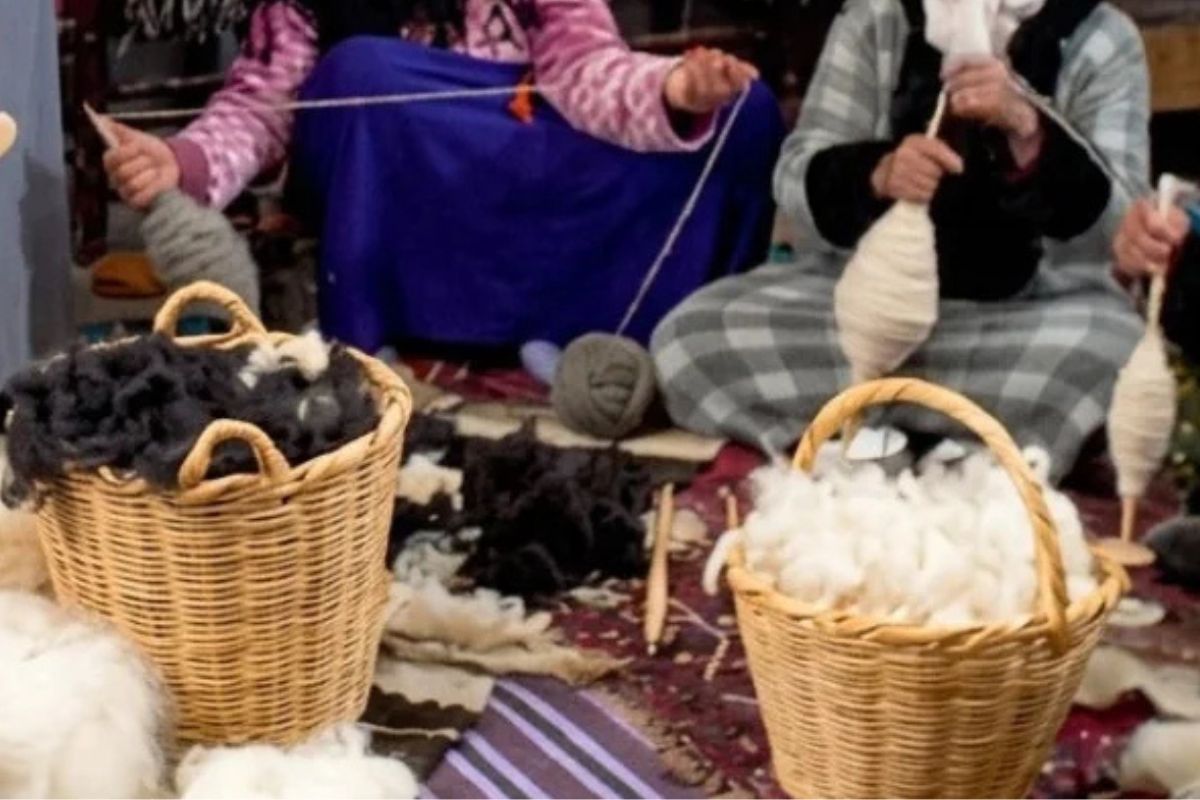
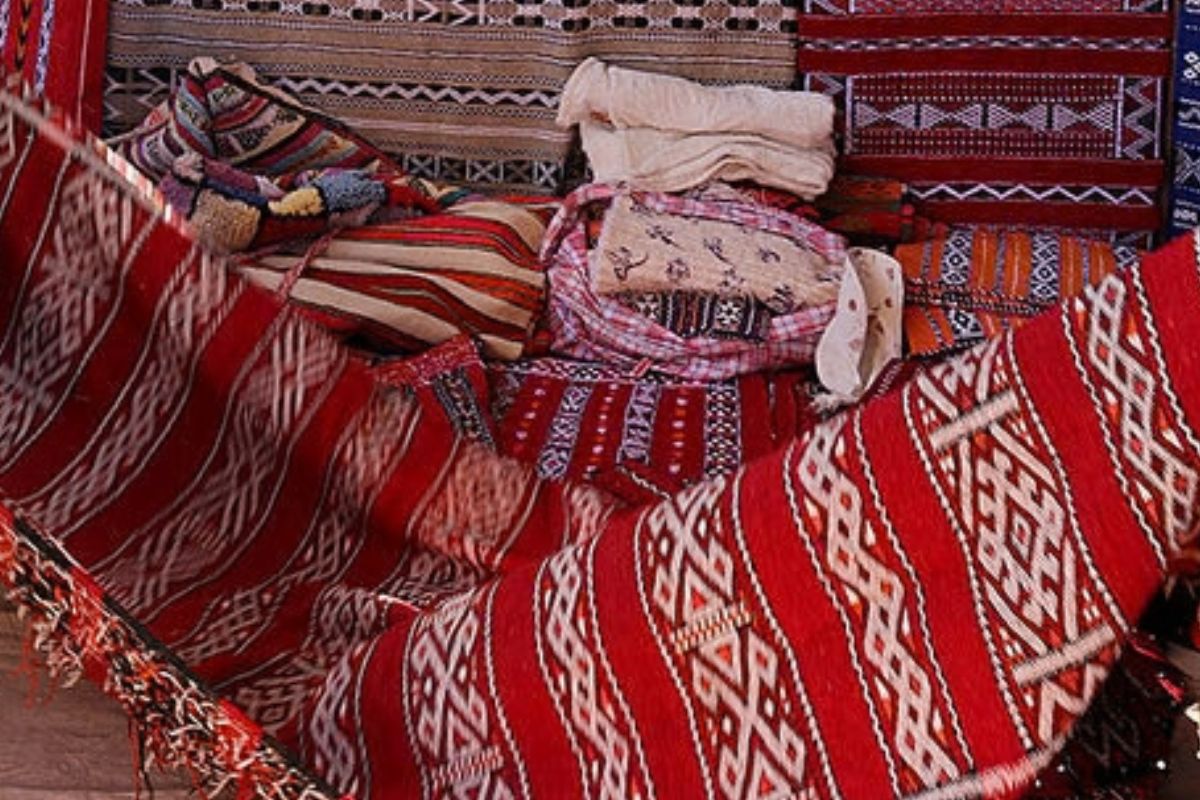
    There is no reliable wage figure for Moroccan rug weavers, but there are documented prices. AFP reported in December 2024 that at the weekly market serving Taznakht, a large rug sells for about 250 Moroccan dirhams, around 24 US dollars at the time, often to middlemen who set the price, and that the same rugs sell in Marrakech bazaars for up to ten times that. That is a sale price for several weeks of work, from one market at one date. It is not an hourly wage, and it is not a figure for the whole country.

    This guide sets out what has actually been reported about weaver pay, who the middlemen are (the answer surprises most people), why the gap between market and showroom is not all profit, and what a buyer can ask.

    What is documented, and by whom

    Every figure below is attributed to a named source with a date, read on 11 September 2026. Nothing here is an estimate by this site.

    What was reported Source Date
    A large rug sells for about 250 dirhams (around $24) at a weekly market, often to middlemen who set the price AFP, via Business Recorder 18 December 2024
    The same rugs sell in Marrakech bazaars for up to ten times the original price; others are listed online at up to $6,000 AFP, same report 18 December 2024
    A carpet takes two to four weeks to make, depending on size AFP, same report 18 December 2024
    Artisans making rugs later sold as "vintage" earn "as little as 5 dirham a day," less than 5% of minimum wage Anou Cooperative blog 14 December 2020
    Sabra textile artisans earning 10 dirhams a day where the minimum agricultural wage is 70 dirhams a day Anou Cooperative blog 5 March 2018
    At the Khemisset rug market, women sellers grade carpets, set a price and take a commission Christian Science Monitor October 2019

    Two cautions on reading that table. The 2018 Anou figure is about sabra, a different textile product, and is included only because it states the wage comparison explicitly. The 2020 Anou figure describes a specific part of the trade, rugs made to order and then processed to look old, not every weaver in Morocco.

    One more figure circulates in some coverage of this topic: that weavers receive around 4 percent of the final sale. This guide could not trace it to a source it could read, so it is not used here.

    Why 250 dirhams is not a wage

    It is tempting to divide 250 dirhams by three weeks and call the result a daily rate. The reporting does not support that arithmetic.

    The AFP figure is what one large rug sold for at one market. The report does not say whether the weaver bought her own wool, who did the spinning and dyeing, how many people worked on the rug, or how many hours a week went into it. Each of those changes what the sale price means as pay. What the figure does show is the order of magnitude a weaver can receive at that first sale, and who controls it.

    A weaver AFP spoke to put the control point plainly: "The intermediaries decide the price, and we have no choice but to accept it because this is our livelihood."

    Who the middlemen are

    Most readers picture the middleman as a man from the city. The documented picture is more varied, and it matters for understanding where the money goes.

    Many of them are women. Anou's December 2020 post states that "the vast majority of middlemen of rugs, are in fact women." They commission rugs, direct the designs, and handle processing and sale.

    Some sell on commission rather than buying outright. The Christian Science Monitor's 2019 report from Khemisset, a town about 60 miles east-southeast of Rabat below the Atlas Mountains, describes a Tuesday rug market where roughly 40 local saleswomen work with about 400 women from surrounding villages. Dealers arrive from Fez, Rabat and Marrakech. One seller, Fatima Rifiya, describes the model: they grade the carpets, explain the values to the weavers, and "set a price and our commission."

    Some buy outright and set the price. That is the arrangement AFP describes at Taznakht, where weavers bring rugs to a Thursday market and sell to intermediaries who decide what to pay.

    These are two genuinely different arrangements. A commission seller's income rises when the weaver's price rises. A buyer who purchases outright profits from buying low. Which arrangement a rug passed through is rarely stated on a listing, and it is one of the most useful things a buyer could know.

    Why the gap is not all profit

    Up to ten times between a weekly market and a Marrakech bazaar sounds like pure margin. Some of it is. Some of it is real cost.

    Between the market and a buyer's floor, a rug may be washed, repaired, stored, photographed, transported, exported, imported, insured and held in stock until it sells. Rugs that never sell have to be paid for by the ones that do. Why the same rug costs more in a showroom walks that chain step by step and separates the costs from the margin.

    One step deserves separate mention because it can multiply the price without adding anything the weaver is paid for. Anou describes new rugs being chemically washed, sun-bleached and sometimes torched to look old, then sold as vintage. The weaver was paid for a new rug. How new rugs are made to look old covers that process.

    What is changing it

    Both news reports describe interventions as well as the problem. AFP reported a new exhibition space in Taznakht that allows some weavers to sell directly to buyers, bypassing middlemen, and quoted Safia Imnoutres, who leads a local women's weaving cooperative. Africanews reported in July 2025 that the Women's Centre for the Promotion of the Taznakht Carpet, established in 2016, brings together 35 cooperatives and 3,500 women weavers. The Taznakht rug guide covers the rugs that come from that area.

    This site cannot measure from abroad whether those changes are raising what weavers earn, and no source it read reports that outcome in figures. What the reporting does establish is the mechanism: the less of the chain between the weaver and the buyer, the more of the price can reach the loom.

    What a buyer can actually ask

    A buyer cannot audit a supply chain. A buyer can ask questions whose answers are informative whichever way they go.

    • Who sold this rug first, and to whom? A seller who knows the cooperative or the weaver will say so. A seller who bought at a market may not know, and an honest one will tell you that.
    • Was the weaver paid a price, or a commission on the sale? This separates the Khemisset model from the Taznakht one.
    • Was the rug processed after it left the weaver? Washing and aging steps change the price without changing what she was paid.
    • What did the weaver receive? Few sellers will answer. The ones who can, specifically, are telling you something about their chain.

    In the souk itself, buying a rug in the Marrakech souk covers what to expect, and what actually drives a Moroccan rug's price covers why two similar rugs can be priced very differently. This site sells no rugs, carries no affiliate links and does not rank sellers.

    FAQ

    How much do Moroccan rug weavers get paid?
    There is no reliable wage figure. AFP reported in December 2024 that a large rug sold at the weekly market serving Taznakht for about 250 dirhams, roughly 24 US dollars, often to middlemen who set the price. That is one sale price at one market, not a wage.

    How much of the retail price reaches the weaver?
    No verified percentage exists that this site could read. AFP reported that rugs bought at the Taznakht market sell in Marrakech bazaars for up to ten times the market price. Part of that gap is real cost and part is margin.

    Who are the middlemen in the Moroccan rug trade?
    Often women. The Anou Cooperative wrote in December 2020 that the vast majority of rug middlemen are women. At Khemisset, the Christian Science Monitor described women sellers who grade rugs, set prices and take a commission.

    Does buying from a cooperative pay the weaver more?
    It shortens the chain, which is the documented mechanism for more of the price reaching the weaver. It does not guarantee a particular amount, and a seller who can say specifically what the weaver received is giving you more than one who only says "cooperative."
  • How Long to Weave a Moroccan Rug: Three Different Clocks

    How Long to Weave a Moroccan Rug: Three Different Clocks

    Weeks, usually, and sometimes months, but the published answers disagree because they measure different things. AFP reported in December 2024 that a single carpet takes two to four weeks depending on its size. Africanews reported in July 2025 that it takes several weeks or even months, depending on size and design complexity. Seller pages quote longer figures again, because a seller's lead time counts washing, drying and shipping as well as weaving.

    This guide sets out the figures that have actually been published, explains the three different clocks hiding inside the question, and says what the time on the loom does and does not tell a buyer. It does not publish a per-square-foot rate, because no source this site could read supports one.

    The published figures, side by side

    Every figure below is attributed to the party that published it and was read on 11 September 2026. The two news reports are independent journalism. The two seller figures are self-reported by businesses that sell rugs, and are included because they are the only published stage-by-stage breakdowns found, not because they are verified.

    Source Figure What it measures Date
    AFP, via Business Recorder Two to four weeks, depending on size Weaving a single carpet, Taznakht 18 December 2024
    Africanews Several weeks or even months Completing a single carpet, by size and design 2 July 2025
    Berber Creations (seller) 6 to 8 weeks for Beni Ourain, 10 to 14 weeks for Beni Mrirt Production lead time Undated page
    Atelier des Atlas (seller) 194 knot-hours of knotting; 12 weeks from order to delivery One custom Azilal commission, 280 x 180 cm, two weavers Undated page

    Read the columns, not just the numbers. The AFP and Africanews figures describe making a rug. The seller figures describe getting a rug to a customer. Those are not the same question, and treating them as the same is where most confusion about this topic comes from.

    The three clocks inside the question

    When someone asks how long to weave a Moroccan rug, they could mean any of three things.

    Clock one: hands-on hours

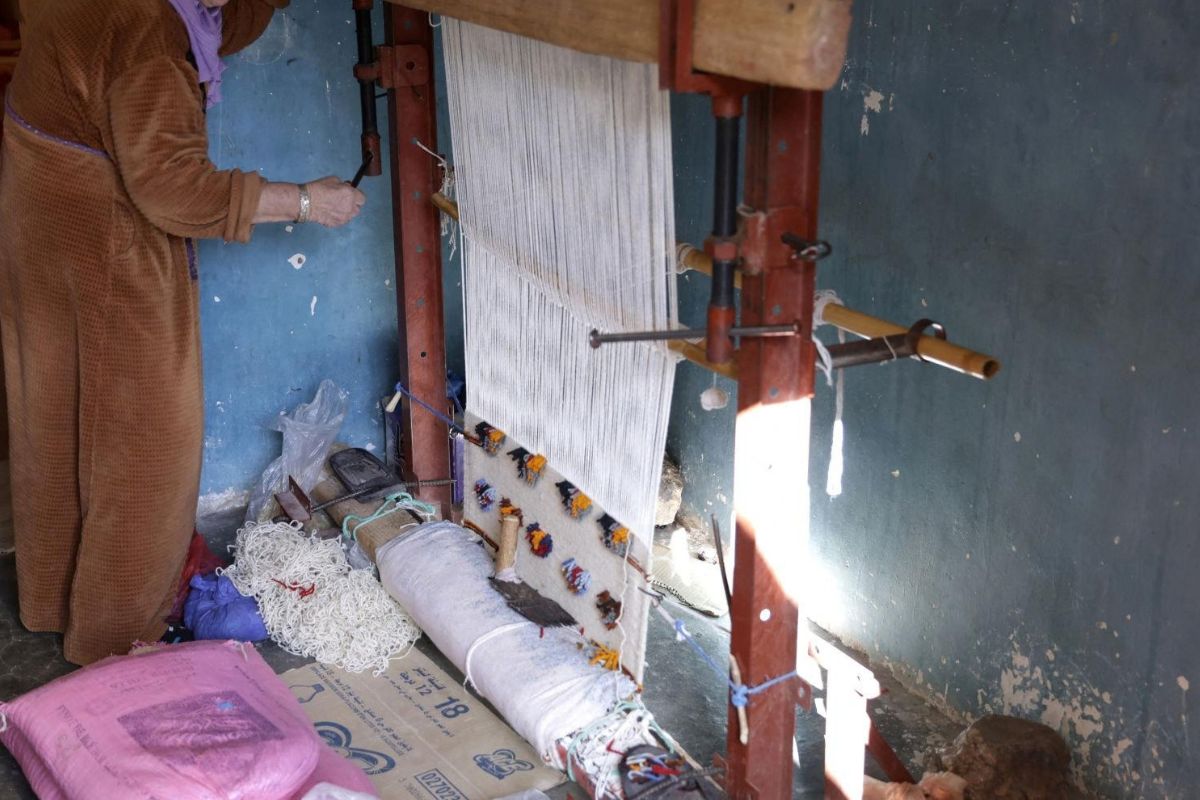
    This is the labor itself: warping the loom, tying knots or passing weft, beating each row down, finishing the ends. It is the number that matters most for thinking about the weaver's work, and it is almost never published.

    The one detailed breakdown found comes from Atelier des Atlas, describing a single commission. It lists about 15 hours of setup (shearing and scouring, warping 560 warp threads, dye preparation), 194 hours of knotting logged in five two-week blocks of 35 to 42 hours each, and about 24 hours of finishing, including securing the fringe, a sun-bleach and drench taking two days with 9 hours of net labor, and shearing the pile level. The seller reports about 50,300 knots in that rug.

    Treat that as one seller's account of one rug. It is useful because it shows the shape of the work, not because its totals apply to any other piece.

    Clock two: calendar time on the loom

    Hands-on hours are spread across real weeks. In the Atelier des Atlas account, two weavers alternated four-hour sessions, and the knotting still ran across ten weeks. A weaver is rarely at the loom for full days every day, and the calendar time depends on how many people share the loom and how many hours a week they can give it.

    This is why "two to four weeks" and "months" can both be accurate. A smaller rug with two weavers working steadily finishes in weeks. A large, dense piece worked by one person in the time she has available takes much longer.

    Clock three: order to door

    A seller's lead time adds everything after the last knot. Berber Creations lists the factors that extend its timelines: size, design complexity and knot density, custom dyeing with natural dyes, and weather, because winter conditions in the Atlas slow the drying of wool and finished rugs. Washing, drying, inspection and international shipping all sit on this clock, and none of it is weaving.

    When a seller quotes twelve weeks, that is a delivery estimate. It is not a claim that a weaver spent twelve weeks at the loom.

    What makes one rug take longer than another

    The factors below come up in every source that explains its figure, news and seller alike.

    Size. The most consistent factor. Both AFP and Africanews tie time to size first.

    Knot density and pile. More knots per square inch means more knots to tie in the same area. A dense Beni Mrirt is quoted by the same seller at roughly half as long again as a looser Beni Ourain, which fits the construction difference between the two. What knots per square inch really tells you covers why that measure is contested.

    Design complexity. Africanews names the complexity of the design alongside size. A plain field with a few lines is faster than a field packed with motifs that change color row by row.

    Wool and dye preparation. Hand-washed, hand-spun and plant-dyed yarn adds time before weaving starts. Whether that stage is counted at all varies by source.

    Number of weavers. Two people at one loom shorten the calendar, though not the total hours.

    What the time tells a buyer, and what it doesn't

    Time on the loom is part of why a hand-knotted rug costs what it does, and what actually drives a Moroccan rug's price covers it alongside wool, size and the chain of sellers. But the link between weaving time and what the weaver is paid is weak. AFP's same report describes a large rug that took weeks to make selling at a weekly market for about 250 dirhams, roughly 24 US dollars at the time. The time is real. It is not what sets her price.

    Weaving time is more useful as a plausibility check on a claim.

    • A custom order promised in days is either coming from existing stock or is not being hand-knotted to order. Either may be fine, but you should know which.
    • "Took a year to make" on a mid-size rug is a claim worth asking about. No source this site read supports a figure like that for an ordinary piece, though very large or unusually dense work could run long.
    • A lead time with no breakdown tells you nothing about the weaving. Ask how much of it is weaving and how much is washing, drying and shipping.

    These are all questions a good seller can answer, and they belong alongside the questions worth asking any rug seller.

    Why this guide does not publish a formula

    Some pages offer a rate: so many hours per square foot, or so many knots per day. This site does not, for three reasons. No independent source it could read publishes one. The figures that do exist come from single commissions described by sellers. And the variables above, especially density and how many hours a week a weaver can work, move the answer too much for one number to be honest.

    What can be said with confidence is the range the reporting supports: weeks for a typical rug, longer for large or dense pieces, and delivery lead times that are longer again because they measure more than weaving.

    FAQ

    How long does it take to weave a Moroccan rug?
    AFP reported in December 2024 that a single carpet takes two to four weeks depending on size. Africanews reported in July 2025 that it takes several weeks or even months, depending on size and design. Large or densely knotted pieces take longer.

    Why do sellers quote longer times than news reports?
    A seller's lead time usually counts washing, drying, finishing and shipping as well as weaving. News reports on Taznakht describe the weaving itself. They are measuring different things.

    Does a Beni Mrirt take longer to weave than a Beni Ourain?
    One seller quotes 6 to 8 weeks for a Beni Ourain and 10 to 14 weeks for a Beni Mrirt, citing the Beni Mrirt's higher knot density. That is a seller's lead time rather than an independent measurement, but the direction fits the construction difference.

    Does a longer weaving time mean the weaver was paid more?
    Not necessarily. AFP reported large rugs selling at a weekly market for about 250 dirhams, often to middlemen who set the price. Weaving time is real labor, but in that market it is not what sets the weaver's price.

  • Moroccan Rug Natural Dyes: What the Sources Actually Say

    Moroccan Rug Natural Dyes: What the Sources Actually Say

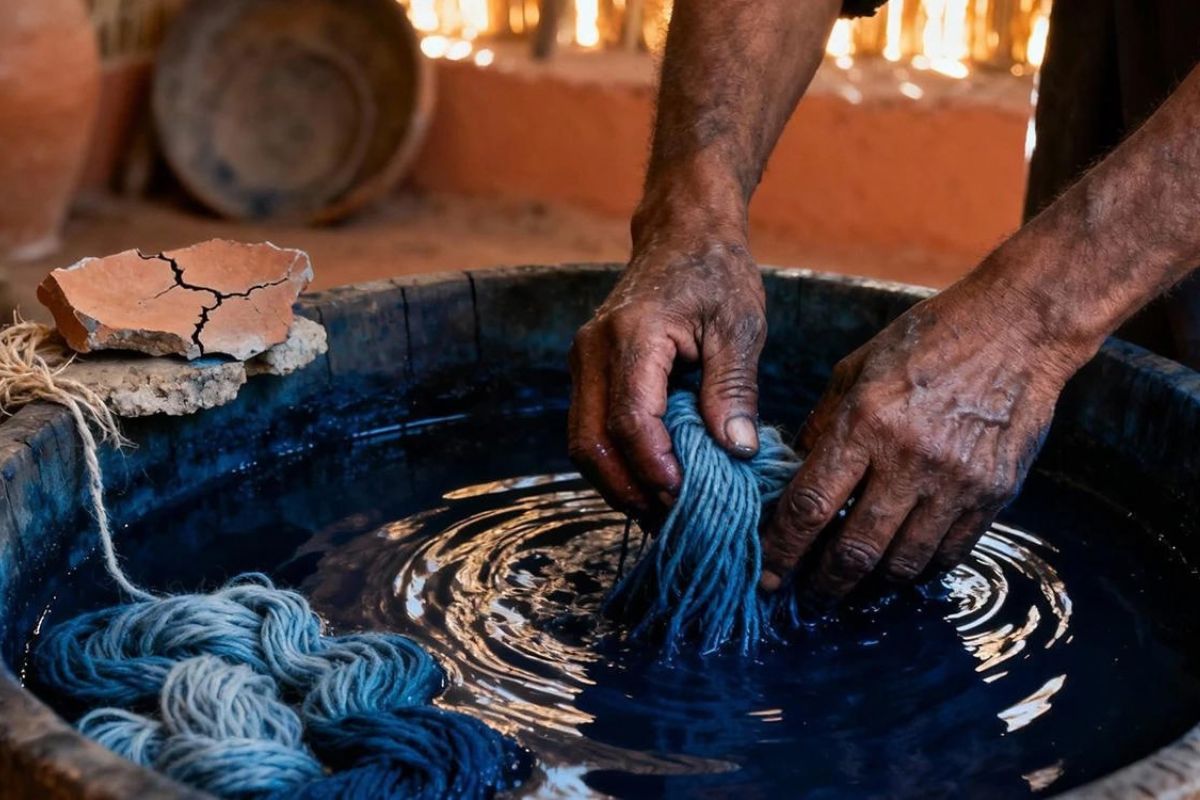
    Some Moroccan rugs are colored with plant dyes, and the plants are on record: Africanews reported in July 2025 that weavers at Taznakht dye their wool with henna, pomegranate peel, saffron and indigo leaves. AFP, reporting from the same town in December 2024, added that industrial dyes have replaced natural ones for most weavers because they are cheaper. So the honest answer to "are the colors really from plants?" is this: sometimes, in named places, and never safely assumed from a listing.

    This guide covers where those four plant names come from, what each is recorded as doing to wool, where claims about natural dye go further than the evidence, and what a buyer can actually establish.

    Where the four plant names come from

    The four names in this article's title were not assembled from seller pages. They come from specific reporting.

    Africanews, in a report dated 2 July 2025 and read on 11 September 2026, describes women in Taznakht who "wash the wool, spin it then dye with colours extracted from local plant materials such as henna, pomegranate peels, saffron or indigo leaves." The same report says the wool is collected from sheep in the region, including the Sirwa mountains.

    AFP's reporting of 18 December 2024, as carried by Business Recorder and read on the same date, names henna, pomegranate peels and indigo as natural pigments. Then it adds the sentence most seller pages leave out: industrial dyes have replaced natural ones for most weavers, because they are cheaper.

    The two reports do not contradict each other. Natural dyeing exists and is practiced, most visibly in cooperative settings. It is also not the norm. The Taznakht rug guide covers what the rugs from that area look like.

    What each plant is recorded as giving wool

    The table below separates what the reporting names from what general dyeing practice attributes. The color families are the ones this site sets out in its guide to where the Moroccan rug palette comes from. They describe what a dye material is generally used for. They say nothing about the dye in any particular rug.

    Plant Named in Color family generally attributed How firm this is
    Henna (Lawsonia inermis) Africanews 2025, AFP 2024 Reddish browns Chemistry documented in dye research (below)
    Indigo, from leaves Africanews 2025, AFP 2024 Blues Named twice; neither report names the plant species used
    Pomegranate peel Africanews 2025, AFP 2024 Yellows, golds, tans Named twice
    Saffron (Crocus sativus) Africanews 2025 only Yellows Named once; volume of use not reported anywhere this guide read

    Two things are missing from this table on purpose.

    Madder root appears on many seller pages as the source of Moroccan reds. It may well be used. It does not appear in either news report from Taznakht, and this guide found no non-commercial source today that documents it for a specific Moroccan weaving area, so it is left out rather than asserted.

    Symbolic meanings are also missing. One seller page in the results for this topic states that saffron yellow was "reserved for special pieces linked to fertility and fortune," with no source given. This site does not repeat claims like that as fact. Where a color or motif meaning is recorded by a named source, the site attributes it. Where it is not, the site says so.

    What the dye chemistry adds

    Most pages on Moroccan rug natural dyes stop at a list of plants. The chemistry matters, because it explains why "natural" does not guarantee how a color will behave.

    A review in Frontiers in Sustainability published on 18 August 2026 by Maha Hassain Eid Almsaudi and Luqman Jameel Rather, read on 11 September 2026, covers henna and saffron among four plant dyes for wool. Three points from it are useful here.

    Henna bonds with wool through a specific molecule. The review identifies lawsone as "the principal chromophore responsible for henna's coloring properties" and says it "readily forms coordination complexes with metallic mordants while simultaneously interacting strongly with amino acid residues present within wool keratin." Wool is a protein fiber, and henna is chemically suited to it.

    Saffron is scarce as a dye. The review notes that saffron dyeing "is constrained by limited pigment availability and high production costs," and cites approximately 85,000 flowers to produce 1 kg of fresh saffron. That does not mean saffron is never used on wool. It does mean a seller describing a whole stock of yellow rugs as saffron-dyed is making a claim worth asking about.

    The mordant often decides durability. The review states that "mordant selection remains particularly influential" for how durable a color is, and that metallic mordants "generally improve wash and light fastness." A mordant is the substance used to fix a dye to the fiber. Two rugs dyed with the same plant can behave very differently depending on how they were mordanted, which the word "natural" on a label does not tell you.

    The "natural dyes never bleed" claim

    The same Africanews report quotes Naima Akhraze saying that natural dyes "remain fixed onto the rug and do not bleed or mix with one another during washing." That is a real statement from someone working in the craft, and it may describe her cooperative's dyeing well. As a general rule it goes too far.

    Whether any dye bleeds depends on how the dyeing was done, what mordant was used, how thoroughly the yarn was rinsed, and what the rug is later exposed to. The Frontiers review's point about mordants is exactly this. This site's guides to why natural dyes can bleed too and to what a bleed test does and does not prove cover the practical side. The short version: bleeding does not prove a dye is synthetic, and not bleeding does not prove it is natural.

    The reverse problem is documented as well. The Anou Cooperative, a weaver-owned organization in Morocco, wrote on its blog on 14 December 2020, read on 11 September 2026, that the dyes available for purchase by artisans "are not of much quality" and "are not light fast." That is a statement about cheap purchased dye, and it is one reason some newer rugs fade quickly. Fading from light is a separate issue from bleeding in water, and the guide to rug fading in sunlight covers what can and cannot be undone.

    Where natural dyeing is being revived

    The documented revival is cooperative work, not a marketing category.

    Anou's post of 3 September 2021, read on 11 September 2026, describes Cooperative Lfarah developing rugs with "full exhaust dyes, sustainable mordants, and no chemicals," and washing techniques that cut water use by roughly half compared with standard middleman practice. Full exhaust means the dye bath is used up rather than discarded with color still in it. The same post contrasts this with conventional processing that pours harsh chemicals into rivers and streams.

    The Taznakht reporting points the same way. The Africanews piece presents plant dyeing as part of what the Women's Centre for the Promotion of the Taznakht Carpet does, while AFP's wider picture is that most weavers use industrial dye. Both can be true: natural dye survives where an organization makes it economically possible.

    What a buyer can and cannot establish

    There is no reliable way to confirm a plant dye by looking at a rug in a photograph, or at home. Museums and conservators identify dyes with laboratory analysis of fiber samples, which is not something a buyer can do at the point of sale.

    What a buyer can do is ask, and judge the answer.

    • Which dyes, specifically? "Natural dyes" is a category. "Henna and pomegranate peel, dyed by the cooperative" is an answer.
    • Who did the dyeing? Yarn dyed by the weaver or her cooperative is a different story from yarn bought already colored.
    • Is every rug in the shop natural-dyed? Given AFP's report that most weavers now use industrial dye, a seller claiming plant dye across an entire stock is claiming something unusual.
    • Does the price depend on the dye claim? If it does, the claim should come with detail.

    None of this makes synthetic dye a defect. Synthetic-dyed rugs can be well made, hand-knotted by the same weavers, and colorfast. The dye question is about what you are being sold, not about whether the rug is good.

    FAQ

    Do Moroccan rugs use natural dyes?
    Some do. Africanews reported in July 2025 that weavers at Taznakht use henna, pomegranate peel, saffron and indigo leaves. AFP reported in December 2024 that industrial dyes have replaced natural ones for most weavers because they are cheaper. A natural-dye claim on a specific rug should be asked about, not assumed.

    What colors do henna, indigo, pomegranate and saffron give wool?
    In general dyeing practice, henna gives reddish browns, indigo gives blues, and pomegranate peel and saffron give yellows and golds. The final shade depends on the plant material, the mordant and the dyeing process, so these are color families rather than exact results.

    Do natural dyes bleed?
    They can. How fast a color is depends heavily on the mordant and the process, as dye research on wool notes. Bleeding does not prove a dye is synthetic, and a rug that does not bleed has not been proven natural.

    Can I tell if my rug is natural-dyed by looking at it?
    No. Dye identification on textiles is done with laboratory analysis. At the point of sale, the useful evidence is a specific, detailed answer from the seller about which dyes were used and who did the dyeing.

  • Taznakht Cooperatives: 3,500 Weavers, One Weekly Market

    Taznakht Cooperatives: 3,500 Weavers, One Weekly Market

    Yes, there is an organized industry behind the rugs sold under the Taznakht name, and it is documented. Africanews reported on 2 July 2025 that the Women's Centre for the Promotion of the Taznakht Carpet, established in 2016, brings together 35 cooperatives and 3,500 women weavers, and can produce up to 300 carpets a month. AFP, reporting from the same town in December 2024, described weavers travelling to a weekly market to sell to middlemen who set the prices. Both facts belong in the same picture: a real institutional structure, and a market that still largely determines what a weaver is paid.

    Every figure on this page is attributed to a named source with a date. Where this guide could not source something, it says so instead of estimating.

    What the numbers are, and where each one comes from

    Figure Source Date
    35 cooperatives in the centre Africanews 2 July 2025
    3,500 women weavers Africanews 2 July 2025
    Up to 300 carpets a month Africanews 2 July 2025
    Centre established 2016 Africanews 2 July 2025
    Weekly market on Thursdays AFP 18 December 2024
    About 250 dirhams, roughly 24 dollars, for a large rug AFP 18 December 2024
    Carpets nearly 22 percent of Morocco's artisan exports in 2022 AFP 18 December 2024
    8,027 women's cooperatives nationally, 73,700+ members, end of 2025 Morocco World News 1 May 2026

    The two rug figures worth being careful with are the last two. The 22 percent export share is a national figure for all traditional carpets, not for Taznakht. The 8,027 women's cooperatives are across every sector of the Moroccan economy, from argan to agriculture, and are not a count of weaving cooperatives.

    What a Moroccan cooperative actually is

    A cooperative in Morocco is a registered legal entity, not a loose group of women who weave together. The governing statute is Law 112-12, published in the Bulletin Officiel on 18 December 2014 and running to 108 articles, which replaced the framework in force since 1983. It defines the permitted categories of cooperative activity, sets out governance obligations including general assemblies and accounts, and creates a public register of cooperatives.

    That is why cooperative membership is a slightly better signal than most things a seller can tell you. A cooperative is registered, named, and in principle traceable, which a middleman at a market is not. It is not, however, a guarantee about pay, and this guide has not read any Taznakht cooperative's accounts. Sources describing the internal role of Morocco's Office de Développement de la Coopération after the 2014 law differ, so this page states the law and stops there.

    The weekly market, and what it does to prices

    This is the part of the Taznakht story that seller pages do not carry. AFP reported that weavers travel every Thursday to a weekly market to sell their rugs, often to middlemen who set the prices, with a large rug going for an average of about 250 Moroccan dirhams, around 24 dollars at the time. The same report described those rugs going on to resell in Marrakech at up to ten times that, and appearing in online listings at up to 6,000 dollars.

    One caution on the day itself. AFP names a Thursday market; travel and tour operator sources describe Taznakht's main souk on a Saturday. This guide could not resolve that from a source it would rely on, and a reader planning a trip around a market day should confirm locally rather than trust either. What is not in dispute is the structure: a periodic rural market, buyers who set the price, and a very large gap between that price and the retail one. How a rug's price changes between the loom and the showroom covers that gap in full.

    What the centre is trying to change

    Both reports describe the same intervention rather than only the problem. Africanews and AFP each note a new exhibition space in Taznakht that lets some weavers sell directly to buyers, bypassing middlemen, and training in digital marketing intended to open independent sales channels. Africanews also describes the wider shift from home weaving into cooperative workshops as an attempt to give the work a steadier income and keep younger women in the profession.

    Whether that succeeds is not something this guide can assess from outside, and no page should tell you it has. What can be said is that the mechanism is real and named, and that buying through a channel where the seller is the cooperative rather than an intermediary is the version of this purchase where the most money reaches the loom. The practical form of that decision is covered in buying a Moroccan rug online, including what a cooperative-direct listing looks like and what it does not prove.

    The wool behind the name

    The materials side has independent corroboration, which is rare here. AFP described the Taznakht weavers using high-quality sheep wool from Jbel Sirwa, the volcanic massif southwest of Ouarzazate. The FAO's reference survey of North African sheep breeds, compiled for livestock specialists rather than for the rug trade, records the Siroua sheep of that same area as producing fine wool used for the "carpet of Tazenakht."

    An agricultural reference work and a news agency arriving independently at the same mountain is stronger evidence than a hundred seller pages repeating each other. On dyes, Africanews lists henna, pomegranate peel, saffron and indigo leaves in use at the centre, while AFP notes that industrial dyes now commonly replace natural ones. Both are current, and neither makes a plant-dye claim safe to assume from the town name alone, which is why natural dye versus synthetic dye matters more than a regional label.

    What a "Taznakht cooperative" label does not settle

    A cooperative name on a listing is a lead, not proof. It does not tell you which of the 35 cooperatives wove the piece, whether the seller bought it from the weaver or from a middleman at a market, when it was made, or whether it was washed or otherwise treated afterwards. None of that is visible in a photograph.

    The useful move is to ask, because on this style the information genuinely exists and a seller who has it will produce it. The questions worth asking a rug seller sets them out in order, and the Taznakht and Ouaouzguit style guide covers what the rugs themselves look like and where the tribal naming is and is not confirmed.

    FAQ

    How many weavers are in the Taznakht cooperatives?
    Africanews reported on 2 July 2025 that the Women's Centre for the Promotion of the Taznakht Carpet brings together 35 cooperatives and 3,500 women weavers. That is the figure this guide uses, attributed to that report, and it describes one organization rather than every weaver in the region.

    How much does a Taznakht weaver get for a rug?
    AFP reported in December 2024 that a large rug sold at the weekly market for an average of about 250 Moroccan dirhams, roughly 24 dollars, usually to middlemen who set the price. That is one figure from one market at one date, not a wage.

    What day is the Taznakht carpet market?
    AFP names a Thursday weekly market. Travel sources describe a Saturday souk in the town. This guide could not settle which applies now, so confirm locally rather than planning around either.

    Is a cooperative rug guaranteed to be fairly paid?
    No. A Moroccan cooperative is a registered legal entity under Law 112-12, which makes it traceable in a way a market middleman is not, but registration is not an audit of what members are paid, and this guide has read no cooperative's accounts.

    Can I buy directly from a Taznakht cooperative?
    Reporting from 2024 and 2025 describes a new exhibition space in the town for direct sales and digital marketing training aimed at independent selling. Whether a particular online listing is genuinely cooperative-direct is a question to put to the seller.