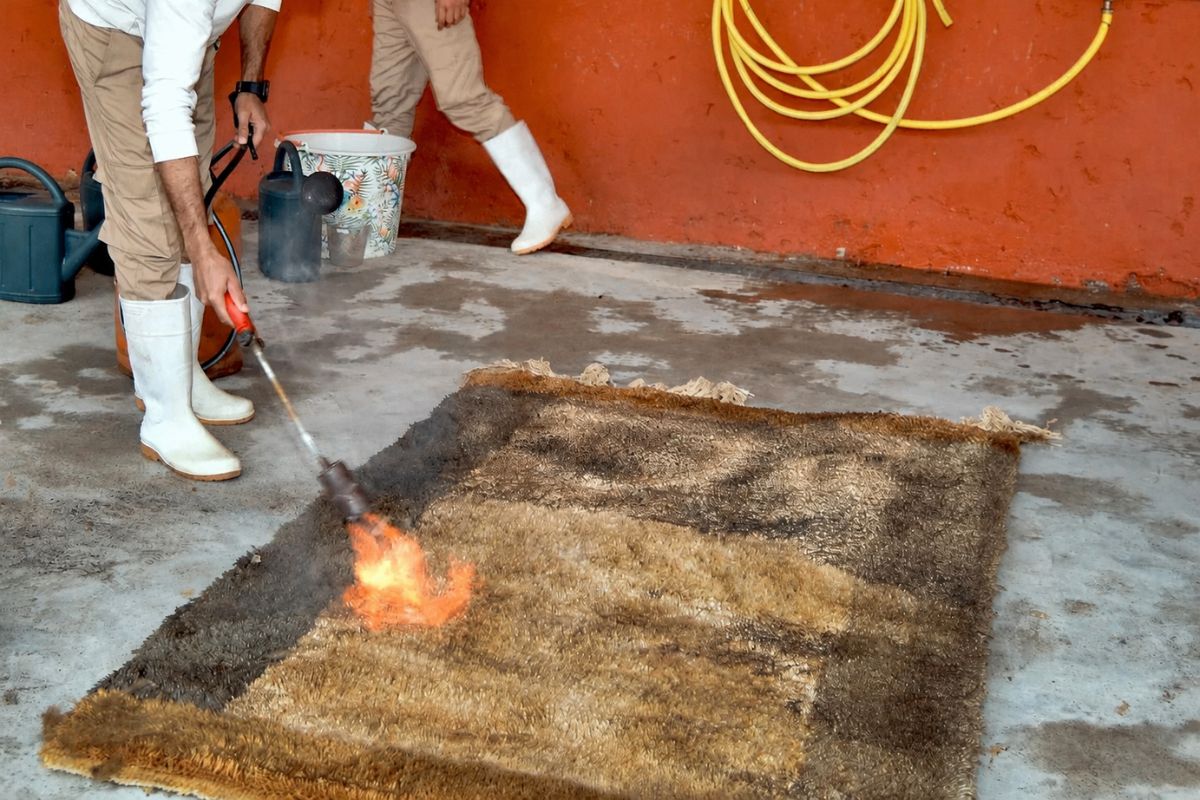
Most Moroccan rugs sold online as “vintage” are new rugs that have been treated to look old. The account below comes from the Anou Cooperative, a weaver-owned organization in Morocco, which described the process in a blog post of 14 December 2020: rugs covered in dirt and walked on, laid out in the sun, washed in a one-to-one water and bleach solution, sometimes treated with sulfur-heavy chemicals to shorten the process, and in some cases blow torched to burn out plastics and force color fading. Their summary was blunt: “Moroccan vintage rugs don’t really exist.”
Who says this, and why their account carries weight
This site went looking for independent reporting on artificial ageing in the Moroccan rug trade in August 2026. There is almost none. Page one for the question is the Anou Cooperative’s own blog, a travel listing for the cooperative, and one US rug dealer and cleaning firm whose description of bleach odor and heavy top-side fading corroborates the account from a trade perspective.
No newspaper covers it. No consumer body covers it. No rug seller’s blog covers it, which is not surprising, because most of them are selling the product in question.
Anou is a national service cooperative and part of a network of Amazigh (Berber) weaving and artisan cooperatives, where artisans sell directly rather than through intermediaries. They are not a neutral party: they have an interest in the alternative model they run, and they say so openly. What they are not is a seller of the rugs they are describing. In a market where every other source has inventory to move, an organization owned by the weavers themselves is the closest thing to an independent account that exists on this question.
The processes, in Anou’s own description
The 14 December 2020 post describes a supply chain in which middlemen, most of them women according to Anou, commission rugs from weavers and then process them for the online market. The techniques it names:
- Dirt and foot traffic. Weavers are instructed to cover the finished rug in dirt and walk over it.
- Sun exposure. The rug is laid out in the sun for an extended period to fade the color.
- Bleach washing. A one-to-one water to bleach solution, which Anou says takes something like 100 liters to fully soak a large wool rug, applied one to three times on average.
- Sulfur-heavy chemicals. Used to cut down processing time, with a toxicity Anou describes as not well understood.
- Blowtorching. Rugs “literally blow torched to burn out plastics” and to promote color fading.
Anou names Khenifra, Kenitra and Taznakht as production hubs for this, and Instagram and Etsy as the sales channels. Their follow-up post of 3 September 2021 adds that chemicals used in this kind of washing “have been banned by US rug washing facilities since the 1980s” after causing lung complications in workers.
None of this is invented by this site, and none of it is generalized beyond what Anou wrote. It describes an industry practice, not any particular shop.
The cost that never appears in the listing
The environmental account is the part of this that no seller mentions, and Anou is specific about it.
Bleach does not biodegrade. In Anou’s words, for every rug on Etsy and Instagram, that is “countless liters of bleach poured directly into the rivers that the artisans who made the rug depend on.” The 2021 post reports that streams in the Khenifra region “now run with brine and are no longer potable,” and describes this as a worsening problem rather than a historical one.
There is a human exposure side too. Anou notes that the people demonstrating the washing process wear boots, and observes that this is for a reason. This site is not in a position to assess the occupational risk and does not attempt to.
The cooperative also documents that a different way is possible: Cooperative Lfarah produced faded, vintage-style rugs using full-exhaust dyes and sustainable mordants with no chemicals, and their pilot washing techniques cut water use by roughly half against standard practice.
What this means for the rug already in your house
The honest answer is that this site does not know what is in your rug, and neither does anybody else who has not tested it.
What can be said: chemical washing is widespread in this trade, the processes described above leave the rug looking exactly as intended, and there is no way to tell by eye whether a given piece went through them. Anou’s own point about the sulfur-heavy chemicals is that the effects are not well understood, and that uncertainty is part of the honest answer rather than something to paper over.
What this guide will not do is offer you a home test or a treatment. There is no reliable kitchen-table way to detect chemical residue in wool, and neutralizing protocols circulating online are not something this site is qualified to endorse. If you are concerned about a specific rug:
- Ask the seller directly whether the rug was chemically washed, and ask for the answer in writing. Many will say yes, because it is normal in the trade.
- Air it thoroughly, outdoors if you can, before it goes into a bedroom or a child’s room. Ventilation is the one measure that is safe, free and universally recommended for new textiles.
- Speak to a professional rug cleaning service, one that does not sell rugs, if a smell persists. They handle chemically washed pieces routinely and can tell you what they are seeing.
- Speak to a clinician, not a rug site, if anyone in the household has symptoms you associate with the rug. That is a medical question and this guide has no standing to answer it.
Why a new rug smells of chemicals covers what different smells actually indicate, including the separate case of adhesive off-gassing in tufted rugs.
What it means for what the weaver was paid
The distressing is also where the money separates from the maker, and this is the part that explains the rest.
Anou’s December 2020 post describes artisans earning as little as 5 dirham a day, which the cooperative characterizes as under 5% of minimum wage, and receiving payment only for the weaving. The processing that transforms a new rug into a saleable “vintage” one, and multiplies its resale price, happens after the weaver is out of the transaction.
That fits the wider picture from AFP’s reporting of December 2024, carried by outlets including Business Recorder, which described weavers in southern Morocco traveling to a weekly market to sell to middlemen who set the prices, with a large rug going for around 250 dirhams, roughly 24 US dollars at the time. Ijja Benchri, a weaver from Taznakht quoted in that reporting, said a single carpet took two to four weeks and that she had no choice but to accept what was offered.
Taznakht rugs and the cooperatives behind the name covers the organizations working against that pattern.
Can you tell, looking at a rug?
Usually not, and anyone who tells you they can from a photograph is overstating.
Some things are suggestive rather than conclusive. A strong bleach or chlorine smell is a signal. Fading that is much heavier on the top surface than in the depth of the pile, or that sits oddly against unfaded areas, is consistent with a surface treatment rather than decades of light. Uniform ageing across a whole rug is less likely than uneven wear from real use.
But each of these can have another explanation, and a well-executed treatment produces exactly the appearance it is meant to. That is the point of it.
Which is why this cluster keeps returning to the same conclusion: buy the rug in front of you for what it is, and treat the age story as unverified unless there is documentation behind it. What “vintage” actually means on a listing covers the vocabulary, and how to buy a Moroccan rug without getting taken covers the full set of failure modes. If it is the faded palette you are drawn to, where the Moroccan rug palette comes from is worth reading first.
Photo credit/source: Nina Roberts; the article identifies the image as “Rugs are washed and torched. Photo: Nina Roberts.
FAQ
Are most vintage Moroccan rugs fake?
The Anou Cooperative, a weaver-owned organization in Morocco, wrote in December 2020 that “Moroccan vintage rugs don’t really exist” at the volume and prices the online market offers, and described the processes used to age new rugs artificially. This site cannot say what proportion of any given seller’s stock that covers.
What chemicals are used to age Moroccan rugs?
Anou names a one-to-one water and bleach solution and sulfur-heavy chemicals used to speed the process, and reports that chemicals of this kind were banned by US rug washing facilities in the 1980s after causing lung complications in workers.
Is a chemically washed rug dangerous to have at home?
This site does not know and will not guess. Anou itself says the toxicity of some of the chemicals involved is not well understood. Air a new rug thoroughly, ask the seller in writing what was done to it, and consult a professional cleaner or a clinician rather than a rug website if you have a specific concern.
Can I tell if my rug was artificially aged?
Usually not by eye. A bleach smell, or fading much heavier on the surface than in the depth of the pile, is suggestive but not conclusive. A well-executed treatment looks exactly like age, which is its purpose.
Does buying from a cooperative avoid this?
Cooperatives such as Anou publish what their members are paid and describe their own washing and dyeing methods, which is more transparency than most of the chain offers. This site does not rank or recommend individual sellers and has no commercial relationship with any of them.
Leave a Reply