Tag: wool rugs

  • Knots Per Square Inch: What KPSI Really Tells You

    Knots Per Square Inch: What KPSI Really Tells You

    Knots per square inch measures one thing honestly: how fine a pattern a weave is capable of resolving. It is a real and useful metric in the tradition it comes from, where detailed curvilinear designs need a dense weave to render a curve without it turning into a staircase. It does not measure quality, it does not measure durability, and on Moroccan pile rugs, which are geometric, sparse and often deliberately open, it is close to the wrong question. This guide publishes no KPSI figure of its own for any Moroccan style, for reasons set out below.

    What the metric counts

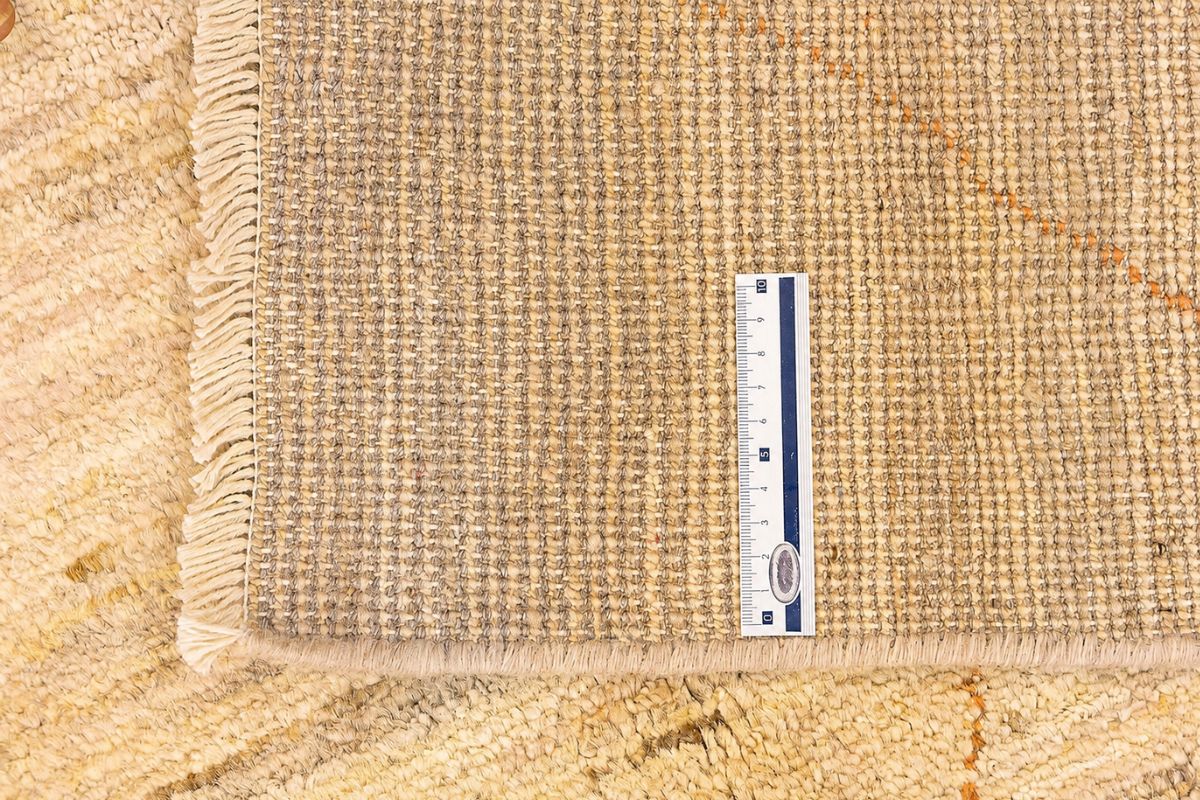
    KPSI applies only to hand-knotted rugs. You count the knots along one inch horizontally, count the knots along one inch vertically, and multiply. A weave with ten knots across and twelve down is 120 KPSI.

    You count on the back, where the knots are visible, and on a genuine hand-knotted piece the count varies slightly from place to place because a person tied them. That variation is normal. A single measured square inch is a sample, not a specification, and where a rug is quoted at an exact figure, someone has usually rounded a range into a number that sounds like a fact.

    The convention is well documented and not controversial. It appears in the general reference literature on knot density and in the explainers published by rug dealers and manufacturers.

    What it genuinely predicts: design resolution

    Think of it as the weave's resolution. Every knot is one point of color, so the number of knots per inch sets how much detail can exist in that inch.

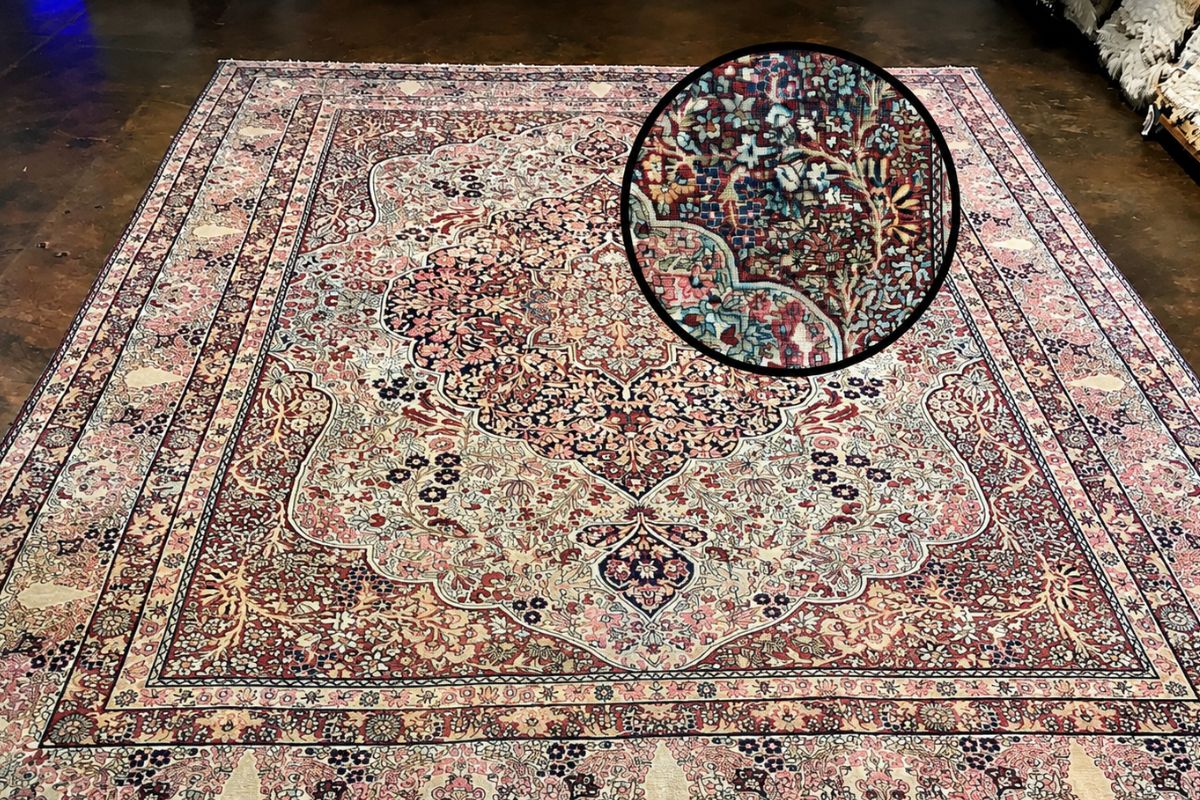
    This matters enormously for a certain kind of rug. Fine floral and curvilinear Persian and Oriental designs, with tendrils, arabesques and shaded medallions, need a high knot count to render those curves smoothly. At a low density the same design would come out blocky. That is the real reason high-KPSI weaving is prized in those traditions: not because the rug lasts longer, but because it can carry designs a coarser weave cannot.

    It is also a straightforward proxy for labor. More knots per inch means more knots in total, which means more weeks at the loom, which is a legitimate part of what a fine Persian rug costs.

    What it does not predict

    Three things, and the dealer explainers largely agree on this, which is worth noticing.

    Quality. A higher figure does not make a better rug and a lower figure does not make a worse one. Several dealer and manufacturer guides state this outright, including explainers published by Jaipur Rugs, TSAR Carpets and Sharafi & Co. When even the trade says the metric is misunderstood, a seller pushing a number at you is departing from their own trade's guidance.

    Durability. This is the most common misconception. Knot density enables elaborate design rather than adding strength, a point made explicitly in Landry & Arcari's guidance on knots and density. What actually governs how a rug wears is the quality of the wool, the tightness and evenness of the weave overall, the pile height, and how the rug is used and cared for.

    Wool quality or worth. A densely knotted rug in poor, brittle wool is a poor rug. Fiber quality and knot count are independent variables, and the one that matters more day to day is the wool.

    Why it barely applies to Moroccan rugs

    Here is the category error, and it is the reason this page exists.

    Moroccan pile rugs are geometric. Their design vocabulary is diamonds, lozenges, lines, crosses and open fields, and much of the visual character comes from the pile itself: high, loose, shaggy, with the wool doing the work rather than the pattern resolution. Beni Ourain in particular is defined by an open, high pile and sparse line work. Applying a fineness metric to that is like judging a wool blanket by thread count.

    The dealer literature actually concedes the principle. The point that knot density is crucial for detailed curvilinear floral patterns and much less important for geometric tribal designs appears in the trade's own explainers. Moroccan rugs are the textbook case of the second category.

    When this site searched specifically for KPSI figures or benchmark ranges for Moroccan and Beni Ourain rugs in August 2026, page one returned seller collection pages and no figures at all. There is no established Moroccan KPSI benchmark to shop against, which is a useful thing to know before somebody quotes you one.

    The one Moroccan knot-count claim in circulation

    There is an exception, and it is instructive.

    One specific pair of numbers does circulate: a knot count for Beni Ourain and a higher one for Beni Mrirt, used across seller pages to explain why Beni Mrirt costs more. This guide went looking for the source of that figure and found the same numbers repeated across four competing sellers' websites, phrased differently and landing in the same range, with no citation behind any of them. No lab measurement, no named researcher, no cooperative source. Repetition across competitors looks like corroboration and is not.

    The full working is in what the Beni Ourain and Beni Mrirt knot-count claims actually rest on, which also sets out what genuinely does differ between the two, because plenty does. The underlying idea that a denser weave takes more wool and more labor is entirely reasonable. Treating an uncited number as a specification is not.

    How to use the number if a seller quotes one

    • Ask how it was measured, and over what area. A real answer describes counting on the back and a range. An exact figure with no method behind it is marketing.
    • Ask what they think it tells you. If the answer is "it means better quality," they have said something the trade's own explainers contradict.
    • Judge the wool instead. Feel it. Springy, slightly greasy with lanolin, resilient under pressure. That tells you more about how the rug will live than any density figure.
    • Judge the weave for evenness, not fineness. Consistent tension and a rug that lies flat matter more than knots per inch.
    • Do not pay a premium for a number nobody will source. If the density claim is doing the work of justifying the price, ask what else justifies it.

    For the checks that do settle something, see what the back of the rug shows and is my Moroccan rug authentic. For the wider set of buying risks, how to buy a Moroccan rug without getting taken, and for the style itself, the Beni Ourain rug guide.

    FAQ

    What is a good KPSI for a Moroccan rug?
    There is no established benchmark, and this guide publishes no figure. Moroccan pile rugs are geometric and often deliberately openly knotted, so knot density is not the metric that describes them well.

    Does a higher knot count mean a better rug?
    No. Dealer and manufacturer explainers state this themselves. Higher density allows finer pattern detail and reflects more labor, but wool quality, weave evenness and construction matter more for how a rug performs.

    Does KPSI affect how long a rug lasts?
    Not directly. Knot density enables elaborate design rather than adding durability. Wool quality, overall weave tightness, pile height and use are what govern wear.

    How is KPSI measured?
    Count knots across one inch and down one inch on the back of the rug, then multiply. On a hand-knotted piece the count varies from place to place, so a single exact figure is a sample rather than a specification.

    Why do sellers quote knot counts for Beni Ourain and Beni Mrirt rugs?
    Because a specific pair of figures circulates widely across seller sites. This guide looked for the original source of those numbers and could not find one cited anywhere, which is covered in detail on the Beni Ourain versus Beni Mrirt page.
  • Judging Moroccan Rug Wool Quality Without a Lab

    Judging Moroccan Rug Wool Quality Without a Lab

    Your hand can tell you four useful things about rug wool: whether it has lanolin still in it, whether it springs back, whether it was hand-spun or machine-spun, and whether it feels alive or dry and chalky. Those are real signals and they matter more to how a rug wears than any knot count does. What your hand cannot tell you is whether the fiber was good to begin with, because chemical washing changes exactly the properties this test reads. On a Moroccan rug sold as vintage, that is not a footnote.

    Why wool is the thing to judge

    If you only learn one quality check, make it this one rather than the number on the tag. Wool quality governs how the pile recovers from a footstep, how it holds colour, how much it sheds, whether it mats in a traffic path, and how it ages over decades. Knot density, by contrast, mostly governs how fine a pattern the weave can carry, which barely applies to geometric Moroccan designs at all. What KPSI does and does not tell you sets out why.

    The good news is that the trade broadly agrees on what good wool feels like, and the descriptions are consistent across dealer and specialist sources. The catch is that every one of those sources is selling rugs, and the checks are written as reasons their stock is good. The checks are still valid. Read them knowing who wrote them.

    Lanolin: sheen, coolness, spring

    Lanolin is the natural grease in a sheep's fleece. It repels water and dirt, and wool that retains it behaves noticeably better in a rug.

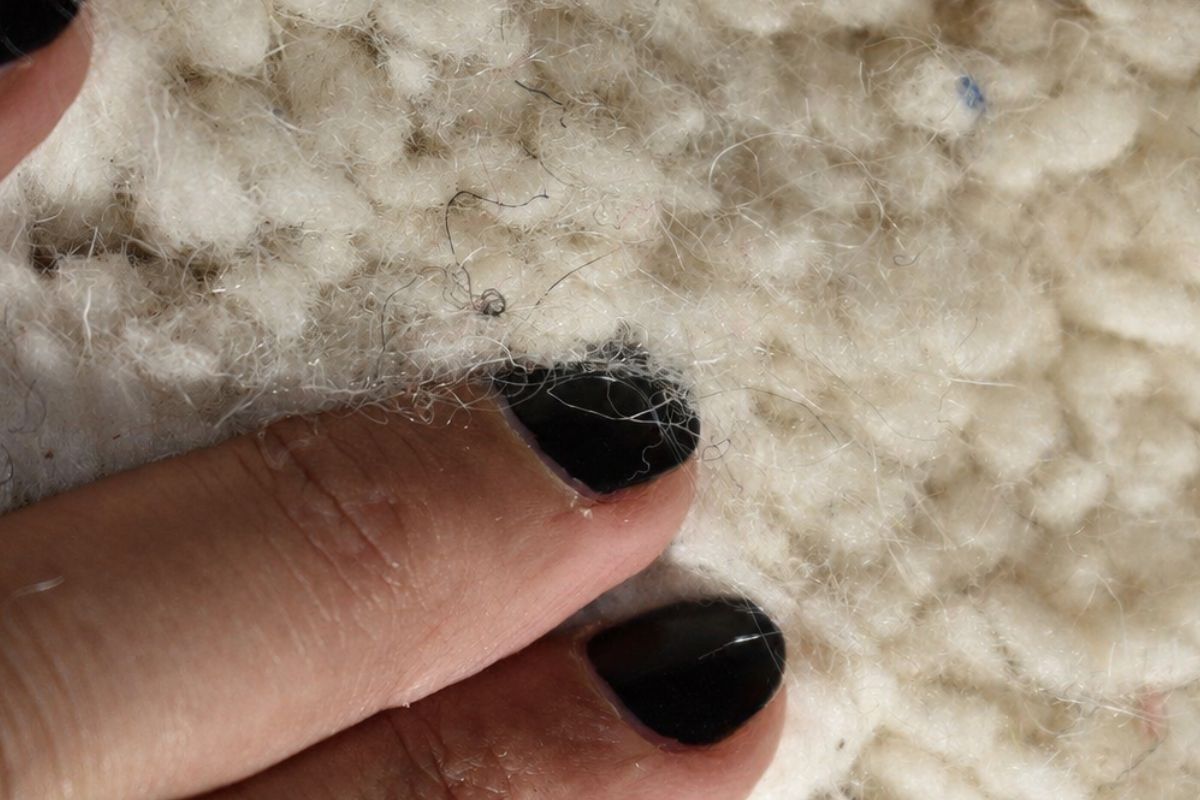
    What to feel for. Run your palm flat across the pile. Wool with lanolin in it has a soft, low sheen rather than a bright shine, feels slightly cool to the touch, and has a faint smoothness that is not slipperiness. Press down with your fingertips and release: the pile should come back rather than staying flat. Grip a small area and let go, and it should recover its shape.

    The trade description that matches this is consistent across sources: good hand-spun wool is rich in lanolin, has a soft sheen, feels cool and springy, and bounces back under pressure. Lanolin also helps the rug resist dirt and staining in ordinary use, which is a practical benefit rather than a romantic one.

    Hand-spun or machine-spun

    This one you can feel, and it is worth learning because it changes the character of the whole rug.

    Hand-spun yarn comes out unevenly, because a person is drawing it. Run your hand across the pile and it reads as slightly bumpy, with subtle variation along a single strand. That irregularity is also why hand-spun wool takes dye unevenly, producing the gentle banding across a field that the trade calls abrash.

    Machine-spun yarn is consistent. It feels softer and smoother precisely because the machine produced an even strand. Specialist sources make the further point that machine processing is thorough enough to strip much of the natural lanolin out of the fiber, which is the trade-off: more uniform, less protected.

    Neither is automatically better for every purpose. Hand-spun generally wears well and looks more alive. Machine-spun can be perfectly serviceable. What matters is whether the rug was sold to you as one and is the other.

    The signs of poor or dead wool

    Poor wool announces itself once you know the vocabulary.

    It feels dry rather than supple, sometimes chalky, sometimes with a faint squeak when you rub it between finger and thumb. It does not spring back when pressed. It looks flat rather than having any sheen. Short, brittle fibers work loose, so the rug sheds persistently well past the settling-in period and mats in walked areas.

    The trade term worth carrying is tabatchi, or dead wool, which specialist sources describe as wool taken from sheep that were already slaughtered rather than shorn from a living animal. It is widely reported as brittle and prone to exactly the shedding and matting above. This guide is repeating a trade distinction here rather than a laboratory one, and it is not something you can confirm by eye on a specific rug.

    What chemical washing does to all of this

    Here is the part the trade sources leave out, and on Moroccan rugs it undercuts the whole test.

    The processes used to make new rugs look old work directly on the fiber. The Anou Cooperative, a weaver-owned organization in Morocco, described them in a post of 14 December 2020: a one-to-one water and bleach solution, roughly 100 litres to soak a large rug, applied one to three times on average, sometimes with sulfur-heavy chemicals to speed things up. A bleach wash of that strength strips lanolin and can leave wool feeling exactly as the section above describes poor wool: dry, flat, without spring.

    So a rug can feel lifeless because the fleece was poor, or because the fleece was fine and the rug was washed hard to produce a faded look. The hand test cannot separate those two, and no one can tell you which happened from a photograph. It runs the other way too: heavy conditioning can make mediocre wool feel better than it is.

    The honest conclusion is narrower than the trade's. Your hand tells you the wool's condition now, which is what you will actually live with. It does not tell you the fiber's original quality or how it got this way. How new rugs are made to look old covers the processes in full.

    What to ask, since the hand test has limits

    • "Has this rug been washed, and how?" Chemical washing is normal in this trade and a straight seller will say so. The answer tells you how to read what your hand just told you.
    • "Is the wool hand-spun or machine-spun?" Then check the answer against the pile. A mismatch is worth pursuing.
    • Ask about shedding. Some settling is normal on a new hand-knotted rug. Persistent shedding months later is a fiber problem.
    • Look at the pile in a walked area if the rug is genuinely old. Real wear tells you more about the wool than a fresh corner does.
    • Get the description in writing before paying, so a wool claim is something you can act on later.

    For the checks that settle construction rather than fiber, see what the back of the rug shows. For the dye half of the same question, natural or synthetic dye. And for the wider set of risks, how to buy a Moroccan rug without getting taken. The style with the strongest reputation for wool is covered in the Beni Ourain rug guide.

    FAQ

    How can I tell if rug wool is good quality?
    Feel for a soft low sheen, a cool touch, and spring that returns when you press the pile. Dry, chalky wool that stays flat and sheds persistently is the opposite signal.

    What is lanolin and why does it matter in a rug?
    It is the natural grease in a sheep's fleece. Wool that retains it resists dirt and moisture better, feels springier, and generally wears longer. Heavy processing and chemical washing strip it out.

    Is hand-spun wool better than machine-spun?
    Not automatically. Hand-spun is uneven, retains more lanolin, and gives the rug abrash and character. Machine-spun is smoother and more uniform but more processed. The problem is only when one is sold as the other.

    What is tabatchi or dead wool?
    A trade term for wool taken from sheep that were already slaughtered rather than shorn. It is described in the trade as brittle and prone to shedding and matting. This guide could not verify it on any specific rug and reports it as a trade distinction.

    Can a bleach wash make good wool feel bad?
    Yes, and that is the main limit of the hand test on Moroccan rugs. The strong washes documented in the trade strip lanolin, so a rug can feel dry because of what was done to it rather than because the fleece was poor.

  • Natural vs Synthetic Rug Dye: Bleeding Proves Nothing

    Natural vs Synthetic Rug Dye: Bleeding Proves Nothing

    If a rug bleeds, it tells you the dye was never properly fixed into the fiber. It does not tell you whether that dye was natural or synthetic, and it is not evidence that the rug is a fake. This matters because the opposite claim, that natural dyes do not run so a color run proves synthetic dye, is stated outright on seller pages and is contradicted by the rug trade's own specialist sources. A properly mordanted natural dye stays put. A badly fixed dye of either origin bleeds.

    Where the false claim comes from

    The claim is convenient. It gives a seller a quick on-the-spot test whose result they can predict, and it lets the word "natural" carry a premium.

    The trade's own literature does not support it. Nazmiyal's page on color runs in rugs makes the point directly: early synthetic reds, and contemporary red dyes too, are prone to running, but the existence of a red color run does not preclude a natural origin. Other specialist and professional-cleaning sources on the same question converge: clean, easy bleeding is the single most useful indicator of a poor dye job, natural or synthetic, and properly mordanted natural reds do not bleed.

    So the test is real, it just answers a different question than the one it is sold as answering. This is the pattern across this whole cluster, and it also applies to the burn test, which is likewise asked to prove far more than it can.

    What actually causes a color run

    Dyeing wool is not simply staining it. The dye has to bond to the fiber, and for most natural dyes that requires a mordant, a metallic salt that fixes the colour in place. Get the mordanting right and the colour is genuinely locked into the wool. Get it wrong, skip it, or overload the fiber with more dye than it can bond, and the excess sits on the surface waiting for water.

    Synthetic dyes have their own fixing requirements, and the same logic applies. Some early synthetic reds were notoriously fugitive, which is where a good deal of the folklore comes from, and the trade's own accounts note that red remains the most run-prone colour family across both dye types.

    The variable is process quality, not chemistry of origin. A cheap dye badly fixed will bleed, fade harshly, or in the worst cases damage the wool itself. That is the thing worth avoiding, and it is not what the natural-versus-synthetic argument is about.

    Why age makes natural dyes less stable, not more

    There is a second reason a genuinely old, genuinely naturally dyed rug can run, and it is the exact opposite of the romantic story.

    Specialist and professional cleaning sources describe natural dyes as more sensitive to heat, moisture and chemical exposure than modern synthetics, and note that age and oxidation make them progressively less stable. So an old rug with real vegetable dyes can bleed under a cleaning approach that a newer synthetic-dyed rug would shrug off.

    The practical consequence is not academic. It means the rug most likely to be damaged by a careless wash is the valuable one, and it is why professional rug cleaners test for colourfastness before they put water on anything. If you own a piece you believe carries natural dyes, that is a reason to be more careful with cleaning, not less.

    What you can honestly tell by looking

    Some things are visible, with limits attached to each.

    Abrash. Gentle horizontal banding across a field of colour, where the tone shifts slightly from one section to the next. It happens when hand-spun yarn takes dye unevenly or when a weaver moves between dye lots. It is a genuine sign of small-batch, hand-processed work, and it is also easy to imitate, so read it as suggestive rather than conclusive.

    Depth and variation within a single colour. Naturally dyed wool often shows subtle variation strand to strand. A flat, perfectly even field is more consistent with an industrial dye lot.

    How the colour reads at the base of the pile. Part the pile and look near the foundation. On a rug that has faded with real light exposure, the colour at the base is usually deeper than at the tip. On a rug faded by a surface treatment, the difference can be more abrupt.

    What you cannot tell by eye is the actual chemistry. Dye analysis is a laboratory procedure, and no amount of looking substitutes for it. Where the Moroccan rug palette comes from covers what can and cannot honestly be said about the colours themselves.

    What this means when a rug bleeds in your home

    First, do not conclude you were sold a fake. You have learned something about the dyeing, not about the rug's origin.

    Second, treat it as a cleaning constraint from now on. A rug that runs will run again. That means blotting rather than rubbing a spill, avoiding saturating the pile, keeping it out of situations where it will get genuinely wet, and telling any cleaner about it before they start.

    Third, if it happened during a cleaning attempt, stop and get professional help rather than escalating. Wet wool holding loose dye spreads colour further with each pass.

    And if the rug is one you were told carries natural dyes, the bleeding is not proof that claim was false. It is consistent with an old natural dye that has become unstable, with a badly mordanted natural dye, or with a poorly fixed synthetic. Those cannot be told apart at home.

    For the wider set of tests that promise more than they deliver, see how to buy a Moroccan rug without getting taken, and for the fiber half of the same assessment, judging wool quality without a lab. The chemical washing described in how new rugs are made to look old is also worth reading here, since it acts directly on colour.

    FAQ

    Do natural dyes bleed?
    Yes, they can. Properly mordanted natural dyes do not, but badly fixed ones do, and specialist sources note that natural dyes become less stable with age and oxidation. Bleeding is not evidence of synthetic dye.

    Does a color run mean my rug is fake?
    No. It means the dye was not properly fixed. That is worth knowing for cleaning, but it says nothing about where or how the rug was made.

    How can I test for natural dyes at home?
    You cannot reliably. Dye analysis is a laboratory procedure. Abrash and subtle colour variation are suggestive but imitable, and this guide does not recommend any home chemical test.

    Which colour bleeds most often?
    Red, across both dye types, according to the trade's own accounts. Early synthetic reds in particular were prone to running, which is part of where the folklore about bleeding began.

    My rug ran while I was cleaning it. What now?
    Stop rather than continuing, because wet wool holding loose dye spreads it further with each pass. Get a professional rug cleaner involved, and tell them the rug runs before they start.