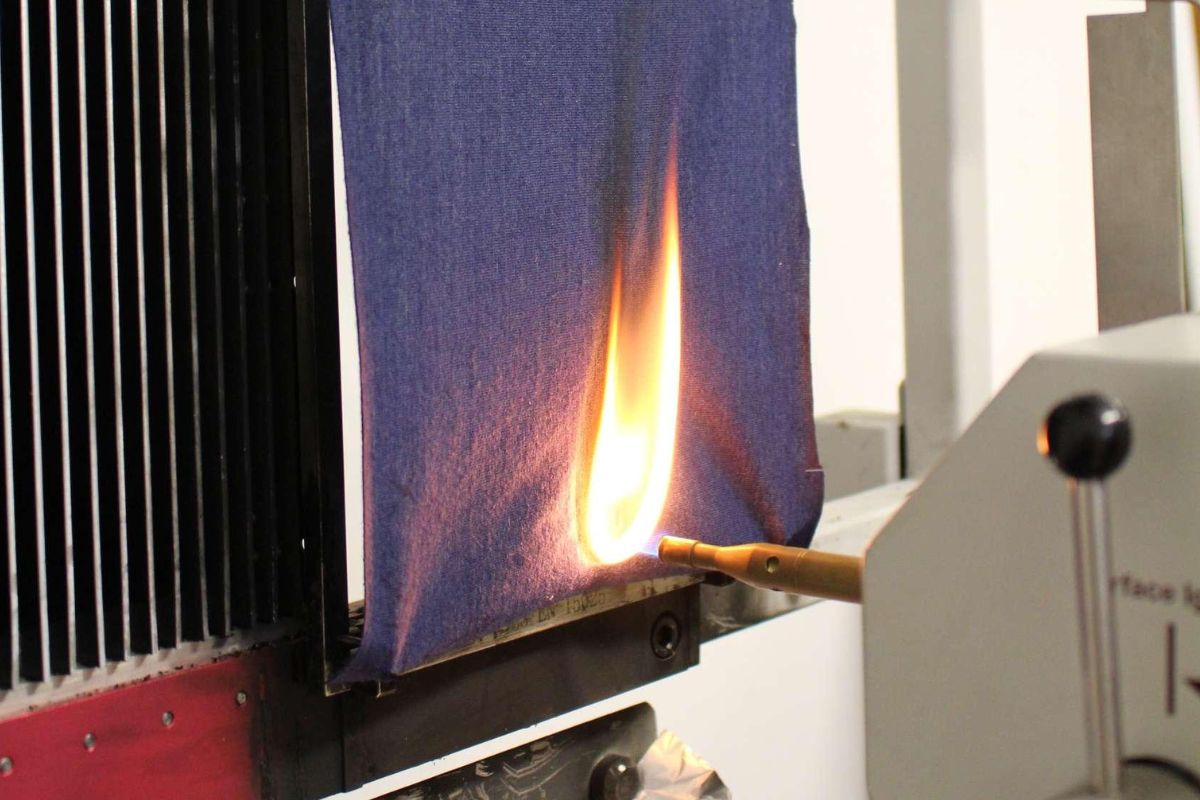
The burn test can tell you, imperfectly and under controlled conditions, whether a fiber is protein or plastic. That is the whole of what it does. It cannot tell you how old a rug is, where it was made, who made it, whether it was hand-knotted, or whether it was chemically treated to look aged, which are the questions Moroccan rug buyers actually have. This guide does not recommend running it, and the most repeated version of the advice, that pure wool "will not light," is wrong in a way that costs buyers money.
Where the claim comes from and why it matters
Two of the buying guides on page one for Moroccan rug advice in August 2026 tell readers to take a lighter to a fiber and report that the flame will not light pure wool but will melt a synthetic. One of them is a travel-tour operator's blog, one is a well-known Morocco travel site. Neither cites anything.
Wool is comparatively flame resistant. That is a real property and a large part of why it has been used in carpets for centuries. There is a body of textile literature on the burning behavior of wool carpets, including work indexed under the title "Burning Behavior of Carpets: The Advantages of Wool and Flame-Resistant Wool." Comparatively flame resistant is not the same statement as fireproof.
The practical consequence is specific and predictable. A buyer holds a flame to a fiber from a genuine wool rug, expecting nothing to happen, sees it catch and burn, and concludes the rug is synthetic. The advice has produced a false negative on a real rug. Someone acting on it walks away from a genuine piece or, worse, uses it to argue the price down on a seller who was telling the truth.
What the test actually shows, at best
In a controlled setting, protein fibers and plastics do behave differently. Protein fibers such as wool are harder to ignite, tend to burn slowly and self-extinguish, smell like burning hair, and leave a brittle ash that crushes to powder. Synthetics such as polypropylene and nylon ignite more readily, burn faster, smell acrid or plastic-like, and leave a hard melted bead.
That is a genuine difference and the reason the test exists at all. Note what it is a test of: fiber chemistry. It is a materials identification, not an authentication.
Even at that job it has known limits, and even sources that recommend it concede them. Blended fibers have to be separated before testing, because a wool and synthetic blend gives a mixed and unreadable result. And a single strand from one corner tells you about that strand, not about a rug that may use different fibers in pile, warp and weft.
Why not to do it
Three reasons, in order of how much they should matter to you.
It is not your rug. If you are testing in a shop, you are taking a lighter to someone else's property, and taking a strand to test means damaging it first. A seller who agrees is being accommodating, not proving anything.
It is an open flame on a textile. You may be holding a four-figure wool object in an enclosed retail space with other flammable stock. This site does not publish a protocol for doing this and will not, because there is no version of the instruction that is responsible to give.
It settles a question you can settle better another way. If fiber content genuinely matters to your decision, a laboratory fiber test gives a definitive answer on the whole rug without burning anything. Against the cost of the rug it is a small expense, and any seller confident in their description will agree to it.
The other tests sold as proof
The burn test is not alone. Three more circulate widely and each carries less weight than its reputation.
The color test. One page-one source advises avoiding "hot" colors, on the theory that a red "hot as a tomato" is machine dyed while a red "as a tulip" is vegetable dyed. Dye chemistry does not divide that neatly, natural dyes produce a wide range of intensities depending on the plant, mordant and process, and a judgment made by eye about a hue is not evidence of anything. Moroccan rug colors: where the palette comes from covers what can honestly be said about the palette.
The wet cloth rub. Rubbing a damp white cloth on the pile to see whether color transfers is often presented as proof of synthetic dye. It is not. Natural dyes can and do bleed, and a color run is not evidence of a fake. It is covered properly in natural or synthetic dye: how to check, and why bleeding proves nothing.
The price test. "Too cheap means fake" is the most repeated claim in the niche and the least supported. It is examined in how to buy a Moroccan rug without getting taken, alongside the documented economics that contradict it.
What these four have in common is that they are quick, they feel like expertise, and they produce a confident answer to a question they do not address.
What to do instead
Spend your effort on the checks that actually resolve something.
- Look at the back. Construction is the one authenticity question you can settle yourself with certainty, and it has direct financial consequences. What the back of the rug shows covers it.
- Ask what the seller can document, rather than what they assert. Region, town and cooperative are answerable. Tribe and decade usually are not.
- Treat the aged look as a look. Fading can be manufactured in weeks by processes that are documented, which how new rugs are made to look old sets out.
- Pay for a fiber test if fiber matters. It is the only version of the burn test question that gives a real answer.
- Get claims in writing before paying. A written description is something you can act on later. A shop-floor flame is not.
If you want the full set of questions hiding inside the word, is my Moroccan rug authentic breaks it into the four that have different answers.
FAQ
Does pure wool burn?
Yes. Wool is harder to ignite than most synthetics, tends to burn slowly and self-extinguish, and smells of burnt hair. It is not fireproof, and advice that says a flame "will not light" wool is wrong.
Should I do a burn test on a rug in a shop?
No. It damages property that is not yours, it is an open flame on a textile in an enclosed space, and it answers only a fiber question that a laboratory test answers properly.
What does the burn test actually prove?
At best, whether a single strand is a protein fiber or a plastic one. It proves nothing about age, origin, tribe, construction or chemical treatment.
How can I be sure my rug is wool?
A laboratory fiber test is the definitive answer. Feel and appearance are suggestive but not conclusive, and blends are specifically designed to be hard to judge by hand.
Does color bleeding mean the dyes are synthetic?
No. Natural dyes bleed too, so a color run is not evidence of a fake. This is one of the most common false claims in the niche and it has its own page here.
Leave a Reply