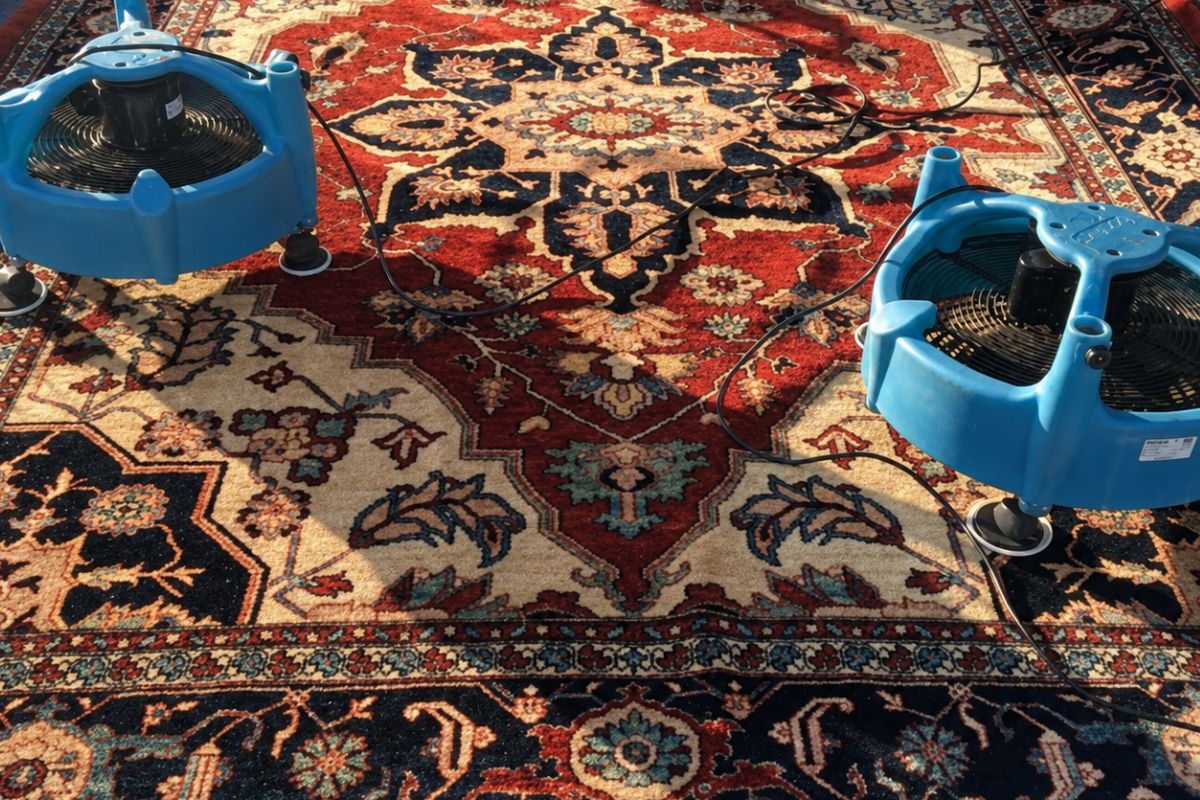
Sometimes, and the question that decides it is not whether you can wash the rug but whether you can dry it. Getting a dense wool pile fully dry, quickly, flat and with air moving through it is the hard part, and a rug that stays damp develops mildew and odour that are considerably harder to fix than whatever you were cleaning off. For an old, valuable or naturally dyed hand-knotted piece the answer is simply no: that is a specialist's job, and this site's own position is that irreplaceable rugs are not DIY projects.
The four things that decide it
Work through these honestly before anything gets wet.
1. What is the rug worth, and can it be replaced? A modern, inexpensive, machine-spun wool rug is a reasonable thing to attempt. A hand-knotted one-off piece is not replaceable at any price, and the downside is not a wasted afternoon, it is the rug.
2. Are the dyes stable? If you do not know, you do not know. See below.
3. Can you dry it fast, flat and with airflow? Not "will it dry eventually." A garden on a hot dry day with a hard surface, or a garage with fans and space to lay it flat, is a yes. A bathroom floor in a damp flat is a no.
4. What are you actually trying to fix? General dullness is usually a vacuuming problem, not a washing problem. A specific set stain, a pet accident, or an odour coming from the foundation are all reasons to call someone rather than reasons to wash the whole rug.
If any of the first three is a no, stop there. The rest of this page explains why.
What water actually does to wool
Wool is a protein fibre with a scaled surface. Agitate it in water, particularly warm water and particularly with anything alkaline, and those scales interlock. That is felting, and it is permanent: the rug shrinks, stiffens and loses its drape.
Alkalinity is the specific enemy, and most household cleaning products are alkaline. Professional rug cleaning sources describe wool as wanting pH-neutral treatment, with professional formulations in the range of roughly 5.5 to 8.0, precisely because pushing outside it strips lanolin, damages the fibre and destabilises dye. Heat accelerates everything. Oxygen bleach and enzyme cleaners are separate categories of permanent damage, covered in cleaning products that quietly destroy wool.
So even the successful version of home washing is a narrow path: cool water, minimal agitation, a wool-safe product used exactly as its manufacturer directs, and testing on a hidden area first. This guide publishes no recipe, no dilution and no temperature, because a wrong number here damages a rug and the right numbers are on the product's own label.
The dye problem, which only appears once it is wet
This is the trap. A rug can look completely stable for years and run the first time it is properly wet.
Bleeding means the dye was never fully fixed into the fibre, and it happens with natural and synthetic dyes alike. Worse for exactly the rugs you would most want to protect: natural dyes become less stable with age and oxidation, so an older hand-woven piece can run under a cleaning approach a newer rug would shrug off. A red that migrates into a cream field while the rug dries is not something you fix afterwards.
Professional cleaners test for colourfastness before water touches a rug, which is one of the concrete things you are paying them for. If you are going to attempt anything at home, test a hidden area with a damp white cloth first, and if any colour transfers, stop. Natural or synthetic dye explains why a colour run is a cleaning constraint rather than evidence you were sold a fake.
The drying problem, which is the real one
Say you have washed it and nothing has felted and nothing has run. You are now at the difficult part.
A hand-knotted wool rug holds a great deal of water and is heavy when wet, heavy enough that lifting it wrong can distort the weave. It needs to dry flat, with air moving over both sides, and it needs to do that quickly rather than over a week. Hanging a soaked rug over a line puts the weight of the water on a fold and can distort it permanently.
What goes wrong when drying is slow: mildew, a persistent musty odour coming from deep in the pile and the foundation, and browning, where residual moisture carries substances up through the fibre and leaves a discoloured area as it evaporates. Each of these is harder to resolve than the dirt you started with, and each is a common reason rugs arrive at professional cleaners.
If you cannot answer "yes, flat, with airflow, within hours" then washing is not the right decision, whatever the rug is worth.
What a professional does differently, and when it is worth it
Rug cleaning specialists dust the rug first, mechanically removing dry grit that would otherwise turn to mud, which is something no home method replicates. They test dyes before wetting anything. They control pH and temperature deliberately. And they have controlled drying, usually flat or with forced air, which is the step a home simply cannot match.
Call one for: anything old, valuable or naturally dyed; a set stain; a pet accident that reached the foundation; an existing odour; a colour run; visible moth damage; or a rug you genuinely cannot dry properly.
Do it yourself for: routine vacuuming, prompt spill blotting, airing the rug outdoors on a dry day, and rotating it. That covers most of what a rug in ordinary domestic use actually needs, and how to care for a Moroccan wool rug is the whole routine.
Use a rug cleaning specialist rather than a general carpet cleaning service, and tell them the rug is hand-knotted wool, whether you believe the dyes are natural, and anything you have already put on it. If you want to understand what you are protecting, judging wool quality without a lab covers what makes a fleece worth being careful with, and spills on wool covers the everyday version of this question.
FAQ
Can I wash a wool rug at home?
Sometimes, for a modern, inexpensive, colourfast rug you can dry quickly, flat and with airflow. For an old, valuable or naturally dyed hand-knotted piece, no. The deciding factor is drying, not washing.
Can I put a wool rug in the washing machine?
Not a hand-knotted rug. Machine agitation and heat felt wool, which shrinks and stiffens it permanently, and the weight of a wet rug is not something a domestic machine is built for.
How do I know if the dyes will run?
Test a hidden area with a damp white cloth before anything else. If colour transfers, stop. Older natural dyes become less stable with age, so an old rug is more at risk than a new one, not less.
What happens if a wool rug dries too slowly?
Mildew, a lasting musty odour from deep in the pile, and browning as residual moisture evaporates. All three are harder to fix than the dirt you were removing.
What does a professional rug cleaner do that I cannot?
They dust out dry grit before wetting the rug, test the dyes for colourfastness, control pH and temperature, and dry it flat with forced air. Controlled drying is the step a home cannot replicate.
Leave a Reply