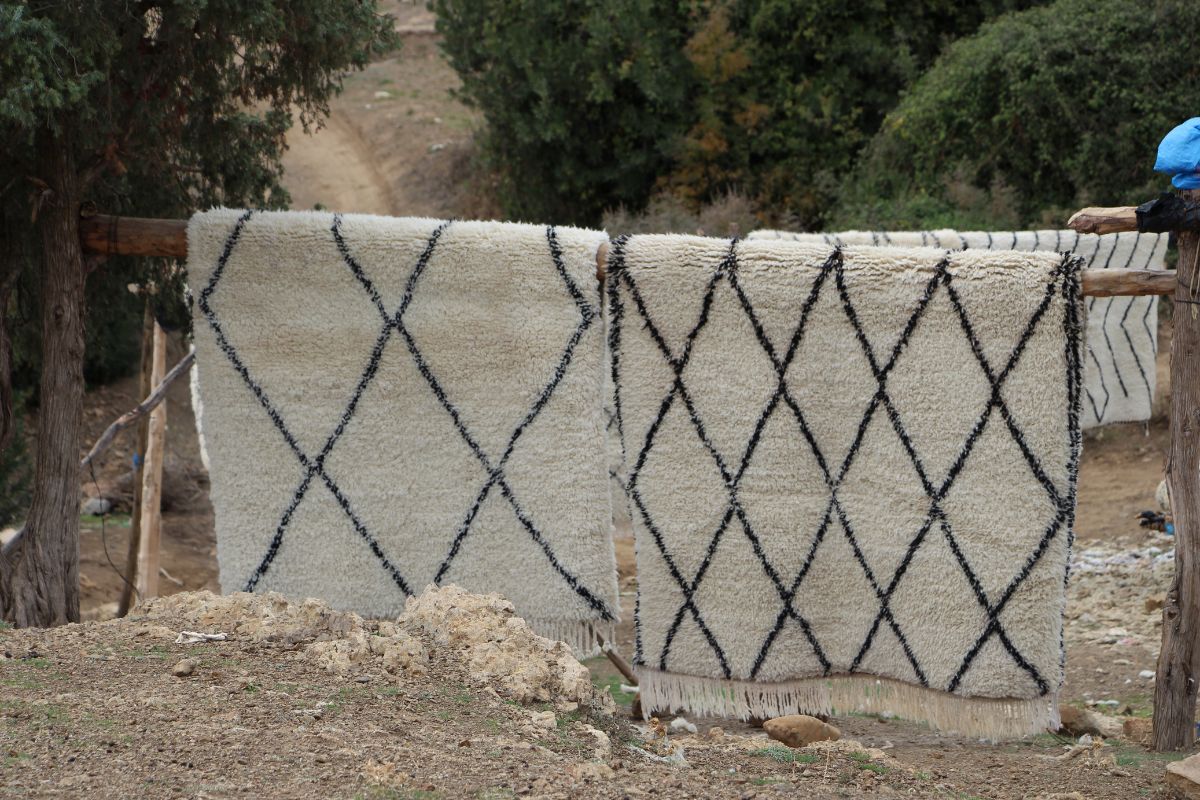
A Beni Ourain rug is a handwoven wool rug made by the Beni Ouarain, a confederation of Berber tribes in the Middle Atlas Mountains of Morocco. The classic version has a thick, plush pile of undyed cream or ivory sheep wool, marked with a sparse pattern of dark brown or black geometric lines and diamonds. Because it is knotted by hand, no two are exactly alike, and small irregularities are normal rather than flaws. Today the name is also used loosely for machine-made lookalikes, so knowing what a genuine one actually is matters before you spend real money.
This guide covers where the style comes from, what a genuine piece feels like, how it differs from the rug it gets confused with most, and the claims floating around the internet that deserve a second look. Atlas Rug Guide does not sell rugs and earns no commission on any purchase, so nothing here is written to steer you toward one seller over another.
What makes a rug a Beni Ourain
The name points to people, not just a pattern. The Beni Ouarain (also spelled Beni Ourain) are often described as a confederation of around 17 Berber tribes living in the high country of the northeastern Middle Atlas. Families there wove thick wool rugs for a practical reason first: warmth. At altitudes above 2,000 meters, a heavy wool pile worked as a sleeping mat and a blanket against mountain cold, which is why traditional pieces were often woven large enough for a whole family.
Three things define the classic look:
- Undyed wool. The cream, ivory, or soft off-white ground is the natural color of the sheep's wool, not a bleached or dyed finish. Slight variation in tone across the rug is expected because the wool is hand-spun.
- Sparse geometric marks. Thin dark-brown or black lines form diamonds, lozenges, and irregular grids. The pattern is minimal and asymmetric, not a dense repeating motif.
- A high, soft pile. Wool from high-altitude sheep tends to be rich in lanolin, which gives the pile its plush, slightly springy feel.
The exact age of the tradition is not well documented, and you will see confident but conflicting origin dates repeated across seller blogs. Where the history is genuinely uncertain, this guide leaves it uncertain rather than picking a number to sound authoritative.
What to expect: pile, weight, and feel
A genuine Beni Ourain is heavy. The dense wool pile gives it real weight for its size, and the surface feels shaggy and open rather than tight and flat. Run your hand across it and you may notice the wool feels slightly oily or waxy; that is natural lanolin, and it is one reason the wool resists dirt and wear.
Traditional sizing runs long and narrow because the rugs followed the shape of a sleeping space, though pieces made for the export market come in a wide range of dimensions today. Color stays in the neutral family: cream grounds with brown or black line work, sometimes with faint gray. Bright, saturated color is not part of the traditional Beni Ourain vocabulary; a rug loaded with vivid dyes is a different style, or a modern reinterpretation, rather than a classic Beni Ourain.
Why the look suits modern interiors
The Beni Ourain became a design icon in the mid-20th century, when modernist architects and designers paired its plain wool ground and graphic lines with clean, minimal rooms. That pairing still works. A neutral high-pile rug adds warmth and texture without competing with the rest of a space, which is why it reads equally at home under mid-century furniture, in a Scandinavian-minimal room, or in a warm neutral "quiet luxury" scheme.
If you like the palette but want a bit more color or a looser, more painterly pattern, two related Middle Atlas styles are worth comparing before you commit: Azilal rugs, which keep a wool ground but add sparse color and freer motifs, and Boujad rugs, which lean into warm pinks and reds. Our complete guide to Moroccan rug styles lays out how all of these relate.
Beni Ourain vs Beni Mrirt: the real differences
The style Beni Ourain gets confused with most is Beni Mrirt, another Middle Atlas wool rug. Several seller pages exist specifically to move shoppers from one to the other, so it helps to see the actual differences plainly:
| Feature | Beni Ourain | Beni Mrirt |
|---|---|---|
| Pile | Higher, shaggier, more open | Lower, denser, more velvet-like |
| Feel | Fluffy, loose, cloud-like | Compact, smooth, plush |
| Knot density | Lower (looser weave) | Higher (tighter weave) |
| Pattern | Minimal lines and diamonds | Often bolder, more detailed |
| Palette | Undyed cream with dark marks | Similar neutrals, sometimes richer |
Neither is "better" in the abstract. A denser weave takes more time and wool, which generally tracks with a higher price, but the open, shaggy Beni Ourain pile is exactly what many people want. The right choice depends on the texture and look you are after, not on which one a seller has framed as the upgrade.
Claims worth being skeptical of
This is where independent guidance matters most, because a few claims get repeated across the web as settled fact when they are not.
The burn test does not prove a rug is a genuine Beni Ourain
Nearly every buying guide online repeats the same "burn test": snip a fiber, hold a flame to it, and judge by how it burns and smells. Real wool chars slowly and smells like burnt hair; synthetic fiber melts, beads up, and smells like plastic. That much is true, and the test can tell you whether a fiber is wool or synthetic.
Here is what those guides leave out: the burn test only checks fiber content. It cannot tell you where a rug was made, whether it was hand-knotted, or how old it is. A rug can be 100% wool and still be a machine-made copy woven far from the Middle Atlas. Passing a burn test means "this is wool," not "this is a genuine Beni Ourain." Treat it as one small data point, not proof of origin.
Knot-density numbers are inconsistent, so treat them as a concept, not a spec
You will also see specific knot-per-square-inch figures quoted for Beni Ourain and Beni Mrirt rugs. The problem is that the exact numbers vary from site to site and are rarely sourced, so it is not sound to treat any single figure as a fixed standard. The underlying idea holds up: a denser, tighter weave takes more labor and more wool, which generally correlates with more value. Use density as a relative sense of quality you can feel with your hand, not as a number to verify a rug against.
"Beni Ourain" vs "Beni Ourain style": the gap sellers skip
The single most useful thing to understand before buying is that the market is full of "Beni Ourain style" rugs, and "style" is doing a lot of quiet work in that phrase. A genuine Beni Ourain is handwoven by weavers in the Middle Atlas from local wool. A "Beni Ourain style" or "Beni Ourain inspired" rug is anything that copies the cream-and-diamond look, including machine-made rugs produced in bulk from synthetic or blended fiber anywhere in the world.
Both can be attractive. But they are not the same object, and they should not carry the same expectations for durability, feel, or value. The look-alike is a product; the genuine article is a handmade textile with real variation baked in.
| Genuine Beni Ourain | "Beni Ourain style" lookalike | |
|---|---|---|
| Made | Hand-knotted by Middle Atlas weavers | Often machine-made, mass-produced |
| Material | Undyed natural sheep wool | Frequently synthetic or wool blend |
| Variation | Slight irregularities throughout | Perfectly uniform, repeating |
| Back of rug | Visible hand-tied knots, uneven | Machine-neat, often a printed or glued backing |
A quick note on limits: Atlas Rug Guide is a reference, not an appraisal service, and no article can authenticate a specific rug from a photo or description. The points below help you ask better questions, not replace an expert's hands-on judgment when a purchase is significant.
What actually helps you judge one in front of you
- Turn it over. On a hand-knotted rug the back shows the pattern in individual, slightly uneven knots. A print or machine copy often looks suspiciously perfect, or has a separate backing material.
- Look for honest irregularity. In a genuine piece, lines wobble slightly, diamonds are not identical, and tone shifts a little across the field. Flawless symmetry is a red flag, not a selling point.
- Feel the wool. Natural wool feels dense and often slightly oily from lanolin, and it has an earthy, not chemical, smell. A strong synthetic odor is a warning sign.
- Ask direct provenance questions. Where was it woven and by whom? Is the wool natural and undyed? Is it hand-knotted? A confident, specific seller answer is worth more than any single physical test.
For how a Beni Ourain sits against the other named Moroccan traditions, and where each one is woven, see the wider family of Moroccan rug styles.
Caring for a Beni Ourain rug
Wool is forgiving, which is part of the appeal. A few basics keep a genuine piece looking right:
- Vacuum gently and avoid a hard beater bar on a high pile, which can pull fibers.
- Blot spills quickly rather than rubbing them in; wool's lanolin helps resist staining if you act fast.
- Rotate the rug periodically so light and foot traffic wear it evenly.
- For deep cleaning, use a professional experienced with handmade wool rugs rather than a general carpet-cleaning machine.
Natural shedding is normal early on and settles over time. It is a property of a real wool pile, not a defect.
FAQ
What is a Beni Ourain rug?
It is a handwoven wool rug from the Beni Ouarain Berber tribes of the Middle Atlas Mountains in Morocco, known for a thick undyed cream or ivory pile marked with sparse dark-brown or black geometric lines and diamonds.
Are Beni Ourain rugs always cream colored?
The traditional palette is undyed cream or ivory wool with dark line work, sometimes with faint gray. Brightly colored versions are either a different Moroccan style or a modern reinterpretation, not the classic Beni Ourain look.
Does the burn test prove a Beni Ourain is authentic?
No. A burn test can suggest whether a fiber is wool or synthetic, but it cannot confirm where a rug was made, whether it was hand-knotted, or how old it is. A wool rug can still be a machine-made copy.
What is the difference between Beni Ourain and Beni Mrirt?
Beni Ourain has a higher, shaggier, more open pile, while Beni Mrirt is denser and more velvet-like from a tighter weave. Both are Middle Atlas wool rugs with similar neutral palettes.
Why do genuine Beni Ourain rugs look slightly imperfect?
Because they are made by hand. Small irregularities in the lines, diamonds, and wool tone are expected and are one of the clearest signs a rug was woven by a person rather than a machine.