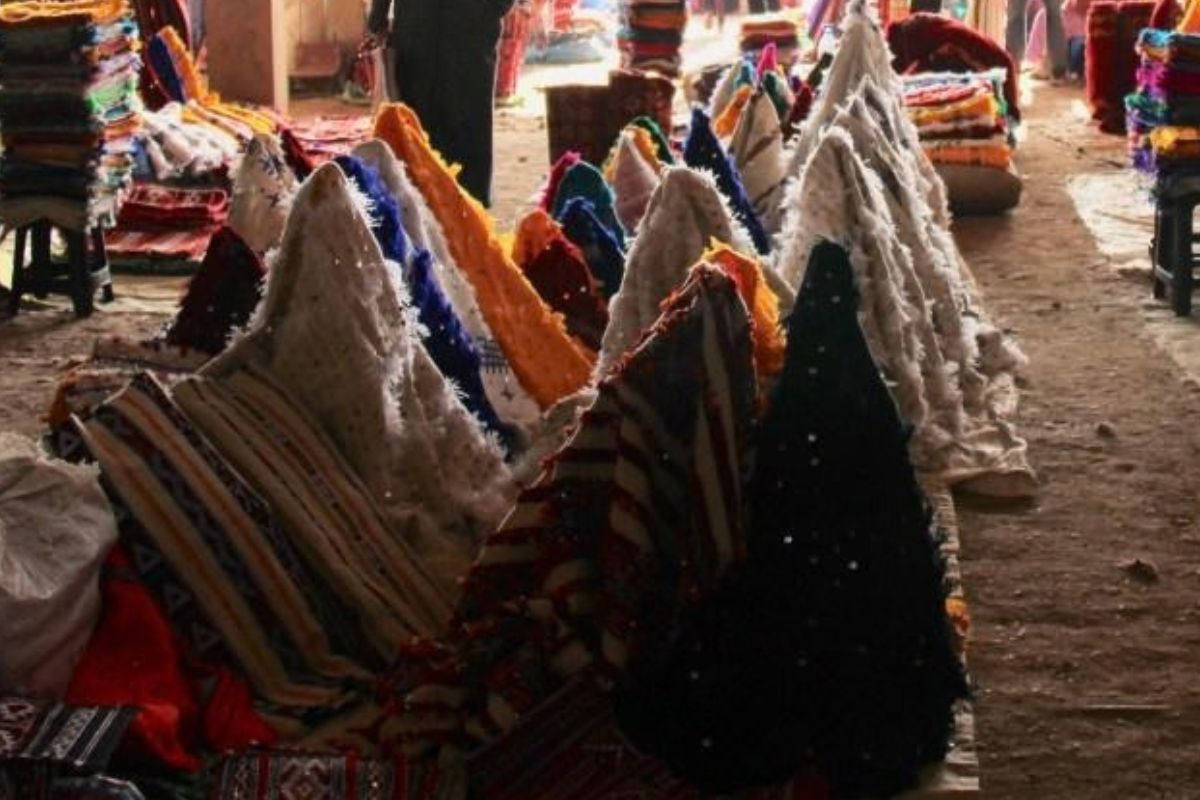
The channel you buy through changes who sets the price more than it guarantees what the weaver receives. A cooperative that sells its own members' rugs keeps the margin a market middleman would otherwise take. A dealer adds real services and a larger share. A "direct" listing can mean anything from an artisan-owned marketplace to a reseller using the word. None of the three proves the weaver's share, and the most useful test is whether the seller can say specifically what the maker was paid.
This guide compares the three channels on what each can actually show a buyer. It names organizations only as sources of evidence. This site sells no rugs, carries no affiliate links, and does not recommend or rank any seller. Everything below was checked on 11 September 2026. Channels and marketplaces change, so treat the specifics as dated.
The three channels at a glance
| Channel | Who sets the first price | What you can usually check | What it does not prove |
|---|---|---|---|
| Cooperative selling its own members' rugs | The cooperative, with its weavers | The cooperative's name and location; sometimes the weaver's name | How the cooperative shares the sale price with members |
| Dealer or retailer | Whoever the dealer bought from, often a market intermediary | Returns, condition, the dealer's own record | Anything about the weaver's price |
| "Direct from the weaver" listing | Varies completely | Only what the seller chooses to document | Everything, until documented |
The table is the whole argument in small: a channel is a structure, and structures shift who controls the price. They do not by themselves tell you the number.
Channel one: the cooperative
This is the channel with the strongest case for sending more of the price to the loom, and also the one where the label is easiest to borrow.
What the reporting shows. Africanews reported on 2 July 2025 that the Women's Centre for the Promotion of the Taznakht Carpet, established in 2016, brings together 35 cooperatives and 3,500 women weavers and can produce up to 300 carpets a month. AFP's report of 18 December 2024, as carried by Business Recorder, described weavers otherwise selling at a weekly market to middlemen who set the prices, and a new exhibition space in Taznakht that lets some weavers sell directly to buyers. The logic is simple: where the cooperative is the seller, there is no market intermediary in between.
What the word can hide. The Anou Cooperative, a weaver-owned organization in Morocco, wrote on 14 December 2020 that artisans may be part of "some loose collective of people, a cooperative in name only, or just weave at home." A rug described as "from a women's cooperative" may have come from a real registered cooperative selling its own work, or from a cooperative that sold to a middleman, or from nowhere the word applies at all.
What to check. The cooperative's actual name and town, whether the seller is the cooperative or bought from it, and whether the cooperative can say how members are paid for a rug. The Taznakht rug guide covers one area where the cooperatives are named in independent reporting.
Channel two: the dealer
Dealers are often presented as the villain in this story. That is too simple, and it is not fair to the good ones.
What a dealer genuinely adds. Selection, cleaning and repair, photographs you can rely on, export and import handling, a returns policy, and someone who will still be there if something goes wrong. Those are real services with real costs. Why the same rug costs more in a showroom separates those costs from margin, step by step.
What a dealer usually cannot tell you. Most dealers buy from intermediaries, at markets or from exporters, several steps from the weaver. A dealer at that distance generally does not know what the weaver was paid, and an honest one will say so rather than invent a story.
What to check. The dealer's returns terms on a large, heavy item, and whether they will describe their sourcing specifically. Rug returns and recourse when it arrives wrong covers what to establish before paying. For a dealer, the useful question about the weaver is less "what did she get?" and more "how far back does your knowledge of this rug go?"
Channel three: "direct"
"Direct from the weaver" is the most attractive phrase in the category and the least regulated. It covers several quite different things.
Artisan-owned marketplaces. Anou describes itself as owned by the artisans who sell on it. Its blog describes a model where major interactions, "such as receiving a quote, paying for an order," happen directly between the customer and the artisan. That is a specific, checkable structure. This site names Anou as a source of documented practice, not as a recommendation, and has no relationship with it.
Commissioned selling at a local market. The Christian Science Monitor's 2019 report from Khemisset describes women sellers who grade weavers' carpets, "set a price and our commission," and sell to dealers arriving from Fez, Rabat and Marrakech. It is not direct in the literal sense, but the seller's income rises with the weaver's price.
Resellers using the word. A shop that says it "works directly with weavers" may do exactly that, or may buy at the same markets as everyone else. The phrase alone is not evidence.
What to check. Whether the platform or seller documents who receives the payment, whether the weaver or cooperative is named, and whether the price is set by the maker. Buying a Moroccan rug online covers the rest of what a listing's photographs and policies can and cannot show.
What a fair trade label adds
A fair trade label is about the organization selling the rug, not about the rug.
The World Fair Trade Organization, checked on 11 September 2026, sets out ten principles for its members, including transparency and fair payment, and grants a "Guaranteed Fair Trade" designation to enterprises that demonstrate compliance with its standard. That is meaningful where it applies. It applies to the enterprise that holds it, and a seller describing a rug as "fair trade" without being a verified member is using a phrase, not holding a label.
This site has not verified the status of any Moroccan rug seller with any fair trade body and does not present any label as proof of what a weaver was paid. If a label matters to your decision, check the seller's membership with the issuing organization yourself.
The questions that work in every channel
Whichever channel you use, the same short set of questions separates a seller with real knowledge from one with a story.
- Who made this, and where? A named cooperative and town, or an honest "I bought it at a market and do not know."
- Who set the first price? The maker, a cooperative, or an intermediary?
- What did the maker receive? Few sellers answer. A specific answer is rare and worth something.
- Was the rug processed after it was woven? Washing and aging steps can multiply a price without reaching the weaver.
- What happens if it arrives wrong? A channel that pays the weaver fairly and gives you no recourse is still a risk to you.
The twelve questions worth asking any rug seller covers these in more depth.
What no channel can prove
It is worth being plain about the limit. From abroad, a buyer cannot audit a cooperative's books, confirm a payment to a named weaver, or verify that a phrase on a listing reflects reality. The best any channel offers is a shorter chain and a seller willing to document it. That is a real improvement over a long chain and a story, and it is not a guarantee.
FAQ
Does buying from a Moroccan rug cooperative pay the weaver more?
It can, because a cooperative selling its own members' rugs removes the market intermediary who otherwise sets the price. It does not guarantee a specific amount, and the Anou Cooperative has noted that some groups are "a cooperative in name only."
Is buying direct from a weaver always better?
Only if "direct" is real. Artisan-owned marketplaces document who receives payment. A reseller saying "direct from weavers" may be buying at the same markets as everyone else. Ask who receives the money.
Are rug dealers taking advantage of weavers?
Not inherently. Dealers add real services, including cleaning, repair, shipping and returns. Most are several steps from the weaver and cannot say what she was paid, which is a limitation rather than wrongdoing.
Does a fair trade label prove the weaver was paid fairly?
It shows that the organization holding it has been assessed against a standard, which is meaningful. It applies to that organization, not to any rug described as fair trade, so check the seller's membership with the issuing body.
Leave a Reply