Tag: weaving cooperatives

  • Moroccan Rug Cooperative, Dealer or Direct: Who Gets Paid

    Moroccan Rug Cooperative, Dealer or Direct: Who Gets Paid

    The channel you buy through changes who sets the price more than it guarantees what the weaver receives. A cooperative that sells its own members' rugs keeps the margin a market middleman would otherwise take. A dealer adds real services and a larger share. A "direct" listing can mean anything from an artisan-owned marketplace to a reseller using the word. None of the three proves the weaver's share, and the most useful test is whether the seller can say specifically what the maker was paid.

    This guide compares the three channels on what each can actually show a buyer. It names organizations only as sources of evidence. This site sells no rugs, carries no affiliate links, and does not recommend or rank any seller. Everything below was checked on 11 September 2026. Channels and marketplaces change, so treat the specifics as dated.

    The three channels at a glance

    Channel Who sets the first price What you can usually check What it does not prove
    Cooperative selling its own members' rugs The cooperative, with its weavers The cooperative's name and location; sometimes the weaver's name How the cooperative shares the sale price with members
    Dealer or retailer Whoever the dealer bought from, often a market intermediary Returns, condition, the dealer's own record Anything about the weaver's price
    "Direct from the weaver" listing Varies completely Only what the seller chooses to document Everything, until documented

    The table is the whole argument in small: a channel is a structure, and structures shift who controls the price. They do not by themselves tell you the number.

    Channel one: the cooperative

    This is the channel with the strongest case for sending more of the price to the loom, and also the one where the label is easiest to borrow.

    What the reporting shows. Africanews reported on 2 July 2025 that the Women's Centre for the Promotion of the Taznakht Carpet, established in 2016, brings together 35 cooperatives and 3,500 women weavers and can produce up to 300 carpets a month. AFP's report of 18 December 2024, as carried by Business Recorder, described weavers otherwise selling at a weekly market to middlemen who set the prices, and a new exhibition space in Taznakht that lets some weavers sell directly to buyers. The logic is simple: where the cooperative is the seller, there is no market intermediary in between.

    What the word can hide. The Anou Cooperative, a weaver-owned organization in Morocco, wrote on 14 December 2020 that artisans may be part of "some loose collective of people, a cooperative in name only, or just weave at home." A rug described as "from a women's cooperative" may have come from a real registered cooperative selling its own work, or from a cooperative that sold to a middleman, or from nowhere the word applies at all.

    What to check. The cooperative's actual name and town, whether the seller is the cooperative or bought from it, and whether the cooperative can say how members are paid for a rug. The Taznakht rug guide covers one area where the cooperatives are named in independent reporting.

    Channel two: the dealer

    Dealers are often presented as the villain in this story. That is too simple, and it is not fair to the good ones.

    What a dealer genuinely adds. Selection, cleaning and repair, photographs you can rely on, export and import handling, a returns policy, and someone who will still be there if something goes wrong. Those are real services with real costs. Why the same rug costs more in a showroom separates those costs from margin, step by step.

    What a dealer usually cannot tell you. Most dealers buy from intermediaries, at markets or from exporters, several steps from the weaver. A dealer at that distance generally does not know what the weaver was paid, and an honest one will say so rather than invent a story.

    What to check. The dealer's returns terms on a large, heavy item, and whether they will describe their sourcing specifically. Rug returns and recourse when it arrives wrong covers what to establish before paying. For a dealer, the useful question about the weaver is less "what did she get?" and more "how far back does your knowledge of this rug go?"

    Channel three: "direct"

    "Direct from the weaver" is the most attractive phrase in the category and the least regulated. It covers several quite different things.

    Artisan-owned marketplaces. Anou describes itself as owned by the artisans who sell on it. Its blog describes a model where major interactions, "such as receiving a quote, paying for an order," happen directly between the customer and the artisan. That is a specific, checkable structure. This site names Anou as a source of documented practice, not as a recommendation, and has no relationship with it.

    Commissioned selling at a local market. The Christian Science Monitor's 2019 report from Khemisset describes women sellers who grade weavers' carpets, "set a price and our commission," and sell to dealers arriving from Fez, Rabat and Marrakech. It is not direct in the literal sense, but the seller's income rises with the weaver's price.

    Resellers using the word. A shop that says it "works directly with weavers" may do exactly that, or may buy at the same markets as everyone else. The phrase alone is not evidence.

    What to check. Whether the platform or seller documents who receives the payment, whether the weaver or cooperative is named, and whether the price is set by the maker. Buying a Moroccan rug online covers the rest of what a listing's photographs and policies can and cannot show.

    What a fair trade label adds

    A fair trade label is about the organization selling the rug, not about the rug.

    The World Fair Trade Organization, checked on 11 September 2026, sets out ten principles for its members, including transparency and fair payment, and grants a "Guaranteed Fair Trade" designation to enterprises that demonstrate compliance with its standard. That is meaningful where it applies. It applies to the enterprise that holds it, and a seller describing a rug as "fair trade" without being a verified member is using a phrase, not holding a label.

    This site has not verified the status of any Moroccan rug seller with any fair trade body and does not present any label as proof of what a weaver was paid. If a label matters to your decision, check the seller's membership with the issuing organization yourself.

    The questions that work in every channel

    Whichever channel you use, the same short set of questions separates a seller with real knowledge from one with a story.

    1. Who made this, and where? A named cooperative and town, or an honest "I bought it at a market and do not know."
    2. Who set the first price? The maker, a cooperative, or an intermediary?
    3. What did the maker receive? Few sellers answer. A specific answer is rare and worth something.
    4. Was the rug processed after it was woven? Washing and aging steps can multiply a price without reaching the weaver.
    5. What happens if it arrives wrong? A channel that pays the weaver fairly and gives you no recourse is still a risk to you.

    The twelve questions worth asking any rug seller covers these in more depth.

    What no channel can prove

    It is worth being plain about the limit. From abroad, a buyer cannot audit a cooperative's books, confirm a payment to a named weaver, or verify that a phrase on a listing reflects reality. The best any channel offers is a shorter chain and a seller willing to document it. That is a real improvement over a long chain and a story, and it is not a guarantee.

    FAQ

    Does buying from a Moroccan rug cooperative pay the weaver more?
    It can, because a cooperative selling its own members' rugs removes the market intermediary who otherwise sets the price. It does not guarantee a specific amount, and the Anou Cooperative has noted that some groups are "a cooperative in name only."

    Is buying direct from a weaver always better?
    Only if "direct" is real. Artisan-owned marketplaces document who receives payment. A reseller saying "direct from weavers" may be buying at the same markets as everyone else. Ask who receives the money.

    Are rug dealers taking advantage of weavers?
    Not inherently. Dealers add real services, including cleaning, repair, shipping and returns. Most are several steps from the weaver and cannot say what she was paid, which is a limitation rather than wrongdoing.

    Does a fair trade label prove the weaver was paid fairly?
    It shows that the organization holding it has been assessed against a standard, which is meaningful. It applies to that organization, not to any rug described as fair trade, so check the seller's membership with the issuing body.
  • Moroccan Rug Weaver Pay: Middlemen and Weekly Markets

    Moroccan Rug Weaver Pay: Middlemen and Weekly Markets

    There is no reliable wage figure for Moroccan rug weavers, but there are documented prices. AFP reported in December 2024 that at the weekly market serving Taznakht, a large rug sells for about 250 Moroccan dirhams, around 24 US dollars at the time, often to middlemen who set the price, and that the same rugs sell in Marrakech bazaars for up to ten times that. That is a sale price for several weeks of work, from one market at one date. It is not an hourly wage, and it is not a figure for the whole country.

    This guide sets out what has actually been reported about weaver pay, who the middlemen are (the answer surprises most people), why the gap between market and showroom is not all profit, and what a buyer can ask.

    What is documented, and by whom

    Every figure below is attributed to a named source with a date, read on 11 September 2026. Nothing here is an estimate by this site.

    What was reported Source Date
    A large rug sells for about 250 dirhams (around $24) at a weekly market, often to middlemen who set the price AFP, via Business Recorder 18 December 2024
    The same rugs sell in Marrakech bazaars for up to ten times the original price; others are listed online at up to $6,000 AFP, same report 18 December 2024
    A carpet takes two to four weeks to make, depending on size AFP, same report 18 December 2024
    Artisans making rugs later sold as "vintage" earn "as little as 5 dirham a day," less than 5% of minimum wage Anou Cooperative blog 14 December 2020
    Sabra textile artisans earning 10 dirhams a day where the minimum agricultural wage is 70 dirhams a day Anou Cooperative blog 5 March 2018
    At the Khemisset rug market, women sellers grade carpets, set a price and take a commission Christian Science Monitor October 2019

    Two cautions on reading that table. The 2018 Anou figure is about sabra, a different textile product, and is included only because it states the wage comparison explicitly. The 2020 Anou figure describes a specific part of the trade, rugs made to order and then processed to look old, not every weaver in Morocco.

    One more figure circulates in some coverage of this topic: that weavers receive around 4 percent of the final sale. This guide could not trace it to a source it could read, so it is not used here.

    Why 250 dirhams is not a wage

    It is tempting to divide 250 dirhams by three weeks and call the result a daily rate. The reporting does not support that arithmetic.

    The AFP figure is what one large rug sold for at one market. The report does not say whether the weaver bought her own wool, who did the spinning and dyeing, how many people worked on the rug, or how many hours a week went into it. Each of those changes what the sale price means as pay. What the figure does show is the order of magnitude a weaver can receive at that first sale, and who controls it.

    A weaver AFP spoke to put the control point plainly: "The intermediaries decide the price, and we have no choice but to accept it because this is our livelihood."

    Who the middlemen are

    Most readers picture the middleman as a man from the city. The documented picture is more varied, and it matters for understanding where the money goes.

    Many of them are women. Anou's December 2020 post states that "the vast majority of middlemen of rugs, are in fact women." They commission rugs, direct the designs, and handle processing and sale.

    Some sell on commission rather than buying outright. The Christian Science Monitor's 2019 report from Khemisset, a town about 60 miles east-southeast of Rabat below the Atlas Mountains, describes a Tuesday rug market where roughly 40 local saleswomen work with about 400 women from surrounding villages. Dealers arrive from Fez, Rabat and Marrakech. One seller, Fatima Rifiya, describes the model: they grade the carpets, explain the values to the weavers, and "set a price and our commission."

    Some buy outright and set the price. That is the arrangement AFP describes at Taznakht, where weavers bring rugs to a Thursday market and sell to intermediaries who decide what to pay.

    These are two genuinely different arrangements. A commission seller's income rises when the weaver's price rises. A buyer who purchases outright profits from buying low. Which arrangement a rug passed through is rarely stated on a listing, and it is one of the most useful things a buyer could know.

    Why the gap is not all profit

    Up to ten times between a weekly market and a Marrakech bazaar sounds like pure margin. Some of it is. Some of it is real cost.

    Between the market and a buyer's floor, a rug may be washed, repaired, stored, photographed, transported, exported, imported, insured and held in stock until it sells. Rugs that never sell have to be paid for by the ones that do. Why the same rug costs more in a showroom walks that chain step by step and separates the costs from the margin.

    One step deserves separate mention because it can multiply the price without adding anything the weaver is paid for. Anou describes new rugs being chemically washed, sun-bleached and sometimes torched to look old, then sold as vintage. The weaver was paid for a new rug. How new rugs are made to look old covers that process.

    What is changing it

    Both news reports describe interventions as well as the problem. AFP reported a new exhibition space in Taznakht that allows some weavers to sell directly to buyers, bypassing middlemen, and quoted Safia Imnoutres, who leads a local women's weaving cooperative. Africanews reported in July 2025 that the Women's Centre for the Promotion of the Taznakht Carpet, established in 2016, brings together 35 cooperatives and 3,500 women weavers. The Taznakht rug guide covers the rugs that come from that area.

    This site cannot measure from abroad whether those changes are raising what weavers earn, and no source it read reports that outcome in figures. What the reporting does establish is the mechanism: the less of the chain between the weaver and the buyer, the more of the price can reach the loom.

    What a buyer can actually ask

    A buyer cannot audit a supply chain. A buyer can ask questions whose answers are informative whichever way they go.

    • Who sold this rug first, and to whom? A seller who knows the cooperative or the weaver will say so. A seller who bought at a market may not know, and an honest one will tell you that.
    • Was the weaver paid a price, or a commission on the sale? This separates the Khemisset model from the Taznakht one.
    • Was the rug processed after it left the weaver? Washing and aging steps change the price without changing what she was paid.
    • What did the weaver receive? Few sellers will answer. The ones who can, specifically, are telling you something about their chain.

    In the souk itself, buying a rug in the Marrakech souk covers what to expect, and what actually drives a Moroccan rug's price covers why two similar rugs can be priced very differently. This site sells no rugs, carries no affiliate links and does not rank sellers.

    FAQ

    How much do Moroccan rug weavers get paid?
    There is no reliable wage figure. AFP reported in December 2024 that a large rug sold at the weekly market serving Taznakht for about 250 dirhams, roughly 24 US dollars, often to middlemen who set the price. That is one sale price at one market, not a wage.

    How much of the retail price reaches the weaver?
    No verified percentage exists that this site could read. AFP reported that rugs bought at the Taznakht market sell in Marrakech bazaars for up to ten times the market price. Part of that gap is real cost and part is margin.

    Who are the middlemen in the Moroccan rug trade?
    Often women. The Anou Cooperative wrote in December 2020 that the vast majority of rug middlemen are women. At Khemisset, the Christian Science Monitor described women sellers who grade rugs, set prices and take a commission.

    Does buying from a cooperative pay the weaver more?
    It shortens the chain, which is the documented mechanism for more of the price reaching the weaver. It does not guarantee a particular amount, and a seller who can say specifically what the weaver received is giving you more than one who only says "cooperative."

  • Taznakht Cooperatives: 3,500 Weavers, One Weekly Market

    Taznakht Cooperatives: 3,500 Weavers, One Weekly Market

    Yes, there is an organized industry behind the rugs sold under the Taznakht name, and it is documented. Africanews reported on 2 July 2025 that the Women's Centre for the Promotion of the Taznakht Carpet, established in 2016, brings together 35 cooperatives and 3,500 women weavers, and can produce up to 300 carpets a month. AFP, reporting from the same town in December 2024, described weavers travelling to a weekly market to sell to middlemen who set the prices. Both facts belong in the same picture: a real institutional structure, and a market that still largely determines what a weaver is paid.

    Every figure on this page is attributed to a named source with a date. Where this guide could not source something, it says so instead of estimating.

    What the numbers are, and where each one comes from

    Figure Source Date
    35 cooperatives in the centre Africanews 2 July 2025
    3,500 women weavers Africanews 2 July 2025
    Up to 300 carpets a month Africanews 2 July 2025
    Centre established 2016 Africanews 2 July 2025
    Weekly market on Thursdays AFP 18 December 2024
    About 250 dirhams, roughly 24 dollars, for a large rug AFP 18 December 2024
    Carpets nearly 22 percent of Morocco's artisan exports in 2022 AFP 18 December 2024
    8,027 women's cooperatives nationally, 73,700+ members, end of 2025 Morocco World News 1 May 2026

    The two rug figures worth being careful with are the last two. The 22 percent export share is a national figure for all traditional carpets, not for Taznakht. The 8,027 women's cooperatives are across every sector of the Moroccan economy, from argan to agriculture, and are not a count of weaving cooperatives.

    What a Moroccan cooperative actually is

    A cooperative in Morocco is a registered legal entity, not a loose group of women who weave together. The governing statute is Law 112-12, published in the Bulletin Officiel on 18 December 2014 and running to 108 articles, which replaced the framework in force since 1983. It defines the permitted categories of cooperative activity, sets out governance obligations including general assemblies and accounts, and creates a public register of cooperatives.

    That is why cooperative membership is a slightly better signal than most things a seller can tell you. A cooperative is registered, named, and in principle traceable, which a middleman at a market is not. It is not, however, a guarantee about pay, and this guide has not read any Taznakht cooperative's accounts. Sources describing the internal role of Morocco's Office de Développement de la Coopération after the 2014 law differ, so this page states the law and stops there.

    The weekly market, and what it does to prices

    This is the part of the Taznakht story that seller pages do not carry. AFP reported that weavers travel every Thursday to a weekly market to sell their rugs, often to middlemen who set the prices, with a large rug going for an average of about 250 Moroccan dirhams, around 24 dollars at the time. The same report described those rugs going on to resell in Marrakech at up to ten times that, and appearing in online listings at up to 6,000 dollars.

    One caution on the day itself. AFP names a Thursday market; travel and tour operator sources describe Taznakht's main souk on a Saturday. This guide could not resolve that from a source it would rely on, and a reader planning a trip around a market day should confirm locally rather than trust either. What is not in dispute is the structure: a periodic rural market, buyers who set the price, and a very large gap between that price and the retail one. How a rug's price changes between the loom and the showroom covers that gap in full.

    What the centre is trying to change

    Both reports describe the same intervention rather than only the problem. Africanews and AFP each note a new exhibition space in Taznakht that lets some weavers sell directly to buyers, bypassing middlemen, and training in digital marketing intended to open independent sales channels. Africanews also describes the wider shift from home weaving into cooperative workshops as an attempt to give the work a steadier income and keep younger women in the profession.

    Whether that succeeds is not something this guide can assess from outside, and no page should tell you it has. What can be said is that the mechanism is real and named, and that buying through a channel where the seller is the cooperative rather than an intermediary is the version of this purchase where the most money reaches the loom. The practical form of that decision is covered in buying a Moroccan rug online, including what a cooperative-direct listing looks like and what it does not prove.

    The wool behind the name

    The materials side has independent corroboration, which is rare here. AFP described the Taznakht weavers using high-quality sheep wool from Jbel Sirwa, the volcanic massif southwest of Ouarzazate. The FAO's reference survey of North African sheep breeds, compiled for livestock specialists rather than for the rug trade, records the Siroua sheep of that same area as producing fine wool used for the "carpet of Tazenakht."

    An agricultural reference work and a news agency arriving independently at the same mountain is stronger evidence than a hundred seller pages repeating each other. On dyes, Africanews lists henna, pomegranate peel, saffron and indigo leaves in use at the centre, while AFP notes that industrial dyes now commonly replace natural ones. Both are current, and neither makes a plant-dye claim safe to assume from the town name alone, which is why natural dye versus synthetic dye matters more than a regional label.

    What a "Taznakht cooperative" label does not settle

    A cooperative name on a listing is a lead, not proof. It does not tell you which of the 35 cooperatives wove the piece, whether the seller bought it from the weaver or from a middleman at a market, when it was made, or whether it was washed or otherwise treated afterwards. None of that is visible in a photograph.

    The useful move is to ask, because on this style the information genuinely exists and a seller who has it will produce it. The questions worth asking a rug seller sets them out in order, and the Taznakht and Ouaouzguit style guide covers what the rugs themselves look like and where the tribal naming is and is not confirmed.

    FAQ

    How many weavers are in the Taznakht cooperatives?
    Africanews reported on 2 July 2025 that the Women's Centre for the Promotion of the Taznakht Carpet brings together 35 cooperatives and 3,500 women weavers. That is the figure this guide uses, attributed to that report, and it describes one organization rather than every weaver in the region.

    How much does a Taznakht weaver get for a rug?
    AFP reported in December 2024 that a large rug sold at the weekly market for an average of about 250 Moroccan dirhams, roughly 24 dollars, usually to middlemen who set the price. That is one figure from one market at one date, not a wage.

    What day is the Taznakht carpet market?
    AFP names a Thursday weekly market. Travel sources describe a Saturday souk in the town. This guide could not settle which applies now, so confirm locally rather than planning around either.

    Is a cooperative rug guaranteed to be fairly paid?
    No. A Moroccan cooperative is a registered legal entity under Law 112-12, which makes it traceable in a way a market middleman is not, but registration is not an audit of what members are paid, and this guide has read no cooperative's accounts.

    Can I buy directly from a Taznakht cooperative?
    Reporting from 2024 and 2025 describes a new exhibition space in the town for direct sales and digital marketing training aimed at independent selling. Whether a particular online listing is genuinely cooperative-direct is a question to put to the seller.

  • Who Weaves Moroccan Rugs: The Women Behind Them

    Who Weaves Moroccan Rugs: The Women Behind Them

    Moroccan rugs are woven overwhelmingly by women, most of them from Amazigh communities in the Atlas and Anti-Atlas regions, working either at home or through registered cooperatives. This is not folklore, it is documented in named reporting and in academic fieldwork. AFP in December 2024 named Ijja Benchri, a 60-year-old weaver in Taznakht, and Safia Imnoutres, who leads a local women's weaving cooperative there. Africanews in July 2025 named Naima Akhraze, a weaver at the Aguiness cooperative in the same town. The craft has names attached to it, and a rug described as the work of anonymous tribal artisans is being described lazily.

    Women, specifically, and why that is well established

    The gendered division here is one of the better-evidenced facts in the whole subject. Museum and academic sources agree with the journalism. The exhibition catalogue material for The Fabric of Moroccan Life, shown at the Indianapolis Museum of Art in 2002 and at the Smithsonian's National Museum of African Art in 2003, states that Berber women learned to weave out of tradition and necessity, producing garments and furnishing textiles for everyday use. The National Museum of African Art published Berber Textiles of Morocco: Technique and Tradition in 2009 off the back of that work.

    Academic fieldwork says the same from closer range. Cynthia Becker's Amazigh Arts in Morocco: Women Shaping Berber Identity, published by the University of Texas Press in 2006, is built on years living among the Ait Khabbash, a Tamazight-speaking community in the Tafilalet oasis of southern Morocco, and argues that women's textile and visual arts are the vehicle through which Amazigh identity is carried between generations.

    Amazigh or Berber, and why this site uses both

    "Berber" is the word the English-language rug trade uses, including in the phrase Berber rug, and you will meet it on every listing. It comes from an exonym, a name applied from outside, and many communities prefer Amazigh, plural Imazighen, which is what people call themselves.

    This guide uses Amazigh when describing people and communities and keeps "Berber" where it is the trade term a reader is actually searching, because pretending the trade word does not exist helps nobody trying to decode a listing. The distinction matters more than it looks: a page that only ever says "Berber tribal weaver" is reproducing the framing of the market rather than of the people in it, and that framing is exactly what makes it easy to sell a rug without ever naming who made it.

    Where they work: home, then cooperative

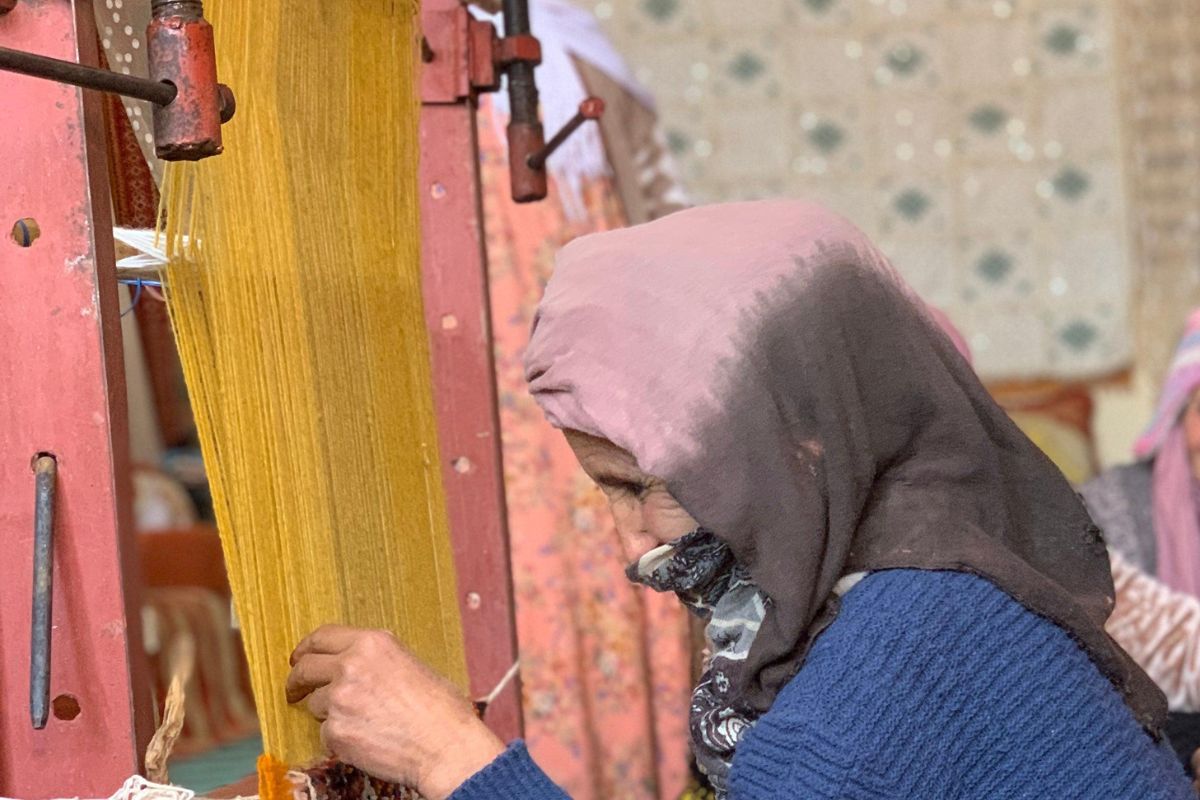
    Two settings, and the shift between them is recent enough to be reported rather than assumed. AFP photographed Ijja Benchri weaving on a wooden loom outside her small home in the village of Taznakht. Africanews described the same region's work moving from home-based weaving into cooperative workshops, framed as a way to secure steadier income and keep the profession alive as rural life changes.

    The cooperative is a legal form, not a metaphor. Moroccan cooperatives are governed by Law 112-12, published in the Bulletin Officiel of 18 December 2014, which replaced the earlier 1983 framework, defines what a cooperative may do and establishes a public register. Morocco World News reported on 1 May 2026 that the country counted 8,027 women's cooperatives at the end of 2025, with more than 73,700 members between them, around 12 percent of all cooperatives nationally. Those are national figures across every sector, not weaving alone, and should not be read as a count of weavers.

    The named organizations behind a style

    For one region the organizational picture is unusually clear, which is why this site keeps returning to it. Africanews reported on 2 July 2025 that the Women's Centre for the Promotion of the Taznakht Carpet, established in 2016, brings together 35 cooperatives and 3,500 women weavers and can produce up to 300 carpets a month, with Abderrahmane Janah named as its manager. That is a named institution, a named person and a dated report, and it is the level of specificity this subject can reach when someone bothers.

    Most named Moroccan styles do not have that. For the Azilal tradition and most of the Middle Atlas names on the Moroccan rug styles guide, the English-language record is thinner and consists largely of seller descriptions. The honest position is that the weavers behind those styles are equally real and are simply less documented in English, not that they are unknowable.

    Men are in this trade too, in different roles

    Saying women weave is not the same as saying the industry is women. AFP's reporting describes weavers travelling to a weekly market to sell to middlemen who set the prices, and the manager named at the Taznakht centre is a man. Urban workshop production, dyeing operations in Fes and Marrakech, export and retail are all part of the same chain.

    The point is not to score this, it is that the person who wove a rug and the person who prices it are usually not the same person and are frequently not the same gender. Where the money sits between them is covered in what happens to a rug's price between the loom and the showroom, and it is the single most useful thing a buyer can understand about this trade.

    What this site will not tell you about them

    Some things are being asserted about Moroccan weavers online that nobody publishing from a keyboard can actually verify, and this guide will not join in.

    • Individual earnings. AFP reported an average of about 250 dirhams, roughly 24 dollars, for a large rug sold to middlemen at the weekly market near Taznakht in December 2024. That is one named figure, from one place, at one date. It is not a wage, it is not a national average, and it does not describe what any particular weaver earns.
    • Working conditions. No page can tell you the conditions behind a specific rug. Certification schemes and cooperative membership are real signals, but they are not proof, and this site does not present them as such.
    • A cooperative's finances. Membership figures are published. Margins, payouts and internal accounts generally are not.
    • What a motif means to the woman who wove it. Symbol meanings are asserted with total confidence across the seller SERP and are frequently projections. What museum and academic sources do support is narrower: the Moroccan exhibition material states that certain designs are believed by weavers to ensure fertility or carry protective power, and Becker documents fertility symbolism as prevalent among the Ait Khabbash specifically. Bruno Barbatti's Berber Carpets of Morocco: The Symbols, Origin and Meaning pushes much further, reading the geometric vocabulary as a system of Neolithic fertility signs, and that reading is disputed. The criticism this guide could find is in reviews and commentary rather than in a published academic rebuttal we could read, so treat the whole area as contested rather than settled. What "vintage" means on a Moroccan rug applies the same caution to the other unregulated word in this trade.

    FAQ

    Are Moroccan rugs made by women?
    Mostly, yes, and it is well documented. Museum exhibition material, academic fieldwork and news reporting from Taznakht all describe weaving as women's work in Amazigh communities. Men are more commonly found in the selling, dyeing and export parts of the chain.

    Should I say Amazigh or Berber?
    Amazigh, plural Imazighen, is what many communities call themselves. Berber comes from an exonym and is the term the rug trade uses. This guide uses Amazigh for people and keeps Berber where it is the trade word a reader is searching.

    Do weavers work alone?
    Both. AFP photographed a weaver working at her own home loom, while Africanews described cooperative workshops in the same town. Larger looms can take more than one weaver at a time.

    Can I find out who wove a specific rug?
    Sometimes, and it is worth asking. Cooperative-direct sellers can often name the cooperative. A dealer who bought at a weekly market usually cannot, and a listing that says only "handmade by Berber artisans" is telling you nothing checkable.

    How many women weave in Morocco?
    There is no reliable national figure this guide can stand behind. Africanews reported 3,500 women weavers within one organization in Taznakht in July 2025. National cooperative counts cover every sector, not weaving, and many weavers work outside cooperatives entirely.