Tag: handwoven rugs

  • Rug Fading in Sunlight: Rotation and What Can’t Be Undone

    Rug Fading in Sunlight: Rotation and What Can’t Be Undone

    Sunlight fades a wool rug by breaking down the chemical bonds in its dye, not by warming or drying it, and that breakdown is permanent. Rotating the rug end to end every few months spreads the exposure evenly, so it ages as one piece instead of developing a bright strip by the window and a darker one under the sofa. UV-filtering window film or ordinary curtains cut the exposure that causes it in the first place. Nothing sold over the counter reverses fading that has already happened, whatever the label claims, so prevention and rotation are the whole strategy here, not a stopgap before a fix.

    What sunlight actually does to a rug's dye

    Sunlight is made up of visible light, infrared heat, and ultraviolet radiation, and it is specifically the UV component that does the damage. As reported by flooring-industry and window-treatment sources that study this closely, UV radiation breaks the chemical bonds that hold color to a fiber, which is a different mechanism from heat drying out a rug or foot traffic wearing down pile. That distinction matters because it explains why a rug can fade badly in a cool, air-conditioned room, and why a fading problem cannot be solved by anything that only manages temperature or humidity.

    This applies to both natural and synthetic dyes, though the chemistry differs between them. A hand-knotted Moroccan rug is usually dyed with plant sources such as madder root, indigo or henna, or with synthetic dyes depending on the piece, and both families of dye are made of the same kind of chemical bonds that UV light breaks down over time. Neither type of dye is UV-proof. Both simply degrade at different rates depending on the specific dye chemistry, how the wool itself was prepared, a factor covered in what makes rug wool worth paying for, and how much direct exposure the rug actually receives. No wool quality or dye type stops UV breakdown once a rug is genuinely exposed; it only changes the rate.

    Why rotation works, and how often to do it

    Rotation does not stop fading. It spreads it. A rug that is turned end to end every three to six months, a figure that appears consistently across rug-manufacturer care guidance, receives roughly the same cumulative light exposure across its whole surface instead of concentrating years of direct sun on one strip near a window. The result is a rug that gets gradually and evenly lighter over years rather than one with a sharply visible line between a bleached section and its original color.

    This is one of the four habits already covered in how to care for a Moroccan wool rug, and it costs nothing beyond remembering to do it. The same rotation habit matters even when a rug spends part of the year out of the room entirely; see storing a wool rug for a season or a year for what changes once light exposure isn't the immediate concern.

    Placement: the real prevention

    Rotation manages exposure you can't avoid. Placement reduces the exposure in the first place, and it is the more powerful lever of the two.

    • Furniture as a shield. A sofa, bookcase or table positioned between a window and the rug blocks direct beams during the hours they hit hardest, without touching the rug at all.
    • Curtains or blinds. A simple curtain closed during peak sun is one of the fastest ways to cut exposure, and side tracks or a bottom seal stop light sneaking in around the edges of a blind, which is where a rug near a window is most vulnerable.
    • UV-filtering window film. As reported by window-film manufacturers, a quality film can block a large majority of UV radiation while still letting visible light into the room. This is a permanent change to the window, not the rug, and it protects everything else in the room from the same damage, not just the floor.
    • Distance and orientation. Where the layout allows it, keeping a valuable rug out of a room's most direct light path, or accepting that a lighter, more replaceable rug goes in that spot instead, avoids the problem rather than managing it.

    Fading vs. dye bleed: the same rug, two different problems

    These two get confused constantly, and they are not the same failure. Fading is dye breaking down under light over months or years, and it happens whether the rug is ever wet or not. Dye bleed is color transferring between wet fibers during a spill or a wash, and it happens in minutes, not years. A pale patch by the window is fading. A pink stain spreading from a red section into a cream one after a spill is bleed. Dye bleed and color run: why natural dyes bleed too covers that second problem, including the common seller claim that only synthetic dyes bleed, which is not accurate. Knowing which one you are looking at changes what you do next: fading gets prevented going forward, bleed needs attention the moment it happens.

    What can't be undone at home, and what a specialist can sometimes do

    There is no product this site can verify that restores original dye chemistry once UV has broken it down. Anything marketed as a fading "repair" applied at home should be treated with the same skepticism this site applies to any uncited claim in this niche: test it on a hidden corner first if you try it at all, and do not expect it to reverse color loss that has already set in.

    What a rug restoration specialist can sometimes do is different, and it is a craft decision rather than a product application. On a valuable hand-knotted piece, a specialist may selectively redye a faded section to match the surrounding color, or in more extensive cases reweave the affected area entirely. Both are case-by-case judgments about a specific rug, its dyes and its condition, not a service this site can promise will be available or affordable for any given piece. If a faded area bothers you enough to consider this, the conversation to have is with a rug restoration specialist who works on hand-knotted pieces, not a general carpet cleaner, and the honest first question to ask them is whether the piece is worth the cost of the work.

    Telling sun fading apart from ordinary wear

    Sign Sun fading Ordinary wear
    Shape Follows the light, often a sharp line matching a window or door edge Follows foot traffic, usually a worn path or dulled center
    Speed Gradual, over months to years of exposure Gradual, tied to how much the rug is walked on
    Texture Pile texture usually unchanged; only color is affected Pile can flatten or thin along with any color change
    Reversible at home No Some evening-out is possible with grooming and rotation of traffic patterns

    FAQ

    Does rotating a rug really stop fading?
    It doesn't stop it, it spreads it evenly across the whole rug instead of concentrating years of exposure on one section, so the rug fades as a whole piece rather than developing an obvious two-tone patch.

    Can sun-faded wool rug color be restored at home?
    No. UV breaks the chemical bonds that hold dye to the fiber, and no product this site can verify reverses that. A rug restoration specialist can sometimes selectively redye or reweave a faded section on a valuable piece, but that is a craft judgment made rug by rug.

    Do UV window films actually help?
    As reported by window-film manufacturers, quality films block a large share of UV radiation while still letting visible light through, and they protect a whole room's contents, not just a rug directly under a window.

    Is a faded patch the same as a color-run stain?
    No. Fading is dye breaking down under light over months or years. Dye bleed is color transferring between wet fibers during a spill or wash, and it happens fast. They need different responses.

    How quickly does sun fading actually happen?
    It varies with dye type, wool quality and how much direct exposure a spot gets, and this site does not have a verified timeline to give. A rug in a sunroom with unfiltered south-facing windows will show it far sooner than one in a room with curtains and indirect light.
  • How to Store a Wool Rug for a Season or a Year

    How to Store a Wool Rug for a Season or a Year

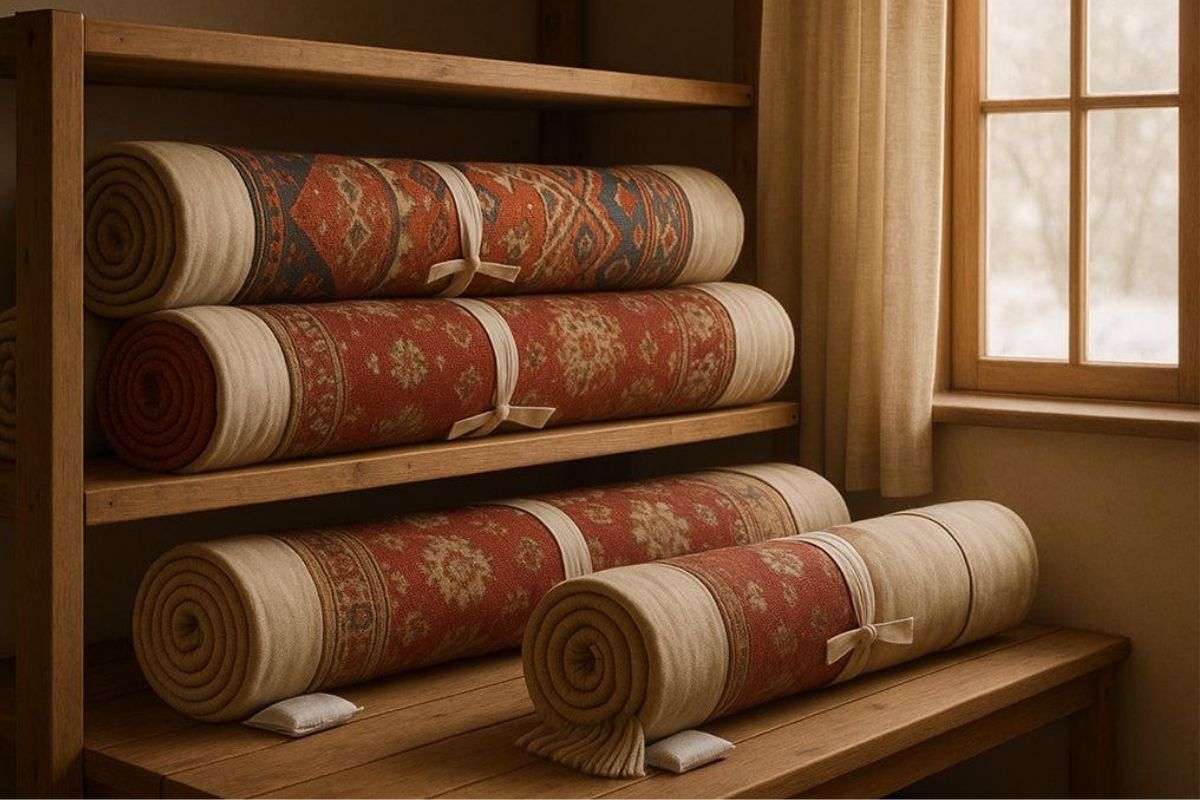
    Clean it and let it dry completely, then roll it, never fold it, with the pile facing in. Wrap it in a breathable material such as a cotton sheet or muslin rather than sealed plastic, and keep it off the floor in a dry, ventilated space out of direct sun. Check on it two or three times over the storage period rather than shutting the door and forgetting about it. Wool is a protein fiber, and the two things that actually damage it in storage are moisture trapped against the fiber and a dark, undisturbed space that carpet moth larvae find ideal. Get those two conditions right and time alone does very little harm.

    Why wool behaves differently in storage than a synthetic rug would

    Wool is a protein fiber, structurally closer to hair than to a plastic filament, and that single fact is what every piece of manufacturer wool-care guidance is built on. A synthetic rug rolled up in a garage for a year is mostly indifferent to the experience. A wool rug is not. The fiber absorbs and holds moisture more readily than synthetic pile, which is why a damp storage space produces mildew on wool well before it would show on a nylon or polypropylene rug. The same protein structure, keratin, is also the food source for carpet moth larvae. That is a separate risk from moisture, but it is made worse by the same conditions: dark, still, and undisturbed for months at a time. The University of Kentucky Extension Entomology fact sheet on clothes moths (ENTFACT-609) notes that "edges and undersides of rugs, or sections beneath furniture are more likely to be attacked," precisely because those are the areas that go longest without disturbance. A rolled rug in storage is that same condition applied to the entire piece.

    Before it goes anywhere: clean it and let it dry completely

    Storing a soiled rug is the single most avoidable mistake here. Body oils, food residue and pet dander left in the pile are exactly what draws moths to a stored rug, and rug-manufacturer storage guidance, Jaipur Rugs' own care guide is one example, is consistent on this point: clean the rug, either a thorough two-sided vacuum or a professional wash, before it goes into storage rather than after it comes back out. Cleaning products that quietly destroy wool covers what is safe to use on the fiber if you clean it yourself, and the same rule applies here as everywhere else on this site: test any product on a hidden corner first, and if the rug is old, valuable or naturally dyed, a professional wash before storage is the safer route. Washing a wool rug at home, or not walks through that decision.

    Drying matters as much as cleaning. A rug that goes into storage even slightly damp is a rug that grows mildew inside its own wrapping, out of sight, for months. Air it in a dry space until it is genuinely dry all the way through, not just dry on the surface, before you wrap anything.

    Roll it, don't fold it

    A hand-knotted rug is built from knots tied onto foundation threads, and a fold puts a sharp, permanent crease across every one of those threads in a single line. Rolled storage spreads the same mechanical stress evenly around a curve instead of concentrating it at a crease, which is why rug-manufacturer and rug-care guides are consistent on rolling over folding for anything beyond a few days. Roll with the pile facing inward, and use a wide cardboard or plastic tube as a core if you have one. A tighter roll puts more stress on the foundation than a looser one does.

    Wrap it right: breathable, not sealed plastic

    This is the point where storage advice most often contradicts itself, and it is worth resolving directly. Plastic sheeting feels protective. For long-term storage of a wool rug, it is closer to the opposite: a sealed plastic wrap traps whatever moisture is already in the fiber, or that gets in through a temperature swing between seasons, against the wool for months at a time. That trapped moisture is what produces both the musty smell and the fiber breakdown that ruins a stored rug. Rug-manufacturer storage guidance is consistent that a rug should be wrapped in something breathable, a cotton sheet or muslin, that lets residual moisture escape instead of sealing it in.

    That is not the same recommendation as the plastic wrap used during an active moth treatment. Professional guidance for treating an infestation that is already present, such as the routine published by Sonya Winner Rug Studio, does call for wrapping a treated rug in plastic for one to two weeks at a time between a spray application and a re-check. That is a short, active step, not a way to store a clean, dry rug for a season. It is an easy mix-up, since both involve plastic and both involve wool. The difference is duration and purpose: days to weeks during active treatment, never months of passive storage.

    A cedar block or a lavender sachet tucked into the wrapping is a reasonable, mild addition. Extension entomologists generally describe cedar and lavender as deterrents rather than a treatment for an infestation that is already established, since neither is a registered pesticide, so add one if you like but don't rely on it if you already suspect moths are active. If that is the situation you are actually in, carpet moths: how to tell if you have an active infestation is the page to read before you wrap anything.

    Where to keep it

    Dry and ventilated matters more than any specific room. A climate-controlled closet or a spare room beats a damp basement or an uninsulated attic that swings from freezing to hot across the year, because both standing damp and repeated condensation from temperature swings feed the same mildew risk as sealing a rug in plastic. Elevate the rolled rug off the floor, on a shelf or a pallet rather than directly on concrete or bare boards, and keep it out of direct sun even while it is only waiting to be moved, since sun fading does not pause because a rug happens to be propped against a window.

    Checking on it while it's stored

    A rug that gets checked periodically is a rug where a problem is caught at a few square inches instead of spreading through the whole roll. Unroll it, look and smell, two or three times over a season or a year rather than only at the end. This is also the moment you would catch the earliest sign of either mildew, a musty smell or discoloration, or moths, fine webbing, small pale cases, sandy grit near the edges, all covered in detail on the carpet moth infestation page.

    When to call a professional before storing, not after

    The riskiest version of this whole process is storing an old, valuable or naturally dyed rug without a professional clean first, because a stain or residue that would be routine to address before storage becomes a much harder problem after months sealed against the fiber. How to care for a Moroccan wool rug sets out the wider routine this fits into, and a specialist rug cleaner, not a general carpet cleaning service, is the right call for anything you are not confident handling yourself.

    FAQ

    Can I store a wool rug in a plastic storage bag?
    Not for long-term storage. A sealed plastic bag traps any residual moisture against the fiber, and that trapped moisture is what produces mildew and odor over months. Wrap it in a breathable material like cotton or muslin instead.

    How often should I check on a stored wool rug?
    Two or three times over the storage period is a reasonable interval, enough to catch mildew or an early moth problem before it spreads through the whole rolled rug.

    Should I fold or roll a wool rug for storage?
    Roll it, with the pile facing inward. Folding puts a permanent crease across the knots and foundation threads at the fold line, which rolling avoids.

    Do cedar blocks stop moths from getting into a stored rug?
    They act as a mild deterrent rather than a treatment. If you already suspect an active infestation, cedar alone will not resolve it. Check for the signs of active damage first.

    How long can a wool rug safely stay in storage?
    There is no fixed safe limit as long as it went in clean and completely dry, is wrapped in breathable material, and is checked periodically. The conditions matter far more than the duration itself.

  • Moroccan Rug Repair: Fringe, Edges and Holes Explained

    Moroccan Rug Repair: Fringe, Edges and Holes Explained

    Most damage on a hand-woven Moroccan rug is not a hole in the middle. It starts at an edge, and it starts because the parts that look like decoration are actually the parts holding the rug together. Understanding that one thing changes what counts as a repair and what counts as covering the problem up.

    This guide explains what each kind of damage is, structurally, and what a restorer is actually doing when they fix it. It does not price the work, it does not name a workshop, and it does not tell you whether your particular rug is worth restoring. We have not handled your rug, and this site does not appraise, authenticate or value anything.

    The fringe is the warp, and that is the whole point

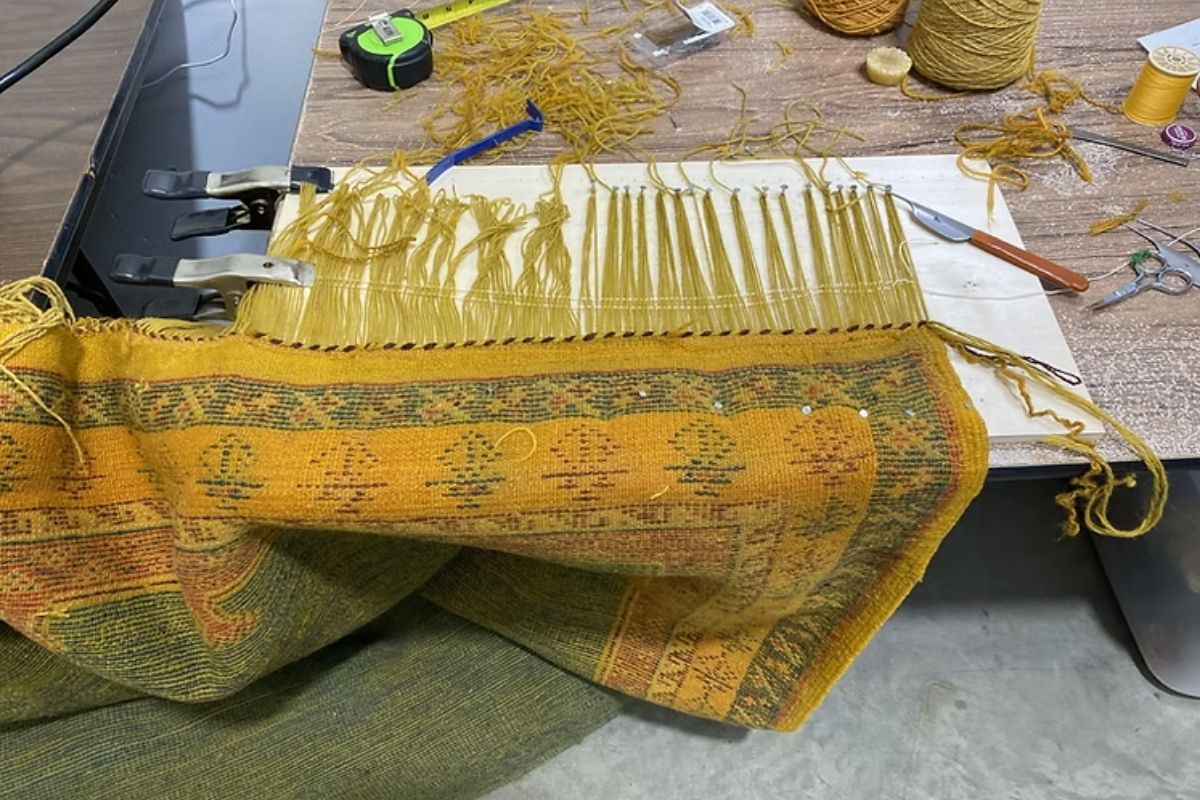
    On a hand-knotted or hand-woven rug, the fringe is not sewn on. It is the ends of the warp, the set of long threads that were strung on the loom before a single knot was tied. Every knot in the rug is tied around those threads. Every weft pass runs between them. The fringe you can see is the last few inches of the structural skeleton, left loose where the rug came off the loom and usually secured with a knotted or braided finish.

    Two consequences follow, and they are the reason this page exists.

    First, losing fringe is not a cosmetic event. A rug shedding fringe is a rug losing the ends of its warp, and once the securing finish at the end of the field goes, the wefts at that end have nothing holding them in place. They start to slide out. Behind them, the end rows of knots lose their anchoring and come away too. The rug does not stop at "no fringe." It carries on unraveling into the field, one row at a time, from the end inward.

    Second, a fringe that has been sewn on is a decoration and not a repair. A machine-made fringe tape stitched across the end of a rug replaces the look of the fringe and does nothing for the warp behind it. That may be exactly what a rug's owner wants, and there is no dishonesty in choosing it, but it should be chosen knowingly. If the end of the rug is unraveling, a stitched-on fringe hides the symptom while the cause continues.

    The honest repair at that end of the rug is to secure the warp ends again: to re-form the knotted or overcast finish that stops the wefts from migrating. A restorer may also rebuild a short band of the field where knots have already been lost, working new wefts and knots into the existing warp. That is real reweaving, it is slow, and it is priced accordingly.

    If you are not sure whether what you are looking at is a knotted pile rug, a flatweave, or a piece that mixes both techniques, that distinction changes what a repair even means, and our guide to flatweave and pile construction is the place to settle it before you get a quote.

    Side edges: the selvage, and why it goes first on one side

    The long sides of a rug are finished differently from the ends. Rather than loose warp ends, the sides carry a selvage: the outermost warp threads, usually bundled and wrapped or overcast with yarn so the edge is solid rather than raw.

    Selvage wear is the most common damage a Moroccan rug in daily use will show, and it is often worse on one side than the other. That asymmetry is usually explained by where the rug sits: the side nearest a doorway, a chair that gets pushed back, or a vacuum's turning point takes more abrasion than the side against a wall.

    When the wrapping yarn wears through, the bundled warps underneath are exposed. They abrade, then break, and the edge starts to open. A restorer's response is to re-wrap the selvage with new yarn over the existing warps, matching color as closely as the available wool allows, and to replace any broken warps in the bundle before wrapping over them. A rug that has been re-wrapped well shows a slight difference in tone along the repaired stretch. That is normal and it is not a sign of a bad job.

    What to avoid is the improvised version: sewing the opening edge shut with a household needle and thread, or running a bead of adhesive along it. Both pull the edge out of line, both are hard for a restorer to undo later, and adhesive in particular stiffens the wool and can discolor it.

    Holes: what caused it decides what is done about it

    A hole in the field of a rug is a symptom with several possible causes, and a restorer will want to know which one before touching it.

    Wear-through happens where the pile has been walked down to the foundation over years, usually in a traffic line or under a chair leg. The knots are gone, the warp and weft are exposed, and eventually they break.

    Moth damage looks different. Carpet moth larvae eat the wool pile, and they do it where they are undisturbed: under furniture, along the edge against a wall, on the underside of a folded rug. Moth damage is often a patch of bare foundation with the pile grazed away around it rather than a clean hole, and it is frequently accompanied by fine debris and silken casings. If that is what you have, the repair is the second job, not the first: an active infestation will eat the new wool as happily as the old.

    Burns, tears and pet damage are localized and usually obvious from their shape.

    For any of these, a restorer has two broad options.

    • Reweaving rebuilds the missing structure in place: new warps where warps are broken, new wefts, and new knots tied in the original technique, then the new pile trimmed to the height of the surrounding rug. Done well it is close to invisible from above and visible from the back, which is where a restorer's work usually shows.
    • Patching cuts a piece from a donor rug of similar construction and stitches it into the opening. It is faster and cheaper. It is also a compromise, because the patch's own warp does not continue into the rug's warp, so the join is a line of stress rather than a continuation of the structure.

    Neither is wrong. Which one is appropriate depends on the rug, on where the damage sits, and on what the owner wants from the piece. What we will not do here is tell you which one your rug deserves, or what either should cost. Rug restoration is priced by the hour and by the area, it varies enormously between workshops and between countries, and any figure published on a page like this one would be a number you could take to a workshop and find wrong.

    The flatwoven end bands are a separate problem

    Many Moroccan rugs, including a great many pile rugs, finish at each end with a band of flatweave before the fringe begins. On a piece that is flatwoven throughout, the whole rug is that structure. Flatweave has no pile to wear down, so it fails differently: the weft yarns abrade and part, and where two color blocks meet you can find slits along the join, which in some flatweaving traditions are structural rather than damage.

    That last point matters before you ask for a repair. A slit at a color boundary may be how the piece was made. Our guide to Moroccan kilims and hanbels covers the flatwoven end of the tradition and what its normal construction looks like, and it is worth reading before you describe something to a restorer as a fault.

    What to do before you call anyone

    Four things, in order, and none of them costs anything.

    1. Stop the damage spreading. If an end is unraveling, keep the rug off that end's traffic line and stop vacuuming over it with a rotating brush. If wefts are visibly sliding out, that end can be temporarily secured by a restorer far more cheaply than it can be rebuilt later.
    2. Rule out moths before you rule out wear. Check the underside, the parts under furniture and the edge against the wall. Moth treatment comes before repair, always, and it is a separate job.
    3. Photograph the front and the back of the damage. The back is where a restorer reads the construction, and most of the questions you will be asked over email are answerable from a back photograph.
    4. Ask the workshop what they will actually do, in the terms above: re-wrapping, re-securing warp ends, reweaving, patching, or a sewn-on fringe. If the answer is "we will fix the fringe" and no further detail is offered, ask which of those two fringe jobs is meant. It is a fair question and a good workshop will answer it plainly.

    What this guide deliberately does not tell you

    There is no cost figure anywhere on this page, no square-inch rate and no per-knot rate. There is no recommendation of a workshop, a country to send the rug to, or a shipping method. And there is no judgment on whether a given piece is "worth" restoring, because that depends on what the rug means to the person who owns it as much as on what it would sell for.

    What is worth saying plainly, and what most of this niche will not say, is that the vocabulary is loose. "Restoration," "conservation," "repair" and "re-fringing" are not defined or certified terms in this trade. Nobody regulates them. Two workshops can use the same word for different work at different prices, which is why the useful question is never "do you do restoration" but "what exactly will you do to this edge." That is the same problem that runs through the rest of this site's buying material, and if you have not read our explanation of what the trade's descriptive words do and do not mean, what a Berber rug actually is is the place that starts.

  • Why Your New Wool Rug Sheds, and When It Stops

    Why Your New Wool Rug Sheds, and When It Stops

    A new wool rug leaving fluff everywhere is normal, it is not a defect, and it decreases over time. The loose fibre is short offcuts left over from spinning and weaving working their way out of the pile, and removing them is what vacuuming is for. As for when it stops: care guidance consistently says it reduces with use and not one source checked for this guide commits to a timeframe, so this page will not invent one either. What matters more is telling shedding apart from the two things that look like it and are not.

    Where the fibre is actually coming from

    A wool yarn is spun from fibres of varying lengths. However well it is spun, some of those fibres are short, and short fibres are not fully locked into the twist. When the pile is cut and the rug is walked on, they work loose.

    That is the whole mechanism. There is a finite supply of them, which is why the rate falls: you are emptying a reservoir, not watching the rug come apart. The rug is losing offcuts, not structure. A hand-knotted rug in particular cannot shed itself away, because the pile is tied to the foundation knot by knot and each knot is anchored independently.

    Retail and care sources are consistent on this: a little fluff from a new wool rug is entirely expected, and the amount depends on how much traffic and use the rug gets.

    What makes one rug shed more than another

    Hand-spun versus machine-spun yarn. Hand-spun yarn is deliberately uneven and generally holds more short fibre, so a hand-spun rug often sheds more at the start. That is not a quality problem; it is the same irregularity that gives the rug its character. Judging wool quality without a lab covers the difference by hand.

    Pile height and density. A long, loose, shaggy pile of the kind common on Moroccan rugs holds more loose fibre and releases it more visibly than a tight low weave.

    Construction. Hand-knotted, hand-tufted and machine-made rugs shed differently, and tufted rugs can continue shedding well past the settling period as the adhesive backing ages. If you do not know which you have, what the back of the rug shows settles it in about ten seconds.

    How much it is used. A rug in a hallway empties its reservoir faster than one under a coffee table. More shedding early usually means less shedding later.

    What to do about it

    Vacuum, regularly and gently. That is the answer, and it is also the thing people avoid doing because they assume vacuuming is causing the shedding. It is not causing it, it is collecting it, and leaving the loose fibre in the pile just means it comes out onto the floor instead.

    Use a plain suction head with the rotating brush off. A spinning brush roll agitates the pile hard enough to pull out fibre that was not going to come out on its own, which is the one way vacuuming genuinely does make things worse. Vacuuming a wool pile rug without damaging it covers doing it properly.

    Do not trim or pull. If a longer strand is standing proud of the surface, snip it level with scissors rather than pulling it, since pulling can draw a whole length of yarn out of a knot.

    And be patient without being passive. Check occasionally that what you are seeing is still shedding, using the section below.

    Shedding versus pilling and fuzzing

    Different problem, different cause, and worth separating because one of them is fixable and one is your vacuum.

    Shedding is loose fibre lying on the floor and coming up in the vacuum. The pile itself looks normal.

    Pilling is small balls of tangled fibre forming on the surface, usually in traffic areas, from friction. Snip them off level with the pile. Do not pull.

    Fuzzing is a hazy, roughened surface where fibres have been broken rather than lifted. The usual cause is a vacuum's rotating brush roll, and the second most common is rubbing at a spill instead of blotting it. Fuzzing does not resolve on its own, so if it is spreading, look at your vacuum before you look at the rug.

    When it is not shedding at all

    This is the reason this page exists, because "shedding is normal" is reassurance that can be applied to the wrong problem for months.

    Carpet moth larvae feed on wool, and the debris they leave can be mistaken for ordinary shedding. The signs are specific and they are different:

    • Sandy or gritty debris, particularly along the edges and under furniture, rather than soft fluff.
    • Short cut fibre ends at the base of the pile, as if the pile has been trimmed from below, rather than whole loose fibres.
    • Thinning or bare patches in one area, especially a dark undisturbed one, rather than even fibre loss across the rug.
    • Fine silk webbing, or small pale tubular cases roughly 1 to 2 mm long tucked into the pile base.

    Two rules of thumb. Shedding is even and happens where you walk. Moth damage is localised and happens where you do not. And shedding gets less over time; moth damage gets worse.

    If any of that sounds like your rug, lift a corner and look underneath and along the edges today. Carpet moths: how to tell if you have an active infestation covers what you are looking for and how to tell current damage from old.

    For everything else, how to care for a Moroccan wool rug is the full routine.

    FAQ

    Is it normal for a new wool rug to shed?
    Yes. Short fibres left over from spinning and weaving work their way out of the pile, and the rate falls as that supply empties. It is not a defect and the rug is not coming apart.

    How long does a wool rug shed for?
    Care sources agree it decreases with use and none of them commits to a timeframe, so this guide will not state one. What matters more is that the amount is falling rather than rising.

    Does vacuuming make shedding worse?
    No, with the rotating brush switched off. Vacuuming collects fibre that is coming out anyway. A spinning brush roll does make it worse, by pulling out fibre that would have stayed put.

    Should I cut the loose fibres?
    Snip a long standing strand level with the pile. Never pull it, because pulling can draw a whole length of yarn out of its knot.

    How do I know it is shedding and not moths?
    Shedding is soft, even, and worst where you walk. Moth damage is gritty debris, short cut ends at the pile base and localised thinning, and it appears in dark undisturbed places. Shedding decreases over time; moth damage increases.

  • Vacuuming a Wool Rug Without Damaging the Pile

    Vacuuming a Wool Rug Without Damaging the Pile

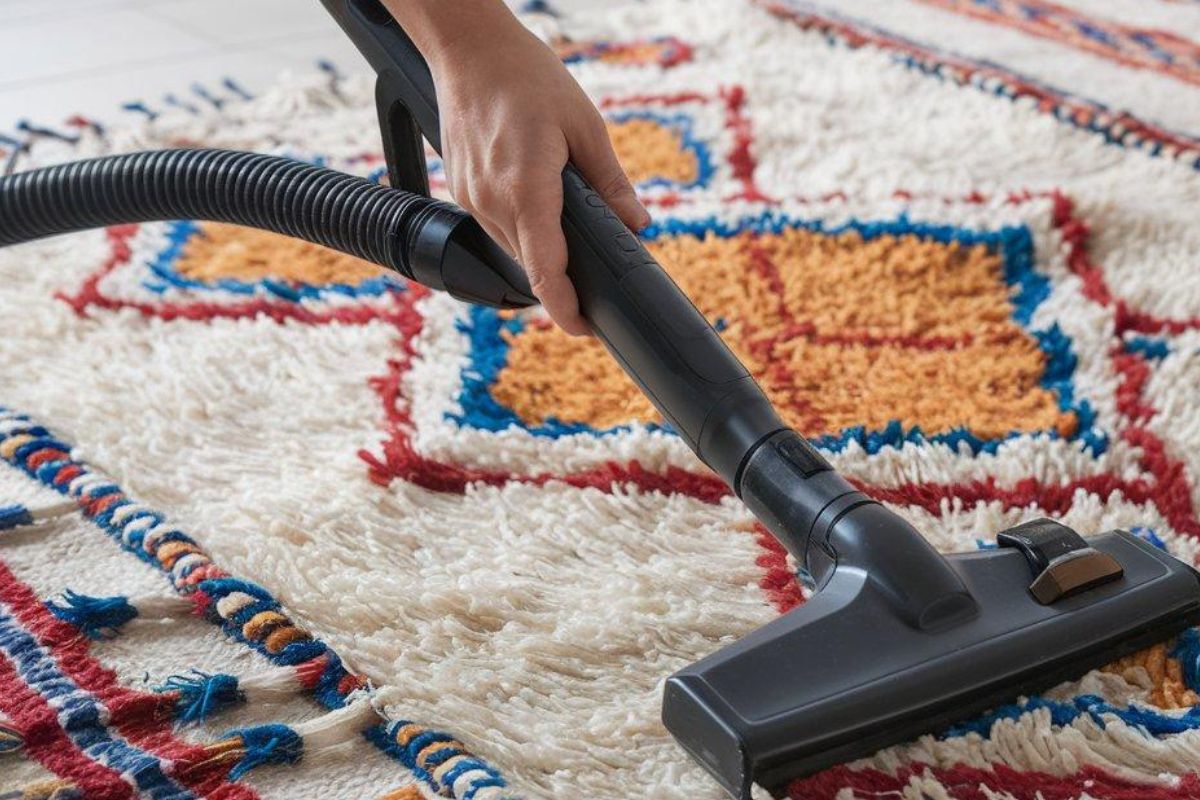
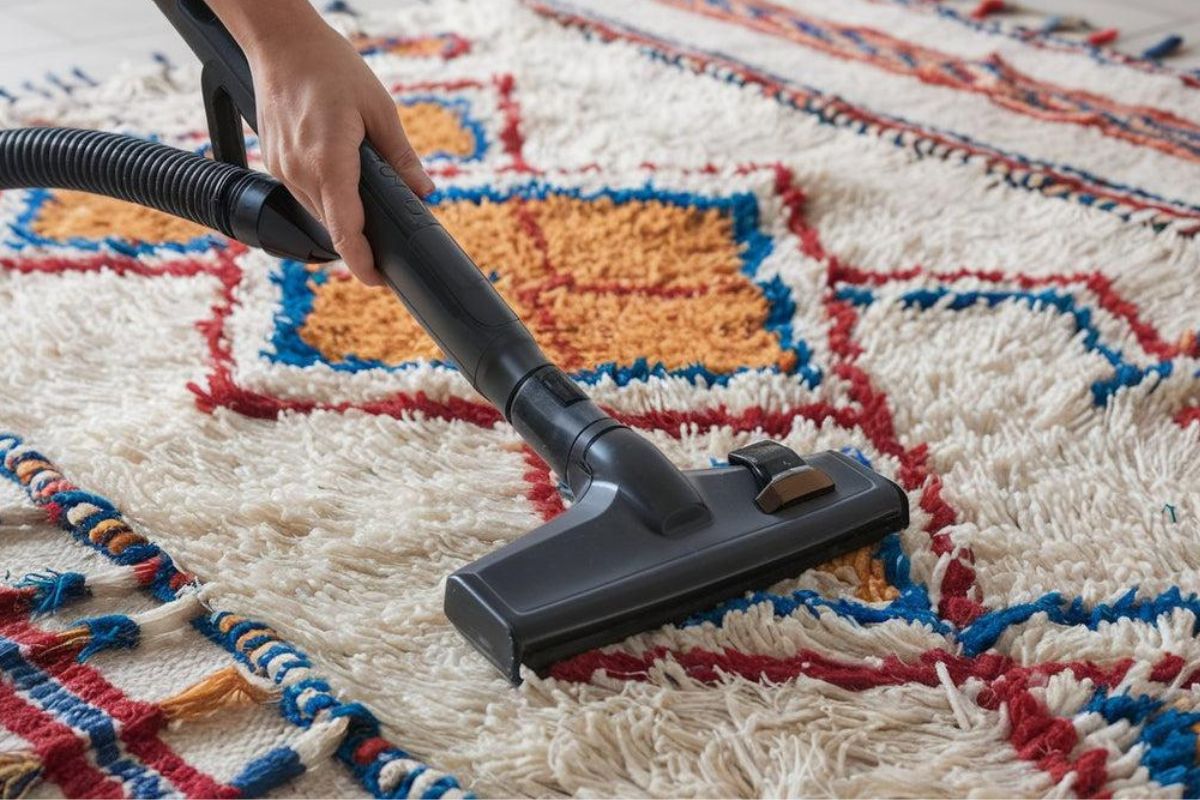
    Yes, vacuum it, and often. Switch the rotating brush roll or beater bar off, or use a bare-floor setting, and keep the machine off the fringe entirely. A spinning brush is the most common way owners damage a hand-knotted wool rug at home: it pulls and fuzzes the pile and can rip the fringe out at the ends, which is the one thing on this page you cannot undo. Work with the direction of the pile, without pressing down, and give the areas under furniture more attention than the open floor.

    What a beater bar actually does to a hand-knotted pile

    A brush roll is designed for tufted wall-to-wall carpet, where the pile is short, uniform, glued into a backing and effectively disposable. It works by agitating fibres to shake dirt loose, which is a reasonable trade on that surface.

    A hand-knotted wool pile is a different object. The pile is tied to the foundation knot by knot, it is often longer and looser on a Moroccan rug than on anything the machine was designed for, and there is no adhesive holding anything down. A stiff rotating brush catches individual tufts, works them loose over time, and raises a fuzzed surface where the fibres have been broken rather than lifted.

    The care guidance from rug specialists and manufacturers converges on the same instruction: turn it off, or use a setting that lifts it away from the pile. This is one of the few points in the whole niche where sellers, cleaners and manufacturers all agree.

    If your vacuum's brush roll cannot be switched off

    This is most people's actual situation, and the advice to "turn off the beater bar" is not much help if there is no switch. Options, roughly in order of preference:

    • Use the hose and a plain suction head. Every upright has one. A bare-floor or upholstery attachment has no rotating parts and is completely safe on wool. It is slower and it is the correct tool.
    • Raise the height setting to its maximum. If your machine has a pile-height adjustment, the highest setting lifts the brush away from the surface so it barely contacts the pile.
    • Use a canister or cylinder vacuum with a plain floor head if you have one in the house.
    • Vacuum the rug from underneath occasionally. Turning a rug over and vacuuming the back on a hard floor drives grit down out of the pile onto the floor, where you then sweep it up. This is genuinely effective and it is not something most people think to do.

    This site does not review, rank or recommend vacuum cleaners, and there is no need to buy anything: the attachment you need almost certainly came in the box.

    Direction, pressure and how often

    Direction. Run the head with the pile rather than against it. Brush a hand across the surface and you will feel which way it lies: one direction is smooth, the other resists. Going against the lay opens the pile and works grit deeper in.

    Pressure. None. Let the suction do the work. Pushing a head down into a long pile compresses it and achieves nothing except wear.

    How often. Regularly rather than intensively. General care guidance points to something like weekly for a rug in normal use, more in a traffic path and less in a quiet room, and this guide will not put a firmer number on it than the sources support. Frequent light vacuuming beats occasional aggressive vacuuming, because the damage grit does is abrasive and cumulative: sand and dust work down to the base of the pile and cut the fibres from below every time someone walks on it.

    That is the real argument for vacuuming a wool rug often. You are not removing surface dust for appearance, you are removing an abrasive.

    The fringe, which is where the irreversible damage happens

    Fringe is not decoration. On a hand-knotted rug it is the warp threads of the foundation, emerging from the body of the rug. Tear it off and you are pulling at the structure.

    A rotating brush catches fringe, wraps it, and rips it. It happens in a second and it cannot be undone at home; replacing or reweaving fringe is specialist work.

    So: keep the vacuum head off the fringe entirely. If the fringe needs cleaning, use the hose held slightly above it, or comb it gently with your fingers. Never run a powered head across it, and never let a robot vacuum near the ends of a fringed rug.

    Why the parts under the furniture matter most

    The instinct is to vacuum the open floor where the dirt shows. The parts that actually need it are the ones nobody walks on.

    Carpet moth larvae feed on wool and avoid light and disturbance, so they settle under sofas, along edges, behind doors, and on the underside of a rug that has not moved in two years. Damage there can be well advanced before anyone notices, because nothing about the visible part of the rug looks wrong.

    Moving furniture and vacuuming underneath a few times a year is the cheapest pest prevention available, and it doubles as the inspection. While the corner is up, look at the base of the pile for fine webbing, small pale tubular cases and sandy grit. Carpet moths: how to tell if you have an active infestation covers what those signs mean.

    One related question this answers: if vacuuming brings up a lot of loose fibre from a new rug, that is usually normal shedding rather than damage. Why your new wool rug sheds explains the difference, and what it means when it is not shedding.

    For the whole routine see how to care for a Moroccan wool rug, and before putting any product on the rug, cleaning products that quietly destroy wool. If you are unsure whether your rug is hand-knotted in the first place, what the back of the rug shows settles it.

    FAQ

    Can I vacuum a wool rug with a normal vacuum cleaner?
    Yes, with the rotating brush roll switched off or the height raised to maximum, and using a plain suction head where possible. Keep it off the fringe.

    Will a beater bar ruin my rug?
    It will not ruin it immediately, but repeated use fuzzes the pile by breaking fibres, and it can tear the fringe out in one pass. The fringe damage is the part that cannot be fixed at home.

    How often should I vacuum a wool rug?
    Roughly weekly in normal use, more in a traffic path. Frequent light vacuuming matters because grit at the base of the pile is abrasive and cuts fibres every time the rug is walked on.

    Should I vacuum the back of a wool rug?
    Occasionally, yes. Turning it over on a hard floor and vacuuming the back drives grit out of the pile onto the floor, where you can sweep it up. It is a genuinely useful habit.

    Can I use a robot vacuum on a hand-knotted rug?
    Keep it away from fringed ends, where the rotating parts can catch and pull. On the body of a low-pile rug it is less of a concern, but a plain suction head remains the safer tool.

  • How to Care for a Moroccan Wool Rug

    How to Care for a Moroccan Wool Rug

    Looking after a hand-knotted wool rug is five habits: vacuum it properly, deal with spills in the first few minutes, rotate it so light and traffic land evenly, check for moths a few times a year, and keep the wrong products away from it. That last one carries most of the weight, because most of the serious damage done to wool rugs at home is done by owners trying to clean them. Wool is a protein fibre. The things that work on synthetic carpet felt it, strip it, or bleach it permanently.

    Why wool needs different treatment from everything else on your floor

    Wool is protein, closer to hair than to plastic. That single fact explains almost every rule on this page.

    Professional rug cleaning sources are consistent about the constraints: wool wants pH-neutral treatment, with professional formulations described in the range of about 5.5 to 8.0. Push it alkaline and the fibre felts and shrinks, the lanolin that protects it is stripped, and the dyes become unstable. Add heat and all of that accelerates. Oxygen bleach, the active ingredient in most "oxy" spot cleaners, lightens wool permanently. Enzyme cleaners are designed to break down protein, which is exactly what the rug is made of.

    The other half of the picture is lanolin, the natural grease still present in good wool. It repels dirt and liquid, which is why a spill sits on the surface for a short while before soaking in, and why a wool rug in ordinary use stays cleaner than people expect. Strip the lanolin and you lose that.

    A Moroccan hand-knotted rug adds one more consideration: it is a one-off object. There is no replacement, which raises the cost of every experiment.

    Routine one: vacuuming, done correctly

    Vacuuming is the most valuable thing you do, and the most common way rugs get damaged.

    The rule that matters: turn the rotating brush roll or beater bar off, or use a bare-floor or upholstery setting. A spinning brush pulls and fuzzes a hand-knotted pile and can tear the fringe out at the ends, which is the one genuinely irreversible thing on this list. Vacuum with the direction of the pile, without forcing the machine down into it, and keep it off the fringe entirely.

    Do the parts under and behind furniture rather than only the open floor. Undisturbed areas are where carpet moth larvae live, so vacuuming there is pest control as much as cleaning. Vacuuming a wool pile rug without damaging it covers what to do if your machine's brush cannot be switched off, which is most machines.

    Routine two: dealing with a spill

    Speed matters more than technique. Lanolin buys you a short window before liquid absorbs, and using it is most of the job.

    Blot, do not rub, working from the outside of the spill inward so you do not spread it. Use plain water sparingly if you use anything, and never saturate the pile. If you use a product, it must state that it is safe for wool, be used exactly as its manufacturer directs, and be tested on a hidden corner first.

    Then stop earlier than you want to. Escalating through stronger products is how a small mark becomes a permanent pale patch. Spills on wool: what to do in the first five minutes is the page to have open when it happens.

    Routine three: rotation, placement and light

    Sunlight fades wool, unevenly, and the part by the window goes first. Rotate the rug end to end a couple of times a year so light and foot traffic land differently, and it ages evenly instead of developing a bright half and a worn path.

    Placement is worth thinking about once rather than regretting later. Direct sustained sun, a damp room, and the strip of floor where a door sweeps are all avoidable problems. Keep wool out of persistently damp spaces.

    Routine four: watching for moths

    Carpet moths are the one problem here that gets worse while you do nothing. The damage is done by larvae feeding on the wool, not by the adult moths you occasionally see, and they favour dark, undisturbed places: under furniture, along edges, the underside of a rug that never moves.

    Look two or three times a year. Lift a corner, look at the base of the pile along the edges and under anything heavy, and check for fine silk webbing, small pale tubular cases, and sandy grit. Carpet moths: how to tell if you have an active infestation covers exactly what those signs look like and how to tell current damage from old damage.

    What never goes on wool

    Categories rather than brands, because the category is what matters.

    • Oxygen bleach, including "oxy" spot cleaners. It lightens wool and the pale patch does not come back.
    • Chlorine bleach. Worse.
    • Enzyme cleaners. They break down protein, and the rug is protein.
    • High-alkaline all-purpose household cleaners, which is most of what is under a kitchen sink. Alkalinity felts wool, strips lanolin and destabilises dyes.
    • Hot water and heat, including steam, which compounds all of the above.
    • Soaking of any kind. Wool holds water, and a rug that stays damp develops mildew and odour that are harder to fix than the original problem.

    Never mix cleaning products. And whatever you do use, follow its own manufacturer's instructions and test it somewhere hidden first. Cleaning products that quietly destroy wool sorts the cupboard properly, and explains why this damage is invisible on the day and obvious a week later.

    When it is genuinely a professional's job

    Not as often as a cleaning company's website suggests, and not as rarely as a confident weekend suggests.

    Do it yourself: routine vacuuming, prompt blotting of ordinary spills, rotation, airing a rug outdoors on a dry day.

    Call someone: a full wash of anything old, valuable or naturally dyed; any spill that has set; pet accidents that have soaked into the foundation; a colour run; a confirmed moth infestation; and anything where the honest answer to "can I get this fully dry, fast and flat" is no. Drying is the part that goes wrong at home. Washing a wool rug at home, or not is built around exactly that question.

    When you do call, use a rug cleaning specialist rather than a general carpet cleaning service, and tell them the rug is hand-knotted wool and whether the dyes have ever run.

    If you are still choosing a rug rather than caring for one, how to buy a Moroccan rug without getting taken and the complete guide to Moroccan rug styles are the places to start. And if your new rug is leaving fluff everywhere, that is usually normal: why your new wool rug sheds.

    FAQ

    How often should I vacuum a wool rug?
    Roughly weekly, and more often in a traffic path, with the rotating brush switched off and the machine kept off the fringe. Include the areas under furniture, because that is where moth larvae live.

    Can I use a steam cleaner on a wool rug?
    No. Heat and saturation both damage wool, causing felting, shrinkage and dye movement, and a dense pile that stays damp develops odour and mildew.

    What is the worst thing to use on a wool rug?
    Oxygen bleach, sold as "oxy" spot cleaner. It bleaches wool permanently. High-alkaline household cleaners and enzyme cleaners are close behind.

    How do I know if my rug has moths?
    Look in dark, undisturbed places for fine silk webbing, pale tubular cases roughly 1 to 2 mm long at the base of the pile, and sandy grit near the edges. Adult moths flying around are a weaker signal than these.

    Do I need professional cleaning, and how often?
    Less often than cleaning companies suggest, and this guide will not quote an interval. Call a rug specialist for a full wash of anything old or naturally dyed, a set stain, a pet accident that reached the foundation, a colour run, or a confirmed moth infestation.

  • Shipping a Rug Home From Morocco: Three Routes

    Shipping a Rug Home From Morocco: Three Routes

    There are three ways to get a rug home: carry it yourself, let the seller arrange shipping, or hire your own courier or freight forwarder. They differ less in price than in who holds the risk if something goes wrong. Carrying it yourself is the only route where the rug never leaves your possession, and it is the option most buyers dismiss too quickly. Whichever you choose, the routine that protects you is the same: photograph the exact piece, get its measured dimensions in writing, and know who is actually carrying it.

    Route one: carrying it yourself

    Most buyers assume a rug is too big for luggage. Many are not. Wool folds and compresses considerably more than people expect, and a rug that looks impossible spread across a shop floor often flattens into a manageable bundle.

    The advantages are decisive when it works. The rug never leaves your hands, so substitution is impossible, non-delivery is impossible, and there is no customs paperwork happening without you. You also skip the entire question of who insured what.

    The limits are real too. Airline baggage allowances, oversize rules and excess fees vary by carrier, route and ticket class, and this guide will not quote any of them because they change and they differ for every reader. Check your own airline's published allowance before you buy, not after. A large, dense pile rug can be genuinely heavy, and weight is usually the binding constraint rather than size.

    If you are travelling on to other stops, factor in carrying it for the rest of the trip.

    Route two: seller-arranged shipping

    This is what most shops offer, often before you have finished deciding, and for a lot of buyers it is the practical answer. Shops that ship regularly have a relationship with a carrier and it usually works.

    The risk it introduces is substitution: the rug that arrives is not the rug you chose. This is not primarily a story about dishonesty. A shop with dozens of similar pieces, a rug rolled after you leave, and a week between purchase and dispatch creates room for an honest mix-up as well as a dishonest swap. Either way you are the one holding a rug you did not pick.

    The second risk is that recourse is remote. If something is wrong, your counterparty is a shop in another country, and whatever protection you have comes from your payment method rather than from the transaction itself.

    Ask three things before agreeing: who is the actual carrier, will you get a tracking number, and who bears the risk if the rug is lost or damaged in transit.

    Route three: your own courier or freight forwarder

    Arranging shipping yourself, through an international courier or a freight forwarder, puts a contracted third party between you and the shop.

    The advantage is that the carrier is accountable to you rather than to the seller, you choose the insurance, and the handover is documented. For a genuinely expensive rug this is usually the most defensible option.

    The costs are effort and money. You will be quoted on dimensional weight as well as actual weight, a rolled rug is an awkward shape, and someone has to get the rug from the shop to the depot. Some forwarders will collect. Ask before you assume.

    This is also the route where customs paperwork is most likely to be handled properly, which matters more than it sounds. Customs, duty and declared value on an imported rug covers what arrives with the rug.

    The evidence routine that protects you on any route

    Do this in the shop, before the rug is rolled. It takes four minutes and it is the difference between a dispute you can win and one you cannot.

    • Photograph the exact rug, front and back, whole and in close-up, with something in frame for scale. The back matters most, because it is effectively a fingerprint: no two hand-knotted rugs have the same irregularities. What the back of the rug shows explains what you are looking at.
    • Photograph any damage, repair or unusual feature. These are identifying marks.
    • Get measured dimensions on the receipt, taken at both ends and both sides, not a rounded description. Hand-woven rugs are rarely perfectly rectangular, and the exact numbers identify the piece.
    • Have the receipt describe the rug, including construction and any claim the seller made about it.
    • Photograph the rug being rolled, if you can do it without being strange about it.
    • Get the carrier name and tracking, not a promise that it will be sent.

    Insurance, damage and what to do on arrival

    Insurance follows declared value, which is the quiet trap. If the value declared for customs is lower than what you paid, that lower figure is usually the ceiling on any claim. A seller offering to declare a low value is not doing you a favour, and rug scams and the "avoid customs" offer covers why.

    Ask who insures the rug in transit and for how much. On seller-arranged shipping the honest answer is often nobody, and it is better to know that in the shop.

    On arrival, before you sign for anything if the carrier allows it: check the packaging for damage and note it on the delivery paperwork. Then unroll the rug and compare it against your photographs, particularly the back. Do this the day it arrives, because claim windows are short and they are defined by your carrier and your payment provider, not by this page.

    If the rug is wrong, returns and recourse covers the ladder in order. If you have not bought yet, buying a rug in the Marrakech souk covers the encounter itself, and how to buy a Moroccan rug without getting taken covers the whole set of risks. For unusually long or awkward pieces, Moroccan runners, rounds and odd shapes is worth reading before you commit to a size you then have to move.

    FAQ

    Can I take a Moroccan rug home in my luggage?
    Often yes. Wool compresses more than buyers expect, and weight is usually the binding limit rather than size. Check your own airline's published baggage and oversize rules before buying, since they vary by carrier, route and ticket.

    Is it safe to let the shop ship the rug for me?
    It usually works, and it introduces substitution and remote-recourse risk. Get the carrier name, a tracking number, and a receipt describing that specific rug with measured dimensions, and photograph the piece front and back before it is rolled.

    Who pays if the rug is damaged in transit?
    It depends on the carrier's terms and what was insured, and often the answer is nobody. Ask explicitly who insures it and for how much before the rug leaves the shop.

    Should I use a freight forwarder?
    For an expensive rug it is usually the most defensible route, because the carrier is accountable to you and you choose the insurance. It costs more effort and you will be quoted on dimensional weight.

    What is the single most useful thing to do before shipping?
    Photograph the back of the rug. The irregularities are effectively a fingerprint, and it is the evidence that settles a substitution dispute.

  • Moroccan Runner Rugs, Rounds and Odd Shapes

    Moroccan Runner Rugs, Rounds and Odd Shapes

    Genuine hand-knotted and handwoven Moroccan rugs do exist as runners (long, narrow pieces suited to hallways and stairs), particularly among flatweave traditions. Rounds are a different matter: they're mostly a modern reproduction-rug format rather than a traditional Moroccan output. And whatever shape you're after, a genuinely hand-knotted piece won't come in a fixed factory size the way a mass-produced rug does; it comes in whatever size the loom and the weaver actually produced.

    Two very different markets are hiding behind the same search term

    Search "Moroccan runner rug" or "Moroccan round rug" and most of what comes back is machine-made reproduction product from mainstream rug retailers (Amazon, big-box rug sites, and decor-focused online stores), sold in standard factory sizes: runners commonly listed from around 2×3 feet up through 8×10, 9×12, and larger, rounds commonly listed in fixed diameters like a 5-foot round. That's a real, legitimate product category, and there's nothing wrong with buying one if a consistent factory size and a lower price point matter more to you than a hand-knotted piece. But it's a different product from what the rest of this site covers, and conflating the two leads to mismatched expectations: someone expecting to shop a genuine hand-knotted runner the way they'd shop a standard-size reproduction rug is going to be looking for something that, by its nature, mostly doesn't exist that way.

    Runners: where they show up in genuine Moroccan weaving

    Long, narrow formats are a real, traditional output in some Moroccan weaving, particularly among flatweave traditions like Zanafi and the broader Moroccan kilim and hanbel family, where the flat construction lends itself naturally to a longer, narrower piece without the bulk a pile weave would add over the same length. A genuine hand-knotted pile runner also exists, but tends to be less common than a flatwoven one, since building a long, narrow, plush pile piece is a more demanding, time-intensive undertaking on the loom than a flatweave of the same dimensions.

    Whatever the construction, a genuine runner's exact length and width are a function of that specific loom and that specific piece, not a menu of standard options. If you need a very specific length, filling an exact hallway measurement, for instance, expect that to be the harder ask, not the easier one, when shopping genuine hand-knotted pieces rather than mass-produced reproductions.

    Rounds and other shapes: mostly a modern reproduction-rug format

    Round rugs are heavily marketed in the general decor-retail space, but this guide did not find evidence that round is a traditional Moroccan hand-weaving output the way rectangular and runner formats are. Most round "Moroccan-style" rugs on the market are machine-made reproductions manufactured specifically in that shape for the modern decor market, not a hand-knotted piece originally woven round. That doesn't make a round reproduction rug a bad purchase on its own terms. It's simply a different category from the hand-knotted traditions this site covers, and calling it "Moroccan" describes its design influence, not necessarily its origin or construction.

    Other irregular shapes (oval, hexagonal, custom-cut pieces) fall into the same bucket: they exist in the market, but predominantly as manufactured decor product cut or woven specifically to that shape for a modern retail audience, not as a traditional Moroccan weaving format this guide can document.

    Machine-made reproduction rugs vs. genuine hand-knotted pieces: why the size charts differ

    A machine-made rug is produced on equipment that can output a consistent size on demand: that's precisely the appeal of a standard size chart, and why reproduction retailers can confidently list 2×3, 5×8, 9×12, and every size in between. A genuinely hand-knotted or handwoven rug is produced by one person (or a small group) on a specific loom, over weeks or months, and its finished dimensions are the result of that particular weaving process, not a target size dialed in beforehand the way a factory setting is. That's precisely why hand-woven Moroccan rugs are widely described in the trade as irregular in size: a piece sold as "roughly 6×9" may run somewhat larger or smaller than that in either dimension, because it was never built to a fixed spec in the first place.

    This matters directly for anyone shopping by exact room measurements. See the complete guide to Moroccan rug styles for the wider identification context, but the size question specifically is worth internalizing on its own: a hand-knotted piece's dimensions are a description of what exists, not an order specification for what will be produced.

    What to expect if you want a specific size or shape in a genuine piece

    • Expect "roughly," not "exactly." A listed dimension on a genuine hand-woven piece is a description, with normal handmade variation built in, not a guaranteed precise measurement.
    • A specific exact length is a harder ask than a general size range. If a hallway genuinely needs an exact 27-inch width, that's a much narrower search than "a runner, roughly 2 to 3 feet wide."
    • Rounds and unusual shapes in genuine hand-knotted construction are rare enough that "Moroccan-style round rug" almost always means reproduction, not traditional weaving, worth knowing going in, rather than assuming a round piece is automatically a hand-knotted antique.
    • If exact dimensions matter more than authenticity, a reproduction rug is a legitimate, honest option. This guide isn't arguing everyone should only buy hand-knotted pieces, only that the two categories shouldn't be confused with each other while shopping.

    Measuring your space against an irregular piece

    Because a genuine hand-woven piece's dimensions are fixed by what was actually made rather than a size you select, the practical approach is to measure your space first and then shop within a range, rather than deciding on an exact number and searching for that precise figure. For a hallway runner, that usually means noting the minimum and maximum width the space can accommodate, and treating anything within that range as a candidate, rather than ruling out a piece that's an inch or two off a single target number. For a room where you're considering an unusual shape, the more useful question is often whether a standard rectangular piece (this site covers many genuine, well-documented styles) would actually serve the space just as well as the odd shape you originally had in mind.

    FAQ

    Do genuine Moroccan runner rugs exist?
    Yes, particularly among flatweave traditions like Zanafi and Moroccan kilim/hanbel, where the construction naturally suits a longer, narrower format.

    Are round Moroccan rugs traditional?
    This guide did not find evidence that round is a traditional hand-woven Moroccan output. Most round "Moroccan-style" rugs on the market are modern reproductions manufactured specifically in that shape.

    Why don't hand-knotted Moroccan rugs come in standard sizes like 5×8 or 9×12?
    Because they're produced by a person on a specific loom over an extended period, not manufactured to a fixed factory spec. Dimensions reflect what was actually woven, with normal handmade variation.

    Can I order a genuine Moroccan rug in an exact custom size?
    This is a much narrower, harder request than shopping standard reproduction sizes, since it depends on finding or commissioning a specific piece rather than selecting from a size chart. This guide cannot promise availability for any specific custom size.

    Is a machine-made reproduction "Moroccan-style" rug a bad choice?
    Not inherently. It's a legitimate, different product category with its own honest use case, particularly where an exact size, shape, or lower price point matters more than hand-knotted construction. The problem is only in confusing the two categories while shopping.

  • How to Identify a Moroccan Rug From a Photo

    How to Identify a Moroccan Rug From a Photo

    A photo can narrow down which named Moroccan style you're likely looking at, and can flag some obvious signs a rug isn't hand-knotted at all. What a photo cannot do is authenticate a specific rug: confirm its exact age, region, or maker with certainty. This site's own Disclaimer says the same thing about hands-on inspection: individual-rug authentication isn't something a guide can do from a distance, and a photo is an even thinner basis than an in-person look. What follows is what to actually check in the photos you have, or can request, without pretending a checklist settles more than it does.

    What the back of the rug shows, if you can get a photo of it

    If a listing includes a photo of the reverse side, look there first. Hand-knotted rugs show individual knots on the back, with natural, small irregularities in spacing and tension. No two knots are perfectly identical, because a person tied each one by hand. A machine-made rug, by contrast, typically shows a uniform, mesh-like backing with none of that hand-tied variation, since it was produced by a loom running a repeating mechanical pattern rather than a weaver's hands.

    Requesting a back-of-rug photo is a reasonable, low-friction ask of any seller. A seller who has nothing to hide about a piece's construction should be able to provide one without objection; one who resists or has only front-facing photos available is giving you less to work with, which is itself useful information.

    Wool, patina, and asymmetry: what a photo can and can't tell you

    Genuine Moroccan tribal rugs are overwhelmingly wool, sometimes with cotton in the warp threads specifically. In a photo, wool tends to show a certain depth and slight sheen that's hard to fake convincingly, though this is a soft, experience-based read rather than a definitive test. It gets easier to judge the more genuine pieces you've actually seen, and harder to trust from a single low-resolution photo of an unfamiliar piece.

    Vintage pieces often show a natural patina: a soft, uneven sheen and slightly muted coloring that develops from age and handling, rather than the flat, uniform coloring of a new synthetic-dye reproduction. Genuine handmade rugs also typically show slight asymmetry: a border that isn't perfectly even, a motif that shifts slightly across the field, which is a normal, expected feature of hand weaving, not a flaw. A rug that looks suspiciously perfect, with mechanically even borders and identical repeating motifs, is worth a second look, though "looks a little too perfect" is a prompt to ask more questions, not proof of anything on its own.

    Matching the pattern to a named style

    Once you've ruled out the more obvious "not handmade at all" signals, the next useful step is pattern-matching against the named styles this site already covers. An undyed ivory ground with sparse, dark geometric motifs points toward Beni Ourain or its denser relative Beni Mrirt. Bright, freehand, almost sketch-like patterns on a lighter ground point toward Azilal. Warm pinks, magentas, and reds in a denser weave point toward Boujad. A flat, patterned rug with the design visible on both sides points toward Zanafi or Moroccan kilim/hanbel. If none of those match and you're seeing an unusual, saturated palette of aubergine, mauve, tangerine, and ochre in a dense pattern, check Aït Bou Ichaouen or Talsint instead. Working through this site's own style pages this way will get you closer to a likely match than a generic "Moroccan rug" search will.

    Other signs a listing photo can reveal

    A few additional checks are worth running through before you get to the point of asking the seller anything:

    • Fringe. Genuine hand-knotted rugs usually have fringe that is a continuation of the warp threads running through the body of the rug, not a separate strip stitched onto the edge afterward. A fringe that looks glued, serged, or obviously sewn on as a distinct trim is a stronger giveaway of a machine-made reproduction than almost anything else visible in a photo.
    • Print versus weave. A genuinely woven pattern has texture and slight color variation within each motif, visible even at a moderate zoom. A printed pattern on a flat or minimally textured backing (common in cheaper decorative "Moroccan-style" rugs sold by mainstream furniture and decor retailers) tends to look flatter and more uniformly colored than a woven equivalent.
    • The listing's own language. Terms like "Moroccan-inspired," "Moroccan-style," or "Beni Ourain-style" are often used honestly by retailers selling machine-made reproductions, and are worth reading carefully rather than skimming past. They're a different product category from a hand-knotted piece attributed to an actual weaving tradition, priced and made very differently.

    None of these checks is definitive alone, and a confident answer on all three still isn't the same as an expert appraisal. But together they narrow the range meaningfully before you ever have to ask the seller a direct question.

    What to ask the seller for, if the photo alone isn't enough

    • A photo of the back, for the knot-versus-mesh check above.
    • Origin information, even if it's general: region, cooperative, or dealer source, rather than just "Morocco."
    • Material confirmation: wool content specifically, and whether any synthetic fiber is blended in.
    • A close-up of the pile or weave texture, if the listing photo is low-resolution or heavily filtered, since both can obscure the details above.

    A seller who can answer these specifically is giving you real information to work with. A listing that stays vague on all of them after being asked isn't necessarily dishonest, but it is offering you less than what a well-documented piece could provide.

    What this guide cannot do

    This guide, and any photo-based checklist, has real limits. It cannot confirm a specific rug's age. No photo-based method reliably does that, and this site does not publish age estimates it cannot support with a named source. It cannot confirm which specific tribe or cooperative made an individual piece, even when a general style is identifiable, since named attribution requires documentation this site has repeatedly noted is often missing even from sellers themselves. And it cannot substitute for an in-person, expert appraisal on a purchase where that level of certainty genuinely matters to you. Photos and questions narrow the range of likely answers; they don't settle them.

    FAQ

    Can I tell if a Moroccan rug is real from a photo alone?
    Partially. A photo can flag some signs a rug is machine-made rather than hand-knotted, and can help match it to a likely named style. It cannot authenticate a specific piece's age, region, or maker with certainty.

    What's the single most useful photo to ask a seller for?
    A clear photo of the back of the rug. It's the most reliable way to check for individual hand-tied knots versus a uniform machine-made mesh backing.

    Does asymmetry in the pattern mean a rug is fake?
    No, the opposite, generally. Slight asymmetry is a normal, expected feature of genuine hand weaving. A pattern that's mechanically perfect and identically repeating is more worth questioning than one with natural variation.

    How do I know which named style I'm looking at?
    Compare the palette and pattern density against this site's style pages, undyed and sparse points toward Beni Ourain, bright and freehand points toward Azilal, pink and dense points toward Boujad, and so on. See the full Moroccan rug styles guide for the complete list.

    Should I buy a rug based on photos alone, without an in-person look or expert opinion?
    For a significant purchase, that's a real risk this guide won't talk you out of taking seriously. Photos and seller questions reduce uncertainty; they don't eliminate it, and this site's own Disclaimer is explicit that it does not offer individual-rug authentication.

  • Flatweave vs Pile Rug: Which Moroccan Style Fits

    Flatweave vs Pile Rug: Which Moroccan Style Fits

    If you're choosing between a plush style like Beni Ourain and a flat one like Zanafi or a Moroccan kilim, the underlying question is construction, not just look. Flatweave rugs are thin, firm, and low-shedding, which suits high-traffic areas, hallways, dining rooms, and anywhere furniture needs to move freely or a door needs clearance. Pile rugs are thicker and softer, with vertical yarn that adds cushioning and sound absorption, which suits living rooms, bedrooms, and spaces where comfort underfoot matters more than low-profile practicality. Moroccan weaving produces genuine, distinct styles in both categories. This isn't a compromise choice.

    Quick comparison

    Flatweave Pile
    Thickness Thin, flat Thick, raised surface
    Feel underfoot Firm Soft, cushioned
    Shedding Minimal Noticeable, especially when new
    Best rooms Hallways, kitchens, dining rooms, stairs Living rooms, bedrooms
    Example Moroccan styles Zanafi, Moroccan kilim/hanbel, Boucherouite Beni Ourain, Beni Mrirt, Beni Mguild, Azilal, Boujad
    Reads on both sides? Often, yes No, pile faces one direction

    What "pile" actually means, and which Moroccan styles are pile

    A pile rug is built with vertical yarn, the pile, standing up from a woven backing, either left as loops or cut, giving the surface height, softness, and texture you can run a hand through. That construction is what makes a pile rug feel warm and cushioned underfoot, but it also means more surface area to trap dust and shed loose fiber, especially when new.

    On this site, the pile family includes the Middle Atlas styles built around plush wool: Beni Ourain, Beni Mrirt, and Beni Mguild, along with the denser, more colorful pile traditions like Azilal and Boujad. These are the rugs people picture when they imagine a thick, soft Moroccan rug underfoot in a photo, the ones that read as substantial the moment you step on them.

    What "flatweave" actually means, and which Moroccan styles are flatweave

    A flatweave rug has no raised pile at all. The warp and weft yarns are woven tightly together into a flat, thin surface, with the pattern visible on both the front and often the back of the piece. That construction produces a thinner, firmer, more durable-underfoot rug that lies flatter, wears differently than a pile rug, and generally sheds far less because there's no loose vertical fiber to begin with.

    Zanafi rugs, reversible flatweaves with a finished look on both sides, sit squarely in this category, as does the broader Moroccan kilim and hanbel family. Boucherouite rugs, the rag-weave style made from recycled textile scraps, are also generally flatwoven, which is part of why they can incorporate such varied, reused materials in the first place. A knotted pile construction would demand a much more uniform yarn supply than a rag weave does.

    Room-by-room fit

    Hallways, entryways, and stairs. A flatweave's low profile and durability make it the more practical choice anywhere a rug needs to withstand frequent foot traffic without bunching under a door or catching a shoe. A thick pile rug in a narrow, high-traffic hallway will show wear faster and can become a trip hazard if it isn't properly secured.

    Kitchens and dining rooms. Flatweave again, for the same reasons: easier to keep clean underfoot, and chair legs move across a flat surface more easily than across a deep pile, which matters directly under a dining table.

    Living rooms and bedrooms. This is where pile earns its keep: the comfort, warmth, and sound-dampening qualities of a plush Middle Atlas style are exactly what these rooms are for. A living room built around lounging on or near the floor, or a bedroom where bare feet hit the rug first thing in the morning, is the natural home for a Beni Ourain or Beni Mguild.

    Home offices and casual spaces. Either can work, depending on whether a rolling chair is involved. A flatweave handles a desk chair's wheels far better than a deep pile does; a low-pile option is a reasonable middle ground if comfort matters more than chair mobility.

    The middle ground: mixed-technique weaves

    Not every Moroccan weaving fits neatly into one category. Glaoui rugs combine flat, pile, and fringe techniques within a single piece, which is worth knowing if you've found one and are trying to judge how it will behave underfoot: parts of it will perform more like a flatweave, and parts more like a pile rug, within the same physical object. That's a genuinely different profile from either pure category, and one more reason "flatweave or pile" is a useful starting question rather than a rigid binary once you're looking at a specific named tradition.

    Spotting the difference in a photo

    Even without touching the rug, construction is often visible in a decent listing photo. A pile rug shows visible height and shadow along the surface, with individual tufts or a clearly textured field; a flatweave reads as flat and graphic in a photo, with the pattern rendered in solid blocks of color rather than a soft, textured surface. If a listing shows the back of the rug, that's an even stronger tell: a flatweave's pattern is usually visible, mirrored or near-identical, on the reverse side, while a pile rug's back shows the knot structure rather than the front-facing pattern itself. This is one of the more reliable checks available from a photo alone, compared to some of the harder authenticity questions covered in how to identify a Moroccan rug from a photo.

    What this doesn't determine

    Construction type says nothing about a rug's age, origin, or authenticity: those are separate questions covered on the individual style pages. A flatweave isn't automatically older or newer, more or less authentic, than a pile rug; it's a different, equally legitimate construction technique with its own named traditions behind it. Nor does construction type tell you whether a specific piece is hand-knotted or hand-woven at all. A machine-made reproduction can imitate the look of either category, which is a separate check covered elsewhere on this site.

    FAQ

    Is a flatweave rug lower quality than a pile rug?
    No. They're different constructions with different strengths, not a quality hierarchy. A well-made flatweave and a well-made pile rug are both genuine, skilled hand-weaving, suited to different practical uses.

    Which is better for a room with pets or kids?
    Flatweave generally holds up better to heavy, frequent use and sheds less, which matters in high-activity rooms. Pile rugs can still work in these spaces; they just need more maintenance and are more forgiving in lower-traffic rooms.

    Do flatweave Moroccan rugs shed less than pile ones?
    Generally yes, because there's no loose vertical pile fiber to shed in the first place. New pile rugs in particular can shed noticeably at first.

    Can a Moroccan rug be both pile and flatweave?
    Yes, Glaoui rugs are a documented mixed-technique tradition combining flat, pile, and fringe sections within one piece.

    Does construction type tell me anything about a rug's age or authenticity?
    No. Pile and flatweave are both long-standing, legitimate construction techniques across Moroccan weaving traditions. Neither one is inherently older, newer, more, or less authentic than the other.