A rug listing looks like a description and is mostly an argument. Read it by sorting every element into three buckets: verifiable (measured dimensions, a photograph of the back, the shop's stated policies, the platform's own rules), claims (age, "vintage," tribe, region, natural dyes, hand-spun wool), and decoration (the origin story, the word "authentic," the weaver narrative). Most of the words are in the third bucket. The one genuinely useful thing about buying on a platform is that some of the claims are made against rules the platform itself publishes.
The title, and what its keywords are doing
Listing titles in this category are written for search, not for you. A title like "Vintage Moroccan Berber Rug 5×8 Beni Ourain Style Handmade Wool Azilal" is a keyword string, and several of those terms are doing specific work.
"Style" is the tell to watch for. "Beni Ourain style" is not a claim that the rug is a Beni Ourain. It is a claim that it resembles one, and it is legally and commercially quite different. The same applies to "Moroccan style," which frequently describes a design influence on a rug made elsewhere entirely.
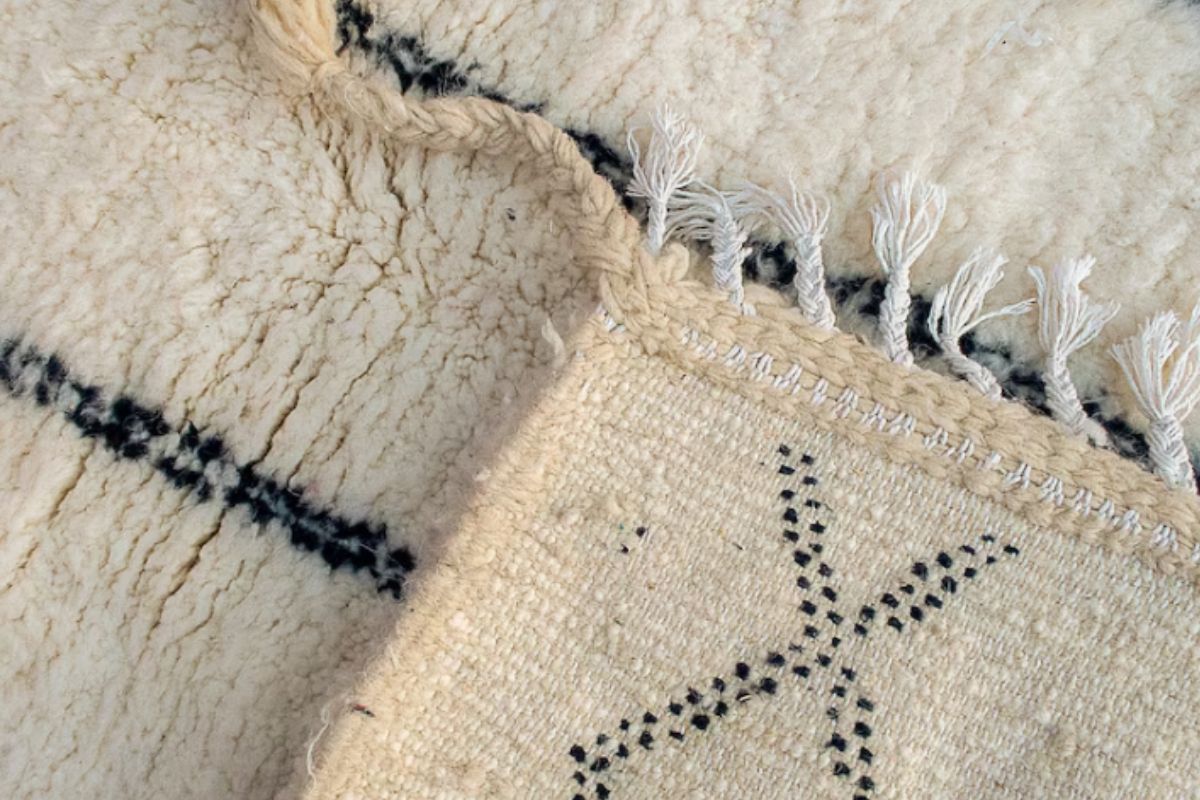
"Handmade" covers three products, as what the back of the rug shows sets out. A hand-tufted rug is genuinely handmade and is not hand-knotted.
Stacked style names are a warning. A rug cannot be a Beni Ourain and an Azilal and a Boujad. When several appear in one title, they are there for search traffic, and the seller is not making a provenance claim they intend to stand behind. The complete guide to Moroccan rug styles covers what the names actually refer to.
"Vintage" on a platform with a stated threshold
This is the most useful lever in the whole listing and almost nobody uses it.
Etsy's own published policy permits resale of vintage items that are over 20 years old, read on 2026-08-04. That means a seller listing in the vintage category is making a claim against a threshold the platform has set, not just using a marketing adjective. It is checkable, it is raisable with the seller, and if it turns out to be false it is raisable with the platform.
Set that beside what the Anou Cooperative, a weaver-owned organization in Morocco, wrote on 14 December 2020: "Moroccan vintage rugs don't really exist" at the volume and prices the online market offers, because the faded appearance is manufactured rather than accumulated. How new rugs are made to look old covers the processes, and what "vintage" actually means covers the vocabulary.
So the question to put to a seller is simple and specific: is this rug over twenty years old, and what is that based on? A confident, detailed answer is worth something. A vague one is worth knowing about. Platform policies change, so check the current version rather than relying on this page.
Dimensions, and the hand-woven measurement problem
Dimensions are in the verifiable bucket, but only if you ask properly.
Hand-woven rugs are rarely perfectly rectangular and listing sizes are routinely rounded. Ask for the measured length and width at both ends and both sides of that specific piece. If it is going into a defined space, that is the difference between fitting and not. Moroccan runners, rounds and odd shapes covers why exact sizes are harder to source in genuine pieces than the listings imply.
A listing that gives dimensions to the centimetre and describes the age as "circa 1970s" is telling you which of the two it actually measured.
The photographs: what is missing matters more than what is there
Go through the images asking what has not been shown.
Is there a photograph of the back? If not, request one. This is the single most valuable image in a rug listing and the most commonly absent.
Are the backgrounds consistent? Guidance on spotting resale and dropshipping notes that images from visibly different settings and sources suggest photographs gathered from elsewhere rather than taken of the item in hand.
Is the rug shown flat and whole, in daylight? Heavily styled interior shots, tight crops and dramatic angles are all ways of showing a rug without showing it. Ask for a plain flat shot and a short unfiltered video.
Are wear, repairs and stains shown? On a piece described as vintage, an absence of any condition photography is itself a condition report.
The provenance paragraph, which is the least verifiable part
This is the passage about the tribe, the mountain village, the weaver and what the diamonds mean. Read it as marketing copy, because that is what it is.
A seller several steps down a chain that runs weaver, weekly market, middleman, processing, export cannot generally know who wove a rug or when. Symbolic readings assigned to motifs are interpretation rather than documented fact, and this site says so wherever the subject arises. Confident tribal attribution to a specific group, stated as certainty, is normally an inference from appearance.
None of this makes the seller dishonest. Much of this copy is inherited from further up the chain and repeated in good faith. It just is not evidence, and it should not be carrying any part of the price. Is my Moroccan rug authentic covers what can actually be established.
Shop signals, and what platform protection covers
Volume against uniqueness. A shop offering hundreds of one-of-a-kind vintage pieces is describing a sourcing operation, not a personal collection. That is not disqualifying, and it is worth registering.
Reviews. Clusters of similarly worded reviews posted close together are flagged in general marketplace guidance as a signal worth weighing rather than a verdict.
Policies over promises. The returns window, who pays return shipping on a large heavy item, and how damage in transit is handled matter more than anything in the description. Buying a Moroccan rug online covers what to establish before paying.
What platform protection actually covers. Marketplace protections are defined by the platform and are generally aimed at items not arriving or arriving materially not as described. They are not an authentication service and they do not adjudicate whether a rug is as old as claimed. Consumer law varies by country and no country's rules are universal, so check your own and your card issuer's terms rather than assuming coverage.
This site sells nothing, carries no affiliate links, names no shop as trustworthy and recommends no platform. Platforms are named here only because the question is about them. For the whole set of failure modes see how to buy a Moroccan rug without getting taken.
FAQ
Are Moroccan rugs on Etsy authentic?
Some are. The category also contains machine-made reproductions and new rugs treated to look old. The listing itself cannot settle it, but a photograph of the back settles the construction question, which is the most expensive one to get wrong.
How old does a rug have to be to be listed as vintage on Etsy?
Etsy's published policy permits vintage resale for items over 20 years old, read on 2026-08-04. Platform policies change, so check the current version. It makes "vintage" a claim against a stated threshold rather than a free-floating adjective.
What does "Beni Ourain style" mean in a listing?
That the rug resembles one, not that it is one. "Style" is a significant qualifier and is worth noticing wherever it appears in a title.
What is the most useful question to ask an online rug seller?
Ask for a clear photograph of the back and of a folded corner. It settles whether the rug is hand-knotted, hand-tufted or machine-made, which no amount of description will.
Does buyer protection cover a rug that is not as old as claimed?
Generally not in the way buyers hope. Marketplace protections are aimed at non-delivery and material misdescription, and they are not an authentication service. Check your platform's current terms and your card issuer's protections.
Leave a Reply