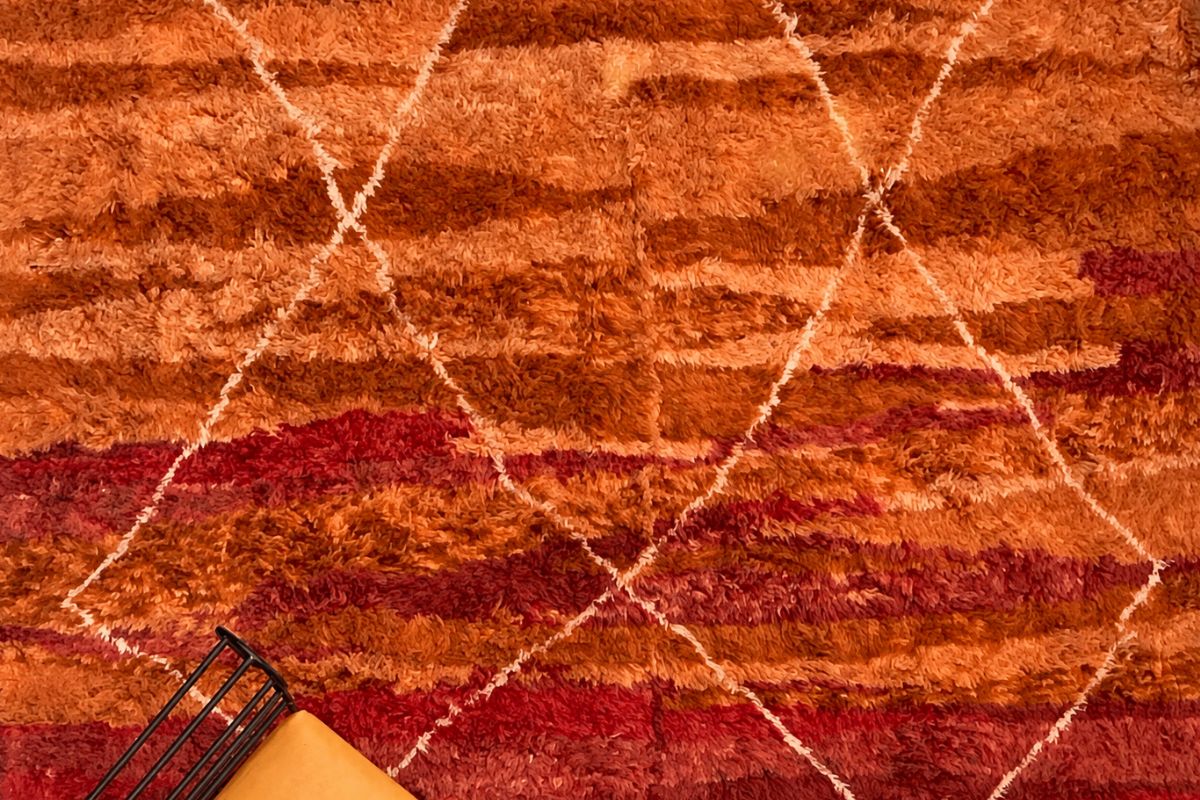
In the rug trade generally, "vintage" conventionally describes a piece roughly thirty to eighty years old, with "semi-antique" and "antique" sitting above it. That is a trade convention, not a regulated definition, and no authority enforces it. In the Moroccan market specifically the word has largely detached from age altogether and now describes an appearance: faded, muted, softened color. The Anou Cooperative, a weaver-owned organization in Morocco, stated the position directly in a post of 14 December 2020: "Moroccan vintage rugs don't really exist," at the volume and prices the online market offers.
Two answers, and page one only gives you the first
Search this question and you get a tidy vocabulary lesson. Dealer sites and rug lexicons, including Nazmiyal, Jozan's rug lexicon, Matt Camron, Rug & Kilim and others, broadly agree on a set of bands, and several are honest enough to add that the lines are widely used but not perfectly standardized.
That answer is genuinely useful. If you are talking to a dealer, it tells you what they probably mean.
What it does not tell you is whether the word on the listing in front of you has any relationship to the age of the object. In this particular category, very often it does not. Both answers are true at once, and you need both.
What the trade conventionally means
The bands you will see quoted, and the sources for them are rug dealers and trade lexicons rather than any standards body:
- Vintage: roughly thirty to eighty years old. The term is a relatively recent addition, covering pieces that are neither new nor antique.
- Semi-antique: roughly fifty to seventy-five years old, sometimes described as the sweet spot, with some patina but better condition than a true antique.
- Antique: at least eighty years old by most accounts, with a hundred years often treated as the threshold for a classic antique.
The bands overlap, different dealers draw them differently, and a piece one seller calls semi-antique another will call vintage. That inconsistency is not fraud. It is the ordinary looseness of trade vocabulary.
Why none of it is enforceable
There is no licensing body for rug dealers, no registry of Moroccan rugs, and no independent verification step anywhere in the chain between the loom and the listing. The words are marketing categories that the trade has settled into by habit.
Customs authorities and auction houses do use age thresholds for their own purposes, and those have real consequences, but they apply to declarations made to those institutions rather than to what a shop writes on a tag.
The practical upshot: "vintage" on a listing is a claim by the seller, at the same evidential level as "beautiful." If it is carrying a price premium, you are paying for an unverified assertion unless something else backs it up.
The Moroccan exception: the word came loose from age
Here is the part the vocabulary guides do not cover, and it is specific to this market.
The look associated with age in Moroccan rugs, muted color and softened contrast, can be produced deliberately in a matter of weeks. Anou's December 2020 post describes the methods used by the middlemen who supply the online market: rugs covered in dirt and walked on, laid out in the sun for extended periods, washed in a one-to-one water and bleach solution, sometimes treated with sulfur-heavy chemicals to speed the process, and in some cases blow torched to force fading. A follow-up post of 3 September 2021 adds that chemicals of this kind were banned by US rug washing facilities in the 1980s after causing lung complications in workers.
The market logic follows. Genuinely pre-2000 Moroccan pieces are collector items and are priced accordingly, so a large, cheap, readily available supply of "vintage" rugs on Etsy and Instagram cannot mostly be what the word implies. How new rugs are made to look old covers Anou's account in full.
Written in 2026, this describes the market as it stands now. It is the kind of thing that changes, and this page should be re-checked rather than assumed permanent.
What a seller can actually prove about age
Very little, and it is worth knowing the difference between proof and confidence.
Things that are not evidence of age: faded color, softness, uneven wear, a worn patch, the presence of natural dyes, a seller's certainty, or a certificate issued by the seller. Every one of those can be produced or asserted.
Things that count for something: a documented chain of ownership, a photograph of the rug in a dated setting, an auction or estate record, a purchase receipt from decades ago, or provenance from a named collection. These are rare in this market, which is precisely why they matter when they exist.
What an expert can add: a textile conservator or independent appraiser examining the piece in person can assess construction, dye chemistry and wear in ways that narrow the range. That is a judgment by a qualified person, not a date stamp, and it costs money. It is still worth more than anything you or this site can conclude from an image.
What to ask before you pay a vintage premium
- "How old do you believe this is, and how do you know?" The second half is the question. "It came from a dealer in Marrakech who said so" is a real answer, and it tells you the claim is second-hand.
- "Has this rug been washed or treated?" Chemical washing is standard in the trade and a straight seller will say so.
- "Will you put the age claim in writing on the invoice?" A seller confident in a claim will. One who will not has told you something useful without saying it.
- "What is your returns policy if the description is wrong?" More useful than the age claim itself, especially buying online or abroad.
- Decide whether you actually want age. If you like the faded look, buy the faded rug and pay for the look. The premium is the only part of this that requires the word to be true.
For the wider set of risks see how to buy a Moroccan rug without getting taken, and for what "authentic" means once age is set aside, is my Moroccan rug authentic. If it is the palette you are drawn to, where the Moroccan rug palette comes from is the honest version of that story, and what "Berber rug" actually means covers another word doing more work than it should.
FAQ
How old does a rug have to be to be called vintage?
By trade convention, roughly thirty to eighty years, with antique starting around eighty to a hundred. The convention comes from dealers and rug lexicons and is not enforced by any authority.
Are most "vintage" Moroccan rugs actually old?
Often not. The Anou Cooperative, a weaver-owned organization in Morocco, wrote in December 2020 that Moroccan vintage rugs "don't really exist" at the volume and prices the online market offers, and described the processes used to age new rugs artificially.
Is a chemically washed rug a bad rug?
Not necessarily, and washing is standard across much of the trade. The problem is paying an age premium for the result of a process, and the environmental and labor costs documented alongside it.
What is the difference between vintage and semi-antique?
Semi-antique is usually given as roughly fifty to seventy-five years and vintage as thirty to eighty, so the bands overlap. Different dealers draw the line differently and neither term is standardized.
How can I verify a rug's age before buying?
Ask for documentation rather than an opinion: ownership history, dated photographs, auction or estate records. Failing that, an independent appraiser examining the piece in person can narrow the range. Nothing else in this market verifies age.
Leave a Reply