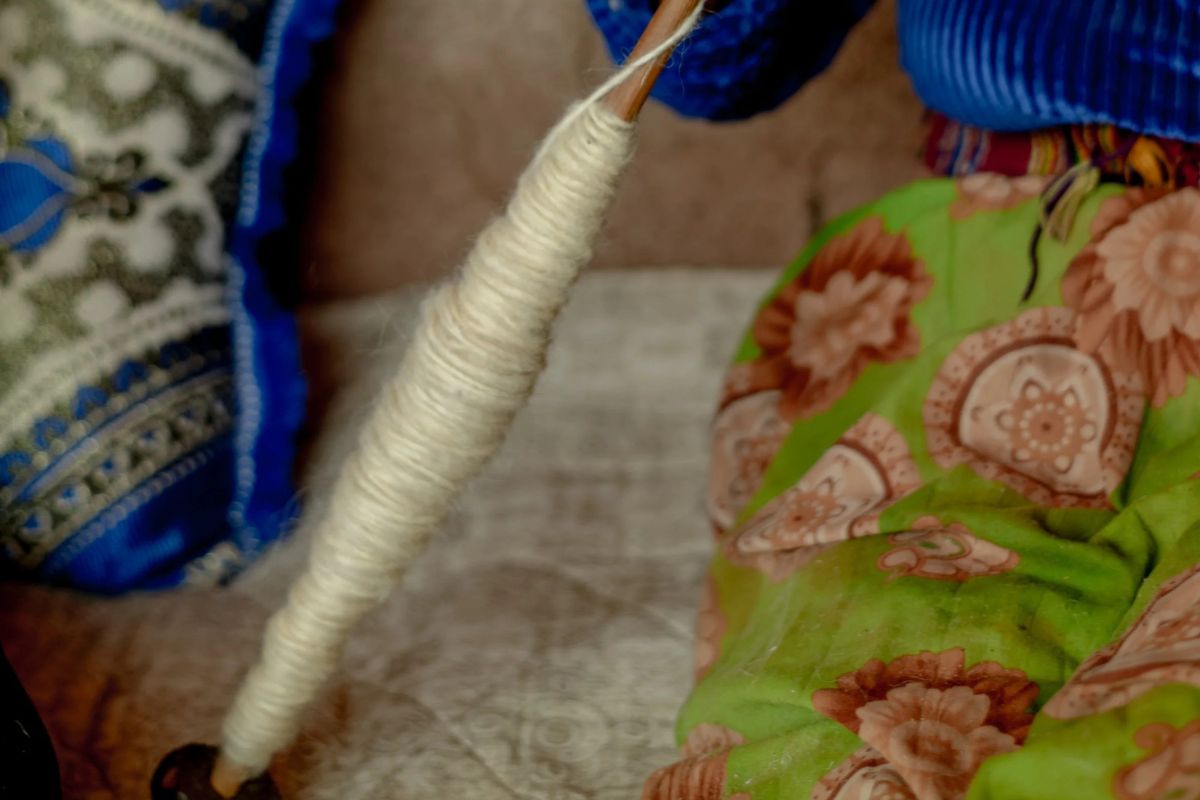
Before any weaving happens, the wool goes through five stages: the sheep is shorn, the fleece is sorted, it is washed to strip grease and dirt, it is carded so the fibers lie in one direction, and it is spun into yarn, traditionally on a hand-held drop spindle. Only then is it dyed and wound onto the loom. In the traditions behind Moroccan rugs this preparation is done by the same communities that weave, and increasingly by cooperatives that specialize in it. The Anou Cooperative, a weaver-owned Moroccan organization, described in a post of 15 May 2017 employing artisans to source wool directly from shepherds and then scour and spin it through cooperatives in the Middle and High Atlas.
Where the wool comes from, by breed
Moroccan rug wool is a livestock product before it is a craft material, and the livestock record is more specific than the rug record. The FAO's reference survey of small ruminants in the Near East, volume III covering North Africa, catalogues Morocco's sheep populations and their fleeces. It is a technical agricultural document, not a rug source, which is exactly why it is useful here.
| Population | Where | What the FAO survey records |
|---|---|---|
| Siroua | Southwest of Ouarzazate | Fine wool, used for the "carpet of Tazenakht" |
| Marmoucha | Taza district | Greasy fleece around 1.3 kg, long staple around 18 cm, coarse grade |
| Sardi | Western plateaus | Around 1.8 kg fleece, fibre diameter around 26 microns |
| Beni Guil | Eastern plateaus | Mixed fine and coarse staples in the Harcha variety |
| D'man | Southern oases | Light fleece, described as poor-quality wool with high kemp |
Two cautions. That survey compiles breed work going back to studies from the 1930s and 1950s, so read it as a description of breed characteristics rather than a snapshot of today's supply chain. And a breed name is not a rug label: no seller can tell you which animal a fleece came from, and this guide has not seen a Moroccan rug listing that could.
The Siroua entry is still the striking one. An agricultural reference work names that wool as the material of the Taznakht carpet, and AFP, reporting from Taznakht in December 2024, independently described weavers there using high-quality sheep wool from Jbel Sirwa. The Taznakht style guide covers what those rugs look like; the wool behind them is a documented regional product.
Sorting and washing
A raw fleece is not uniform. Wool from the back, the belly and the britch differ in length, fineness and cleanliness, and the soiled and heavily matted parts are separated out. Sorting is a judgment job and it is where the eventual character of the yarn is largely decided.
Washing, or scouring, removes the lanolin, the suint and the dust and vegetable matter caught in the fleece. How thoroughly it is done matters more than it sounds: wool that retains some of its natural grease behaves differently in a rug, resisting dirt and moisture and feeling springier under the hand. Industrial processing strips more of it out. That is why the hand test on a finished rug reads condition rather than origin, and why heavy chemical treatment later can undo everything this stage did. Judging wool quality without a lab covers what your hand can and cannot detect.
Carding
Carding pulls the washed fleece apart and aligns the fibers so they run roughly parallel, opening up clumps and removing remaining debris. Done by hand it uses a pair of toothed paddles worked against each other, producing a soft airy batt ready to be drawn out.
The step sounds mechanical and is not. How much the fibers are opened, and how evenly, sets how smoothly the yarn can be spun and how consistent the finished pile will be. Under-carded wool spins into lumpy yarn with weak points; over-processed wool loses loft. It is also the stage where short broken fibers can survive into the yarn, and short fibers are the ones that later work loose from the pile. If you want the practical consequence of that on a finished rug, why a wool rug sheds is the page.
Spinning, and the drop spindle
The traditional tool is the drop spindle: a weighted shaft, set spinning by hand, that twists a drawn-out length of carded wool into yarn while gravity keeps tension on it. The International Folk Art Market's profile of Atelier Talasin, a women's weaving cooperative in an Amazigh village in the Atlas, published on 11 April 2024, describes exactly this, local Siroua wool hand-spun on traditional drop spindles.
Handspun yarn is never perfectly even, because a person is drawing it out. Thickness varies slightly along a single strand, and that unevenness carries all the way through to the finished rug in two visible ways: a pile with subtle texture rather than a uniform surface, and dye that takes unevenly along the yarn, producing the soft horizontal banding across a field that the trade calls abrash. Machine-spun yarn is consistent by design, which is precisely why it looks flatter.
What changed, and why some yarn is not local at all
The romantic version of this article would stop at the spindle. The current reality includes a supply chain, and the most candid account of it comes from within the craft rather than from the retail end.
The Anou Cooperative's 2017 post describes a materials market shaped by intermediaries, arguing that middlemen retained on average 96 percent of a piece's final selling price, sometimes paying artisans in materials rather than cash, and that this left weavers unable to afford good wool. It reports one major supplier offering more than 90 percent synthetic material imported from India and China, and describes artisans suffering allergic reactions to wool treated with formaldehyde by dye workshops in Marrakech and Fes to bond cheap dye quickly. Those are that organization's own figures and claims, from a body founded to bypass intermediaries, and they are dated 2017.
Take from it the structural point rather than the percentage: the wool in a Moroccan rug is not automatically local, not automatically handspun, and not automatically untreated. Which of those is true of a given rug is a question for the seller.
Dyeing comes after spinning, not before
One sequencing detail that clears up a lot of confusion in listings: in these traditions the wool is generally spun first and dyed as yarn, rather than being dyed as loose fleece. That is why abrash follows the yarn's own thickness variation, and why a single skein's worth of slightly different color can appear as a band across a rug.
What goes into the dye pot is a separate question from how the wool was prepared, and it is one where the reporting is mixed. Africanews described weavers at the Taznakht centre in July 2025 using henna, pomegranate peel, saffron and indigo leaves. AFP, from the same town months earlier, noted that industrial dyes now commonly replace the natural ones. Both can be true in one town. The full comparison is in natural dye versus synthetic dye, including one claim about natural dyes that this site does not accept at face value.
What good preparation looks like in a finished rug
You cannot watch the fleece being sorted, so here is what survives into the object: a pile with slight irregularity along individual strands, some spring and recovery when pressed, gentle banding rather than flat uniform color, and shedding that settles down rather than continuing indefinitely. None of these proves handspun local wool on its own, and a hard chemical wash later can mask all of them, which is the honest limit of every visual check on this subject. The style most associated with heavy, high-loft fleece is covered in the Beni Ourain guide, and the coarse long-staple wool of the Taza mountain populations sits behind the Marmoucha tradition.
FAQ
How is wool prepared for a Moroccan rug?
Shearing, sorting the fleece, washing to remove grease and dirt, carding to align the fibers, then spinning into yarn, traditionally on a hand drop spindle. Dyeing usually comes after spinning.
What is a drop spindle?
A weighted shaft spun by hand that twists carded wool into yarn while hanging under its own weight. A 2024 profile of the Moroccan cooperative Atelier Talasin describes its weavers hand-spinning local Siroua wool on traditional drop spindles.
Where does Moroccan rug wool come from?
Regional sheep. The FAO's North African breed survey records the Siroua population southwest of Ouarzazate producing the fine wool used for the Taznakht carpet, alongside other populations with coarser or finer fleeces across the plateaus, mountains and oases.
Is all Moroccan rug wool local and handspun?
No. The weaver-owned Anou Cooperative reported in 2017 that intermediaries in the materials market were supplying largely synthetic imported material to artisans. Local handspun wool exists, but it cannot be assumed from a style name.
Why does the color band across my rug?
That is abrash, and it usually comes from handspun yarn taking dye unevenly along its length, or from a new batch of yarn entering partway up the weaving. It is a normal feature of hand-prepared wool rather than a flaw.
Leave a Reply