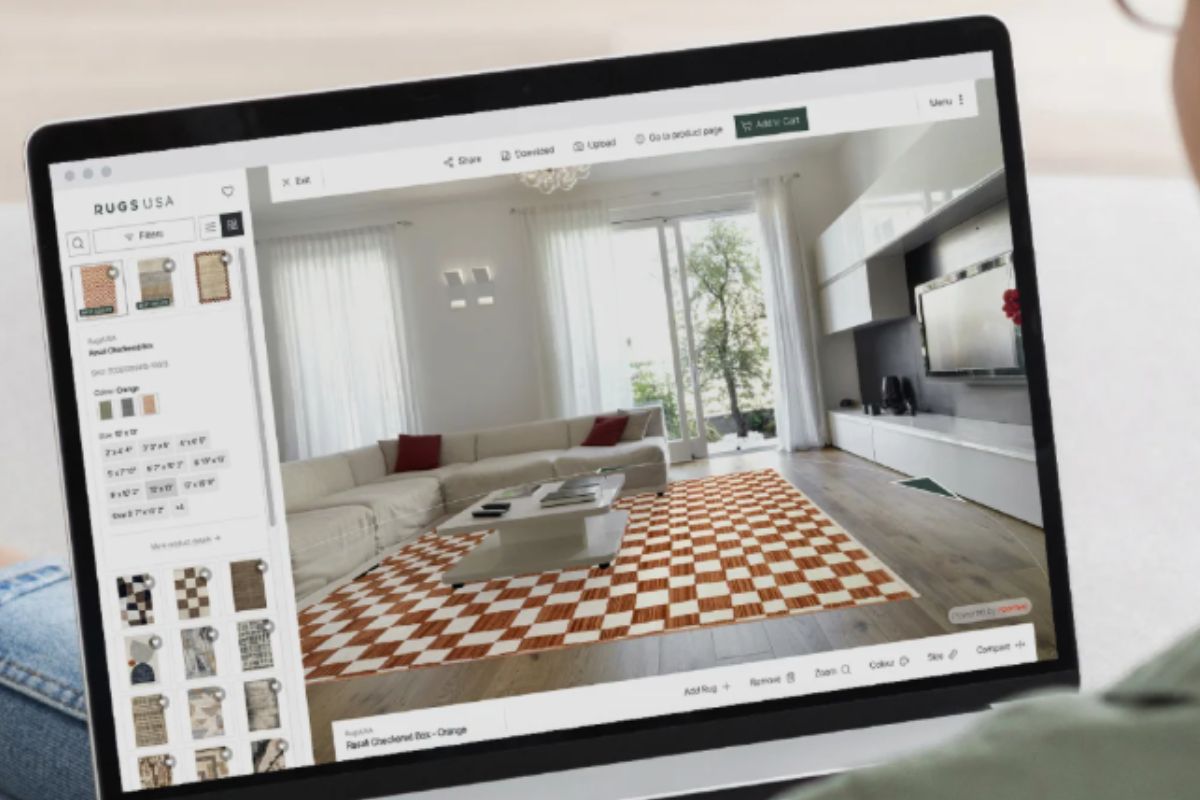
Everything this site recommends checking on a rug requires you to be standing next to it. Look at the back, feel the wool, smell it, and see the colour in your own light: those four checks answer most of the questions worth asking, and buying online removes all four at once. Two have workable substitutes you can request from a seller. Two do not. Knowing which is which, before you pay, is the difference between a considered remote purchase and a hopeful one.
Start from what you have lost, not what you can gain
Retailer guidance on buying rugs online is written from the opposite direction: here is how to choose well, here is how to picture it in your room. That is useful as far as it goes and it skips the part that matters.
The honest framing is subtractive. A rug is a physical object whose important properties are tactile, and a photograph is a flat image made by someone with an interest in how it looks. Everything below is organised around a specific loss and what, if anything, closes it.
None of this means buying online is a bad idea. Most people buying a Moroccan rug will never stand in a Moroccan souk, and remote sellers include serious ones. It means the checks have to be replaced deliberately rather than skipped quietly.
Loss one: the back of the rug
This is the biggest single loss, because the back is the one check that does not require trusting anybody. It tells you whether a rug is hand-knotted, hand-tufted or machine-made, and those are three products with very different costs and lifespans. What the back of the rug shows covers exactly what to look for.
The substitute exists and it is simple: ask for a photograph of the back. Ideally a close one, in daylight, plus one of the corner folded over so you can see where the pile meets the foundation.
A seller with a hand-knotted rug has no reason to refuse this, and it takes them a minute. A listing with twelve styled interior shots and nothing of the underside is worth a question, and an evasive answer to that question is itself an answer. This single request eliminates the most expensive misunderstanding available in this category.
Loss two: the wool in your hand
Whether the pile springs back, whether it has lanolin left in it, whether it feels dry and chalky: none of this survives a photograph, and it is the property that most determines how the rug lives with you. Judging wool quality without a lab covers what your hand would have told you.
There is no real substitute, and this guide will not pretend otherwise. What partially helps is asking directly and specifically: is the wool hand-spun or machine-spun, and has the rug been chemically washed and how. Those are answerable questions, and a seller who answers them precisely is telling you something about themselves as well as about the rug.
A returns policy that genuinely lets you feel the rug at home and send it back is the only complete answer to this one. That makes the returns terms a more important part of an online rug purchase than most buyers treat them as.
Loss three: colour, and what screens do to it
Rug colour photographs badly and the failures run in both directions. Screens vary, white balance shifts with the light the photograph was taken in, editing raises saturation, and a rug shot in bright Moroccan daylight will not look the same in a north-facing room in winter.
Partial substitute: ask for a short video taken in daylight, moving around the rug, with no filter. Motion and changing angles give you far more colour and texture information than any still. Ask for one photograph taken indoors under ordinary lighting as well.
What cannot be fixed remotely is how the colour will sit against your own floor and walls in your own light. Buy assuming some drift, and be more cautious with a rug whose appeal is a very specific shade. Where the Moroccan rug palette comes from covers what the colours actually are.
Loss four: smell, which is a construction signal
You cannot smell a listing, and smell carries real information. A strong rubber or glue odour indicates latex backing adhesive, which means a tufted or machine-made rug rather than a hand-knotted one. A bleach or chlorine smell on a piece sold as vintage points to the chemical washing used to fade rugs artificially. Why a new rug smells of chemicals sorts out which is which.
No substitute exists. The only mitigation is to ask the chemical-wash question directly and in writing before paying, so that if the rug arrives smelling of bleach you have something to point at.
Size, and why a hand-woven measurement is not a chart entry
A machine-made rug in a listed size is that size. A hand-knotted rug is whatever the loom produced, so descriptions get rounded and a piece sold as roughly six by nine may be neither.
Ask for the actual measured dimensions of that specific piece, at both ends and both sides, because hand-woven rugs are frequently not perfectly rectangular. If it is going into a tight space, that difference decides whether it fits.
What to establish in writing before you pay
- The return window, who pays return shipping, and whether a large rug is even returnable. On a purchase you cannot inspect first, this is the most important term in the transaction.
- Whether the rug has been chemically washed, and what the seller says was done to it.
- Construction, stated plainly: hand-knotted, hand-tufted or machine-made. Then check it against the photograph of the back when it arrives.
- Measured dimensions of that specific piece.
- Any age, region or tribe claim, in writing rather than in conversation, so a misdescription is something you can act on.
- What happens if it arrives damaged, and who insures it in transit.
- What your payment method protects. Card protections vary by issuer and country, so check your own terms rather than assuming. Platform protections are covered in reading an Etsy or 1stDibs listing properly.
This site sells nothing, carries no affiliate links, and recommends no seller or platform. For the wider set of failure modes see how to buy a Moroccan rug without getting taken, and if you are shopping for an unusual shape or a long narrow piece, Moroccan runners, rounds and odd shapes explains why exact sizes are harder to find than the listings suggest.
FAQ
Is it safe to buy a Moroccan rug online?
It can be, provided you replace the checks you have lost. Ask for a photograph of the back, a daylight video, measured dimensions, and a clear returns policy, and get any age or construction claim in writing.
What should I ask a seller before buying a rug online?
Photograph of the back and the folded corner, hand-spun or machine-spun wool, whether the rug has been chemically washed, exact measured dimensions, construction type, and the full returns terms including who pays return shipping.
Why does the rug look different from the photos?
Screens vary, white balance shifts with the light a photograph was taken in, and editing often raises saturation. A daylight video with no filter gives a much more reliable impression than a styled still.
Can I tell if a rug is hand-knotted from a listing photo?
Only if the listing shows the back. A photograph of the underside is the single most useful thing to request, and it settles the question that costs the most money to get wrong.
Does a returns policy matter more when buying a rug online?
Yes. It is the only complete substitute for feeling the wool yourself, so treat it as a central term of the purchase rather than fine print.
Leave a Reply