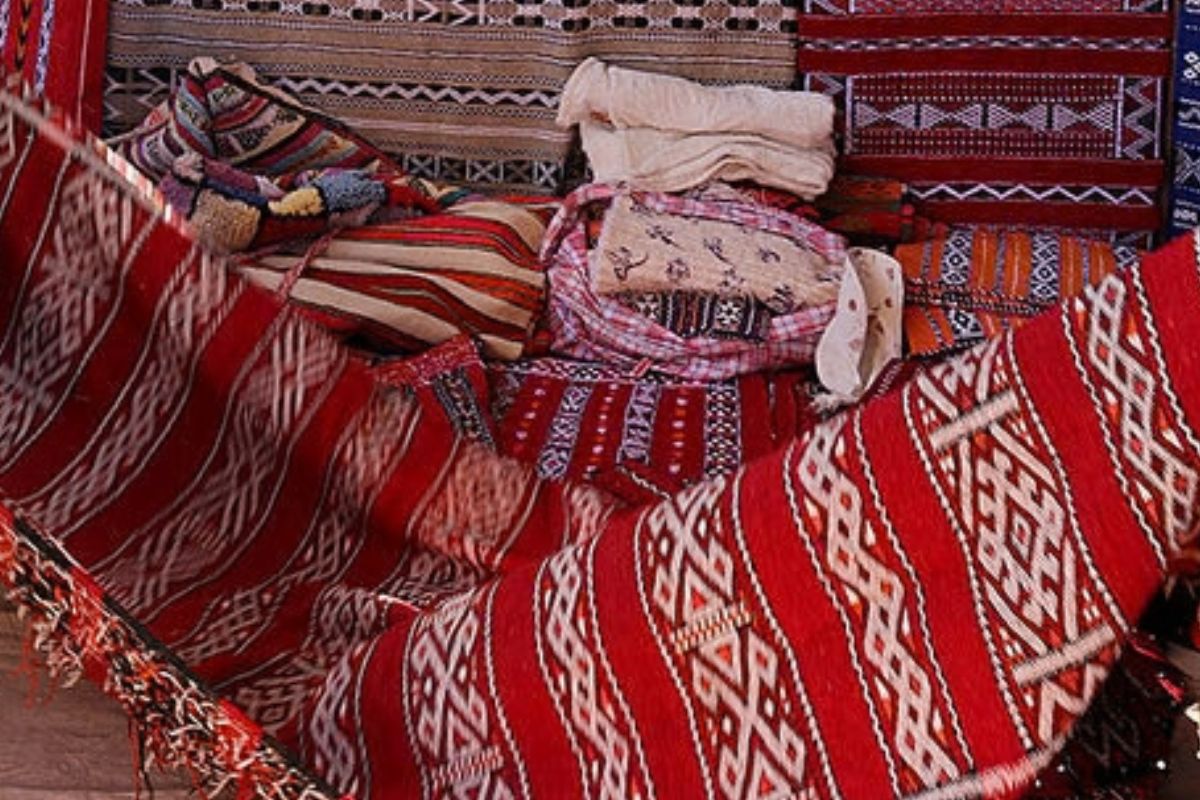
There is no reliable wage figure for Moroccan rug weavers, but there are documented prices. AFP reported in December 2024 that at the weekly market serving Taznakht, a large rug sells for about 250 Moroccan dirhams, around 24 US dollars at the time, often to middlemen who set the price, and that the same rugs sell in Marrakech bazaars for up to ten times that. That is a sale price for several weeks of work, from one market at one date. It is not an hourly wage, and it is not a figure for the whole country.
This guide sets out what has actually been reported about weaver pay, who the middlemen are (the answer surprises most people), why the gap between market and showroom is not all profit, and what a buyer can ask.
What is documented, and by whom
Every figure below is attributed to a named source with a date, read on 11 September 2026. Nothing here is an estimate by this site.
| What was reported | Source | Date |
|---|---|---|
| A large rug sells for about 250 dirhams (around $24) at a weekly market, often to middlemen who set the price | AFP, via Business Recorder | 18 December 2024 |
| The same rugs sell in Marrakech bazaars for up to ten times the original price; others are listed online at up to $6,000 | AFP, same report | 18 December 2024 |
| A carpet takes two to four weeks to make, depending on size | AFP, same report | 18 December 2024 |
| Artisans making rugs later sold as "vintage" earn "as little as 5 dirham a day," less than 5% of minimum wage | Anou Cooperative blog | 14 December 2020 |
| Sabra textile artisans earning 10 dirhams a day where the minimum agricultural wage is 70 dirhams a day | Anou Cooperative blog | 5 March 2018 |
| At the Khemisset rug market, women sellers grade carpets, set a price and take a commission | Christian Science Monitor | October 2019 |
Two cautions on reading that table. The 2018 Anou figure is about sabra, a different textile product, and is included only because it states the wage comparison explicitly. The 2020 Anou figure describes a specific part of the trade, rugs made to order and then processed to look old, not every weaver in Morocco.
One more figure circulates in some coverage of this topic: that weavers receive around 4 percent of the final sale. This guide could not trace it to a source it could read, so it is not used here.
Why 250 dirhams is not a wage
It is tempting to divide 250 dirhams by three weeks and call the result a daily rate. The reporting does not support that arithmetic.
The AFP figure is what one large rug sold for at one market. The report does not say whether the weaver bought her own wool, who did the spinning and dyeing, how many people worked on the rug, or how many hours a week went into it. Each of those changes what the sale price means as pay. What the figure does show is the order of magnitude a weaver can receive at that first sale, and who controls it.
A weaver AFP spoke to put the control point plainly: "The intermediaries decide the price, and we have no choice but to accept it because this is our livelihood."
Who the middlemen are
Most readers picture the middleman as a man from the city. The documented picture is more varied, and it matters for understanding where the money goes.
Many of them are women. Anou's December 2020 post states that "the vast majority of middlemen of rugs, are in fact women." They commission rugs, direct the designs, and handle processing and sale.
Some sell on commission rather than buying outright. The Christian Science Monitor's 2019 report from Khemisset, a town about 60 miles east-southeast of Rabat below the Atlas Mountains, describes a Tuesday rug market where roughly 40 local saleswomen work with about 400 women from surrounding villages. Dealers arrive from Fez, Rabat and Marrakech. One seller, Fatima Rifiya, describes the model: they grade the carpets, explain the values to the weavers, and "set a price and our commission."
Some buy outright and set the price. That is the arrangement AFP describes at Taznakht, where weavers bring rugs to a Thursday market and sell to intermediaries who decide what to pay.
These are two genuinely different arrangements. A commission seller's income rises when the weaver's price rises. A buyer who purchases outright profits from buying low. Which arrangement a rug passed through is rarely stated on a listing, and it is one of the most useful things a buyer could know.
Why the gap is not all profit
Up to ten times between a weekly market and a Marrakech bazaar sounds like pure margin. Some of it is. Some of it is real cost.
Between the market and a buyer's floor, a rug may be washed, repaired, stored, photographed, transported, exported, imported, insured and held in stock until it sells. Rugs that never sell have to be paid for by the ones that do. Why the same rug costs more in a showroom walks that chain step by step and separates the costs from the margin.
One step deserves separate mention because it can multiply the price without adding anything the weaver is paid for. Anou describes new rugs being chemically washed, sun-bleached and sometimes torched to look old, then sold as vintage. The weaver was paid for a new rug. How new rugs are made to look old covers that process.
What is changing it
Both news reports describe interventions as well as the problem. AFP reported a new exhibition space in Taznakht that allows some weavers to sell directly to buyers, bypassing middlemen, and quoted Safia Imnoutres, who leads a local women's weaving cooperative. Africanews reported in July 2025 that the Women's Centre for the Promotion of the Taznakht Carpet, established in 2016, brings together 35 cooperatives and 3,500 women weavers. The Taznakht rug guide covers the rugs that come from that area.
This site cannot measure from abroad whether those changes are raising what weavers earn, and no source it read reports that outcome in figures. What the reporting does establish is the mechanism: the less of the chain between the weaver and the buyer, the more of the price can reach the loom.
What a buyer can actually ask
A buyer cannot audit a supply chain. A buyer can ask questions whose answers are informative whichever way they go.
- Who sold this rug first, and to whom? A seller who knows the cooperative or the weaver will say so. A seller who bought at a market may not know, and an honest one will tell you that.
- Was the weaver paid a price, or a commission on the sale? This separates the Khemisset model from the Taznakht one.
- Was the rug processed after it left the weaver? Washing and aging steps change the price without changing what she was paid.
- What did the weaver receive? Few sellers will answer. The ones who can, specifically, are telling you something about their chain.
In the souk itself, buying a rug in the Marrakech souk covers what to expect, and what actually drives a Moroccan rug's price covers why two similar rugs can be priced very differently. This site sells no rugs, carries no affiliate links and does not rank sellers.
FAQ
How much do Moroccan rug weavers get paid?
There is no reliable wage figure. AFP reported in December 2024 that a large rug sold at the weekly market serving Taznakht for about 250 dirhams, roughly 24 US dollars, often to middlemen who set the price. That is one sale price at one market, not a wage.
How much of the retail price reaches the weaver?
No verified percentage exists that this site could read. AFP reported that rugs bought at the Taznakht market sell in Marrakech bazaars for up to ten times the market price. Part of that gap is real cost and part is margin.
Who are the middlemen in the Moroccan rug trade?
Often women. The Anou Cooperative wrote in December 2020 that the vast majority of rug middlemen are women. At Khemisset, the Christian Science Monitor described women sellers who grade rugs, set prices and take a commission.
Does buying from a cooperative pay the weaver more?
It shortens the chain, which is the documented mechanism for more of the price reaching the weaver. It does not guarantee a particular amount, and a seller who can say specifically what the weaver received is giving you more than one who only says "cooperative."
Leave a Reply