Tag: Amazigh weaving

  • How Moroccan Rugs Are Made: Fleece to Finished Rug

    How Moroccan Rugs Are Made: Fleece to Finished Rug

    A Moroccan rug is made by hand, in a sequence: fleece is shorn from a sheep, washed, carded and spun into yarn, dyed, then wound onto a vertical wooden loom as the warp. The rug is built up row by row, either by tying pile knots or by passing weft, usually by a woman working from memory rather than from a drawn pattern. It is then cut from the loom, its ends are secured, and it is washed again. AFP, reporting from the town of Taznakht in December 2024, described a single carpet as two to four weeks of work.

    The chain, in order

    Stage What happens Who does it
    Shearing Fleece comes off the sheep, usually in spring Herders, often the weaver's own household
    Sorting and washing Grease, vegetable matter and soiled wool removed Weaver, household, or a cooperative
    Carding and spinning Fibers aligned, then drawn into yarn, often on a hand spindle Weaver
    Dyeing Plant or synthetic dye, applied to the spun yarn Weaver, cooperative, or a dye workshop in Fes or Marrakech
    Warping Vertical threads tensioned between two beams Weaver, usually with help
    Weaving Knots tied or weft passed, then beaten down Weaver, sometimes several at one loom
    Finishing Cut from the loom, ends secured, pile trimmed, washed Weaver, then often the trade

    Every stage on that list is done by hand in the traditions this site covers. What varies, and what a listing rarely tells you, is which stages the weaver did herself and which were bought in.

    Where the wool comes from

    Moroccan rug wool is a regional product before it is a craft material. The FAO's reference volume on small ruminants in the Near East, which compiles breed surveys for North Africa, records a set of distinct Moroccan sheep populations with measurably different fleeces: the Sardi of the western plateaus, the Beni Guil of the eastern plateaus, the D'man of the southern oases, and mountain types including the Marmoucha of the Taza district.

    One entry in that survey is unusually specific for this subject. The FAO describes the Siroua sheep, found southwest of Ouarzazate, as producing fine wool used for the "carpet of Tazenakht." That is an agricultural reference work, written for livestock specialists, independently naming the wool source that AFP later named from the weaving side, describing high-quality sheep wool from Jbel Sirwa. Two unrelated sources landing on the same mountain is the kind of corroboration this subject rarely gets.

    Washing, carding and spinning

    Raw fleece cannot go on a loom. It carries lanolin, dust and vegetable matter, so it is washed, then carded to align the fibers, then spun into yarn. In the cooperatives that supply the trade directly, this is skilled paid work in its own right. The Anou Cooperative, a weaver-owned Moroccan organization, described in a post of 15 May 2017 how it employs artisans to identify shepherds, shear wool directly, and then scour and spin it through cooperatives in the Middle and High Atlas before the yarn is dyed.

    Hand spinning gives yarn that varies slightly in thickness along its length, which is why hand-spun wool takes dye unevenly and produces the soft banding across a field that the trade calls abrash. That texture is a by-product of the method, not a decorative choice, and it is one of the more reliable things your hand can read on a finished rug. Judging wool quality without a lab sets out what the fiber tells you and where that test stops working.

    Dyeing, and the honest state of it

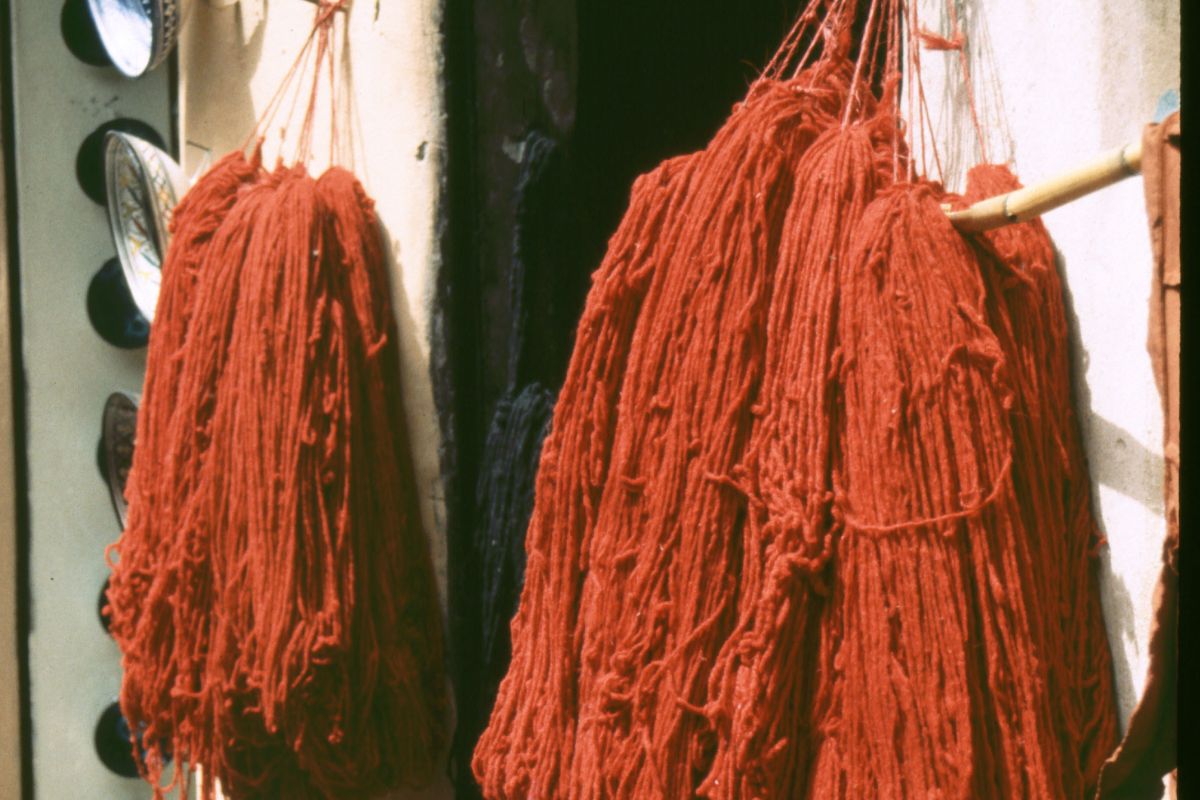
    Africanews, reporting from Taznakht on 2 July 2025, described weavers dyeing wool with colors drawn from henna, pomegranate peel, saffron and indigo leaves. AFP's December 2024 report from the same town named henna, pomegranate peel and indigo as the traditional pigments and then added the part sellers tend to leave out: industrial dyes now commonly replace the natural ones.

    Both things are true at once, and a buyer should hold them together. Plant dyeing is a live practice with named plants behind it in specific places, and most Moroccan rugs on the market today are not dyed that way. The Anou Cooperative's 2017 account goes further, describing artisans suffering allergic reactions to wool that dye workshops in Marrakech and Fes had treated with formaldehyde to bond cheap dye in twenty minutes rather than through a slower process. If you want the difference set out properly, natural dye versus synthetic dye is the page for it.

    The loom, and what happens on it

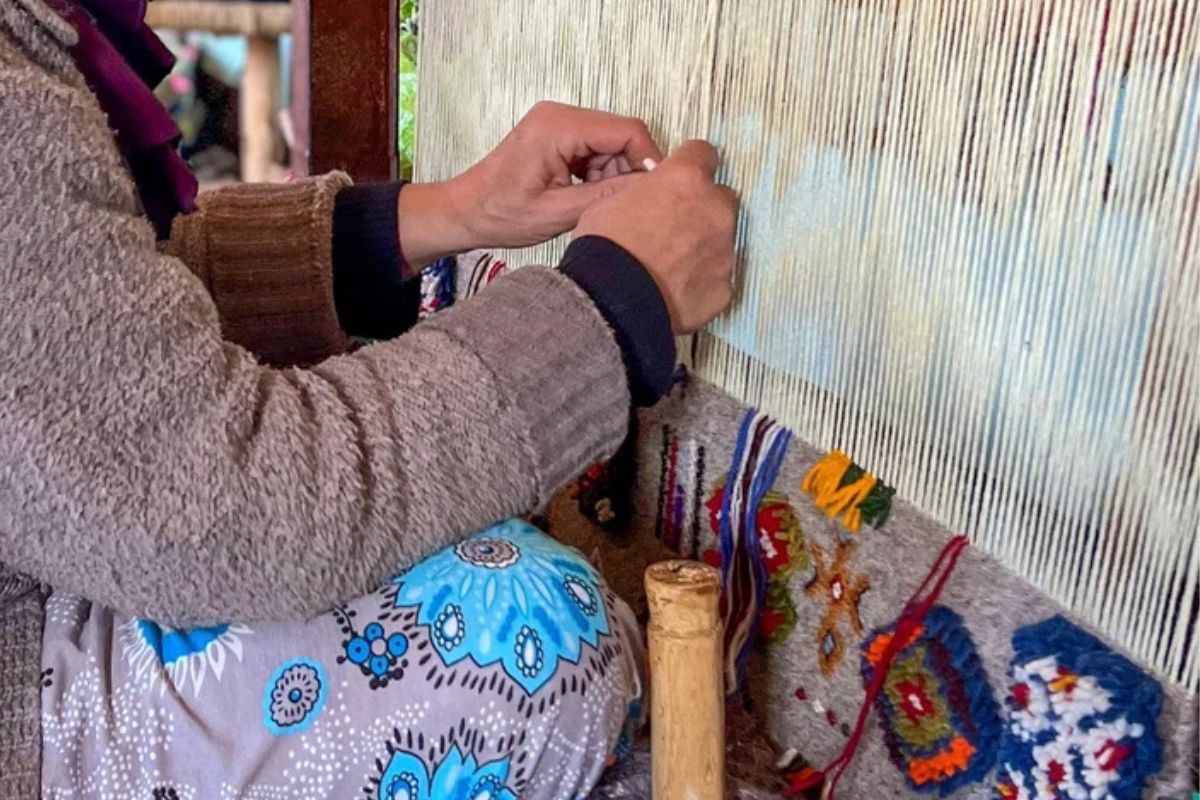
    The loom is vertical: two horizontal beams held in a wooden frame, with the warp threads tensioned between them. It is simple enough to be built, dismantled and moved, and Africanews describes the Taznakht weavers working on traditional wooden looms of this kind. Africanews and AFP both photograph women weaving at home or in a cooperative workshop rather than in a factory.

    From there the rug is built upward. A pile rug is made by tying rows of knots onto pairs of warp threads and beating each row down with a heavy comb, with plain weft passes locking the rows in place. A flatweave has no knots at all: the pattern is made entirely by the weft passing through the warp. Both are genuine Moroccan traditions, not a quality ladder, which is the argument set out in flatweave versus pile.

    Off the loom, and the wash nobody advertises

    When the weaving reaches the top beam the rug is cut free, the ends are secured, and the pile is trimmed level. Then it is washed, and this is where the process stops being only craft.

    A finishing wash is normal. What is not always disclosed is the strength of it, or its purpose. The Anou Cooperative described in a post of 14 December 2020 the treatments used to make new rugs look old, including a roughly one-to-one water and bleach solution applied repeatedly, and sulfur-heavy chemicals to accelerate fading. A wash at that strength changes the wool itself, which means the rug you handle may not feel the way the fleece would predict. How new rugs are made to look old covers the practice in detail.

    How long it takes, and why the sources disagree

    This is worth stating plainly rather than resolving. AFP reported in December 2024 that creating a single carpet takes two to four weeks depending on size. Africanews reported in July 2025 that it takes several weeks or even months, depending on size and the complexity of the design. Both were reporting from the same town, less than a year apart.

    They are not necessarily contradicting each other, since size and pattern density change the answer enormously and a plain flatweave is not a densely knotted pile rug. But they are also not the same claim, and anyone quoting a single figure for "how long a Moroccan rug takes" is choosing one and dropping the other. This guide publishes no single number for it.

    What the making does not decide

    The last thing worth knowing about how a Moroccan rug is made is that the making is not what sets its price. AFP reported that weavers around Taznakht travel to a weekly market on Thursdays to sell to middlemen who set the prices, with a large rug going for an average of about 250 Moroccan dirhams, roughly 24 dollars at the time, and the same piece reselling in Marrakech at up to ten times that, or up to 6,000 dollars online. The Anou Cooperative has put the middlemen's share of the final selling price at an average of 96 percent, which is that organization's own figure from its 2017 post and reflects the position of a body set up to bypass them.

    One further note on status. Moroccan rug weaving is often described online as UNESCO-recognized. It is not. Checked against UNESCO's own list of Morocco's inscribed elements, the country has sixteen entries, from Jemaa el-Fna and Gnawa to couscous, henna and, in 2025, the Moroccan caftan. No carpet, rug or general weaving element appears among them.

    FAQ

    Are Moroccan rugs made by hand?
    In the named traditions this site covers, yes. Spinning, dyeing, warping and weaving are hand processes, done on a wooden vertical loom. Machine-made imitations of the same designs exist and are a separate product.

    Who makes Moroccan rugs?
    Overwhelmingly women in Amazigh communities, working at home or through cooperatives. AFP and Africanews both reported from women's weaving cooperatives in Taznakht, naming individual weavers and the organizations they work through.

    How long does it take to make a Moroccan rug?
    Reported figures differ. AFP said two to four weeks in December 2024; Africanews said several weeks to months in July 2025. Size and pattern density change the answer, so this guide does not publish a single figure.

    What wool is used in Moroccan rugs?
    Sheep wool, sourced regionally. The FAO's North African breed survey records the Siroua sheep southwest of Ouarzazate as producing the fine wool used for the Taznakht carpet, and AFP named Jbel Sirwa as the wool source for the same town.

    Are Moroccan rugs dyed with plants?
    Some are. Henna, pomegranate peel, saffron and indigo are named in reporting from Taznakht. AFP also reported that industrial dyes now commonly replace natural ones, so plant dyeing cannot be assumed from a style name alone.
  • Morocco’s Antique Rug Export Permit Rule, Explained

    Morocco’s Antique Rug Export Permit Rule, Explained

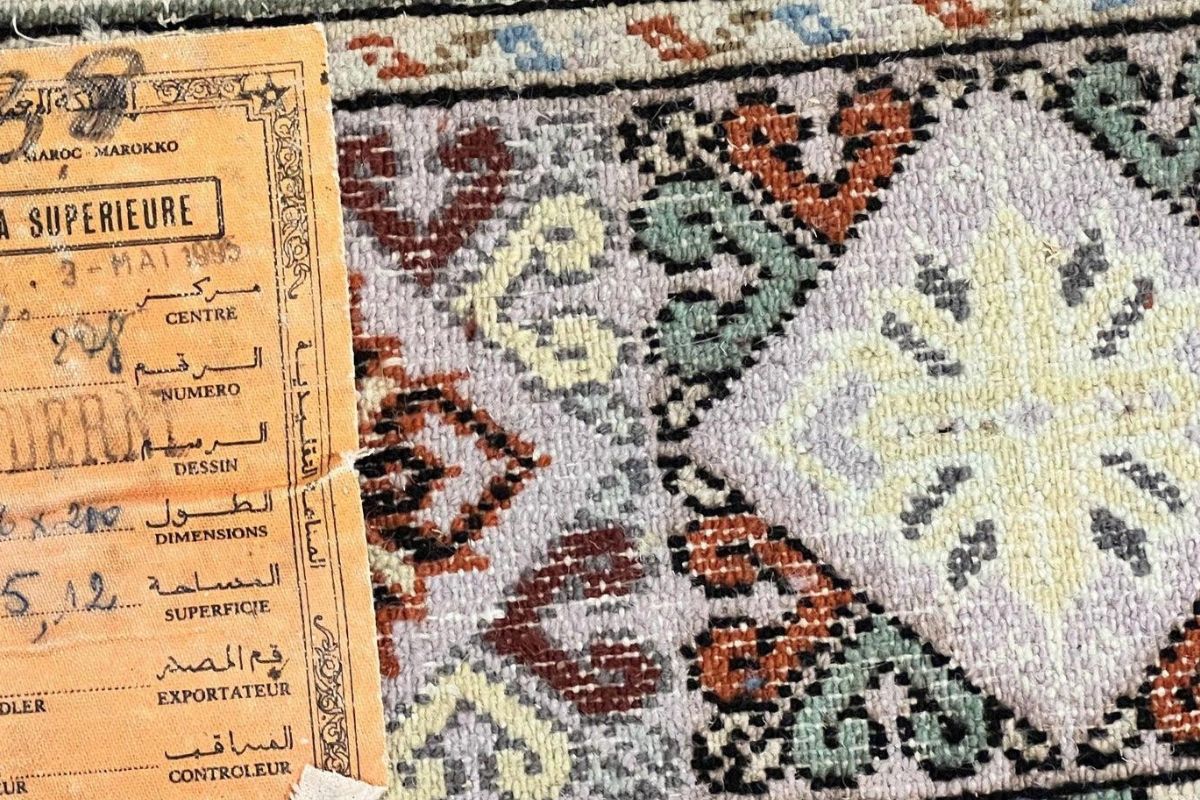
    Two separate laws sit at either end of this journey and they are constantly confused. At the Moroccan end, genuine antiques, described as items over 100 years old, require an export permit from the Ministry of Culture under Morocco's heritage legislation. At the United States end, a bilateral cultural property agreement restricts the import of specific categories of Moroccan archaeological and ethnological material. Reading both carefully, an ordinary Amazigh wool pile rug of the kind this site covers appears to fall outside the US restriction, and outside Morocco's permit rule too unless it is genuinely a century old. Most are not.

    Why this page exists

    Buyers hear "cultural property law" and either panic or ignore it entirely. Sellers rarely raise it at all. The result is a question with real legal exposure attached and almost no accurate information available in the niche.

    This page is not legal advice, gives no opinion on any specific rug, and cannot tell you what applies to your purchase. What it does is name the actual instruments, with dates, so you know what you are dealing with and who to ask.

    Morocco's side: the 100-year permit

    Morocco's framework is Law No. 22-80, on the conservation of historic monuments and sites, inscriptions, works of art and antiquity. Under it, genuine antiques, described in the sources consulted as items over 100 years old, are subject to export licensing and require a permit from the Ministry of Culture.

    For contemporary craft, and that includes essentially all rugs made in recent decades, there is no export restriction. You buy it, you take it, and nothing else applies.

    The obligation falls at the point of export, from Morocco. If you have bought something genuinely a century old, the paperwork is not optional and it is not something to sort out at the airport. The seller should be able to speak to it, and if a seller is claiming that kind of age while shrugging at the paperwork, those two positions do not sit together.

    The United States' side: the cultural property agreement

    The United States and Morocco entered into an agreement under the Convention on Cultural Property Implementation Act, and import restrictions on categories of Moroccan archaeological and ethnological material were imposed in January 2021. They were extended effective 14 January 2026 and now run through 14 January 2031, per US Customs and Border Protection's Federal Register notice.

    Material on the Designated List may not be imported into the United States unless it is accompanied by documentation certifying that it left Morocco legally.

    Why an ordinary Moroccan wool rug appears to sit outside both

    This is the part worth reading closely, because the Designated List is specific and almost nobody in this niche has looked at it.

    The archaeological category covers material dated roughly from one million BC to 1750 AD. It does include textiles, and the textiles it describes are linen, hemp and silk cloth used for burial wrapping, shrouds, garments, banners and sails. A twentieth-century Amazigh wool pile rug is none of those things, in neither material nor use nor date.

    The ethnological category covers architectural elements, manuscripts, and ceremonial and ritual objects of Islamic culture from the Saadian and Alaouite dynasties, roughly 1549 to 1912. Again, a domestic wool floor rug woven for use in a household is not an architectural element, a manuscript, or a ceremonial or ritual object, and the great majority of rugs in the market postdate 1912 in any case.

    So on the face of the list, the US restriction is aimed at a different class of object entirely. This guide reports that as a reading of the published categories, not as a legal opinion, and the list can be amended. If you are importing something you believe is genuinely old or unusual, check the current Designated List and, if there is any doubt, ask a customs broker or a lawyer rather than this page.

    Readers outside the United States: this restriction is US-specific. Your own country will have its own rules on cultural property imports, and they are not the same. Morocco's export rule, on the other hand, applies to everyone leaving Morocco.

    What to do if a seller genuinely claims 100-plus years

    This is where the legal question loops back into the commercial one that runs through the rest of this site.

    If a seller tells you a rug is a century old or more, that claim has consequences. It means an export permit is required, and it means the seller should be able to produce or arrange documentation. Ask for both, in writing, on the invoice.

    What usually happens next is instructive. The age claim softens. As what "vintage" actually means on a Moroccan rug listing sets out, the vocabulary in this trade is loose, unregulated and frequently detached from actual age, and the Anou Cooperative has reported that a great deal of "vintage" Moroccan stock is new and treated to look old, covered in how new rugs are made to look old.

    So the permit question is a useful test of a seller as well as a legal step. A seller who will put a hundred-year claim in writing and handle the permit is telling you something real. A seller who will not do either has answered a different, more important question. Is my Moroccan rug authentic covers what can and cannot be established about age.

    If the rug really is that old, treat the purchase accordingly: proper documentation, a proper declaration, and professional advice. Customs, duty and declared value covers the arrival end, and shipping a rug home from Morocco the journey.

    What this guide is not

    It is not legal advice. It does not interpret the law for your circumstances, it does not tell you whether your rug is covered, and it does not offer any way to reduce or avoid a legal obligation.

    These laws exist to protect cultural property, including the heritage of Amazigh communities whose work this site writes about, and that is a good reason for them rather than an inconvenience. Where a permit is required, the answer is to get one.

    For anything genuinely old, ask the Moroccan Ministry of Culture, your own national customs authority, and a qualified lawyer or customs broker. Sources named on this page were read on 2026-08-04; laws and designated lists change, so check the current versions.

    FAQ

    Do I need a permit to take a Moroccan rug out of Morocco?
    Only if it is a genuine antique. Morocco's heritage law requires an export permit from the Ministry of Culture for items over 100 years old. Contemporary craft, which covers almost all rugs on the market, carries no export restriction.

    Can I bring a Moroccan rug into the United States?
    Ordinary wool rugs are not what the US-Morocco restriction targets. The Designated List covers archaeological material up to 1750 AD, whose textiles are described as linen, hemp and silk burial cloth and similar, and ethnological material such as architectural elements, manuscripts and ceremonial objects from 1549 to 1912. Check the current list if your piece is genuinely old or unusual.

    How long do the US import restrictions last?
    They were imposed in January 2021 and extended effective 14 January 2026, running through 14 January 2031, per CBP's Federal Register notice. They can be extended again.

    My seller says the rug is 100 years old. What should I ask for?
    The age claim in writing on the invoice, and the export permit. If a seller will not provide either, treat the age claim as unsupported rather than treating the paperwork as optional.

    Does this apply if I am not American?
    Morocco's export rule applies to everyone leaving Morocco. The import restriction described here is US-specific, and your own country will have its own cultural property rules, which are not the same.

  • Moroccan Rug Colors: Where the Palette Comes From

    Moroccan Rug Colors: Where the Palette Comes From

    Moroccan rug color comes from three things: the natural tone of undyed wool, plant-based natural dyes, and, increasingly in modern production, synthetic dyes, not from a fixed symbolic code where a given color always "means" something specific. Across the styles already covered on this site, you'll have seen the undyed cream of a Beni Ourain, the deep indigo of a Beni Mguild, the warm magenta of a Boujad, and the plant-dyed range documented at Taznakht. This page pulls that pattern together in one place, and explains what determines it.

    The undyed base: cream, ivory, brown, black

    Sheep's wool in its natural, undyed state already spans a real range: cream, ivory, light brown, darker grey-brown, and black, depending on the specific fleece. Several Middle Atlas styles, most famously Beni Ourain, lean heavily on this undyed range, using dark natural wool sparingly for outline motifs against a light, undyed field rather than relying on any dye process at all. This is the simplest, most direct source of a Moroccan rug's color: no dye, just the wool itself, sorted and used as it comes off the animal.

    Natural dyes and what they actually produce

    Where color is added, historical and traditional practice draws on a specific, recurring set of plant materials, documented consistently across multiple independent sources: madder root, producing reds and terracottas; indigo, producing blues; saffron and pomegranate rind, producing yellows and golds; henna, producing reddish-browns; and walnut shell or hull, producing dark browns and blacks. This is the same palette named directly, with sources attributed, in this site's own Taznakht guide, where Africanews's reporting specifically named henna, pomegranate peel, saffron, and indigo leaves as the cooperative's dye materials.

    Natural dyes produce color with real variation built in: no two dye batches land on exactly the same shade, since the result depends on the specific plant material, water, mordant, and even the season it was prepared in. That's part of why natural-dyed pieces develop the muted, complex, slightly uneven color character collectors associate with older or traditionally made rugs, as opposed to the flatter uniformity of a modern synthetic-dye batch.

    Synthetic dyes and why modern production leans on them

    Modern Moroccan rug production increasingly uses synthetic dyes, which produce brighter, more saturated, and more consistent color than natural dyeing allows, a real practical advantage for a producer trying to match a specific shade reliably across a production run. Some of the brighter, more electric colors seen in contemporary Azilal and Boujad production reflect this shift toward synthetic dye availability, alongside older natural-dye traditions that continue in parallel rather than having been fully replaced by it.

    Neither natural nor synthetic dye is inherently "more authentic" on its own. Synthetic dyes have been in use in various forms for well over a century in many textile traditions worldwide, and a rug's genuine hand-knotted or handwoven construction is a separate question from which dye technology colored its yarn. Treating synthetic dye as automatic proof of a fake, or natural dye as automatic proof of authenticity, is exactly the kind of oversimplified claim this site avoids making.

    Quick reference: common natural dye sources

    Dye source Color produced
    Madder root Red, terracotta
    Indigo Blue
    Saffron Yellow, gold
    Pomegranate rind Yellow, gold, tan
    Henna Reddish-brown
    Walnut shell/hull Dark brown, black

    This table reflects what plant material is documented to produce which color family in traditional dyeing practice generally. It is not a claim about the specific dye used on any individual rug, which would require asking the seller or, ideally, having documentation from the maker.

    Color also changes over time, and that's not a defect

    A rug's color the day it's finished is not necessarily its color a decade later. Natural dyes in particular are more light-reactive than most synthetic equivalents, and gradual fading or mellowing with sun exposure and handling is part of how a natural-dyed piece is expected to age, contributing to the muted "vintage" look collectors often prize. That's a genuinely different situation from a colorfastness defect or damage, though telling the two apart in a specific piece is a hands-on question this guide won't attempt to settle from a description alone.

    Why this guide won't tell you what a color "means"

    You will find plenty of content elsewhere asserting that a specific color carries a fixed symbolic meaning, that yellow "symbolizes joy," or red "symbolizes life," stated as settled fact with no source attached. This guide won't repeat those claims here. Symbol and color meaning in Amazigh weaving is a genuinely contested area: the same seller pages that assert confident color meanings are, in this site's own research for its symbolism cluster, often the only pages making the claim at all, with no museum, academic, or named cultural source behind it.

    Where a specific source can support a specific claim, as with the akhnif's documented motif, discussed in the akhnif guide, this site states it and names the source. For general color-in-rugs claims of the kind repeated across seller sites, no comparable sourcing was found in this guide's research, so none is asserted here as settled fact. If you've read elsewhere that a color in your rug "means" something specific, treat that as a claim from whoever told you, not a documented fact this site can confirm.

    How color connects to the styles already covered on this site

    Color is one of the fastest ways to narrow down which named style you're looking at, alongside pattern and density covered in how to identify a Moroccan rug from a photo. An undyed cream-and-black field points toward the Middle Atlas pile styles; warm plant-dyed reds and golds point toward southern traditions like Taznakht; bright, saturated color in a dense field points toward Azilal or Boujad; and an unusual palette of aubergine, mauve, and ochre points toward the underserved Aït Bou Ichaouen / Talsint tradition. Color alone won't settle an identification, but combined with pattern and construction, it's a genuinely useful signal.

    FAQ

    What determines a Moroccan rug's color?
    Three things: the natural tone of undyed wool, traditional plant-based dyes, and modern synthetic dyes. There's no single fixed factor, and no fixed symbolic code behind it.

    What plant materials were traditionally used to dye Moroccan rugs?
    Documented sources name madder root (red/terracotta), indigo (blue), saffron and pomegranate rind (yellow/gold), henna (reddish-brown), and walnut shell (dark brown/black).

    Does a specific color mean something in Moroccan rug weaving?
    This guide could not find a credible, named non-commercial source confirming fixed color meanings and will not repeat unsourced claims found on seller sites as settled fact. Where a specific documented meaning exists, as with the akhnif's motif, it is attributed to its actual source.

    Are natural-dyed rugs more authentic than synthetic-dyed ones?
    No. Dye type is a separate question from whether a rug is genuinely hand-knotted or handwoven. Both natural and synthetic dyes appear in genuine traditional production, and neither one alone proves or disproves authenticity.

    Can I tell which named style a rug is just from its color?
    Color is a useful clue, especially combined with pattern density and construction, but it isn't decisive on its own. See how to identify a Moroccan rug from a photo for the fuller identification approach.

  • Moroccan vs Persian vs Turkish Rugs Compared

    Moroccan vs Persian vs Turkish Rugs Compared

    Browsing a general "oriental rug" or "vintage rug" category and can't tell which broad tradition you're looking at? As a rough, non-absolute test: Moroccan rugs tend toward abstract or geometric motifs with a looser, more relaxed knot structure and an organic, slightly rustic texture; Persian rugs favor curvilinear, floral, or medallion-based designs with dense, small asymmetrical knots; Turkish rugs favor geometric medallions and repeating patterns using a symmetrical, double-wrapped knot. These are trade generalizations about three enormously varied traditions, not fixed rules every individual piece follows, but they're a genuinely useful starting orientation.

    Design: geometric vs. floral vs. medallion

    Moroccan rugs, the family this site covers in depth, from minimalist Beni Ourain to colorful Azilal and Boujad, lean toward abstract, geometric, or freehand tribal motifs, often with visible asymmetry that reads as intentional rather than a flaw. Persian rugs are generally associated with more intricate, curvilinear design work: florals, vines, and central medallions rendered with fine detail. Turkish rugs sit somewhere in between stylistically, more likely than Persian work to foreground geometric shapes (diamonds, stars, hexagons) but still frequently built around a central medallion or repeating floral border, rather than the freer, more abstract fields typical of Moroccan tribal weaving.

    None of these design tendencies are absolute. Persian weaving traditions include plenty of tribal, geometric work (Gabbeh and various nomadic Persian traditions, for instance, look far more abstract than a fine Isfahan or Tabriz piece), and Moroccan weaving includes some more structured, symmetrical traditions alongside its freer tribal styles. Treat "geometric means Moroccan" as a starting heuristic, not a rule that overrides everything else you can see in a piece.

    Knot technique: three different structures

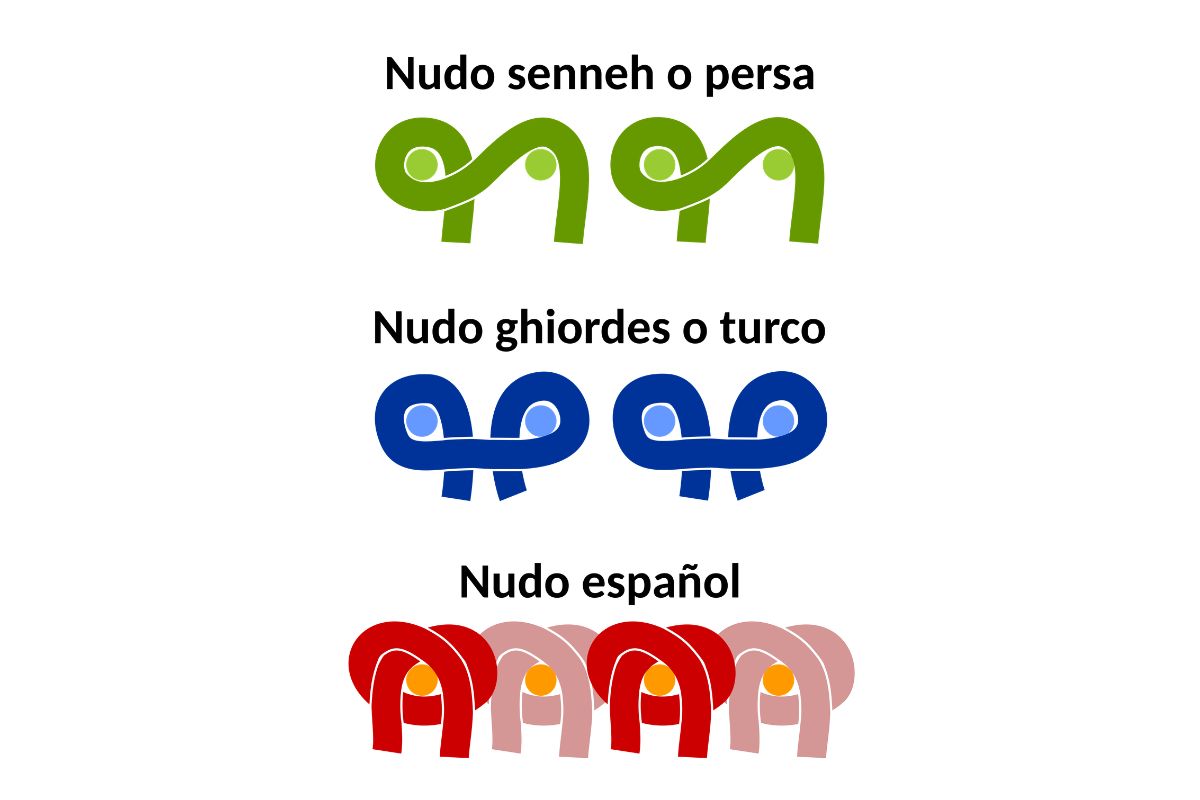
    This is where the traditions genuinely diverge on a technical level, not just a stylistic one. Persian weaving is closely associated with the asymmetrical knot, sometimes called the Persian or Senneh knot, which wraps around one warp thread and loops loosely around the adjacent one, allowing weavers to pack knots more densely and produce finer detail. Turkish weaving is associated with the symmetrical, double-wrapped knot, the Turkish or Ghiordes knot, where the yarn wraps fully around two adjacent warp threads, producing a slightly bulkier, more secure knot. Moroccan tribal weaving, by contrast, is generally described as using a looser, less rigidly uniform knotting structure than either of those two traditions, which is part of what gives finished Moroccan rugs their characteristic soft, organic, slightly irregular texture rather than the tight uniformity of a fine Persian or Turkish piece.

    None of this is something you can reliably verify from a listing photo alone. Knot structure is a back-of-the-rug, hands-on question, closer to what's covered in how to identify a Moroccan rug from a photo, but it's useful to know these are real, named, technically distinct construction methods, not just marketing language for three interchangeable products.

    Material: correcting a claim that gets repeated wrong

    Here's a specific inaccuracy worth naming directly, because it shows up across a lot of general rug-comparison content: several sources describe Persian rugs as "typically made from silk." That's not accurate. The overwhelming majority of Persian rugs, historically and today, are wool; silk is used in a specific minority of fine, high-end production (some Qum and Isfahan pieces, for example), not as the material baseline for the tradition as a whole. A buyer who assumes "Persian equals silk" is liable to either overpay for a wool piece expecting silk-level delicacy, or underestimate the fineness of a genuinely well-made wool Persian rug because it "isn't silk."

    Turkish rugs are similarly primarily wool, with silk used in specific fine production. Moroccan tribal rugs, the family this site covers, are essentially always wool. This site has not found silk used as a base material in any of the named Moroccan traditions covered here, which is one more reason "which one is silk" is the wrong question to be asking when sorting these three broad traditions apart.

    Why the general "oriental rug" label tells you less than it sounds like it does

    "Oriental rug" is a retail catch-all covering Persian, Turkish, Caucasian, Central Asian, and various other hand-knotted traditions, in the same loose way that "Berber rug" is a catch-all for several distinct Moroccan and Amazigh traditions (see what "Berber rug" actually means for that specific confusion). A listing that says only "vintage oriental rug" is telling you almost nothing about the actual origin, technique, or material of the piece. If a Moroccan rug ends up filed under a general "oriental rug" category, which happens on some marketplaces, the design and knot-structure signals above are what will actually help you sort it out, more than the category label itself.

    What to check on the specific listing in front of you

    • Design first. Abstract/geometric with visible asymmetry points toward Moroccan; fine curvilinear floral or medallion work points toward Persian; geometric medallion work with repeating borders points toward Turkish, as a starting orientation, not a verdict.
    • Ask about material specifically, rather than assuming from the region named. Don't assume "Persian" means silk, or that a wool Persian rug is somehow lesser for being wool.
    • Ask for a photo of the back, if construction detail matters to your decision: that's the more reliable way to assess knot density and structure than a front-facing listing photo alone.
    • Treat regional and tradition names as a starting point, not a certainty, especially on older or unlabeled pieces where several traditions' visual and technical features can genuinely overlap.

    FAQ

    What's the main visual difference between Moroccan, Persian, and Turkish rugs?
    Moroccan rugs generally favor abstract, geometric tribal motifs; Persian rugs favor curvilinear floral and medallion designs; Turkish rugs favor geometric medallions and repeating patterns. These are general tendencies, not fixed rules for every piece.

    Are Persian rugs made of silk?
    Mostly no. The large majority of Persian rugs are wool. Silk is used in a specific minority of fine, high-end production and should be treated as a premium exception, not the material baseline for the tradition.

    What's the knot difference between Persian and Turkish rugs?
    Persian weaving is generally associated with the asymmetrical (Senneh) knot, which allows denser packing and finer detail. Turkish weaving is generally associated with the symmetrical, double-wrapped (Ghiordes) knot, which is slightly bulkier and more secure.

    Are Moroccan rugs the same as "oriental rugs"?
    "Oriental rug" is a broad retail category that can include Moroccan pieces alongside Persian, Turkish, Caucasian, and other traditions. It isn't a specific style, in the same way "Berber rug" isn't one specific Moroccan style either.

    Can I tell these three traditions apart from a listing photo alone?
    Design tendency is often visible in a photo. Knot structure generally isn't, without a clear photo of the rug's back. Neither check substitutes for asking the seller directly about origin and material.

    Is one of these three traditions better quality than the others?
    Not as a blanket rule. Each tradition spans a wide range of quality, from coarse everyday pieces to museum-grade work. A fine Persian rug and a well-made Moroccan tribal rug are excellent in different, tradition-specific ways rather than ranked against a single quality scale, and this guide won't manufacture a ranking that doesn't reflect that variation.

  • What Is a Berber Rug? The Word, and Its History

    What Is a Berber Rug? The Word, and Its History

    "Berber rug" is not one style. In a rug listing, it usually means one of several distinct named traditions grouped under a single, loosely used retail label: Beni Ourain, Azilal, Boujad, and others already covered on this site. The word "Berber" itself also has a contested history: it comes from an ancient exonym with roots meaning "foreigner" or "barbarian," and many Amazigh people and scholars reject it for that reason, preferring their own name for themselves, Amazigh. This guide uses both terms, and explains why.

    Where the word "Berber" comes from, and why it's contested

    "Berber" traces back to the Latin barbarus, itself from the Greek bárbaros, a term Greeks and Romans originally applied broadly to foreigners whose speech sounded unintelligible to them, later extended by Romans specifically to North African peoples encountered during Roman expansion into Numidia and Mauretania. That origin is documented in linguistic-anthropology sources including the Society for Linguistic Anthropology and Britannica's own entry on the Berber people.

    The word's baggage doesn't stop in antiquity. Its root is widely noted to overlap with, and sometimes be treated as equivalent to, the Arabic word for "barbarian," which is a live reason many Amazigh scholars and activists reject "Berber" as a pejorative label rather than a neutral ethnonym. There's also a more recent political layer: French colonial administration in 20th-century North Africa institutionalized "Berber" as an official administrative category, part of a broader colonial strategy that treated Amazigh and Arab populations as separate groups to be managed differently. That history is one more reason the term carries weight beyond its dictionary definition.

    Amazigh: the term the people use for themselves

    The people commonly labeled "Berber" from the outside use their own name for themselves: Imazighen (singular Amazigh). Linguistic sources gloss the term's root as meaning something close to "free people" or "noble free people", a self-description that stands in direct contrast to an exonym rooted in "foreigner" or "barbarian." Respecting that self-chosen name, rather than defaulting only to the externally imposed one, is a small but real editorial choice, and it's the reason every style page on this site introduces its subject as Amazigh weaving alongside the more commercially familiar "Berber" label.

    None of this means "Berber" is a slur that must never appear. It's the term most buyers will search and most sellers will use, which is exactly why a guide that only ever said "Amazigh" would be less useful to an actual shopper trying to make sense of a listing. The goal here isn't to police vocabulary; it's to explain what the word is actually doing so a reader isn't left assuming it's a neutral technical term with a single fixed meaning.

    What "Berber rug" means in a rug listing, in practice

    Walk into any rug retailer's site and "Berber rug" functions as a broad category header, not a specific product description. Underneath that heading you'll typically find named traditions this site treats as genuinely distinct: the minimalist, mostly-undyed Beni Ourain; the colorful, freehand Azilal; the pink-and-magenta Boujad; flatweaves like Zanafi or Moroccan kilim and hanbel; and others. These traditions differ in region, material, technique, and look. Collapsing all of them into one umbrella term is convenient for a retailer's navigation menu, but it hides real distinctions a buyer benefits from knowing.

    There's a parallel worth naming: the same collapsing happens with the word "Amazigh" itself in some usage, since it also refers to an enormously diverse set of peoples and languages across North Africa, not one homogenous group. "Berber rug" and "Amazigh weaving" both function, in casual use, as umbrella terms over real internal diversity. The difference is that one term's origin is external and contested, and the other is the term the people themselves use.

    What "Berber" doesn't tell you

    Because "Berber rug" is a retail catch-all, the word alone tells you almost nothing about region, era, dye type, or construction, the exact information a buyer usually actually wants. A listing that says only "vintage Berber rug" with no named style, no stated region, and no material detail is giving you less information than the trade actually has available for most of these traditions, several of which, like Taznakht, have real, citable, documented cooperative histories behind them. If a seller can't or won't go beyond "Berber rug" as a description, that's worth noting, not necessarily as a red flag, but as a prompt to ask for more.

    A different confusion: "Berber carpet" in flooring

    If you searched "Berber rug" and ended up reading about wall-to-wall carpet installation, you've run into a completely separate use of the word. In the US flooring trade, "Berber carpet" refers to a specific machine-made, loop-pile broadloom carpet style, sold by the roll for wall-to-wall installation, that took its name from a resemblance to the coarser texture of some Amazigh weaving but has no other connection to it. It's manufactured on entirely different equipment, sold through entirely different retail channels, and has nothing to do with an actual hand-knotted or handwoven Moroccan rug. This site covers hand-knotted wool rugs only, never wall-to-wall carpet of any kind. A loop-pile broadloom product and a hand-knotted rug are different objects with different care needs, a distinction worth keeping in mind if you ever compare cleaning advice between the two.

    If a search result or a home-improvement forum is discussing carpet padding, stretching, or wall-to-wall installation under the word "Berber," that's this unrelated flooring product, not anything covered on this site.

    How this site uses the two terms

    This site uses "Amazigh" as the primary term for the people and the weaving tradition, and uses "Berber" where it reflects how the trade and search terms actually work, because a reader searching "Berber rug" deserves an answer, not a lecture. Where a specific named style, region, or cooperative is known, this site uses that specific name rather than resting on either umbrella term. That's the same discipline applied across every style page here: name what's actually known, and say plainly when a broader label is standing in for something more specific.

    FAQ

    Is "Berber rug" a real rug style?
    No. It's a retail umbrella term covering multiple distinct named Moroccan and Amazigh weaving traditions, not a single defined style with consistent construction or origin.

    Why do some people object to the word "Berber"?
    Because it derives from an ancient exonym rooted in "foreigner" or "barbarian," and its root overlaps with the Arabic word for "barbarian." Many Amazigh scholars and activists consider it a pejorative label imposed from outside rather than a neutral name.

    What does "Amazigh" mean?
    It's the term the people themselves use, commonly glossed as "free people" or "noble free people," and is generally the preferred term over "Berber" in scholarly and activist usage.

    Should I stop using the word "Berber rug" when shopping?
    Not necessarily. It's the term most listings and search results actually use. This guide uses both terms for that reason, while being clear about the word's contested history and preferring named, specific styles over the umbrella label wherever possible.

    If a listing just says "Berber rug" with nothing else, what should I do?
    Ask the seller which specific tradition or region the piece is attributed to. See how to identify a Moroccan rug from a photo for what else to check before relying on a generic label alone.

  • Akhnif Morocco: The Amazigh Cape, Not a Rug

    Akhnif Morocco: The Amazigh Cape, Not a Rug

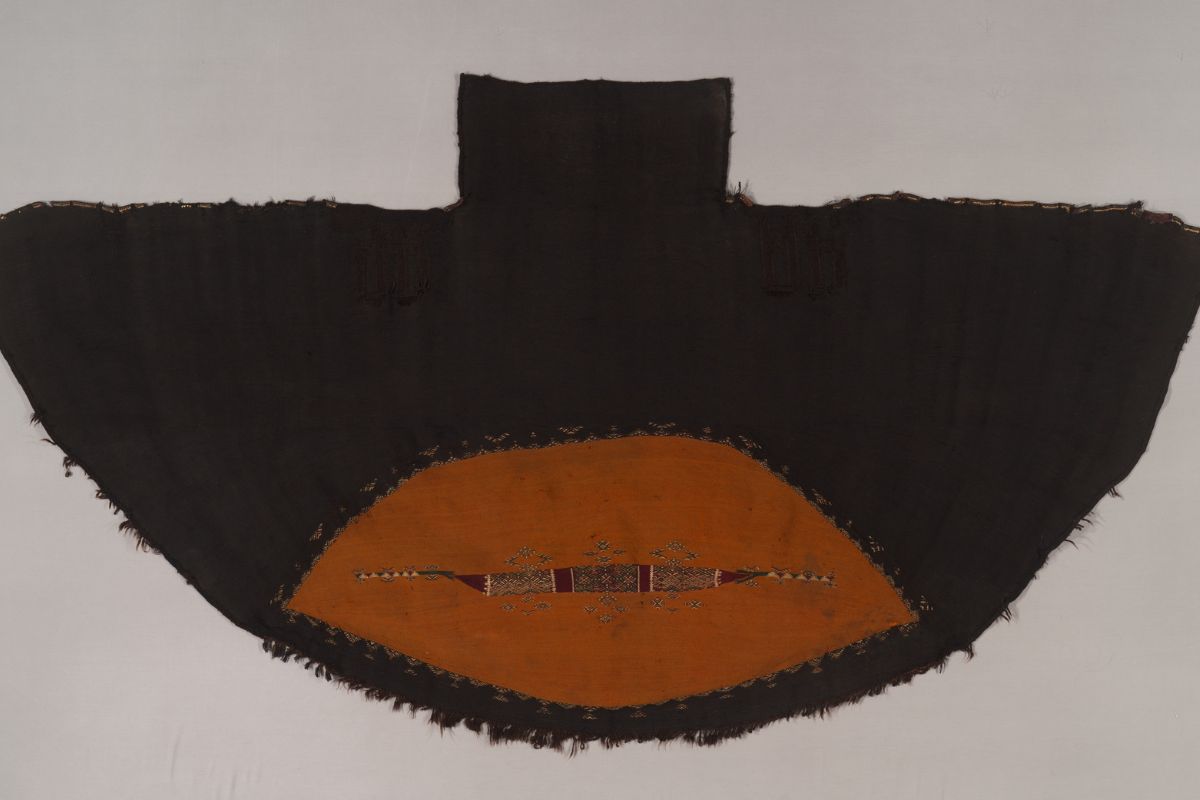
    An akhnif is a handwoven hooded cape, not a rug. It was made by Aït Ouaouzguite Amazigh women in southern Morocco on a wide vertical loom, woven entirely to shape starting upside-down from the hood, in wool mixed with goat hair that gives the finished cloak its dark, near-black ground. If you've seen "akhnif" attached to a textile listing or a museum object and assumed it was some kind of floor covering, it isn't. It's clothing, and understanding that distinction matters for reading Amazigh-textile listings generally, not just this one item.

    Not every Amazigh textile is a rug

    Every other style page on this site covers a floor rug: something knotted or woven flat, meant to be walked on. The akhnif breaks that pattern on purpose, because it's a useful reminder that Amazigh weaving traditions produced far more than rugs: clothing, blankets, and ceremonial textiles all came out of the same regional weaving knowledge, often made by the same communities. A seller or a collector database that files an akhnif alongside "Moroccan rugs" is filing it in the wrong category, even if the weaving technique and cultural context genuinely overlap.

    Unusually for this niche, the strongest sources on the akhnif are not rug dealers. They're museums and academic textile scholarship: the Art Institute of Chicago's own collection records, Smarthistory's dedicated essay on the akhnif, and a Textile Museum Journal article from The George Washington University's museum specifically reconstructing the historical akhnif of southern Morocco. That is a meaningfully different evidence base than most of what this site can cite for individual rug styles, and it lets this page state some facts with more confidence than usual.

    How it's woven

    The akhnif is woven entirely to shape on a wide vertical loom, starting upside-down from what becomes the hood. That is a genuinely demanding technical feat: the weaver has to control vertical warp tension and manage complex horizontal weft turns to build a curved shape into a flat weaving process, a skill Smarthistory's essay describes as reserved for the most experienced weavers. Once the main cloak was off the loom, male artisans, not the women who wove it, added the leather binding and other finishing details, a division of labor worth noting on its own, since it means the akhnif's production involved both women's and men's specialized work at different stages.

    The body of the cape is wool blended with goat hair, which is what produces its distinctive dark, near-black color, rather than the undyed ivory associated with a style like Beni Ourain or the bright plant-dyed range seen in a piece like a Taznakht rug.

    The motif on the back, and what it's said to mean

    Every akhnif carries a prominent motif on its back, usually a circular or diamond-centered design that dominates the garment visually. Smarthistory's essay names this motif irghis n-ukhnif, translating it as roughly "the eye" or "the red of the akhnif," and describes it as serving two roles at once: it was the garment's visual focal point, and it functioned as a protective sign centered over the wearer's back.

    That is a genuinely sourced symbolic reading, attributed to a specific academic essay, not a claim manufactured by a seller with a piece to move. This site is generally cautious about symbol-meaning claims for exactly that reason. Most "this pattern means X" statements found elsewhere in this niche trace to nobody in particular. Here, the source is named, which is why this page states the reading directly instead of hedging it into vagueness.

    Who wore it, and why it largely disappeared

    Akhnif capes were worn by men, and museum sourcing notes they were worn by both Muslim and Jewish men in the regions where the tradition was practiced, typically layered over a haik (a large wrapped cloth) or a jellaba (a hooded gown with sleeves). The akhnif functioned as an outer layer against cold, and its visual weight made it a garment of real social presence, not simply a practical wrap.

    Production of new akhnifs largely stopped by the early 20th century. Museum sourcing attributes this to straightforward economics: the amount of skilled labor the weave demanded, combined with the cost of the wool involved, made the garment increasingly impractical to keep producing as available time, materials, and demand shifted. What survives today is largely older stock in collections and the antiques market, rather than an ongoing living production the way some rug traditions on this site still are.

    Where to see real, documented examples

    Because the akhnif is one of the most widely collected Amazigh textiles, documented examples sit in major public collections rather than only in private dealer inventories: the Art Institute of Chicago, the Peabody Museum of Archaeology and Ethnology at Harvard, the Metropolitan Museum, the Musée du Quai Branly in Paris, the Newark Museum, and the National Museum of World Cultures in the Netherlands all hold pieces. For a reader who wants to see a documented, provenanced example rather than a dealer photo, a museum collection record is the more reliable starting point.

    Why this matters for reading other listings

    If you encounter a Moroccan or Amazigh textile that clearly isn't a floor rug (a heavy woven cape, a ceremonial cloth, a blanket with a similar weaving character), it may well belong to this same broader craft tradition without being a rug at all. The weaving skill, the wool sourcing, and often the same regional or family lineages produced multiple kinds of textiles, not just carpets. A seller who describes every Amazigh textile they carry as a "rug" for search-engine convenience is flattening a genuinely wider craft into one product category, and a reader who only ever searches "Moroccan rug" may simply never encounter pieces like the akhnif at all. Treating "Moroccan rug" and "Moroccan weaving" as interchangeable terms, the way some general decor content does, misses real distinctions that matter both for accurate identification and for understanding the actual scope of Amazigh textile craft. See what "Berber rug" actually means for more on how loosely that broader terminology gets used in the trade.

    FAQ

    What is an akhnif?
    A handwoven hooded cape made by Aït Ouaouzguite Amazigh women in southern Morocco, woven to shape on a vertical loom from wool mixed with goat hair. It is a garment, not a rug.

    What does the motif on an akhnif mean?
    Smarthistory's essay on the akhnif names the motif irghis n-ukhnif, translating it as "the eye" or "the red of the akhnif," and describes it as both the garment's visual focus and a protective sign. That attribution is to the essay specifically, not to unnamed tradition.

    Who wore an akhnif?
    Men, layered over a haik or jellaba. Museum sourcing notes it was worn by both Muslim and Jewish men in the regions where the weaving tradition was practiced.

    Why did akhnif production largely stop?
    Museum sourcing attributes the decline, by the early 20th century, to the heavy skilled labor the weave required combined with the cost of the wool, making it increasingly impractical to keep producing at scale.

    Where can I see a real akhnif rather than a dealer photo?
    Documented examples are held by the Art Institute of Chicago, the Peabody Museum at Harvard, the Metropolitan Museum, the Musée du Quai Branly, the Newark Museum, and the National Museum of World Cultures, among others.

  • Ait Bou Ichaouen Rug: Morocco’s Eastern Outlier

    Ait Bou Ichaouen Rug: Morocco’s Eastern Outlier

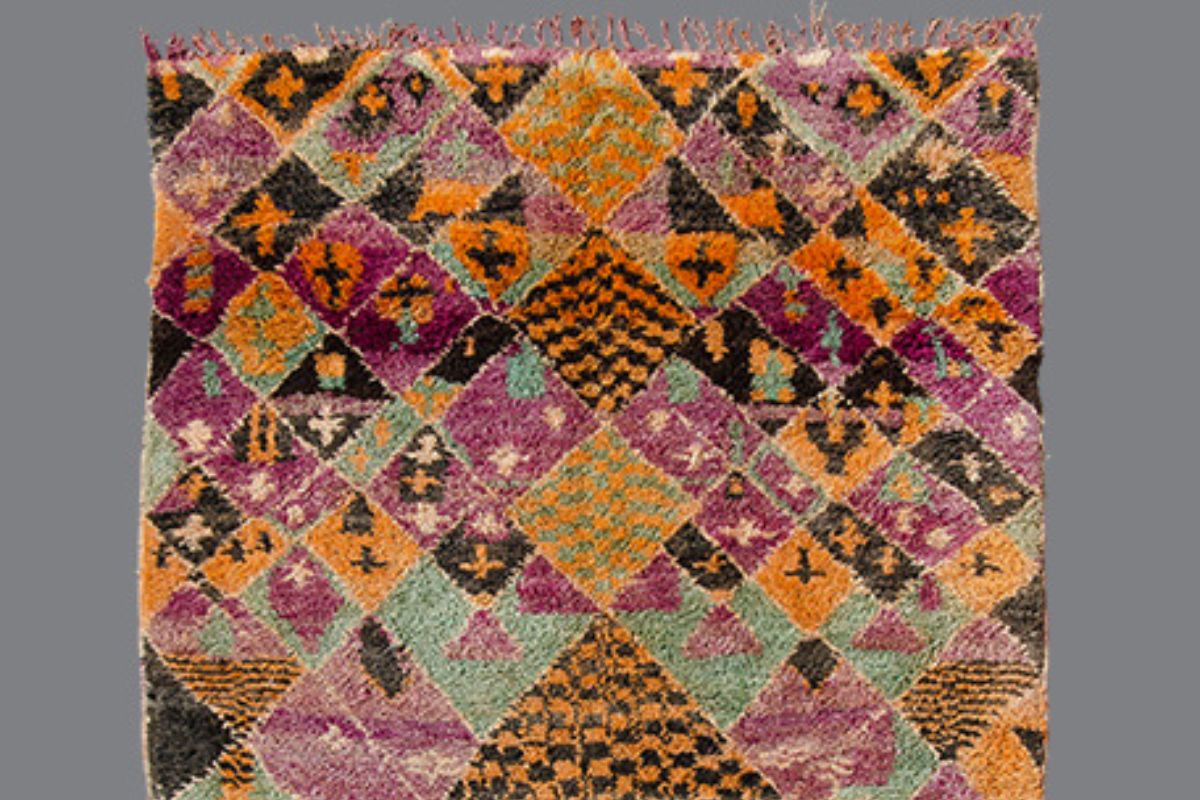
    An Aït Bou Ichaouen rug, sometimes labeled a Talsint rug after the nearby town, comes from the far eastern edge of Morocco's High Atlas, near the Algerian border. It looks different from almost everything else covered on this site: instead of the undyed ivory of a Beni Ourain or the sketchy brightness of an Azilal, expect a dense, saturated palette of aubergine, mauve, tangerine, sage, and ochre worked into bold, tightly packed geometric motifs. If a rug you're looking at doesn't fit the Middle Atlas or High Atlas families already covered here, this is one of the styles worth checking against.

    Where the name and territory sit

    Rug dealers place the Aït Bou Ichaouen in the far eastern High Atlas, in the Figuig province, close to the Algerian frontier. Several vintage-rug dealers and collectors describe this area as geographically isolated enough that it remained largely outside the international rug trade until sometime in the 1990s, when a wider audience of collectors began acknowledging pieces from the region. That specific timeline is a dealer claim, repeated across several rug-trade sites, not something this guide found in independent journalism or academic sourcing. Treat it as the trade's own account of how these rugs entered the market, not a verified historical date.

    The nearby town of Talsint gives the weaving its alternate market name, and you will see "Ait Bou Ichaouen" and "Talsint" used more or less interchangeably in listings for the same tradition.

    This is one of the least-documented styles in this site's own Cluster 1 map, and that is worth saying up front rather than glossing over. Compare it with Taznakht, where independent journalism names an actual women's cooperative and a manager by name, or with Beni Ourain, a style so commercially dominant that dozens of sellers describe it in overlapping detail. Aït Bou Ichaouen sits at the opposite end: a real weaving tradition that entered the international collector market comparatively recently and late, according to the dealers who sell it, and about which comparatively little independent material exists in English.

    What the rugs look like

    Where this differs from most of what this site has already covered is the color. Rug dealers consistently describe an aubergine-and-mauve base, often combined with tangerine, sage green, and ochre, arranged into dense, geometric, knotted-pile patterns. That knotted-pile construction is itself notable: it is described in dealer sourcing as an unusual survival of an older North African weaving approach in a region where other eastern traditions lean more toward flatweave. The motifs tend to be packed closer together than the open, sparse fields common on some High Atlas styles, giving the rugs a busier, more saturated look overall.

    If you're trying to place a rug from a photo, the combination of aubergine/mauve tones with tangerine and ochre accents, in a dense pattern, is the strongest visual signal for this style specifically, a very different read from the cream-ground minimalism of a Beni Ourain.

    Quick comparison

    Aït Bou Ichaouen / Talsint Beni Ourain Taznakht
    Region Far eastern High Atlas, near Algeria Middle Atlas Southeastern Morocco, Anti-Atlas edge
    Ground color Aubergine, mauve base Undyed ivory/cream Colorful, plant-dyed
    Pattern density Dense, tightly packed Sparse, minimal Dense, geometric
    Independent sourcing found Dealer accounts only Extensive dealer coverage Named journalism (Africanews)

    This table reflects what dealer sources describe and what this guide could verify independently, not a scientific classification, and not a claim that every individual rug sold under these names will match the pattern exactly. Hand-woven work varies piece to piece even within one named tradition.

    What this guide could and could not source

    This is worth stating plainly, because it's a real difference from some of the other style pages on this site. For a row like Taznakht, independent journalism, Africanews and reporting picked up by The Arab Weekly, named actual cooperatives, a specific manager, and reported weaver counts. For Aït Bou Ichaouen, every source found in this guide's research is a rug dealer, auction house, or collector site: 1stDibs listings, an auction description from a private collector, and vintage-rug retailers. No museum record, academic paper, or independent news report turned up in this guide's research to corroborate the tribal name, the isolation date, or the specific palette description beyond what dealers themselves state.

    That doesn't mean the dealer account is wrong. It means this guide cannot independently verify it the way it can for better-documented traditions, and says so rather than presenting dealer marketing copy with the same confidence as sourced journalism. No age, knot count, or production date should be taken as settled fact from a dealer listing alone, and this guide will not manufacture one.

    This gap also matters for a practical reason. A style with thin independent documentation is easier for a seller to describe however suits a sale, since there is less published material a buyer can check a claim against. That is not a reason to avoid a genuinely interesting, underserved tradition; it is a reason to ask more questions of the specific seller, not fewer, before treating any dealer's account of origin, age, or rarity as settled.

    Why this style shows up in decor searches at all

    Aït Bou Ichaouen and Talsint rugs turn up in general "eclectic," "boho," or "colorful vintage rug" decor searches more often than in dedicated Morocco-style searches, largely because their saturated, jewel-toned palette photographs well against neutral modern interiors, a different appeal than the muted, minimalist look that made Beni Ourain a design-world staple. If you found one this way rather than by searching for the tradition by name, that is consistent with how dealers say these pieces circulate: as standout color pieces first, named tradition second.

    What to look for

    • The palette first. Aubergine, mauve, tangerine, sage, and ochre together, in a dense pattern, is the strongest identifying signal dealers describe for this style.
    • Ask where the sourcing comes from. If a seller states a specific age, weaving date, or tribal attribution with certainty, ask what that's based on. Given how thin the independent sourcing is for this style, a confident-sounding claim deserves a follow-up question, not automatic trust.
    • Compare construction, not just color. The knotted-pile structure described for this tradition is a different construction than a flatweave like a Moroccan kilim or hanbel, even where colors might look superficially similar in a photo.
    • Don't expect this guide, or any photo-based guide, to authenticate a specific piece. As with every style on this site, an actual purchase decision on an individual rug should involve direct questions to the seller, not a checklist alone.

    FAQ

    What is an Aït Bou Ichaouen rug?
    A knotted-pile rug tradition attributed to the Aït Bou Ichaouen people of Morocco's far eastern High Atlas, near the Algerian border, known in the rug trade for a distinctive aubergine, mauve, tangerine, sage, and ochre palette in dense geometric patterns.

    Is Talsint the same thing as Aït Bou Ichaouen?
    In the rug trade, yes, "Talsint" is used as an alternate market name, referring to a nearby town, for rugs attributed to the same tradition.

    How old are Aït Bou Ichaouen rugs typically?
    This guide could not find an independently sourced age figure for this tradition and will not state one. Dealer listings sometimes describe specific pieces as vintage or antique, but those are claims about the individual item for sale, not a verified fact about the tradition as a whole.

    How is this different from a Beni Ourain rug?
    Visually, almost entirely opposite: a Beni Ourain is built around undyed ivory wool with sparse dark motifs, while an Aït Bou Ichaouen rug is densely patterned in saturated purple, orange, and green tones. See the Beni Ourain guide for the contrast in detail.

    Why is there less written about this style than about Taznakht or Beni Ourain?
    Based on this guide's own research, the sourcing available is thinner. Taznakht has independent journalism naming cooperatives and weaver numbers; for Aït Bou Ichaouen, only dealer and collector sources were found. That gap is stated here rather than papered over.

  • Marmoucha Rug: Beni Ourain’s Quieter Relative

    Marmoucha Rug: Beni Ourain’s Quieter Relative

    A Marmoucha rug is a lighter, thinner, and generally smaller relative of Beni Ourain, woven in the Eastern Middle Atlas near Fes, south of Beni Ouarain territory. If you've found a listing for one and struggled to find much written about it, that's not an accident: it is one of the least commercially prominent named Middle Atlas styles, overshadowed by its heavier, far more widely marketed neighbor.

    Where the name and territory sit

    Rug specialists place Marmoucha weaving in the Eastern Middle Atlas, close to Fes and south of the territory associated with Beni Ouarain. That puts it in the same broad mountain region as the other Middle Atlas styles covered on this site, but at its eastern edge rather than the areas typically associated with Beni Ourain, Beni Mrirt, or Beni Mguild.

    The look: freedom within apparent symmetry

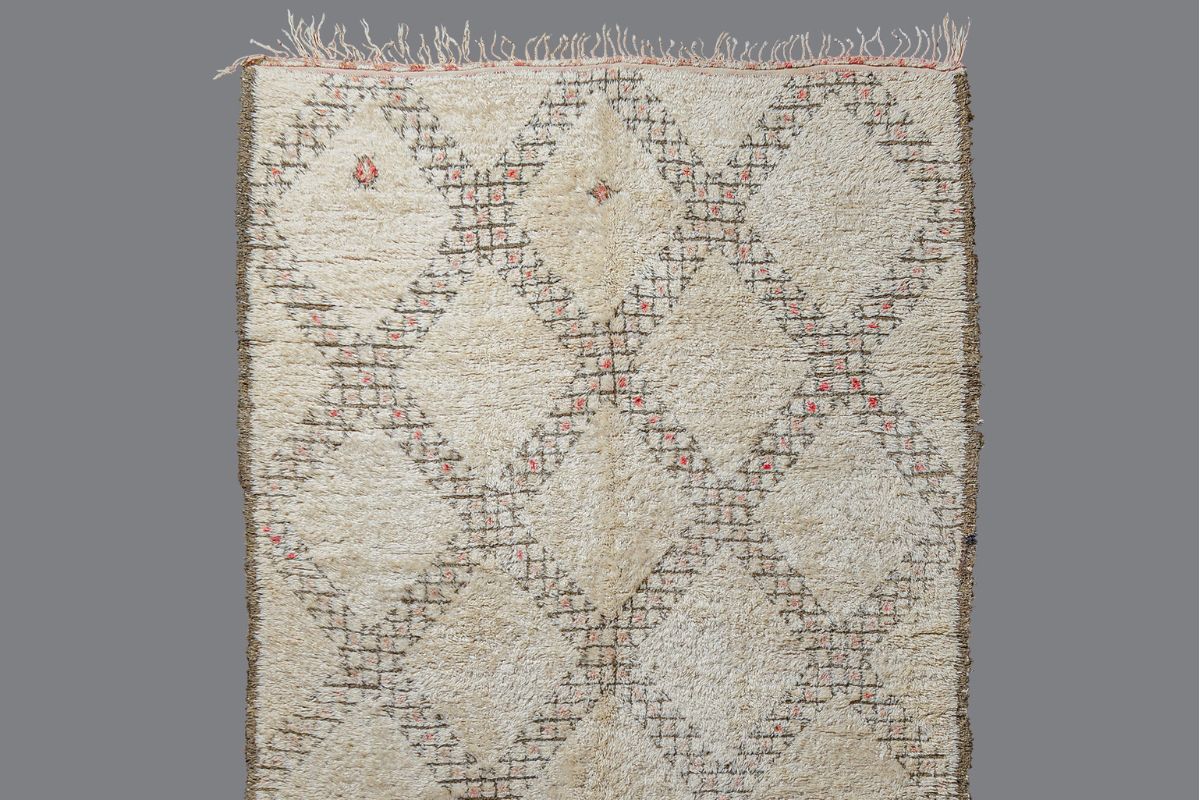
    Visually, a Marmoucha sits close to Beni Ourain's family: a beige or white ground with bright pattern work rather than Beni Ourain's typically sparser, darker line work. Specialists describe the weaving as having real freedom, motifs are placed without rigid precision, yet the overall effect still reads as loosely symmetrical rather than as scattered as Azilal's freehand style. The construction is described as directly influenced by Beni Ouarain's style, but the finished rugs tend to be lighter in weight, smaller in size, and thinner than a typical Beni Ourain.

    That combination, Beni-Ourain-adjacent construction and palette, but lighter and less bulky, is the most useful thing to know if you're trying to place an unfamiliar "Marmoucha" listing: think of it as Beni Ourain's quieter, more modestly scaled cousin rather than an entirely different visual tradition.

    Feature Beni Ourain Marmoucha
    Ground Undyed cream Beige or white
    Pattern Sparse dark lines, diamonds Brighter, freer motifs, loosely symmetrical
    Weight Heavy, high pile Lighter, thinner
    Typical size Often larger Generally smaller
    Market presence Widely marketed, easy to find Underdocumented, fewer listings

    Nothing in that table should be read as a strict rule; it describes a general tendency reported across the sources this guide checked, not a fixed specification for every piece sold under either name.

    A wool claim this guide won't confirm

    One source describes Marmoucha wool as coming from the first shearing of a specific local sheep breed associated with the region. This guide could not find a second, independent source corroborating that specific claim, so it is noted here as something you may see stated in a listing, not as a confirmed fact. If wool provenance matters to your decision, ask the seller directly what they can document about where the wool came from, rather than relying on a breed name you can't independently verify.

    Why being underdocumented can actually help a buyer

    There is a practical upside to a style with less marketing behind it. Names that sell in high volume, Beni Ourain above all, attract more copies, more inflated claims, and more competing "upgrade" narratives, simply because there is more money moving through that name. A less commercially prominent style like Marmoucha has less incentive behind it to dress up a plain wool rug with invented provenance or an inflated price story. That is not a guarantee of honesty from any individual seller, but it is a reasonable, checkable observation about where commercial pressure to embellish is strongest.

    The trade-off is real too: fewer listings means less to compare against, and less written material anywhere, including here, to check a specific claim against. Ask more questions of a Marmoucha seller than you might for a heavily documented style, precisely because there is less independent material available to catch an inconsistency for you.

    Where a Marmoucha fits in a room

    Because it shares Beni Ourain's palette family but in a lighter, thinner build, a Marmoucha suits similar settings without quite the same bulk: a bedroom or a living room where you want a soft, pale, textured base but don't need the deep insulating pile of a full Beni Ourain. Its lighter weight also makes it easier to reposition or rotate than a heavier equivalent, a small practical advantage in a room where wear needs to be spread evenly over time.

    What to look for

    • Compare weight against a Beni Ourain you've seen or handled. A genuine Marmoucha should feel noticeably lighter and thinner, which is one of its most consistently reported traits.
    • Look at the pattern for freehand irregularity. The motifs should show real freedom rather than a rigid repeating grid, while still reading as roughly balanced across the field.
    • Check the back, as with any hand-knotted rug. Individual knots and small irregularities indicate genuine hand construction; a mechanically uniform back suggests a machine-made copy regardless of the name on the listing.
    • Treat unfamiliar specifics with the same caution as any other style here. Because this is a less commercially documented name, listings may lean harder on specific-sounding claims (breed names, precise origins) precisely because there's less competing information to check them against.
    • Compare price against a Beni Ourain of similar size, and ask what accounts for any difference. A lighter, thinner rug using less wool is a reasonable basis for a lower price; an unexplained premium is worth a direct question.

    For the style it sits closest to, see our Beni Ourain rug guide, and for how it fits among the rest of the named Moroccan traditions, see the complete guide to Moroccan rug styles.

    FAQ

    What is a Marmoucha rug?
    A lighter, thinner, generally smaller relative of Beni Ourain, woven in the Eastern Middle Atlas near Fes, south of Beni Ouarain territory.

    How is a Marmoucha rug different from a Beni Ourain rug?
    Both share a similar beige-to-white ground and Middle Atlas construction style, but Marmoucha rugs are consistently described as lighter, thinner, and smaller than typical Beni Ourain pieces.

    Where are Marmoucha rugs from?
    The Eastern Middle Atlas region of Morocco, near Fes, placed by specialists south of the territory associated with Beni Ouarain weaving.

    Is it true Marmoucha wool comes from a specific local sheep breed?
    That claim appears in one source this guide checked, but it could not be independently corroborated, so it is presented here as an unverified claim rather than a confirmed fact.

    Why is there so little written about Marmoucha rugs online?
    It is one of the least commercially prominent named Middle Atlas styles, overshadowed by the much more widely marketed Beni Ourain, which is likely why detailed, independent information is harder to find for this style than for its neighbors.

  • Zemmour Rug: The Red Berber Flatweave Explained

    Zemmour Rug: The Red Berber Flatweave Explained

    A Zemmour rug (also spelled Azmour or Azemmour) is known in the rug trade primarily as a dense, red-dominant flatweave, patterned with geometric bands, chessboard arrangements, and diamond or triangular motifs worked in vertical and horizontal rows. The name is associated with a Berber tribal confederation whose historical territory rug specialists place between Rabat and Meknès, further north than most of the Middle Atlas styles covered elsewhere on this site.

    Where the name and territory sit

    The Zemmour are described by rug and textile specialists as a confederation of tribes whose territory historically sat between Rabat and Meknès, a more northerly stretch of the Middle Atlas region than Beni Ourain, Beni Mrirt, or Beni Mguild territory. This guide presents that geography as reported by specialists rather than as independently verified from a primary historical source, consistent with how every regional and tribal attribution is handled on this site.

    The look: red grounds and geometric bands

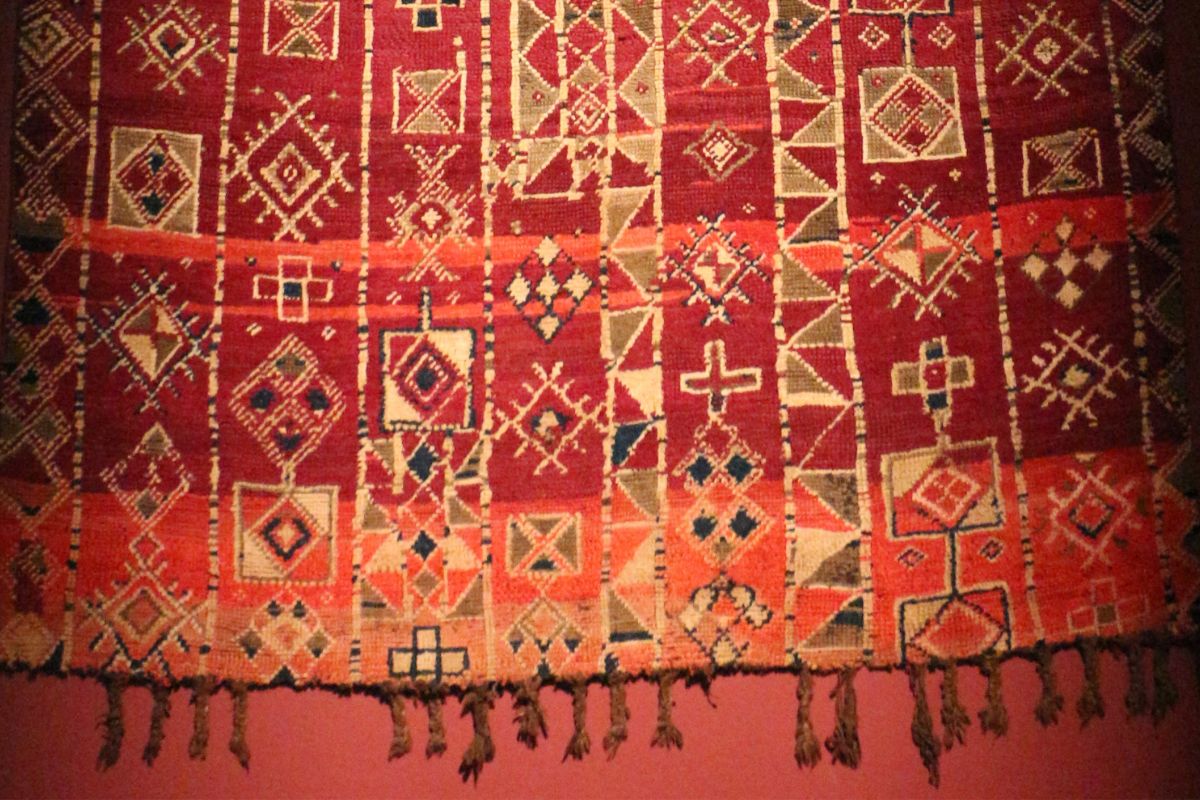
    The defining visual feature is color: a dominant, dense red ground, worked with geometric motifs arranged in vertical and horizontal bands rather than scattered loosely across the field. Chessboard-style arrangements are common, along with diamond and triangular shapes, often set off with white or lighter-toned line work that stands out sharply against the red. The overall effect reads as more structured and banded than the sparse, asymmetric lines of Beni Ourain or the scattered motifs of Azilal.

    A note on construction: flatweave, mostly

    Most retail descriptions of Zemmour rugs treat them as a flatweave, kilim-style tradition, without a knotted pile, and that is the more commonly stated construction across the sources this guide checked. A smaller number of sources also describe piled rugs attributed to the same tribal name. This guide did not find a way to resolve that inconsistency cleanly, so it is stated here as an open point rather than settled either way: if you are shopping for a specific construction, ask the seller directly whether the individual piece in front of you is flatwoven or knotted, rather than assuming from the name alone.

    If you want the general mechanics of how a flatweave is built and why it behaves differently from a pile rug, see our guide to Moroccan kilim and hanbel rugs.

    How it compares to Rehamna

    Zemmour is not the only red-dominant Moroccan style; Rehamna rugs also run warm and red-toned. The distinguishing features are geography and construction detail: Rehamna comes from the Haouz plains north of Marrakech and is typically described with a goat-hair warp and a sawtooth-edge border, while Zemmour is placed further north, between Rabat and Meknès, and is more consistently described as a banded, geometric flatweave without the sawtooth border. If you're trying to tell the two apart in a listing, check for the sawtooth edge and goat-hair warp first; their absence points toward Zemmour rather than Rehamna.

    Where a Zemmour suits a room

    A dense red ground with organized geometric banding reads as a strong, graphic statement rather than a quiet neutral base, closer in role to Boujad or Rehamna than to Beni Ourain. Because the pattern runs in structured bands rather than scattered motifs, a Zemmour tends to look more formal and considered on the floor than the looser, more improvised styles in this cluster, which can make it a good fit for a room that wants boldness without visual chaos. Its smaller reported sizing, where accurate, also makes it a reasonable candidate for an accent placement, a hallway, or layering over a larger neutral rug, rather than as a single large-room anchor.

    What to look for

    • Confirm construction directly. Given the flatweave/piled ambiguity in available sources, ask the seller plainly whether the specific rug is a flatweave or a knotted pile rather than assuming from the style name.
    • Look for banded, not scattered, patterning. Zemmour's geometric motifs typically run in organized vertical and horizontal rows, which is a more structured look than Azilal's freehand scattering or Boucherouite's improvisation.
    • Check the red for depth and variation. A genuine hand-dyed red ground often shows some natural variation in tone rather than a single flat, uniform shade.
    • Ask about size expectations. Some sources describe Zemmour pieces as running smaller than typical Middle Atlas rugs; treat this as a general tendency to ask about, not a fixed rule, since no dimension figures are verified here.
    • Ask what materials were used. Specialists describe Zemmour weaving as combining wool with cotton in some pieces; confirm the specific material mix for the rug you're considering rather than assuming an all-wool construction.

    One honest limit that applies here as on every page in this guide: description and reported tendencies are not the same as authentication. This guide can tell you what a Zemmour rug is generally reported to look like and how it is generally constructed; it cannot confirm the origin of a specific piece from a photograph.

    For how Zemmour fits alongside the rest of the region's named traditions, see the complete guide to Moroccan rug styles.

    FAQ

    What is a Zemmour rug?
    A red-dominant geometric rug, most commonly described as a flatweave, associated with a Berber tribal confederation whose historical territory specialists place between Rabat and Meknès in Morocco.

    Is a Zemmour rug flatwoven or knotted?
    Most retail sources describe it as a flatweave (kilim-style), but a smaller number of sources also mention piled production under the same name. This guide could not resolve that inconsistency, so ask the seller directly which construction a specific piece uses.

    How is a Zemmour rug different from a Rehamna rug?
    Both run warm and red-toned, but Rehamna comes from the Haouz plains near Marrakech and typically has a goat-hair warp and sawtooth-edge border, while Zemmour is placed further north, between Rabat and Meknès, and is described more as a banded geometric flatweave without that sawtooth border.

    What patterns appear on Zemmour rugs?
    Geometric motifs arranged in organized vertical and horizontal bands, including chessboard arrangements, diamonds, and triangles, often in white or light line work against a dense red ground.

    Are Zemmour rugs small?
    Some sources describe them as tending to run smaller than typical Middle Atlas rugs, though this guide has no verified dimension data and treats it as a general tendency rather than a fixed rule.

    What materials are used in a Zemmour rug?
    Specialists describe the tradition as using both wool and cotton, alongside notably skilled use of red dye. Confirm the specific material mix directly with a seller for any individual piece rather than assuming a single standard construction.

  • Rehamna Rug: The Marrakech Plains Style Explained

    Rehamna Rug: The Marrakech Plains Style Explained

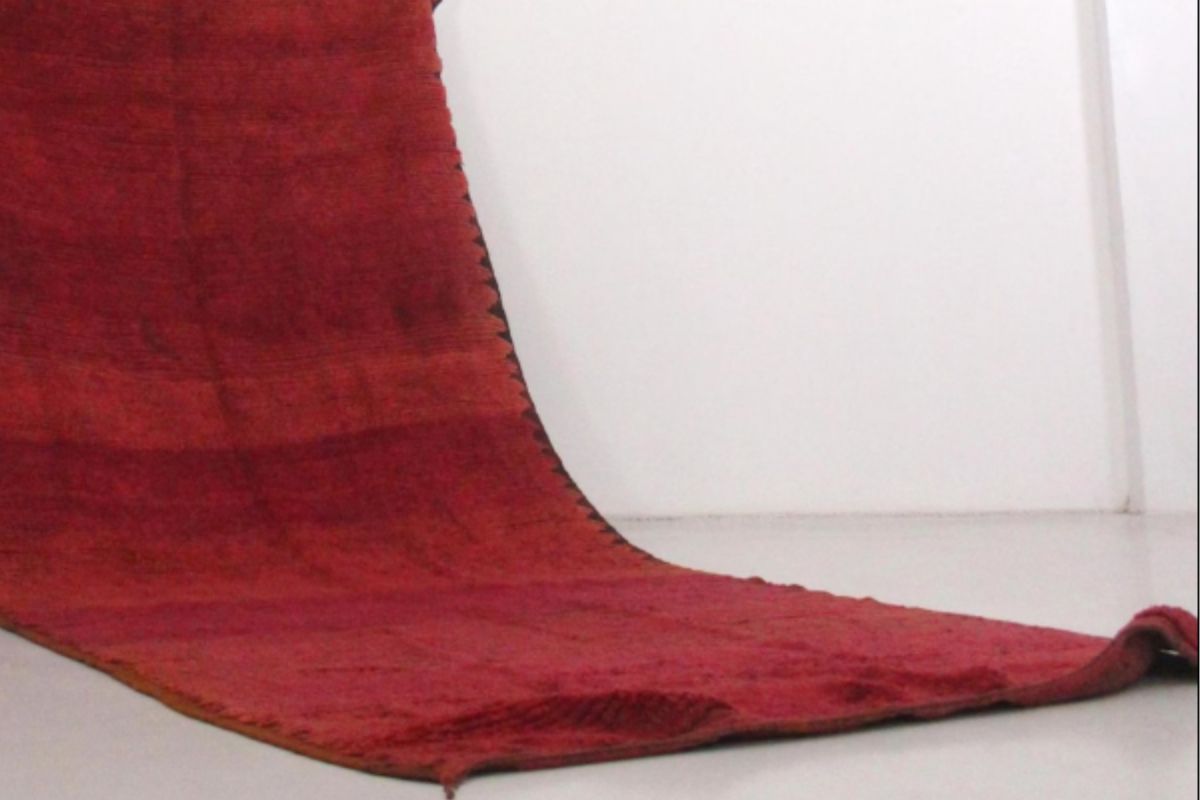
    A Rehamna rug comes from the Haouz plains north of Marrakech, and it looks different from anything else covered so far in this guide: a dominant red or orange ground, often with natural color variation across the field, framed by a distinctive sawtooth-edge border, rather than the neutral cream or saturated pastel palettes of the Atlas Mountain styles.

    Where the name and region sit

    Rehamna refers to a region on the Haouz plains, extending north of Marrakech and bordered by the Oum Er-Rbia river. Rug specialists commonly attribute the tradition to the Rehamna, described as an Arab Maqil tribal group alongside Arabised Berber communities in the area, a reminder, consistent with what our Boujad guide already notes, that Moroccan weaving is not a single uniform Amazigh tradition but includes Arab and Arabised Berber groups as well. This guide treats that specific tribal attribution as reported by rug specialists rather than as independently confirmed, in keeping with how it treats every tribal-name claim across this site.

    Two recognized looks

    Rug dealers and specialists generally describe Rehamna production as falling into two recognizable types:

    1. Monochromatic red or orange ground. A dominant single-color field, often showing abrash, natural variation in tone caused by dye lots or hand-spinning, sometimes with a few sparsely scattered motifs rather than a dense pattern.
    2. A more abstract, scattered-motif style. Directional lines and chess-board-style elements arranged across the field, said by some specialists to draw influence from the urban carpet tradition of Rabat, further north.

    Both types typically share a red or orange ground framed by a sawtooth-edge border. Which type a specific rug falls into is mostly a matter of what a weaver chose for a given piece rather than a strict rule tied to age or sub-region, so treat the two descriptions as a useful way to recognize what you're looking at, not as two separate named styles you need to choose between. On the monochromatic type especially, the abrash is often the main source of visual texture, since the pattern itself is otherwise minimal.

    Construction details

    A few construction features show up consistently across multiple independent rug-dealer descriptions, which gives them more weight than a single seller's claim:

    • Goat-hair warp, sometimes blended with wool, rather than the all-wool construction of the Atlas Mountain styles
    • Sawtooth-edge framing around the field, a distinctive zigzag border rather than a plain edge
    • Striped kilim bands woven at both ends of the rug, a flatwoven finish bracketing the main knotted or patterned field

    These are useful, checkable identification points: if you're looking at a rug with a warm monochrome or sparsely scattered field, a zigzag border, and flatwoven striped bands at each end, Rehamna is a reasonable style to consider before assuming it's simply "a red Moroccan rug."

    How this differs from the Atlas Mountain styles

    Everything else covered in this cluster so far, Beni Ourain, Beni Mrirt, Beni Mguild, Azilal, Boujad, Zanafi, comes from the Middle or High Atlas mountain regions. Rehamna sits on the plains, closer to Marrakech itself, which shows up directly in the look: a plains rug tends toward a bolder, more saturated single-color field rather than the mountain styles' either neutral-and-restrained (Beni Ourain) or scattered-and-painterly (Azilal) approach to color. If you're trying to place a red or orange rug geographically, Rehamna and its plains neighbors are a more likely starting point than the Atlas styles covered in our complete guide to Moroccan rug styles.

    Where a Rehamna suits a room

    Because the field runs bold and warm rather than neutral, a Rehamna tends to work as a statement piece rather than a background rug, closer in role to Boujad than to the quieter Beni Ourain or Beni Mrirt. A monochromatic red-ground piece with abrash reads as a single strong block of color, useful for anchoring a room that otherwise stays neutral. The more abstract, scattered-motif type carries more visual activity and suits a space that can take a busier floor without feeling crowded. Either type tends to compete with, rather than sit quietly beside, other strongly patterned or brightly colored elements in a room.

    What to look for

    • Check the warp material. A goat-hair or goat-hair-blend warp, visible at the fringe or edges, is a specific, checkable detail distinguishing this style's construction from the all-wool Atlas styles.
    • Look at the border, not just the field. The sawtooth edge is one of the more distinctive and consistent identification markers across sources for this style.
    • Don't assume every red Moroccan rug is Rehamna. Boujad also runs warm and red-toned, but on a fully dyed wool ground without the sawtooth border or goat-hair warp. Compare construction, not just color.
    • Ask about the region directly, since the tribal attribution here, as with most named styles on this site, is reported by specialists rather than something this guide can independently verify from a listing.
    • Check the end-bands specifically. The striped kilim bands at each end are a flatwoven finish distinct from the main field's construction; their presence and condition are a useful, checkable quality signal separate from the field itself.

    One honest limit worth repeating here as on every style page: this guide can describe the tradition and its typical markers, but it cannot authenticate a specific rug from a photo, and no checklist substitutes for a seller who can answer direct questions about where a specific piece came from.

    FAQ

    What is a Rehamna rug?
    A rug from the Rehamna region on the Haouz plains north of Marrakech, typically featuring a red or orange ground, a sawtooth-edge border, a goat-hair or goat-hair-blend warp, and striped kilim bands at both ends.

    Where do Rehamna rugs come from?
    The Haouz plains, extending north of Marrakech and bordered by the Oum Er-Rbia river, distinct from the Middle and High Atlas mountain regions that produce styles like Beni Ourain and Azilal.

    What's the difference between a Rehamna rug and a Boujad rug?
    Both run warm and red-toned, but Boujad is a fully dyed wool ground without a sawtooth border, while Rehamna typically shows a goat-hair warp and a distinctive zigzag sawtooth edge, sometimes with abrash color variation in a largely monochromatic field.

    Are Rehamna rugs made by a specific tribe?
    Rug specialists commonly attribute the tradition to the Rehamna, described as an Arab Maqil tribal group alongside Arabised Berber communities in the area. This guide treats that as a reported attribution rather than an independently verified fact.

    What does "abrash" mean on a Rehamna rug?
    Natural variation in color tone across a single-color field, typically caused by different dye lots or hand-spun wool. It's a normal feature of handmade rugs, not a flaw.