Tag: natural dyes

  • Azilal Rugs: The Colorful Berber Rug Explained

    Azilal Rugs: The Colorful Berber Rug Explained

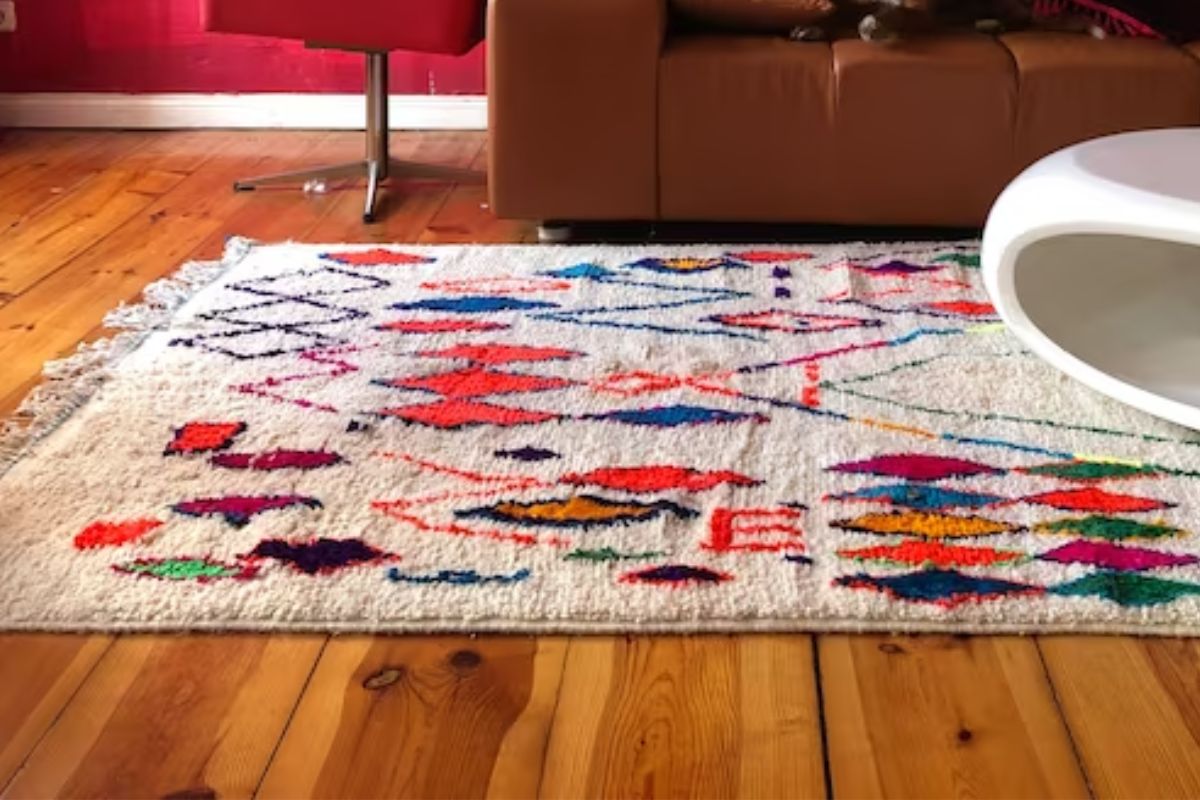
    An Azilal rug is a hand-knotted Berber rug from the Azilal province in Morocco's High Atlas Mountains, built on a natural, undyed cream or ivory wool base and covered with vivid, freeform, abstract patterns. It is the colorful, expressive counterpart to the neutral Beni Ourain: thinner in pile, brighter in palette, and far less bound by fixed tribal templates. Each Azilal is essentially a one-off, improvised by the weaver, so no two are truly alike. If you found a bright, loosely drawn Moroccan rug floating on a cream ground and wondered what it was, it is almost certainly an Azilal.

    The rest of this guide covers where the style comes from, why the designs never repeat, what the rugs are made of, how they differ from the two styles they are most often confused with (Beni Ourain and Boujad), and the honest parts most rug listings leave out. For the wider family this style belongs to, see our complete guide to Moroccan rug styles.

    Where Azilal rugs come from

    Azilal is both a rug style and a real place. The province and town of Azilal sit in the High Atlas Mountains, roughly 100 miles from Marrakech, and the rugs take their name from that region. They are woven by Azilali Berber (Amazigh) communities, and by long tradition the weaving is done by women, with techniques passed down within families.

    Beyond that, the deep history gets murky, and this is a good moment to be honest about it. You will see origin dates for Azilal weaving stated confidently across the web, from a few centuries to "ancient," but there is no firmly documented, agreed-upon start date. What is clear is that the style stayed local and largely unknown to outside collectors until the late twentieth century, when Moroccan tribal rugs found a Western design audience. So the safe, accurate statement is this: Azilal is a regional High Atlas weaving tradition that became internationally collected fairly recently. Precise founding dates are not settled, and any single source that pins one should be read with caution.

    Why no two Azilal rugs match

    This is the trait that defines the style, and it is the one most worth understanding before you buy. Where a Beni Ourain follows a fairly restrained visual template, the Azilal weaver works freehand. The motifs (lines, diamonds, chevrons, ladders, and looser figurative shapes) are arranged from the maker's own imagination rather than a set pattern book. The results are personal, improvised, and often asymmetric.

    The practical consequence: you cannot shop for "the Azilal design," because there isn't one. Two rugs from the same village, the same year, even the same weaver, will not match. Irregular spacing, a color that appears once and never again, a motif that drifts off-center: these are features of the tradition, not flaws or signs of a mistake. If you want a rug that reads as a single artistic object rather than a repeating textile, that improvised quality is the whole appeal. If you want two matching runners, this is the wrong style to hunt for.

    What Azilal rugs are made of

    The ground of an Azilal is typically natural, undyed sheep's wool in cream, ivory, or soft beige. The colored motifs are worked in dyed wool, and often cotton, laid over that light base. Some newer pieces incorporate recycled cotton or mixed fibers for the bright accents, which is part of why modern Azilals can look more saturated than older ones.

    Construction-wise, Azilal rugs are single-knotted, commonly with a cotton warp and wool knots and weft. The pile tends to be lower and the rug lighter and thinner than a plush Beni Ourain. That makes them easier to layer and move, though it also means they feel less cushioned underfoot.

    Azilal vs Beni Ourain: the honest comparison

    These two are the styles buyers most often weigh against each other, because they sit at opposite ends of the same shelf: one neutral, one colorful. Neither is "better." They solve different problems in a room.

    Feature Azilal Beni Ourain
    Region Azilal province, High Atlas Beni Ourain tribes, Middle Atlas
    Palette Cream base with bright, multicolor motifs Cream or ivory base with brown or black lines
    Design Freeform, abstract, improvised Minimalist, geometric, restrained
    Pile Lower and thinner Thick, plush, high pile
    Materials Wool plus cotton, sometimes recycled fiber Typically all wool
    Feeling in a room Playful, artistic, a focal point Calm, neutral, a backdrop

    The short version: choose an Azilal when you want the rug to be the color story in the room, and a Beni Ourain when you want the rug to disappear into a neutral scheme and let everything else stand out. For the full breakdown of the neutral option, see our Beni Ourain rug guide.

    Azilal vs Boujad: the other easy mix-up

    Boujad is the style most often confused with Azilal once color enters the picture, and telling them apart comes down to one word: space. Boujad rugs are woven in the Middle Atlas near the town of Boujad, by Arab and Arabised Berber communities, and they tend to flood the entire field with saturated color, especially pinks, reds, oranges, and purples. The color fills the rug edge to edge.

    An Azilal does the opposite. It keeps a lot of open cream ground showing, with bright motifs floating on top of it. So a quick tell: if most of the rug is cream with color drawn onto it, you are likely looking at an Azilal; if the whole surface is soaked in warm color, it leans Boujad. Our Boujad rug guide covers that saturated style on its own terms.

    Older Azilal vs newer production

    "Azilal" is not one static look, and the difference between older and newer pieces is real enough to explain rather than blur. Older Azilal rugs lean on natural undyed wool and plant-based dyes, with sparser designs and a more muted, earthy set of accent colors. Many newer pieces are brighter, use more cotton, and may rely on synthetic dyes to hit those electric blues, pinks, and yellows.

    This matters because natural and synthetic dyes age differently. Natural dyes tend to mellow and harmonize over years, softening into the wool. Synthetic dyes are generally stable in a good modern rug, but some can fade or shift over time rather than settle. Neither is automatically "better," but they are not the same thing, and price and expectation should follow the reality of the piece.

    One caution: "vintage" is not a regulated term in the rug trade, and the age of a specific rug is hard to verify from a photo or a listing alone. Treat an age claim as a claim, not a certified fact, and ask what it is based on.

    What the motifs might mean, and why "might" is the right word

    You will find blogs that hand you a tidy dictionary of Azilal symbols, assigning fixed meanings to diamonds, zigzags, and figures. Read those with care. The motifs are commonly described as touching on rural life, motherhood, birth, and protection, and many weavers do work personal or symbolic content into their rugs. But there is no single, universal, decoded code. Meanings vary by weaver, family, and region, and a great deal of it is undocumented or interpreted after the fact.

    So the accurate framing is that Azilal motifs may carry meaning, often personal to the maker, and that specific "this shape always means X" claims should be treated as interpretation rather than settled fact. When a source states a precise symbolic meaning, look for what it is sourced to.

    The part most rug listings leave out

    Here is the honest section a seller has little reason to write. Because the defining traits of an Azilal are loose ("colorful abstract motifs on a light ground"), the label gets applied broadly in the market. A colorful High or Middle Atlas rug that is arguably Boujad-adjacent or a regional blend may still be listed as "Azilal," simply because that name sells. And the words that surround these rugs, including Azilal, vintage, authentic, tribal, and Berber, are not regulated or certified by anyone. The label on a listing is a description, not a guarantee of origin.

    That is not a reason to distrust every rug. It is a reason to buy the rug in front of you rather than the word attached to it: judge the wool, the ground, the knotting, and the look you actually want. Atlas Rug Guide is a reference, not an appraisal or authentication service, and we will not tell you a specific rug is genuine from afar. For a high-stakes purchase, an in-person expert who can handle the piece is the right authority.

    Before you buy or live with one

    A few grounded checks, in plain terms:

    • Feel the wool. Real sheep's wool has a slightly greasy, springy hand and recovers when you press it. A flat, squeaky, or plasticky feel is worth questioning.
    • Look at the ground. A classic Azilal shows a natural, undyed cream or ivory base with color drawn on top, not color everywhere.
    • Check the back. Hand-knotting shows on the reverse. Ask whether the piece is knotted rather than machine-made or tufted.
    • Ask about dyes and age. A confident seller can tell you natural versus synthetic dye and roughly how old the piece is, and will not oversell what they cannot prove.
    • Expect asymmetry. Irregularity is normal here. Do not treat an off-center motif as a defect.

    In a room, an Azilal earns its keep as a color anchor over neutral floors, and its thinner pile makes it easy to layer over a larger natural rug or a flatweave. Because the palette is already doing the work, it usually looks best with fairly restrained furniture around it.

    FAQ

    Are Azilal rugs handmade?
    Yes. Azilal rugs are hand-knotted, traditionally by women in the Azilal region of the High Atlas, using wool and often cotton. Handwork is why each one is slightly irregular and one of a kind.

    Is an Azilal rug better than a Beni Ourain?
    Neither is better; they are built for different rooms. An Azilal brings color and acts as a focal point, while a Beni Ourain is neutral and recedes into the background. Choose based on whether you want the rug to be the color story or a quiet backdrop.

    Why are Azilal rugs so colorful?
    The style is defined by expressive, improvised design. Weavers work freehand rather than to a fixed template, laying bright dyed wool and cotton over a natural cream base. Newer pieces often look more saturated because they use more cotton and, in some cases, synthetic dyes.

    What are Azilal rugs made of?
    A natural undyed wool ground, with motifs in dyed wool and often cotton. Some newer pieces use recycled cotton or mixed fibers for the bright accents. They are usually knotted with a cotton warp and wool knots.

    How can I tell a real Azilal rug?
    Look for real wool, a natural cream ground with color drawn on top, visible hand-knotting on the back, and honest answers about dyes and age. Keep in mind that "Azilal" is an unregulated market label, so for an important purchase, a hands-on expert appraisal is the only reliable way to confirm origin.
  • How New Rugs Are Made to Look Old in Morocco

    How New Rugs Are Made to Look Old in Morocco

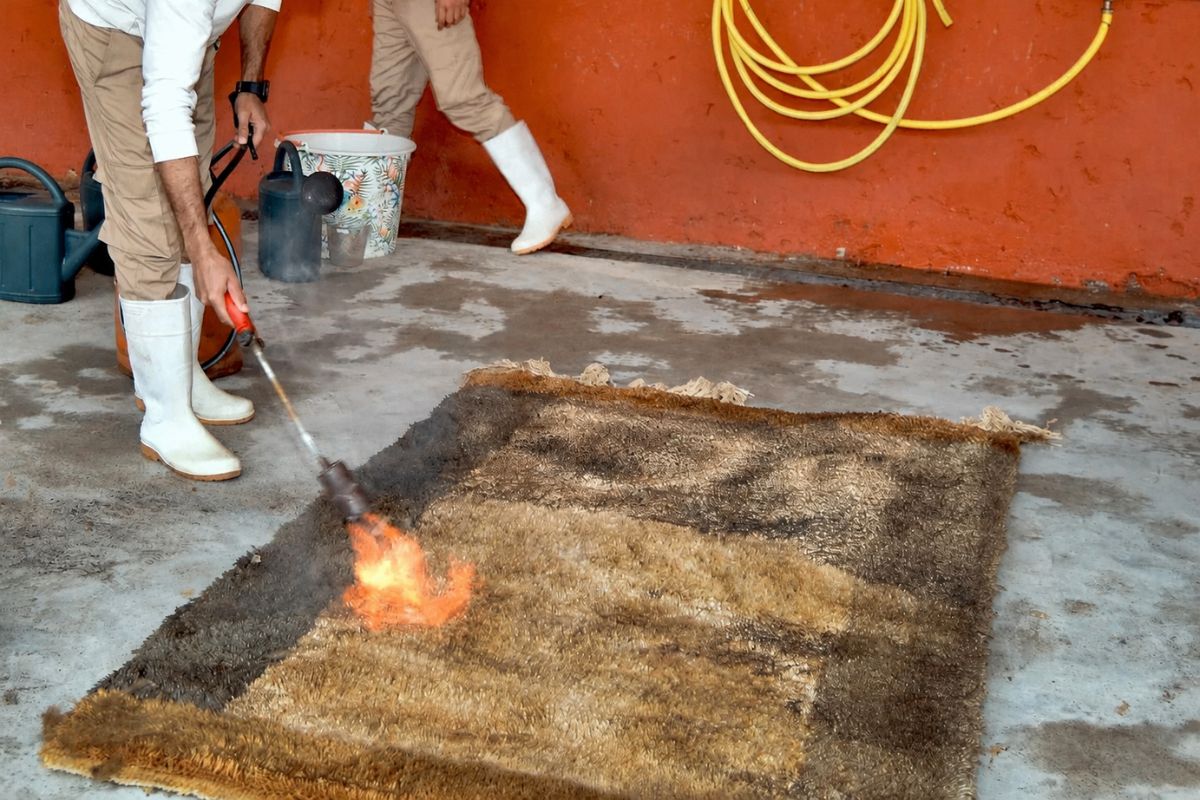
    Most Moroccan rugs sold online as “vintage” are new rugs that have been treated to look old. The account below comes from the Anou Cooperative, a weaver-owned organization in Morocco, which described the process in a blog post of 14 December 2020: rugs covered in dirt and walked on, laid out in the sun, washed in a one-to-one water and bleach solution, sometimes treated with sulfur-heavy chemicals to shorten the process, and in some cases blow torched to burn out plastics and force color fading. Their summary was blunt: “Moroccan vintage rugs don’t really exist.”

    Who says this, and why their account carries weight

    This site went looking for independent reporting on artificial ageing in the Moroccan rug trade in August 2026. There is almost none. Page one for the question is the Anou Cooperative’s own blog, a travel listing for the cooperative, and one US rug dealer and cleaning firm whose description of bleach odor and heavy top-side fading corroborates the account from a trade perspective.

    No newspaper covers it. No consumer body covers it. No rug seller’s blog covers it, which is not surprising, because most of them are selling the product in question.

    Anou is a national service cooperative and part of a network of Amazigh (Berber) weaving and artisan cooperatives, where artisans sell directly rather than through intermediaries. They are not a neutral party: they have an interest in the alternative model they run, and they say so openly. What they are not is a seller of the rugs they are describing. In a market where every other source has inventory to move, an organization owned by the weavers themselves is the closest thing to an independent account that exists on this question.

    The processes, in Anou’s own description

    The 14 December 2020 post describes a supply chain in which middlemen, most of them women according to Anou, commission rugs from weavers and then process them for the online market. The techniques it names:

    • Dirt and foot traffic. Weavers are instructed to cover the finished rug in dirt and walk over it.
    • Sun exposure. The rug is laid out in the sun for an extended period to fade the color.
    • Bleach washing. A one-to-one water to bleach solution, which Anou says takes something like 100 liters to fully soak a large wool rug, applied one to three times on average.
    • Sulfur-heavy chemicals. Used to cut down processing time, with a toxicity Anou describes as not well understood.
    • Blowtorching. Rugs “literally blow torched to burn out plastics” and to promote color fading.

    Anou names Khenifra, Kenitra and Taznakht as production hubs for this, and Instagram and Etsy as the sales channels. Their follow-up post of 3 September 2021 adds that chemicals used in this kind of washing “have been banned by US rug washing facilities since the 1980s” after causing lung complications in workers.

    None of this is invented by this site, and none of it is generalized beyond what Anou wrote. It describes an industry practice, not any particular shop.

    The cost that never appears in the listing

    The environmental account is the part of this that no seller mentions, and Anou is specific about it.

    Bleach does not biodegrade. In Anou’s words, for every rug on Etsy and Instagram, that is “countless liters of bleach poured directly into the rivers that the artisans who made the rug depend on.” The 2021 post reports that streams in the Khenifra region “now run with brine and are no longer potable,” and describes this as a worsening problem rather than a historical one.

    There is a human exposure side too. Anou notes that the people demonstrating the washing process wear boots, and observes that this is for a reason. This site is not in a position to assess the occupational risk and does not attempt to.

    The cooperative also documents that a different way is possible: Cooperative Lfarah produced faded, vintage-style rugs using full-exhaust dyes and sustainable mordants with no chemicals, and their pilot washing techniques cut water use by roughly half against standard practice.

    What this means for the rug already in your house

    The honest answer is that this site does not know what is in your rug, and neither does anybody else who has not tested it.

    What can be said: chemical washing is widespread in this trade, the processes described above leave the rug looking exactly as intended, and there is no way to tell by eye whether a given piece went through them. Anou’s own point about the sulfur-heavy chemicals is that the effects are not well understood, and that uncertainty is part of the honest answer rather than something to paper over.

    What this guide will not do is offer you a home test or a treatment. There is no reliable kitchen-table way to detect chemical residue in wool, and neutralizing protocols circulating online are not something this site is qualified to endorse. If you are concerned about a specific rug:

    • Ask the seller directly whether the rug was chemically washed, and ask for the answer in writing. Many will say yes, because it is normal in the trade.
    • Air it thoroughly, outdoors if you can, before it goes into a bedroom or a child’s room. Ventilation is the one measure that is safe, free and universally recommended for new textiles.
    • Speak to a professional rug cleaning service, one that does not sell rugs, if a smell persists. They handle chemically washed pieces routinely and can tell you what they are seeing.
    • Speak to a clinician, not a rug site, if anyone in the household has symptoms you associate with the rug. That is a medical question and this guide has no standing to answer it.

    Why a new rug smells of chemicals covers what different smells actually indicate, including the separate case of adhesive off-gassing in tufted rugs.

    What it means for what the weaver was paid

    The distressing is also where the money separates from the maker, and this is the part that explains the rest.

    Anou’s December 2020 post describes artisans earning as little as 5 dirham a day, which the cooperative characterizes as under 5% of minimum wage, and receiving payment only for the weaving. The processing that transforms a new rug into a saleable “vintage” one, and multiplies its resale price, happens after the weaver is out of the transaction.

    That fits the wider picture from AFP’s reporting of December 2024, carried by outlets including Business Recorder, which described weavers in southern Morocco traveling to a weekly market to sell to middlemen who set the prices, with a large rug going for around 250 dirhams, roughly 24 US dollars at the time. Ijja Benchri, a weaver from Taznakht quoted in that reporting, said a single carpet took two to four weeks and that she had no choice but to accept what was offered.

    Taznakht rugs and the cooperatives behind the name covers the organizations working against that pattern.

    Can you tell, looking at a rug?

    Usually not, and anyone who tells you they can from a photograph is overstating.

    Some things are suggestive rather than conclusive. A strong bleach or chlorine smell is a signal. Fading that is much heavier on the top surface than in the depth of the pile, or that sits oddly against unfaded areas, is consistent with a surface treatment rather than decades of light. Uniform ageing across a whole rug is less likely than uneven wear from real use.

    But each of these can have another explanation, and a well-executed treatment produces exactly the appearance it is meant to. That is the point of it.

    Which is why this cluster keeps returning to the same conclusion: buy the rug in front of you for what it is, and treat the age story as unverified unless there is documentation behind it. What “vintage” actually means on a listing covers the vocabulary, and how to buy a Moroccan rug without getting taken covers the full set of failure modes. If it is the faded palette you are drawn to, where the Moroccan rug palette comes from is worth reading first.

    Photo credit/source: Nina Roberts; the article identifies the image as “Rugs are washed and torched. Photo: Nina Roberts.

    FAQ

    Are most vintage Moroccan rugs fake?
    The Anou Cooperative, a weaver-owned organization in Morocco, wrote in December 2020 that “Moroccan vintage rugs don’t really exist” at the volume and prices the online market offers, and described the processes used to age new rugs artificially. This site cannot say what proportion of any given seller’s stock that covers.

    What chemicals are used to age Moroccan rugs?
    Anou names a one-to-one water and bleach solution and sulfur-heavy chemicals used to speed the process, and reports that chemicals of this kind were banned by US rug washing facilities in the 1980s after causing lung complications in workers.

    Is a chemically washed rug dangerous to have at home?
    This site does not know and will not guess. Anou itself says the toxicity of some of the chemicals involved is not well understood. Air a new rug thoroughly, ask the seller in writing what was done to it, and consult a professional cleaner or a clinician rather than a rug website if you have a specific concern.

    Can I tell if my rug was artificially aged?
    Usually not by eye. A bleach smell, or fading much heavier on the surface than in the depth of the pile, is suggestive but not conclusive. A well-executed treatment looks exactly like age, which is its purpose.

    Does buying from a cooperative avoid this?
    Cooperatives such as Anou publish what their members are paid and describe their own washing and dyeing methods, which is more transparency than most of the chain offers. This site does not rank or recommend individual sellers and has no commercial relationship with any of them.

  • Natural vs Synthetic Rug Dye: Bleeding Proves Nothing

    Natural vs Synthetic Rug Dye: Bleeding Proves Nothing

    If a rug bleeds, it tells you the dye was never properly fixed into the fiber. It does not tell you whether that dye was natural or synthetic, and it is not evidence that the rug is a fake. This matters because the opposite claim, that natural dyes do not run so a color run proves synthetic dye, is stated outright on seller pages and is contradicted by the rug trade's own specialist sources. A properly mordanted natural dye stays put. A badly fixed dye of either origin bleeds.

    Where the false claim comes from

    The claim is convenient. It gives a seller a quick on-the-spot test whose result they can predict, and it lets the word "natural" carry a premium.

    The trade's own literature does not support it. Nazmiyal's page on color runs in rugs makes the point directly: early synthetic reds, and contemporary red dyes too, are prone to running, but the existence of a red color run does not preclude a natural origin. Other specialist and professional-cleaning sources on the same question converge: clean, easy bleeding is the single most useful indicator of a poor dye job, natural or synthetic, and properly mordanted natural reds do not bleed.

    So the test is real, it just answers a different question than the one it is sold as answering. This is the pattern across this whole cluster, and it also applies to the burn test, which is likewise asked to prove far more than it can.

    What actually causes a color run

    Dyeing wool is not simply staining it. The dye has to bond to the fiber, and for most natural dyes that requires a mordant, a metallic salt that fixes the colour in place. Get the mordanting right and the colour is genuinely locked into the wool. Get it wrong, skip it, or overload the fiber with more dye than it can bond, and the excess sits on the surface waiting for water.

    Synthetic dyes have their own fixing requirements, and the same logic applies. Some early synthetic reds were notoriously fugitive, which is where a good deal of the folklore comes from, and the trade's own accounts note that red remains the most run-prone colour family across both dye types.

    The variable is process quality, not chemistry of origin. A cheap dye badly fixed will bleed, fade harshly, or in the worst cases damage the wool itself. That is the thing worth avoiding, and it is not what the natural-versus-synthetic argument is about.

    Why age makes natural dyes less stable, not more

    There is a second reason a genuinely old, genuinely naturally dyed rug can run, and it is the exact opposite of the romantic story.

    Specialist and professional cleaning sources describe natural dyes as more sensitive to heat, moisture and chemical exposure than modern synthetics, and note that age and oxidation make them progressively less stable. So an old rug with real vegetable dyes can bleed under a cleaning approach that a newer synthetic-dyed rug would shrug off.

    The practical consequence is not academic. It means the rug most likely to be damaged by a careless wash is the valuable one, and it is why professional rug cleaners test for colourfastness before they put water on anything. If you own a piece you believe carries natural dyes, that is a reason to be more careful with cleaning, not less.

    What you can honestly tell by looking

    Some things are visible, with limits attached to each.

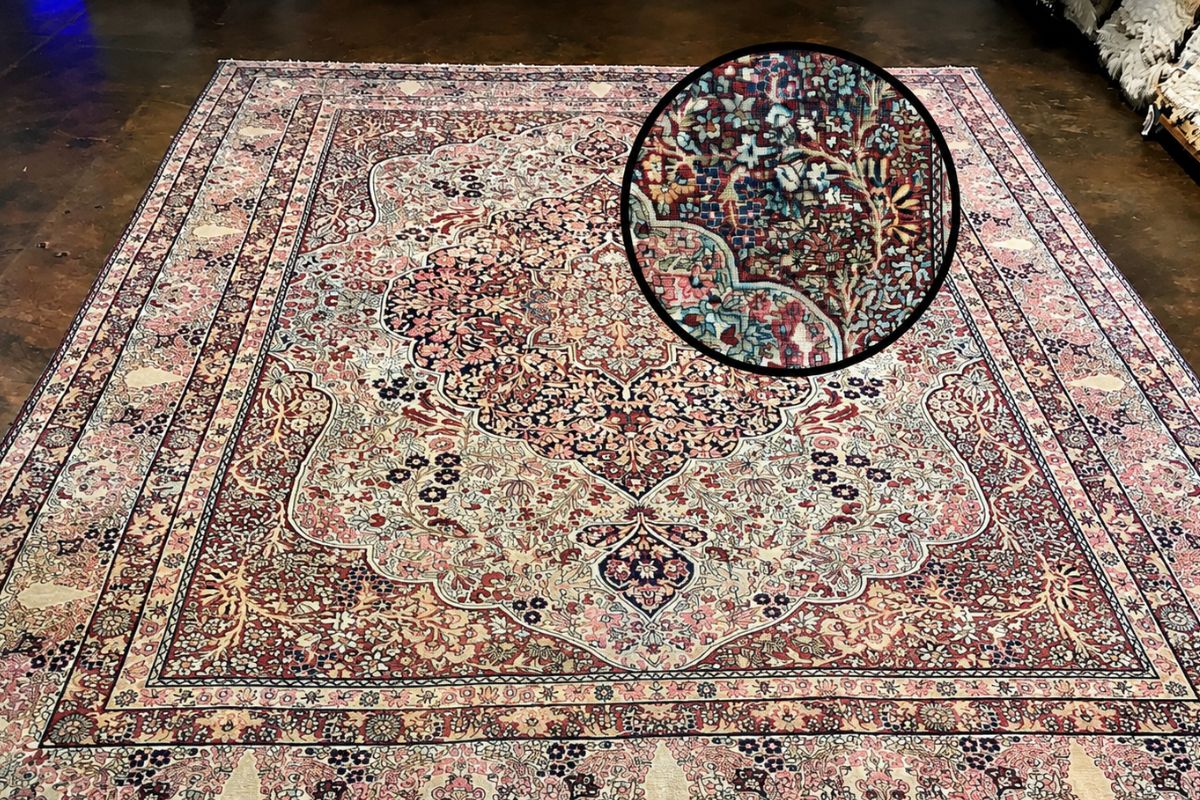
    Abrash. Gentle horizontal banding across a field of colour, where the tone shifts slightly from one section to the next. It happens when hand-spun yarn takes dye unevenly or when a weaver moves between dye lots. It is a genuine sign of small-batch, hand-processed work, and it is also easy to imitate, so read it as suggestive rather than conclusive.

    Depth and variation within a single colour. Naturally dyed wool often shows subtle variation strand to strand. A flat, perfectly even field is more consistent with an industrial dye lot.

    How the colour reads at the base of the pile. Part the pile and look near the foundation. On a rug that has faded with real light exposure, the colour at the base is usually deeper than at the tip. On a rug faded by a surface treatment, the difference can be more abrupt.

    What you cannot tell by eye is the actual chemistry. Dye analysis is a laboratory procedure, and no amount of looking substitutes for it. Where the Moroccan rug palette comes from covers what can and cannot honestly be said about the colours themselves.

    What this means when a rug bleeds in your home

    First, do not conclude you were sold a fake. You have learned something about the dyeing, not about the rug's origin.

    Second, treat it as a cleaning constraint from now on. A rug that runs will run again. That means blotting rather than rubbing a spill, avoiding saturating the pile, keeping it out of situations where it will get genuinely wet, and telling any cleaner about it before they start.

    Third, if it happened during a cleaning attempt, stop and get professional help rather than escalating. Wet wool holding loose dye spreads colour further with each pass.

    And if the rug is one you were told carries natural dyes, the bleeding is not proof that claim was false. It is consistent with an old natural dye that has become unstable, with a badly mordanted natural dye, or with a poorly fixed synthetic. Those cannot be told apart at home.

    For the wider set of tests that promise more than they deliver, see how to buy a Moroccan rug without getting taken, and for the fiber half of the same assessment, judging wool quality without a lab. The chemical washing described in how new rugs are made to look old is also worth reading here, since it acts directly on colour.

    FAQ

    Do natural dyes bleed?
    Yes, they can. Properly mordanted natural dyes do not, but badly fixed ones do, and specialist sources note that natural dyes become less stable with age and oxidation. Bleeding is not evidence of synthetic dye.

    Does a color run mean my rug is fake?
    No. It means the dye was not properly fixed. That is worth knowing for cleaning, but it says nothing about where or how the rug was made.

    How can I test for natural dyes at home?
    You cannot reliably. Dye analysis is a laboratory procedure. Abrash and subtle colour variation are suggestive but imitable, and this guide does not recommend any home chemical test.

    Which colour bleeds most often?
    Red, across both dye types, according to the trade's own accounts. Early synthetic reds in particular were prone to running, which is part of where the folklore about bleeding began.

    My rug ran while I was cleaning it. What now?
    Stop rather than continuing, because wet wool holding loose dye spreads it further with each pass. Get a professional rug cleaner involved, and tell them the rug runs before they start.