Tag: wool rugs

  • Can You Wash a Wool Rug at Home? The Real Question

    Can You Wash a Wool Rug at Home? The Real Question

    Sometimes, and the question that decides it is not whether you can wash the rug but whether you can dry it. Getting a dense wool pile fully dry, quickly, flat and with air moving through it is the hard part, and a rug that stays damp develops mildew and odour that are considerably harder to fix than whatever you were cleaning off. For an old, valuable or naturally dyed hand-knotted piece the answer is simply no: that is a specialist's job, and this site's own position is that irreplaceable rugs are not DIY projects.

    The four things that decide it

    Work through these honestly before anything gets wet.

    1. What is the rug worth, and can it be replaced? A modern, inexpensive, machine-spun wool rug is a reasonable thing to attempt. A hand-knotted one-off piece is not replaceable at any price, and the downside is not a wasted afternoon, it is the rug.

    2. Are the dyes stable? If you do not know, you do not know. See below.

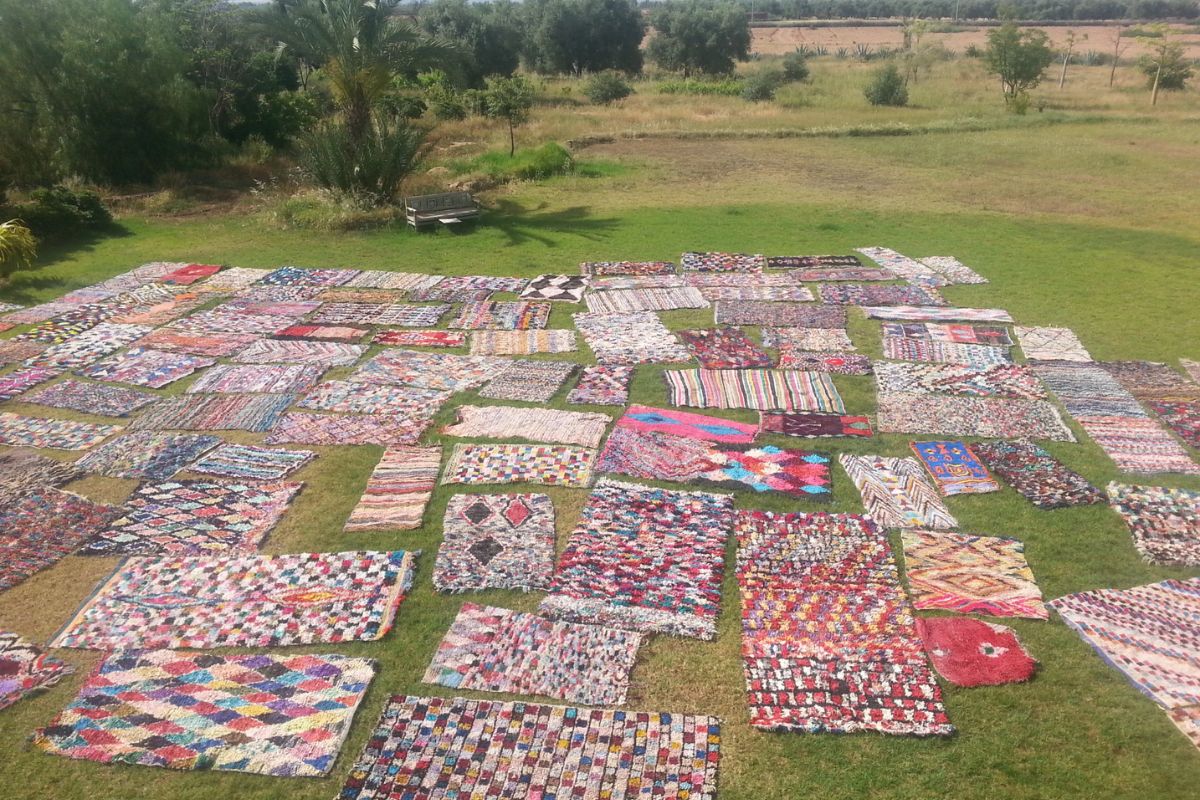
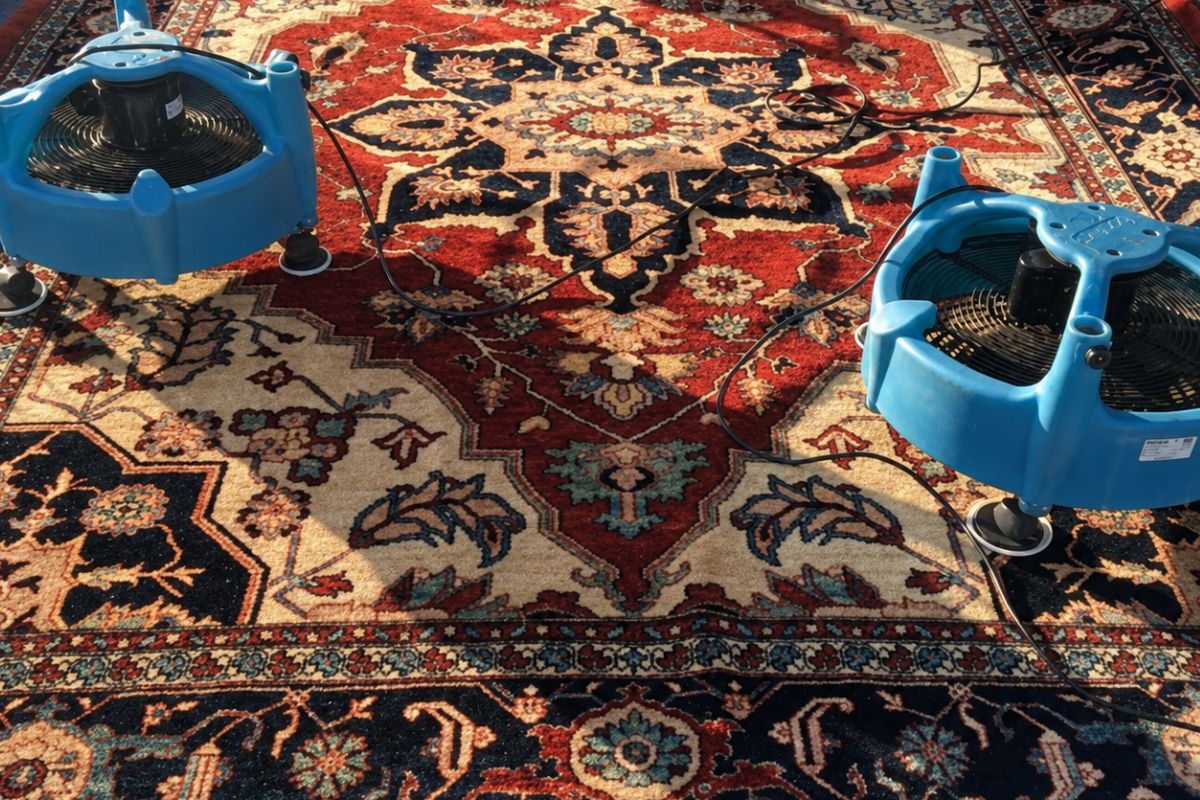
    3. Can you dry it fast, flat and with airflow? Not "will it dry eventually." A garden on a hot dry day with a hard surface, or a garage with fans and space to lay it flat, is a yes. A bathroom floor in a damp flat is a no.

    4. What are you actually trying to fix? General dullness is usually a vacuuming problem, not a washing problem. A specific set stain, a pet accident, or an odour coming from the foundation are all reasons to call someone rather than reasons to wash the whole rug.

    If any of the first three is a no, stop there. The rest of this page explains why.

    What water actually does to wool

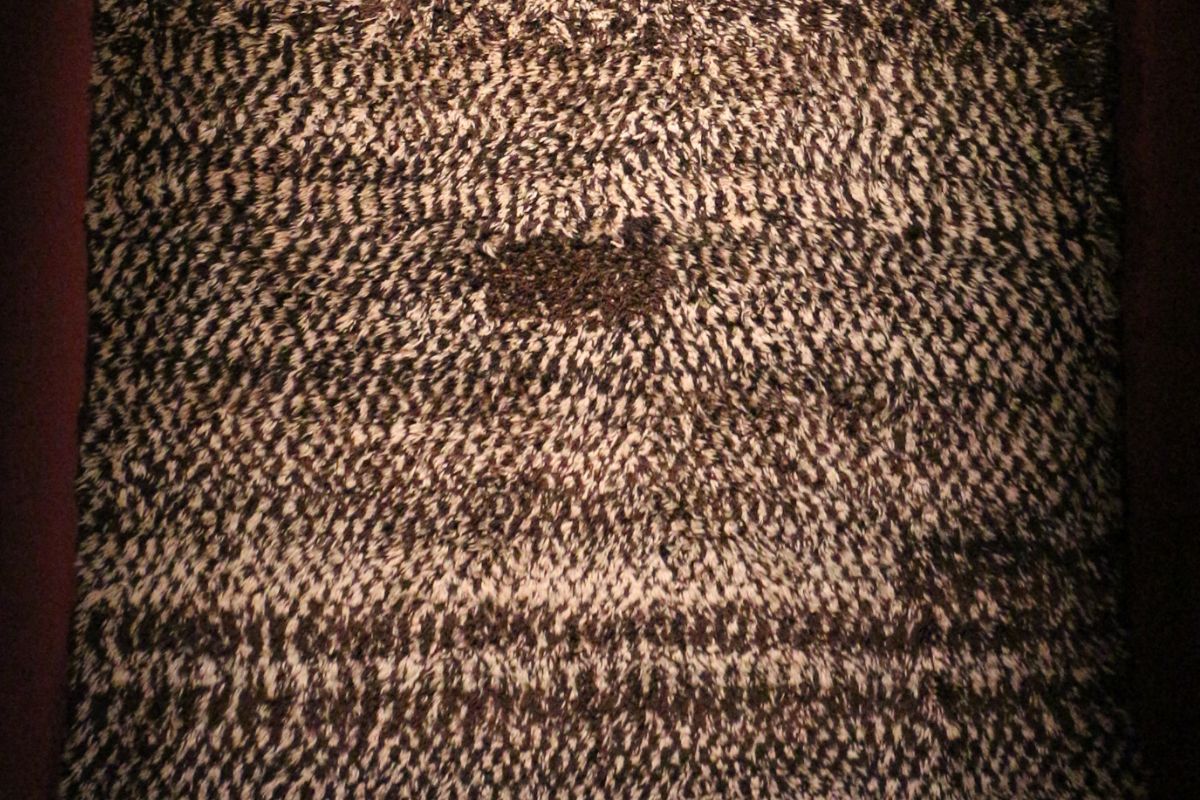
    Wool is a protein fibre with a scaled surface. Agitate it in water, particularly warm water and particularly with anything alkaline, and those scales interlock. That is felting, and it is permanent: the rug shrinks, stiffens and loses its drape.

    Alkalinity is the specific enemy, and most household cleaning products are alkaline. Professional rug cleaning sources describe wool as wanting pH-neutral treatment, with professional formulations in the range of roughly 5.5 to 8.0, precisely because pushing outside it strips lanolin, damages the fibre and destabilises dye. Heat accelerates everything. Oxygen bleach and enzyme cleaners are separate categories of permanent damage, covered in cleaning products that quietly destroy wool.

    So even the successful version of home washing is a narrow path: cool water, minimal agitation, a wool-safe product used exactly as its manufacturer directs, and testing on a hidden area first. This guide publishes no recipe, no dilution and no temperature, because a wrong number here damages a rug and the right numbers are on the product's own label.

    The dye problem, which only appears once it is wet

    This is the trap. A rug can look completely stable for years and run the first time it is properly wet.

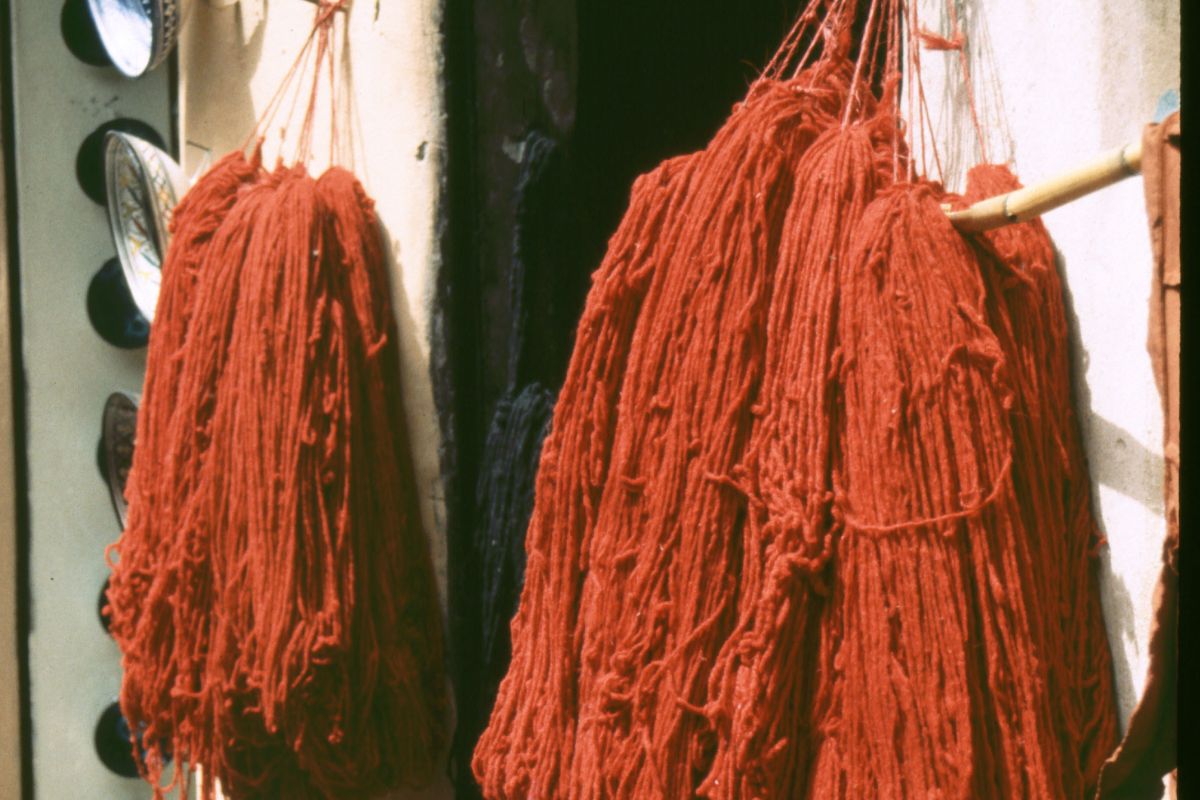
    Bleeding means the dye was never fully fixed into the fibre, and it happens with natural and synthetic dyes alike. Worse for exactly the rugs you would most want to protect: natural dyes become less stable with age and oxidation, so an older hand-woven piece can run under a cleaning approach a newer rug would shrug off. A red that migrates into a cream field while the rug dries is not something you fix afterwards.

    Professional cleaners test for colourfastness before water touches a rug, which is one of the concrete things you are paying them for. If you are going to attempt anything at home, test a hidden area with a damp white cloth first, and if any colour transfers, stop. Natural or synthetic dye explains why a colour run is a cleaning constraint rather than evidence you were sold a fake.

    The drying problem, which is the real one

    Say you have washed it and nothing has felted and nothing has run. You are now at the difficult part.

    A hand-knotted wool rug holds a great deal of water and is heavy when wet, heavy enough that lifting it wrong can distort the weave. It needs to dry flat, with air moving over both sides, and it needs to do that quickly rather than over a week. Hanging a soaked rug over a line puts the weight of the water on a fold and can distort it permanently.

    What goes wrong when drying is slow: mildew, a persistent musty odour coming from deep in the pile and the foundation, and browning, where residual moisture carries substances up through the fibre and leaves a discoloured area as it evaporates. Each of these is harder to resolve than the dirt you started with, and each is a common reason rugs arrive at professional cleaners.

    If you cannot answer "yes, flat, with airflow, within hours" then washing is not the right decision, whatever the rug is worth.

    What a professional does differently, and when it is worth it

    Rug cleaning specialists dust the rug first, mechanically removing dry grit that would otherwise turn to mud, which is something no home method replicates. They test dyes before wetting anything. They control pH and temperature deliberately. And they have controlled drying, usually flat or with forced air, which is the step a home simply cannot match.

    Call one for: anything old, valuable or naturally dyed; a set stain; a pet accident that reached the foundation; an existing odour; a colour run; visible moth damage; or a rug you genuinely cannot dry properly.

    Do it yourself for: routine vacuuming, prompt spill blotting, airing the rug outdoors on a dry day, and rotating it. That covers most of what a rug in ordinary domestic use actually needs, and how to care for a Moroccan wool rug is the whole routine.

    Use a rug cleaning specialist rather than a general carpet cleaning service, and tell them the rug is hand-knotted wool, whether you believe the dyes are natural, and anything you have already put on it. If you want to understand what you are protecting, judging wool quality without a lab covers what makes a fleece worth being careful with, and spills on wool covers the everyday version of this question.

    FAQ

    Can I wash a wool rug at home?
    Sometimes, for a modern, inexpensive, colourfast rug you can dry quickly, flat and with airflow. For an old, valuable or naturally dyed hand-knotted piece, no. The deciding factor is drying, not washing.

    Can I put a wool rug in the washing machine?
    Not a hand-knotted rug. Machine agitation and heat felt wool, which shrinks and stiffens it permanently, and the weight of a wet rug is not something a domestic machine is built for.

    How do I know if the dyes will run?
    Test a hidden area with a damp white cloth before anything else. If colour transfers, stop. Older natural dyes become less stable with age, so an old rug is more at risk than a new one, not less.

    What happens if a wool rug dries too slowly?
    Mildew, a lasting musty odour from deep in the pile, and browning as residual moisture evaporates. All three are harder to fix than the dirt you were removing.

    What does a professional rug cleaner do that I cannot?
    They dust out dry grit before wetting the rug, test the dyes for colourfastness, control pH and temperature, and dry it flat with forced air. Controlled drying is the step a home cannot replicate.
  • Spills on a Wool Rug: The First Five Minutes

    Spills on a Wool Rug: The First Five Minutes

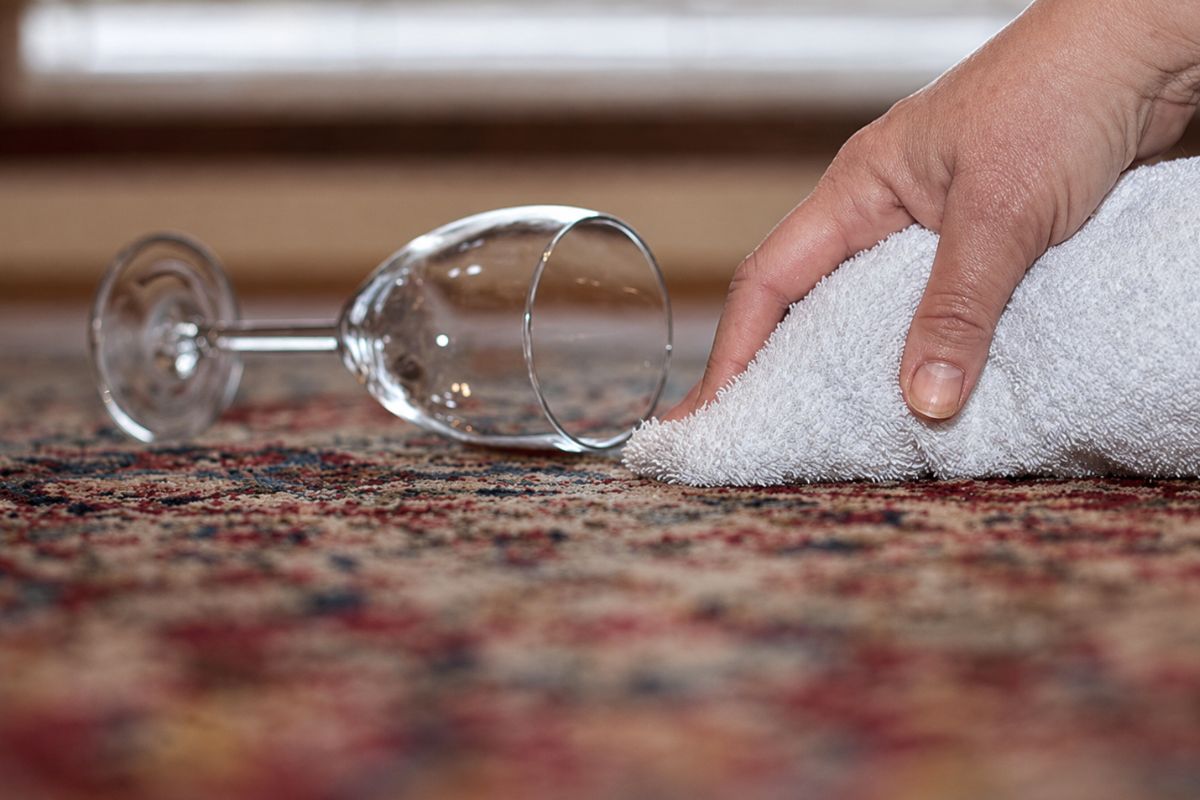
    Do these five things now, in this order. One: lift or scoop away anything solid with a spoon or a blunt edge, do not press it in. Two: blot with a clean white cloth or plain kitchen paper, pressing straight down, working from the outside of the spill inward. Three: keep swapping to a dry part of the cloth until it stops lifting colour. Four: if you use liquid at all, use a very little plain cool water and blot again, never soak. Five: press dry, weight it with a dry towel, and let air get to it. Do not rub, do not use heat, and do not reach for a spot cleaner.

    Why blotting and not rubbing, on wool specifically

    Rubbing does two things to a hand-knotted wool pile, both bad. It pushes the spill down through the pile toward the foundation, where it is far harder to remove and where it can wick back up as the rug dries. And it abrades the fibre surface, leaving a fuzzed patch that stays visible after the stain itself has gone.

    Blotting works because of lanolin. The natural grease in good wool repels liquid for a short window before absorption, which is why a wool rug survives spills that would ruin other fibres, and why speed matters more than technique. You are racing that window, not scrubbing a surface.

    Work from the outside in for the same reason you would with any textile: pressing at the centre of a spill spreads it outward into clean pile and makes the mark larger than it needed to be.

    What to use, and what must never touch it

    Safe: a clean white absorbent cloth or plain white kitchen paper, and a small amount of plain cool water. White matters, because a coloured cloth can transfer its own dye into damp wool.

    Only with care: a product that explicitly states it is safe for wool, used exactly as its own manufacturer directs, and tested first on a hidden corner or the rug's underside. Apply it to the cloth rather than pouring it onto the rug.

    Never, and each of these is permanent:

    • Oxygen bleach, the active ingredient in most "oxy" spot cleaners. It bleaches wool, and the pale patch does not come back.
    • Chlorine bleach.
    • Enzyme cleaners. They are formulated to break down protein and wool is protein.
    • High-alkaline all-purpose household cleaners. Alkalinity felts the fibre, strips lanolin and destabilises dyes.
    • Hot water, steam or a hairdryer on a hot setting. Heat sets many stains and accelerates every kind of wool damage.

    Never combine products. Professional rug cleaning sources describe wool as wanting pH-neutral treatment, with professional formulations in the range of roughly 5.5 to 8.0, and that is the whole reason the list above exists. Cleaning products that quietly destroy wool goes through the cupboard properly.

    Common spills and where each one differs

    Water, tea or coffee without milk. Blot hard and fast. Most of it lifts if you get there quickly.

    Red wine, juice and anything strongly coloured. Blot immediately and keep swapping cloth. Do not reach for the internet's favourite remedies here, because the strongly coloured spills are exactly the ones people try to bleach out, and bleaching wool is irreversible.

    Milk, cream and anything with protein or fat. Lift the solids, blot, then be patient. These are the ones that develop an odour if any residue is left in the pile, and they are a good candidate for professional help rather than escalating at home.

    Pet accidents. Blot what you can and treat this as a different problem. Urine that has reached the foundation is not a surface stain, it is a contamination and odour issue, and it commonly needs a professional. Do not use an enzyme cleaner on wool, despite it being the standard recommendation for pet accidents on synthetic carpet.

    Mud and solids. Counter-intuitively, let it dry completely, then vacuum it up with a plain suction head. Attacking wet mud pushes it in. Vacuuming a wool pile rug covers doing that safely.

    Wax and chewing gum. Do not apply heat. This is a job for someone who does it professionally.

    The stop rule: when to leave it and call someone

    Nearly every other page on this topic escalates you through progressively stronger interventions. This one tells you where to stop, because the second and third attempts are what turn a mark into permanent damage.

    Stop now, and get a rug cleaning specialist, if:

    • The rug is old, valuable, or you believe it carries natural dyes. These pieces are irreplaceable and this site's own position is that they are not DIY. Natural dyes also become less stable with age, so water can move colour in ways nothing will reverse.
    • Colour is lifting into your cloth from the rug itself, rather than from the spill. Stop immediately. Continuing spreads a dye run across clean pile. Natural or synthetic dye explains why this happens and why it is not evidence your rug is fake.
    • The spill has soaked through to the foundation.
    • It is a pet accident, oil, wax, or anything you have already tried something on.
    • You cannot get the area properly dry within a few hours.

    Stopping is not giving up. A professional can almost always work with a damp spot handled sensibly. Far fewer can undo a bleached patch or a set dye run.

    What to do about the mark that is still there tomorrow

    Once the area is dry, look again in daylight. A faint shadow often turns out to be flattened pile rather than a stain, and gently working it with your fingers or a soft brush, with the pile direction, lifts it.

    If there is still a real mark, resist the second round. This is the moment people cause the damage: the spill is no longer urgent, and the temptation is to try something stronger on a stain that is now set. Call a rug cleaning specialist rather than a general carpet cleaning service, and tell them what the spill was, what you have already used on it, and whether any colour lifted.

    For the whole routine see how to care for a Moroccan wool rug, and if you are weighing a full clean, washing a wool rug at home, or not is built around the question that actually decides it.

    FAQ

    What should I do first when something spills on a wool rug?
    Lift solids away, then blot straight down with a clean white cloth from the outside of the spill inward, swapping to dry cloth as it lifts. Do not rub and do not soak.

    Can I use vinegar or baking soda on a wool rug?
    This guide does not publish home remedies for wool. Use plain cool water sparingly, or a product that states it is safe for wool used exactly as its manufacturer directs and tested on a hidden area first.

    Why can't I use an oxy spot cleaner?
    Oxygen bleach lightens wool permanently. The pale patch it leaves cannot be reversed, and it is one of the most common causes of irreversible home damage to wool rugs.

    Colour came off on my cloth. Is my rug fake?
    No, and stop cleaning immediately. Bleeding means the dye was not fully fixed, which happens with natural and synthetic dyes alike, and continuing will spread it into clean pile.

    Is a pet accident different from an ordinary spill?
    Yes. Urine that reaches the foundation is a contamination and odour problem rather than a surface stain, and it usually needs a professional. Do not use enzyme cleaners on wool, even though they are standard advice for synthetic carpet.

  • Vacuuming a Wool Rug Without Damaging the Pile

    Vacuuming a Wool Rug Without Damaging the Pile

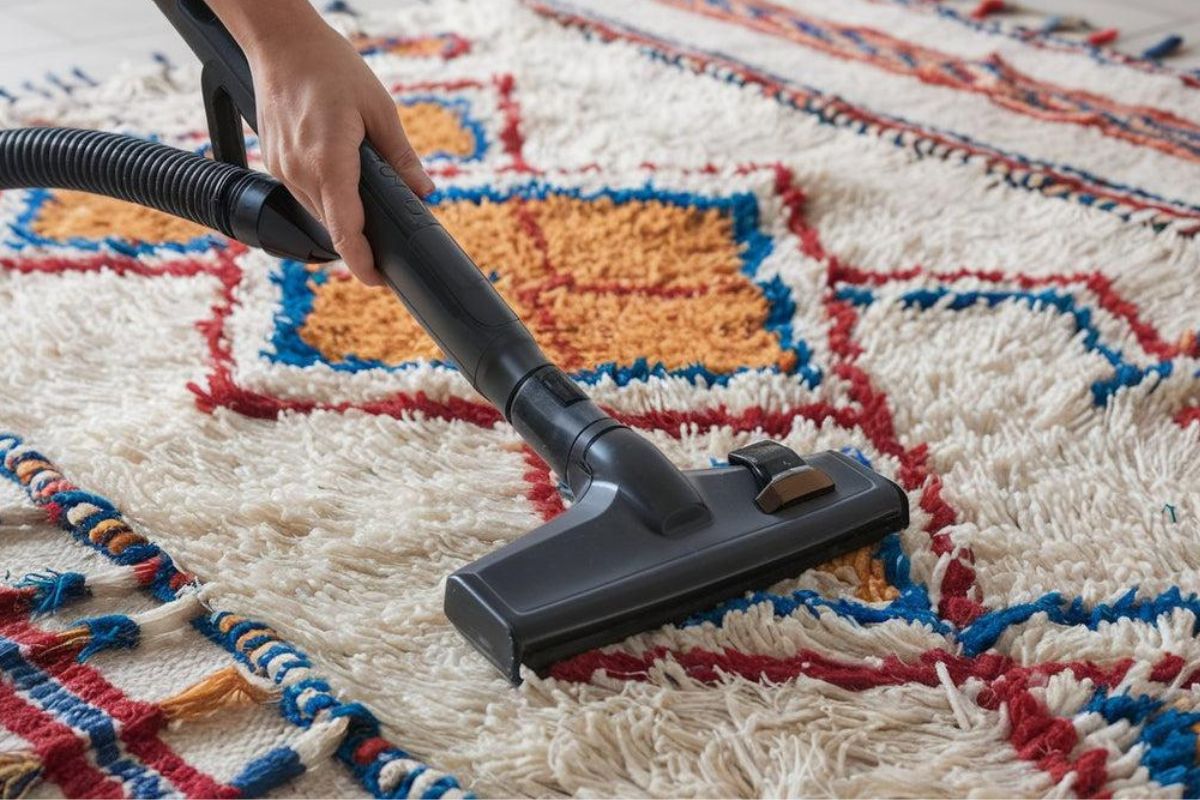
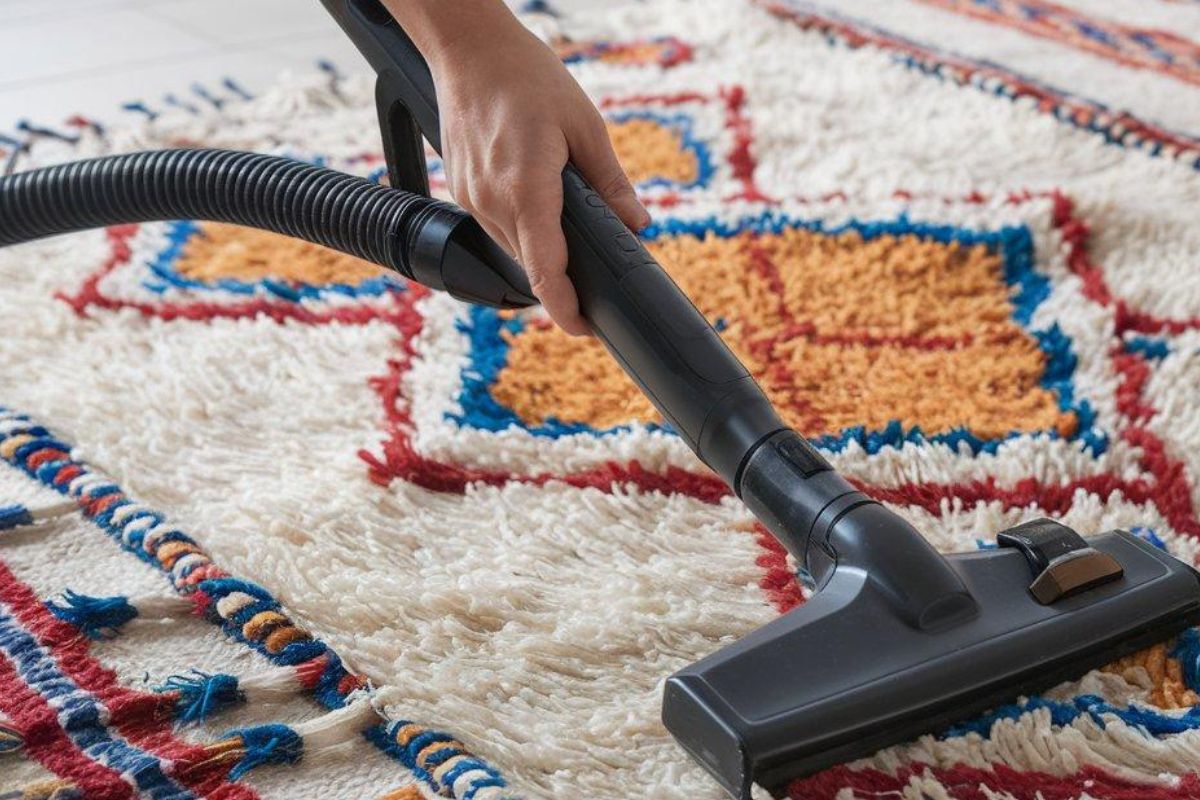
    Yes, vacuum it, and often. Switch the rotating brush roll or beater bar off, or use a bare-floor setting, and keep the machine off the fringe entirely. A spinning brush is the most common way owners damage a hand-knotted wool rug at home: it pulls and fuzzes the pile and can rip the fringe out at the ends, which is the one thing on this page you cannot undo. Work with the direction of the pile, without pressing down, and give the areas under furniture more attention than the open floor.

    What a beater bar actually does to a hand-knotted pile

    A brush roll is designed for tufted wall-to-wall carpet, where the pile is short, uniform, glued into a backing and effectively disposable. It works by agitating fibres to shake dirt loose, which is a reasonable trade on that surface.

    A hand-knotted wool pile is a different object. The pile is tied to the foundation knot by knot, it is often longer and looser on a Moroccan rug than on anything the machine was designed for, and there is no adhesive holding anything down. A stiff rotating brush catches individual tufts, works them loose over time, and raises a fuzzed surface where the fibres have been broken rather than lifted.

    The care guidance from rug specialists and manufacturers converges on the same instruction: turn it off, or use a setting that lifts it away from the pile. This is one of the few points in the whole niche where sellers, cleaners and manufacturers all agree.

    If your vacuum's brush roll cannot be switched off

    This is most people's actual situation, and the advice to "turn off the beater bar" is not much help if there is no switch. Options, roughly in order of preference:

    • Use the hose and a plain suction head. Every upright has one. A bare-floor or upholstery attachment has no rotating parts and is completely safe on wool. It is slower and it is the correct tool.
    • Raise the height setting to its maximum. If your machine has a pile-height adjustment, the highest setting lifts the brush away from the surface so it barely contacts the pile.
    • Use a canister or cylinder vacuum with a plain floor head if you have one in the house.
    • Vacuum the rug from underneath occasionally. Turning a rug over and vacuuming the back on a hard floor drives grit down out of the pile onto the floor, where you then sweep it up. This is genuinely effective and it is not something most people think to do.

    This site does not review, rank or recommend vacuum cleaners, and there is no need to buy anything: the attachment you need almost certainly came in the box.

    Direction, pressure and how often

    Direction. Run the head with the pile rather than against it. Brush a hand across the surface and you will feel which way it lies: one direction is smooth, the other resists. Going against the lay opens the pile and works grit deeper in.

    Pressure. None. Let the suction do the work. Pushing a head down into a long pile compresses it and achieves nothing except wear.

    How often. Regularly rather than intensively. General care guidance points to something like weekly for a rug in normal use, more in a traffic path and less in a quiet room, and this guide will not put a firmer number on it than the sources support. Frequent light vacuuming beats occasional aggressive vacuuming, because the damage grit does is abrasive and cumulative: sand and dust work down to the base of the pile and cut the fibres from below every time someone walks on it.

    That is the real argument for vacuuming a wool rug often. You are not removing surface dust for appearance, you are removing an abrasive.

    The fringe, which is where the irreversible damage happens

    Fringe is not decoration. On a hand-knotted rug it is the warp threads of the foundation, emerging from the body of the rug. Tear it off and you are pulling at the structure.

    A rotating brush catches fringe, wraps it, and rips it. It happens in a second and it cannot be undone at home; replacing or reweaving fringe is specialist work.

    So: keep the vacuum head off the fringe entirely. If the fringe needs cleaning, use the hose held slightly above it, or comb it gently with your fingers. Never run a powered head across it, and never let a robot vacuum near the ends of a fringed rug.

    Why the parts under the furniture matter most

    The instinct is to vacuum the open floor where the dirt shows. The parts that actually need it are the ones nobody walks on.

    Carpet moth larvae feed on wool and avoid light and disturbance, so they settle under sofas, along edges, behind doors, and on the underside of a rug that has not moved in two years. Damage there can be well advanced before anyone notices, because nothing about the visible part of the rug looks wrong.

    Moving furniture and vacuuming underneath a few times a year is the cheapest pest prevention available, and it doubles as the inspection. While the corner is up, look at the base of the pile for fine webbing, small pale tubular cases and sandy grit. Carpet moths: how to tell if you have an active infestation covers what those signs mean.

    One related question this answers: if vacuuming brings up a lot of loose fibre from a new rug, that is usually normal shedding rather than damage. Why your new wool rug sheds explains the difference, and what it means when it is not shedding.

    For the whole routine see how to care for a Moroccan wool rug, and before putting any product on the rug, cleaning products that quietly destroy wool. If you are unsure whether your rug is hand-knotted in the first place, what the back of the rug shows settles it.

    FAQ

    Can I vacuum a wool rug with a normal vacuum cleaner?
    Yes, with the rotating brush roll switched off or the height raised to maximum, and using a plain suction head where possible. Keep it off the fringe.

    Will a beater bar ruin my rug?
    It will not ruin it immediately, but repeated use fuzzes the pile by breaking fibres, and it can tear the fringe out in one pass. The fringe damage is the part that cannot be fixed at home.

    How often should I vacuum a wool rug?
    Roughly weekly in normal use, more in a traffic path. Frequent light vacuuming matters because grit at the base of the pile is abrasive and cuts fibres every time the rug is walked on.

    Should I vacuum the back of a wool rug?
    Occasionally, yes. Turning it over on a hard floor and vacuuming the back drives grit out of the pile onto the floor, where you can sweep it up. It is a genuinely useful habit.

    Can I use a robot vacuum on a hand-knotted rug?
    Keep it away from fringed ends, where the rotating parts can catch and pull. On the body of a low-pile rug it is less of a concern, but a plain suction head remains the safer tool.

  • How to Care for a Moroccan Wool Rug

    How to Care for a Moroccan Wool Rug

    Looking after a hand-knotted wool rug is five habits: vacuum it properly, deal with spills in the first few minutes, rotate it so light and traffic land evenly, check for moths a few times a year, and keep the wrong products away from it. That last one carries most of the weight, because most of the serious damage done to wool rugs at home is done by owners trying to clean them. Wool is a protein fibre. The things that work on synthetic carpet felt it, strip it, or bleach it permanently.

    Why wool needs different treatment from everything else on your floor

    Wool is protein, closer to hair than to plastic. That single fact explains almost every rule on this page.

    Professional rug cleaning sources are consistent about the constraints: wool wants pH-neutral treatment, with professional formulations described in the range of about 5.5 to 8.0. Push it alkaline and the fibre felts and shrinks, the lanolin that protects it is stripped, and the dyes become unstable. Add heat and all of that accelerates. Oxygen bleach, the active ingredient in most "oxy" spot cleaners, lightens wool permanently. Enzyme cleaners are designed to break down protein, which is exactly what the rug is made of.

    The other half of the picture is lanolin, the natural grease still present in good wool. It repels dirt and liquid, which is why a spill sits on the surface for a short while before soaking in, and why a wool rug in ordinary use stays cleaner than people expect. Strip the lanolin and you lose that.

    A Moroccan hand-knotted rug adds one more consideration: it is a one-off object. There is no replacement, which raises the cost of every experiment.

    Routine one: vacuuming, done correctly

    Vacuuming is the most valuable thing you do, and the most common way rugs get damaged.

    The rule that matters: turn the rotating brush roll or beater bar off, or use a bare-floor or upholstery setting. A spinning brush pulls and fuzzes a hand-knotted pile and can tear the fringe out at the ends, which is the one genuinely irreversible thing on this list. Vacuum with the direction of the pile, without forcing the machine down into it, and keep it off the fringe entirely.

    Do the parts under and behind furniture rather than only the open floor. Undisturbed areas are where carpet moth larvae live, so vacuuming there is pest control as much as cleaning. Vacuuming a wool pile rug without damaging it covers what to do if your machine's brush cannot be switched off, which is most machines.

    Routine two: dealing with a spill

    Speed matters more than technique. Lanolin buys you a short window before liquid absorbs, and using it is most of the job.

    Blot, do not rub, working from the outside of the spill inward so you do not spread it. Use plain water sparingly if you use anything, and never saturate the pile. If you use a product, it must state that it is safe for wool, be used exactly as its manufacturer directs, and be tested on a hidden corner first.

    Then stop earlier than you want to. Escalating through stronger products is how a small mark becomes a permanent pale patch. Spills on wool: what to do in the first five minutes is the page to have open when it happens.

    Routine three: rotation, placement and light

    Sunlight fades wool, unevenly, and the part by the window goes first. Rotate the rug end to end a couple of times a year so light and foot traffic land differently, and it ages evenly instead of developing a bright half and a worn path.

    Placement is worth thinking about once rather than regretting later. Direct sustained sun, a damp room, and the strip of floor where a door sweeps are all avoidable problems. Keep wool out of persistently damp spaces.

    Routine four: watching for moths

    Carpet moths are the one problem here that gets worse while you do nothing. The damage is done by larvae feeding on the wool, not by the adult moths you occasionally see, and they favour dark, undisturbed places: under furniture, along edges, the underside of a rug that never moves.

    Look two or three times a year. Lift a corner, look at the base of the pile along the edges and under anything heavy, and check for fine silk webbing, small pale tubular cases, and sandy grit. Carpet moths: how to tell if you have an active infestation covers exactly what those signs look like and how to tell current damage from old damage.

    What never goes on wool

    Categories rather than brands, because the category is what matters.

    • Oxygen bleach, including "oxy" spot cleaners. It lightens wool and the pale patch does not come back.
    • Chlorine bleach. Worse.
    • Enzyme cleaners. They break down protein, and the rug is protein.
    • High-alkaline all-purpose household cleaners, which is most of what is under a kitchen sink. Alkalinity felts wool, strips lanolin and destabilises dyes.
    • Hot water and heat, including steam, which compounds all of the above.
    • Soaking of any kind. Wool holds water, and a rug that stays damp develops mildew and odour that are harder to fix than the original problem.

    Never mix cleaning products. And whatever you do use, follow its own manufacturer's instructions and test it somewhere hidden first. Cleaning products that quietly destroy wool sorts the cupboard properly, and explains why this damage is invisible on the day and obvious a week later.

    When it is genuinely a professional's job

    Not as often as a cleaning company's website suggests, and not as rarely as a confident weekend suggests.

    Do it yourself: routine vacuuming, prompt blotting of ordinary spills, rotation, airing a rug outdoors on a dry day.

    Call someone: a full wash of anything old, valuable or naturally dyed; any spill that has set; pet accidents that have soaked into the foundation; a colour run; a confirmed moth infestation; and anything where the honest answer to "can I get this fully dry, fast and flat" is no. Drying is the part that goes wrong at home. Washing a wool rug at home, or not is built around exactly that question.

    When you do call, use a rug cleaning specialist rather than a general carpet cleaning service, and tell them the rug is hand-knotted wool and whether the dyes have ever run.

    If you are still choosing a rug rather than caring for one, how to buy a Moroccan rug without getting taken and the complete guide to Moroccan rug styles are the places to start. And if your new rug is leaving fluff everywhere, that is usually normal: why your new wool rug sheds.

    FAQ

    How often should I vacuum a wool rug?
    Roughly weekly, and more often in a traffic path, with the rotating brush switched off and the machine kept off the fringe. Include the areas under furniture, because that is where moth larvae live.

    Can I use a steam cleaner on a wool rug?
    No. Heat and saturation both damage wool, causing felting, shrinkage and dye movement, and a dense pile that stays damp develops odour and mildew.

    What is the worst thing to use on a wool rug?
    Oxygen bleach, sold as "oxy" spot cleaner. It bleaches wool permanently. High-alkaline household cleaners and enzyme cleaners are close behind.

    How do I know if my rug has moths?
    Look in dark, undisturbed places for fine silk webbing, pale tubular cases roughly 1 to 2 mm long at the base of the pile, and sandy grit near the edges. Adult moths flying around are a weaker signal than these.

    Do I need professional cleaning, and how often?
    Less often than cleaning companies suggest, and this guide will not quote an interval. Call a rug specialist for a full wash of anything old or naturally dyed, a set stain, a pet accident that reached the foundation, a colour run, or a confirmed moth infestation.

  • Twelve Questions Worth Asking Any Rug Seller

    Twelve Questions Worth Asking Any Rug Seller

    Here are twelve questions, grouped by whether they can actually be answered. Four are about construction and material and a competent seller will answer them precisely. Three are about treatment and condition and are answerable but rarely volunteered. Three are about provenance and usually cannot be answered honestly at all, which is exactly why they are worth asking: the manner of the answer tells you more than the content. Two are commercial and matter more than any of the romantic ones. Pay attention to how a seller handles the questions they cannot answer.

    How to use this list

    You are not interrogating anybody. Most rug sellers are ordinary businesspeople and most will be glad to talk about their stock in detail.

    The reason to ask in this order is that the answerable questions establish whether the seller knows their material, and the unanswerable ones establish whether they will admit a limit. A seller who is precise about construction and says "honestly, I don't know how old it is" has told you they are reliable. A seller who is vague about construction and certain about the tribe has told you the opposite.

    Take notes, or ask for the important answers in writing on the invoice.

    The four about construction and material

    1. Is this hand-knotted, hand-tufted or machine-made?
    A good answer is immediate and specific, and the seller will happily show you the back to prove it. A weak answer is "handmade," which covers all three and settles nothing. Check it yourself regardless: what the back of the rug shows takes five minutes to learn and is the one thing here you never have to take on trust.

    2. What is the pile, and what is the foundation?
    Wool pile on a cotton or wool foundation is the common answer for Moroccan rugs. A seller who does not know what the warp and weft are made of does not know their stock.

    3. Is the wool hand-spun or machine-spun?
    Answerable, and it should match what your hand tells you. Judging wool quality without a lab covers the feel.

    4. Can you show me the back and a folded corner?
    Not really a question, and the most useful thing on this list. Any hesitation here is information.

    The three about treatment and condition

    5. Has this rug been washed or chemically treated, and how?
    Chemical washing is normal in this trade, so a straight seller will simply say yes and describe it. This matters because it affects how the wool feels, how the colour will age, and whether the rug smells. How new rugs are made to look old covers what the processes involve.

    6. Are there any repairs, reweaves or replaced fringes?
    Answerable by anyone who has handled the rug. Repairs are not disqualifying; undisclosed repairs are a description problem.

    7. Do the dyes run?
    A seller who has washed or tested the rug knows. If they do not know, assume they might, and read natural or synthetic dye, because a colour run is a cleaning constraint rather than proof of anything.

    The three about provenance, which usually cannot be answered

    8. How old is this rug, and how do you know?
    The second half is the whole question. "I bought it from a dealer who said 1970s" is an honest answer and tells you the claim is second-hand. A confident decade with no basis is not better, it is worse.

    9. Where was it made, and can you name the town, region or cooperative?
    Sometimes genuinely answerable, and specificity is the signal. "The Middle Atlas" is plausible. A named town or cooperative is stronger. A general appeal to tribal tradition is not an answer.

    10. Do you know who wove it, or what the seller before you was told?
    Almost never answerable, and asking it politely maps the chain. A seller several steps from the loom will say so if they are straight with you.

    On all three: "I don't know" is a good answer. These claims are usually inferences from appearance rather than documented facts, and a seller willing to say so is more trustworthy than one who is certain. Use Amazigh alongside Berber when you ask, and notice whether the seller distinguishes a style name from a claim about who made the rug. Is my Moroccan rug authentic covers what can actually be established.

    The two commercial ones, which matter most

    11. Will you put the description in writing on the invoice, with measured dimensions?
    Construction, materials, any treatment, any repair, and any age or origin claim, with the rug's actual measurements at both ends and both sides. This single question converts every answer above into something you can act on later, and a refusal tells you how much the seller believes their own description.

    12. What is your returns policy, who pays return shipping, and what happens if it arrives damaged?
    The least romantic question here and statistically the one most likely to matter. On a shipped or online purchase it is the term that decides your outcome. Returns and recourse covers why.

    How to read the answers as a whole

    Look at the pattern rather than any single answer.

    Reassuring: precise on construction, relaxed about admitting what they do not know, willing to put it in writing, clear on returns.

    Worth pausing over: vague on construction but certain about age and tribe. That combination is the classic shape of a seller who is repeating inherited copy rather than describing an object they understand.

    A reason to walk: unwilling to show the back, or unwilling to write the description down. Neither costs an honest seller anything.

    And decide separately what you would pay if the provenance story turned out to be unverifiable, because it usually is. If that number is far below the asking price, the story is what you are buying. How to buy a Moroccan rug without getting taken covers the whole set of risks these twelve questions are designed to surface.

    FAQ

    What is the most important question to ask a rug seller?
    Whether the rug is hand-knotted, hand-tufted or machine-made, and then asking to see the back. It is the answer with the biggest financial consequence and the only one you can verify yourself.

    What if the seller does not know how old the rug is?
    That is a good answer. Age is rarely documented in this market, and a seller who admits the limit is more reliable than one who states a confident decade with nothing behind it.

    Should I ask for things in writing?
    Yes. A description on the invoice covering construction, materials, treatment, repairs, measured dimensions and any age claim is what turns a conversation into something you can act on if the rug is wrong.

    Is it rude to ask this many questions?
    No. Most sellers enjoy talking about their stock, and a serious buyer asking specific questions is treated as a serious buyer.

    What question do buyers most often skip?
    The returns policy, including who pays return shipping. On a shipped or online purchase it is the term most likely to decide the outcome.

  • Customs and Duty on a Rug Imported From Morocco

    Customs and Duty on a Rug Imported From Morocco

    Possibly, and whether you get a bill depends on four things your own country decides: the customs value of the rug, how it is classified for tariff purposes, where it is deemed to originate, and the thresholds your country applies below which nothing is charged. This guide publishes no rates and no thresholds, because they differ by country, they change, and a wrong number here would cost you real money. What it does explain is the mechanism, so you know what to look up and what you are being asked to sign.

    Why this page has no numbers in it

    Every reader of this page is importing into a different jurisdiction. Duty rates, sales or value-added tax on imports, de minimis thresholds, handling fees and the treatment of personal effects all differ by country, and several of them have changed in recent years.

    Forum answers are where most people get this, and they are the worst source available: written by someone in a different country, on a different date, about a different value, and almost never updated. A confident answer from 2019 about a package into one country tells you nothing about yours.

    So the useful thing this guide can do is name the moving parts and point you at the only authority that can answer for you, which is your own national customs administration. Written in 2026, and worth re-checking, because this is exactly the kind of thing that moves.

    The four moving parts

    Customs value. Broadly, what you paid, and depending on the country it may also include shipping and insurance. This is the base everything else is calculated on, and it is why the declared figure matters so much.

    Tariff classification. Goods are classified under a harmonised code, and hand-knotted wool floor coverings often sit in a different category from machine-made ones. The classification determines the rate. It is not something to guess at, and it is a normal thing to ask a broker about on a large purchase.

    Origin. Where the goods are deemed to come from, which affects whether any preferential trade arrangement between your country and Morocco applies. Origin is a technical determination, not simply where you bought it.

    Thresholds. Most countries set a value below which duty, or tax, or both, are not collected, and the two thresholds are often different. Some also treat goods accompanying a traveller differently from goods shipped separately, which is one of the real advantages of carrying a rug yourself.

    Who calculates it, and when you find out

    You usually do not calculate any of this. The carrier or a customs broker submits a declaration on your behalf, the authority assesses it, and the charge appears either as a condition of delivery or as an invoice afterwards.

    The practical consequence is that you often learn the figure at the worst moment: when the rug is already in the country and someone wants payment before releasing it. Carriers also add their own handling or brokerage fee on top of the duty and tax, which surprises people who budgeted only for the government's share.

    If you want to know in advance, that is a question for a customs broker or your national customs helpline before you ship, using the actual value and a description of the goods. On a four-figure rug that call is worth making.

    Declared value, and why under-declaring is your problem

    At some point a seller may offer to declare a low value, or to mark the shipment as a gift or a sample. It is presented as a favour and it usually is not one.

    Three things are true about it. The declaration is made on your behalf and you are the importer, so the legal exposure for a false declaration is yours, not the shop's. The declared value is also the ceiling on any insurance claim, so a rug declared at a fraction of what you paid is a rug you cannot claim properly for if it is lost or damaged. And if the goods are inspected and the value is obviously wrong, the consequences range from a corrected assessment and a penalty to seizure, again against you.

    The "gift" route has the same shape. Gift allowances, where they exist, are defined narrowly and a purchase you made for yourself is not a gift. Sellers offering this are managing their own convenience, not your risk.

    Declare what you paid, and keep the receipt that proves it.

    What does not work

    "It's for personal use." Personal use often changes which rules apply, and it rarely means nothing is owed. It is a category, not an exemption.

    "It's antique, so it's exempt." Some countries treat genuine antiques differently for duty purposes, and the age thresholds are strict and require documentation. It also opens a separate question, because a genuinely antique rug may need an export permit from Morocco. Antique rugs and Morocco's export permit rule covers both ends. In practice most rugs sold as antique are not, as what "vintage" actually means explains.

    "It's handmade, so it's duty-free." Handicraft provisions exist in some trade arrangements and they are specific, conditional and documented. They are not a general exemption you can claim by asserting it.

    What to do before you ship

    • Look up your own country's rules on its official customs website, not a forum, and note the date you checked.
    • Ask the carrier whether duty and tax are collected on delivery or billed later, and what their handling fee is.
    • Get a proper commercial invoice describing the rug, its materials, its construction and what you paid.
    • Declare the real value. Insurance and legal exposure both follow it.
    • Budget for it rather than being surprised by it. It is part of what the rug costs, which is why it belongs in what actually drives a Moroccan rug's price.
    • On a large purchase, talk to a customs broker before shipping rather than after.

    This guide is not legal or tax advice and cannot tell you what you will owe. For the shipping decision itself see shipping a rug home from Morocco, and for the offers that transfer risk to you, rug scams and the "avoid customs" offer.

    FAQ

    Will I pay customs duty on a rug from Morocco?
    Possibly. It depends on your country's duty rate for that classification, its import tax, and the thresholds it sets. Only your national customs authority can answer it for your situation.

    How much is customs duty on a rug?
    This guide publishes no rate, because rates differ by country and change. Check your own customs authority, or ask a customs broker before shipping on a large purchase.

    Should I let the seller declare a lower value?
    No. You are the importer, so the exposure for a false declaration is yours, and the declared value is also the ceiling on any insurance claim if the rug is lost or damaged.

    Is a rug I carry in my luggage treated differently from one that is shipped?
    In many countries, yes. Goods accompanying a traveller are often handled under different rules from separately shipped goods. Check your own country's traveller allowance before assuming either way.

    Are antique rugs exempt from duty?
    Some countries treat genuine antiques differently, with strict age thresholds and documentation requirements. It also raises a separate export-permit question at the Moroccan end, and most rugs sold as antique are not old enough for either to apply.

  • Shipping a Rug Home From Morocco: Three Routes

    Shipping a Rug Home From Morocco: Three Routes

    There are three ways to get a rug home: carry it yourself, let the seller arrange shipping, or hire your own courier or freight forwarder. They differ less in price than in who holds the risk if something goes wrong. Carrying it yourself is the only route where the rug never leaves your possession, and it is the option most buyers dismiss too quickly. Whichever you choose, the routine that protects you is the same: photograph the exact piece, get its measured dimensions in writing, and know who is actually carrying it.

    Route one: carrying it yourself

    Most buyers assume a rug is too big for luggage. Many are not. Wool folds and compresses considerably more than people expect, and a rug that looks impossible spread across a shop floor often flattens into a manageable bundle.

    The advantages are decisive when it works. The rug never leaves your hands, so substitution is impossible, non-delivery is impossible, and there is no customs paperwork happening without you. You also skip the entire question of who insured what.

    The limits are real too. Airline baggage allowances, oversize rules and excess fees vary by carrier, route and ticket class, and this guide will not quote any of them because they change and they differ for every reader. Check your own airline's published allowance before you buy, not after. A large, dense pile rug can be genuinely heavy, and weight is usually the binding constraint rather than size.

    If you are travelling on to other stops, factor in carrying it for the rest of the trip.

    Route two: seller-arranged shipping

    This is what most shops offer, often before you have finished deciding, and for a lot of buyers it is the practical answer. Shops that ship regularly have a relationship with a carrier and it usually works.

    The risk it introduces is substitution: the rug that arrives is not the rug you chose. This is not primarily a story about dishonesty. A shop with dozens of similar pieces, a rug rolled after you leave, and a week between purchase and dispatch creates room for an honest mix-up as well as a dishonest swap. Either way you are the one holding a rug you did not pick.

    The second risk is that recourse is remote. If something is wrong, your counterparty is a shop in another country, and whatever protection you have comes from your payment method rather than from the transaction itself.

    Ask three things before agreeing: who is the actual carrier, will you get a tracking number, and who bears the risk if the rug is lost or damaged in transit.

    Route three: your own courier or freight forwarder

    Arranging shipping yourself, through an international courier or a freight forwarder, puts a contracted third party between you and the shop.

    The advantage is that the carrier is accountable to you rather than to the seller, you choose the insurance, and the handover is documented. For a genuinely expensive rug this is usually the most defensible option.

    The costs are effort and money. You will be quoted on dimensional weight as well as actual weight, a rolled rug is an awkward shape, and someone has to get the rug from the shop to the depot. Some forwarders will collect. Ask before you assume.

    This is also the route where customs paperwork is most likely to be handled properly, which matters more than it sounds. Customs, duty and declared value on an imported rug covers what arrives with the rug.

    The evidence routine that protects you on any route

    Do this in the shop, before the rug is rolled. It takes four minutes and it is the difference between a dispute you can win and one you cannot.

    • Photograph the exact rug, front and back, whole and in close-up, with something in frame for scale. The back matters most, because it is effectively a fingerprint: no two hand-knotted rugs have the same irregularities. What the back of the rug shows explains what you are looking at.
    • Photograph any damage, repair or unusual feature. These are identifying marks.
    • Get measured dimensions on the receipt, taken at both ends and both sides, not a rounded description. Hand-woven rugs are rarely perfectly rectangular, and the exact numbers identify the piece.
    • Have the receipt describe the rug, including construction and any claim the seller made about it.
    • Photograph the rug being rolled, if you can do it without being strange about it.
    • Get the carrier name and tracking, not a promise that it will be sent.

    Insurance, damage and what to do on arrival

    Insurance follows declared value, which is the quiet trap. If the value declared for customs is lower than what you paid, that lower figure is usually the ceiling on any claim. A seller offering to declare a low value is not doing you a favour, and rug scams and the "avoid customs" offer covers why.

    Ask who insures the rug in transit and for how much. On seller-arranged shipping the honest answer is often nobody, and it is better to know that in the shop.

    On arrival, before you sign for anything if the carrier allows it: check the packaging for damage and note it on the delivery paperwork. Then unroll the rug and compare it against your photographs, particularly the back. Do this the day it arrives, because claim windows are short and they are defined by your carrier and your payment provider, not by this page.

    If the rug is wrong, returns and recourse covers the ladder in order. If you have not bought yet, buying a rug in the Marrakech souk covers the encounter itself, and how to buy a Moroccan rug without getting taken covers the whole set of risks. For unusually long or awkward pieces, Moroccan runners, rounds and odd shapes is worth reading before you commit to a size you then have to move.

    FAQ

    Can I take a Moroccan rug home in my luggage?
    Often yes. Wool compresses more than buyers expect, and weight is usually the binding limit rather than size. Check your own airline's published baggage and oversize rules before buying, since they vary by carrier, route and ticket.

    Is it safe to let the shop ship the rug for me?
    It usually works, and it introduces substitution and remote-recourse risk. Get the carrier name, a tracking number, and a receipt describing that specific rug with measured dimensions, and photograph the piece front and back before it is rolled.

    Who pays if the rug is damaged in transit?
    It depends on the carrier's terms and what was insured, and often the answer is nobody. Ask explicitly who insures it and for how much before the rug leaves the shop.

    Should I use a freight forwarder?
    For an expensive rug it is usually the most defensible route, because the carrier is accountable to you and you choose the insurance. It costs more effort and you will be quoted on dimensional weight.

    What is the single most useful thing to do before shipping?
    Photograph the back of the rug. The irregularities are effectively a fingerprint, and it is the evidence that settles a substitution dispute.

  • Moroccan Runner Rugs, Rounds and Odd Shapes

    Moroccan Runner Rugs, Rounds and Odd Shapes

    Genuine hand-knotted and handwoven Moroccan rugs do exist as runners (long, narrow pieces suited to hallways and stairs), particularly among flatweave traditions. Rounds are a different matter: they're mostly a modern reproduction-rug format rather than a traditional Moroccan output. And whatever shape you're after, a genuinely hand-knotted piece won't come in a fixed factory size the way a mass-produced rug does; it comes in whatever size the loom and the weaver actually produced.

    Two very different markets are hiding behind the same search term

    Search "Moroccan runner rug" or "Moroccan round rug" and most of what comes back is machine-made reproduction product from mainstream rug retailers (Amazon, big-box rug sites, and decor-focused online stores), sold in standard factory sizes: runners commonly listed from around 2×3 feet up through 8×10, 9×12, and larger, rounds commonly listed in fixed diameters like a 5-foot round. That's a real, legitimate product category, and there's nothing wrong with buying one if a consistent factory size and a lower price point matter more to you than a hand-knotted piece. But it's a different product from what the rest of this site covers, and conflating the two leads to mismatched expectations: someone expecting to shop a genuine hand-knotted runner the way they'd shop a standard-size reproduction rug is going to be looking for something that, by its nature, mostly doesn't exist that way.

    Runners: where they show up in genuine Moroccan weaving

    Long, narrow formats are a real, traditional output in some Moroccan weaving, particularly among flatweave traditions like Zanafi and the broader Moroccan kilim and hanbel family, where the flat construction lends itself naturally to a longer, narrower piece without the bulk a pile weave would add over the same length. A genuine hand-knotted pile runner also exists, but tends to be less common than a flatwoven one, since building a long, narrow, plush pile piece is a more demanding, time-intensive undertaking on the loom than a flatweave of the same dimensions.

    Whatever the construction, a genuine runner's exact length and width are a function of that specific loom and that specific piece, not a menu of standard options. If you need a very specific length, filling an exact hallway measurement, for instance, expect that to be the harder ask, not the easier one, when shopping genuine hand-knotted pieces rather than mass-produced reproductions.

    Rounds and other shapes: mostly a modern reproduction-rug format

    Round rugs are heavily marketed in the general decor-retail space, but this guide did not find evidence that round is a traditional Moroccan hand-weaving output the way rectangular and runner formats are. Most round "Moroccan-style" rugs on the market are machine-made reproductions manufactured specifically in that shape for the modern decor market, not a hand-knotted piece originally woven round. That doesn't make a round reproduction rug a bad purchase on its own terms. It's simply a different category from the hand-knotted traditions this site covers, and calling it "Moroccan" describes its design influence, not necessarily its origin or construction.

    Other irregular shapes (oval, hexagonal, custom-cut pieces) fall into the same bucket: they exist in the market, but predominantly as manufactured decor product cut or woven specifically to that shape for a modern retail audience, not as a traditional Moroccan weaving format this guide can document.

    Machine-made reproduction rugs vs. genuine hand-knotted pieces: why the size charts differ

    A machine-made rug is produced on equipment that can output a consistent size on demand: that's precisely the appeal of a standard size chart, and why reproduction retailers can confidently list 2×3, 5×8, 9×12, and every size in between. A genuinely hand-knotted or handwoven rug is produced by one person (or a small group) on a specific loom, over weeks or months, and its finished dimensions are the result of that particular weaving process, not a target size dialed in beforehand the way a factory setting is. That's precisely why hand-woven Moroccan rugs are widely described in the trade as irregular in size: a piece sold as "roughly 6×9" may run somewhat larger or smaller than that in either dimension, because it was never built to a fixed spec in the first place.

    This matters directly for anyone shopping by exact room measurements. See the complete guide to Moroccan rug styles for the wider identification context, but the size question specifically is worth internalizing on its own: a hand-knotted piece's dimensions are a description of what exists, not an order specification for what will be produced.

    What to expect if you want a specific size or shape in a genuine piece

    • Expect "roughly," not "exactly." A listed dimension on a genuine hand-woven piece is a description, with normal handmade variation built in, not a guaranteed precise measurement.
    • A specific exact length is a harder ask than a general size range. If a hallway genuinely needs an exact 27-inch width, that's a much narrower search than "a runner, roughly 2 to 3 feet wide."
    • Rounds and unusual shapes in genuine hand-knotted construction are rare enough that "Moroccan-style round rug" almost always means reproduction, not traditional weaving, worth knowing going in, rather than assuming a round piece is automatically a hand-knotted antique.
    • If exact dimensions matter more than authenticity, a reproduction rug is a legitimate, honest option. This guide isn't arguing everyone should only buy hand-knotted pieces, only that the two categories shouldn't be confused with each other while shopping.

    Measuring your space against an irregular piece

    Because a genuine hand-woven piece's dimensions are fixed by what was actually made rather than a size you select, the practical approach is to measure your space first and then shop within a range, rather than deciding on an exact number and searching for that precise figure. For a hallway runner, that usually means noting the minimum and maximum width the space can accommodate, and treating anything within that range as a candidate, rather than ruling out a piece that's an inch or two off a single target number. For a room where you're considering an unusual shape, the more useful question is often whether a standard rectangular piece (this site covers many genuine, well-documented styles) would actually serve the space just as well as the odd shape you originally had in mind.

    FAQ

    Do genuine Moroccan runner rugs exist?
    Yes, particularly among flatweave traditions like Zanafi and Moroccan kilim/hanbel, where the construction naturally suits a longer, narrower format.

    Are round Moroccan rugs traditional?
    This guide did not find evidence that round is a traditional hand-woven Moroccan output. Most round "Moroccan-style" rugs on the market are modern reproductions manufactured specifically in that shape.

    Why don't hand-knotted Moroccan rugs come in standard sizes like 5×8 or 9×12?
    Because they're produced by a person on a specific loom over an extended period, not manufactured to a fixed factory spec. Dimensions reflect what was actually woven, with normal handmade variation.

    Can I order a genuine Moroccan rug in an exact custom size?
    This is a much narrower, harder request than shopping standard reproduction sizes, since it depends on finding or commissioning a specific piece rather than selecting from a size chart. This guide cannot promise availability for any specific custom size.

    Is a machine-made reproduction "Moroccan-style" rug a bad choice?
    Not inherently. It's a legitimate, different product category with its own honest use case, particularly where an exact size, shape, or lower price point matters more than hand-knotted construction. The problem is only in confusing the two categories while shopping.

  • Moroccan Rug Colors: Where the Palette Comes From

    Moroccan Rug Colors: Where the Palette Comes From

    Moroccan rug color comes from three things: the natural tone of undyed wool, plant-based natural dyes, and, increasingly in modern production, synthetic dyes, not from a fixed symbolic code where a given color always "means" something specific. Across the styles already covered on this site, you'll have seen the undyed cream of a Beni Ourain, the deep indigo of a Beni Mguild, the warm magenta of a Boujad, and the plant-dyed range documented at Taznakht. This page pulls that pattern together in one place, and explains what determines it.

    The undyed base: cream, ivory, brown, black

    Sheep's wool in its natural, undyed state already spans a real range: cream, ivory, light brown, darker grey-brown, and black, depending on the specific fleece. Several Middle Atlas styles, most famously Beni Ourain, lean heavily on this undyed range, using dark natural wool sparingly for outline motifs against a light, undyed field rather than relying on any dye process at all. This is the simplest, most direct source of a Moroccan rug's color: no dye, just the wool itself, sorted and used as it comes off the animal.

    Natural dyes and what they actually produce

    Where color is added, historical and traditional practice draws on a specific, recurring set of plant materials, documented consistently across multiple independent sources: madder root, producing reds and terracottas; indigo, producing blues; saffron and pomegranate rind, producing yellows and golds; henna, producing reddish-browns; and walnut shell or hull, producing dark browns and blacks. This is the same palette named directly, with sources attributed, in this site's own Taznakht guide, where Africanews's reporting specifically named henna, pomegranate peel, saffron, and indigo leaves as the cooperative's dye materials.

    Natural dyes produce color with real variation built in: no two dye batches land on exactly the same shade, since the result depends on the specific plant material, water, mordant, and even the season it was prepared in. That's part of why natural-dyed pieces develop the muted, complex, slightly uneven color character collectors associate with older or traditionally made rugs, as opposed to the flatter uniformity of a modern synthetic-dye batch.

    Synthetic dyes and why modern production leans on them

    Modern Moroccan rug production increasingly uses synthetic dyes, which produce brighter, more saturated, and more consistent color than natural dyeing allows, a real practical advantage for a producer trying to match a specific shade reliably across a production run. Some of the brighter, more electric colors seen in contemporary Azilal and Boujad production reflect this shift toward synthetic dye availability, alongside older natural-dye traditions that continue in parallel rather than having been fully replaced by it.

    Neither natural nor synthetic dye is inherently "more authentic" on its own. Synthetic dyes have been in use in various forms for well over a century in many textile traditions worldwide, and a rug's genuine hand-knotted or handwoven construction is a separate question from which dye technology colored its yarn. Treating synthetic dye as automatic proof of a fake, or natural dye as automatic proof of authenticity, is exactly the kind of oversimplified claim this site avoids making.

    Quick reference: common natural dye sources

    Dye source Color produced
    Madder root Red, terracotta
    Indigo Blue
    Saffron Yellow, gold
    Pomegranate rind Yellow, gold, tan
    Henna Reddish-brown
    Walnut shell/hull Dark brown, black

    This table reflects what plant material is documented to produce which color family in traditional dyeing practice generally. It is not a claim about the specific dye used on any individual rug, which would require asking the seller or, ideally, having documentation from the maker.

    Color also changes over time, and that's not a defect

    A rug's color the day it's finished is not necessarily its color a decade later. Natural dyes in particular are more light-reactive than most synthetic equivalents, and gradual fading or mellowing with sun exposure and handling is part of how a natural-dyed piece is expected to age, contributing to the muted "vintage" look collectors often prize. That's a genuinely different situation from a colorfastness defect or damage, though telling the two apart in a specific piece is a hands-on question this guide won't attempt to settle from a description alone.

    Why this guide won't tell you what a color "means"

    You will find plenty of content elsewhere asserting that a specific color carries a fixed symbolic meaning, that yellow "symbolizes joy," or red "symbolizes life," stated as settled fact with no source attached. This guide won't repeat those claims here. Symbol and color meaning in Amazigh weaving is a genuinely contested area: the same seller pages that assert confident color meanings are, in this site's own research for its symbolism cluster, often the only pages making the claim at all, with no museum, academic, or named cultural source behind it.

    Where a specific source can support a specific claim, as with the akhnif's documented motif, discussed in the akhnif guide, this site states it and names the source. For general color-in-rugs claims of the kind repeated across seller sites, no comparable sourcing was found in this guide's research, so none is asserted here as settled fact. If you've read elsewhere that a color in your rug "means" something specific, treat that as a claim from whoever told you, not a documented fact this site can confirm.

    How color connects to the styles already covered on this site

    Color is one of the fastest ways to narrow down which named style you're looking at, alongside pattern and density covered in how to identify a Moroccan rug from a photo. An undyed cream-and-black field points toward the Middle Atlas pile styles; warm plant-dyed reds and golds point toward southern traditions like Taznakht; bright, saturated color in a dense field points toward Azilal or Boujad; and an unusual palette of aubergine, mauve, and ochre points toward the underserved Aït Bou Ichaouen / Talsint tradition. Color alone won't settle an identification, but combined with pattern and construction, it's a genuinely useful signal.

    FAQ

    What determines a Moroccan rug's color?
    Three things: the natural tone of undyed wool, traditional plant-based dyes, and modern synthetic dyes. There's no single fixed factor, and no fixed symbolic code behind it.

    What plant materials were traditionally used to dye Moroccan rugs?
    Documented sources name madder root (red/terracotta), indigo (blue), saffron and pomegranate rind (yellow/gold), henna (reddish-brown), and walnut shell (dark brown/black).

    Does a specific color mean something in Moroccan rug weaving?
    This guide could not find a credible, named non-commercial source confirming fixed color meanings and will not repeat unsourced claims found on seller sites as settled fact. Where a specific documented meaning exists, as with the akhnif's motif, it is attributed to its actual source.

    Are natural-dyed rugs more authentic than synthetic-dyed ones?
    No. Dye type is a separate question from whether a rug is genuinely hand-knotted or handwoven. Both natural and synthetic dyes appear in genuine traditional production, and neither one alone proves or disproves authenticity.

    Can I tell which named style a rug is just from its color?
    Color is a useful clue, especially combined with pattern density and construction, but it isn't decisive on its own. See how to identify a Moroccan rug from a photo for the fuller identification approach.

  • How to Identify a Moroccan Rug From a Photo

    How to Identify a Moroccan Rug From a Photo

    A photo can narrow down which named Moroccan style you're likely looking at, and can flag some obvious signs a rug isn't hand-knotted at all. What a photo cannot do is authenticate a specific rug: confirm its exact age, region, or maker with certainty. This site's own Disclaimer says the same thing about hands-on inspection: individual-rug authentication isn't something a guide can do from a distance, and a photo is an even thinner basis than an in-person look. What follows is what to actually check in the photos you have, or can request, without pretending a checklist settles more than it does.

    What the back of the rug shows, if you can get a photo of it

    If a listing includes a photo of the reverse side, look there first. Hand-knotted rugs show individual knots on the back, with natural, small irregularities in spacing and tension. No two knots are perfectly identical, because a person tied each one by hand. A machine-made rug, by contrast, typically shows a uniform, mesh-like backing with none of that hand-tied variation, since it was produced by a loom running a repeating mechanical pattern rather than a weaver's hands.

    Requesting a back-of-rug photo is a reasonable, low-friction ask of any seller. A seller who has nothing to hide about a piece's construction should be able to provide one without objection; one who resists or has only front-facing photos available is giving you less to work with, which is itself useful information.

    Wool, patina, and asymmetry: what a photo can and can't tell you

    Genuine Moroccan tribal rugs are overwhelmingly wool, sometimes with cotton in the warp threads specifically. In a photo, wool tends to show a certain depth and slight sheen that's hard to fake convincingly, though this is a soft, experience-based read rather than a definitive test. It gets easier to judge the more genuine pieces you've actually seen, and harder to trust from a single low-resolution photo of an unfamiliar piece.

    Vintage pieces often show a natural patina: a soft, uneven sheen and slightly muted coloring that develops from age and handling, rather than the flat, uniform coloring of a new synthetic-dye reproduction. Genuine handmade rugs also typically show slight asymmetry: a border that isn't perfectly even, a motif that shifts slightly across the field, which is a normal, expected feature of hand weaving, not a flaw. A rug that looks suspiciously perfect, with mechanically even borders and identical repeating motifs, is worth a second look, though "looks a little too perfect" is a prompt to ask more questions, not proof of anything on its own.

    Matching the pattern to a named style

    Once you've ruled out the more obvious "not handmade at all" signals, the next useful step is pattern-matching against the named styles this site already covers. An undyed ivory ground with sparse, dark geometric motifs points toward Beni Ourain or its denser relative Beni Mrirt. Bright, freehand, almost sketch-like patterns on a lighter ground point toward Azilal. Warm pinks, magentas, and reds in a denser weave point toward Boujad. A flat, patterned rug with the design visible on both sides points toward Zanafi or Moroccan kilim/hanbel. If none of those match and you're seeing an unusual, saturated palette of aubergine, mauve, tangerine, and ochre in a dense pattern, check Aït Bou Ichaouen or Talsint instead. Working through this site's own style pages this way will get you closer to a likely match than a generic "Moroccan rug" search will.

    Other signs a listing photo can reveal

    A few additional checks are worth running through before you get to the point of asking the seller anything:

    • Fringe. Genuine hand-knotted rugs usually have fringe that is a continuation of the warp threads running through the body of the rug, not a separate strip stitched onto the edge afterward. A fringe that looks glued, serged, or obviously sewn on as a distinct trim is a stronger giveaway of a machine-made reproduction than almost anything else visible in a photo.
    • Print versus weave. A genuinely woven pattern has texture and slight color variation within each motif, visible even at a moderate zoom. A printed pattern on a flat or minimally textured backing (common in cheaper decorative "Moroccan-style" rugs sold by mainstream furniture and decor retailers) tends to look flatter and more uniformly colored than a woven equivalent.
    • The listing's own language. Terms like "Moroccan-inspired," "Moroccan-style," or "Beni Ourain-style" are often used honestly by retailers selling machine-made reproductions, and are worth reading carefully rather than skimming past. They're a different product category from a hand-knotted piece attributed to an actual weaving tradition, priced and made very differently.

    None of these checks is definitive alone, and a confident answer on all three still isn't the same as an expert appraisal. But together they narrow the range meaningfully before you ever have to ask the seller a direct question.

    What to ask the seller for, if the photo alone isn't enough

    • A photo of the back, for the knot-versus-mesh check above.
    • Origin information, even if it's general: region, cooperative, or dealer source, rather than just "Morocco."
    • Material confirmation: wool content specifically, and whether any synthetic fiber is blended in.
    • A close-up of the pile or weave texture, if the listing photo is low-resolution or heavily filtered, since both can obscure the details above.

    A seller who can answer these specifically is giving you real information to work with. A listing that stays vague on all of them after being asked isn't necessarily dishonest, but it is offering you less than what a well-documented piece could provide.

    What this guide cannot do

    This guide, and any photo-based checklist, has real limits. It cannot confirm a specific rug's age. No photo-based method reliably does that, and this site does not publish age estimates it cannot support with a named source. It cannot confirm which specific tribe or cooperative made an individual piece, even when a general style is identifiable, since named attribution requires documentation this site has repeatedly noted is often missing even from sellers themselves. And it cannot substitute for an in-person, expert appraisal on a purchase where that level of certainty genuinely matters to you. Photos and questions narrow the range of likely answers; they don't settle them.

    FAQ

    Can I tell if a Moroccan rug is real from a photo alone?
    Partially. A photo can flag some signs a rug is machine-made rather than hand-knotted, and can help match it to a likely named style. It cannot authenticate a specific piece's age, region, or maker with certainty.

    What's the single most useful photo to ask a seller for?
    A clear photo of the back of the rug. It's the most reliable way to check for individual hand-tied knots versus a uniform machine-made mesh backing.

    Does asymmetry in the pattern mean a rug is fake?
    No, the opposite, generally. Slight asymmetry is a normal, expected feature of genuine hand weaving. A pattern that's mechanically perfect and identically repeating is more worth questioning than one with natural variation.

    How do I know which named style I'm looking at?
    Compare the palette and pattern density against this site's style pages, undyed and sparse points toward Beni Ourain, bright and freehand points toward Azilal, pink and dense points toward Boujad, and so on. See the full Moroccan rug styles guide for the complete list.

    Should I buy a rug based on photos alone, without an in-person look or expert opinion?
    For a significant purchase, that's a real risk this guide won't talk you out of taking seriously. Photos and seller questions reduce uncertainty; they don't eliminate it, and this site's own Disclaimer is explicit that it does not offer individual-rug authentication.