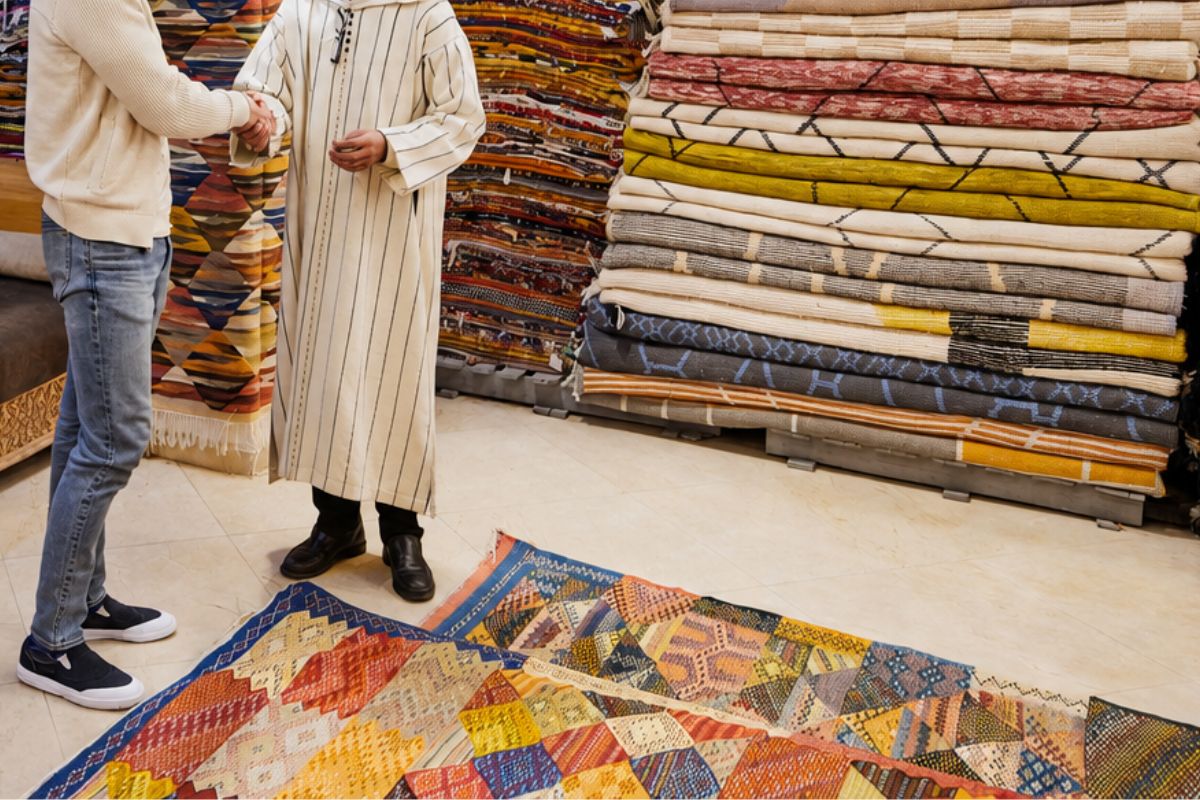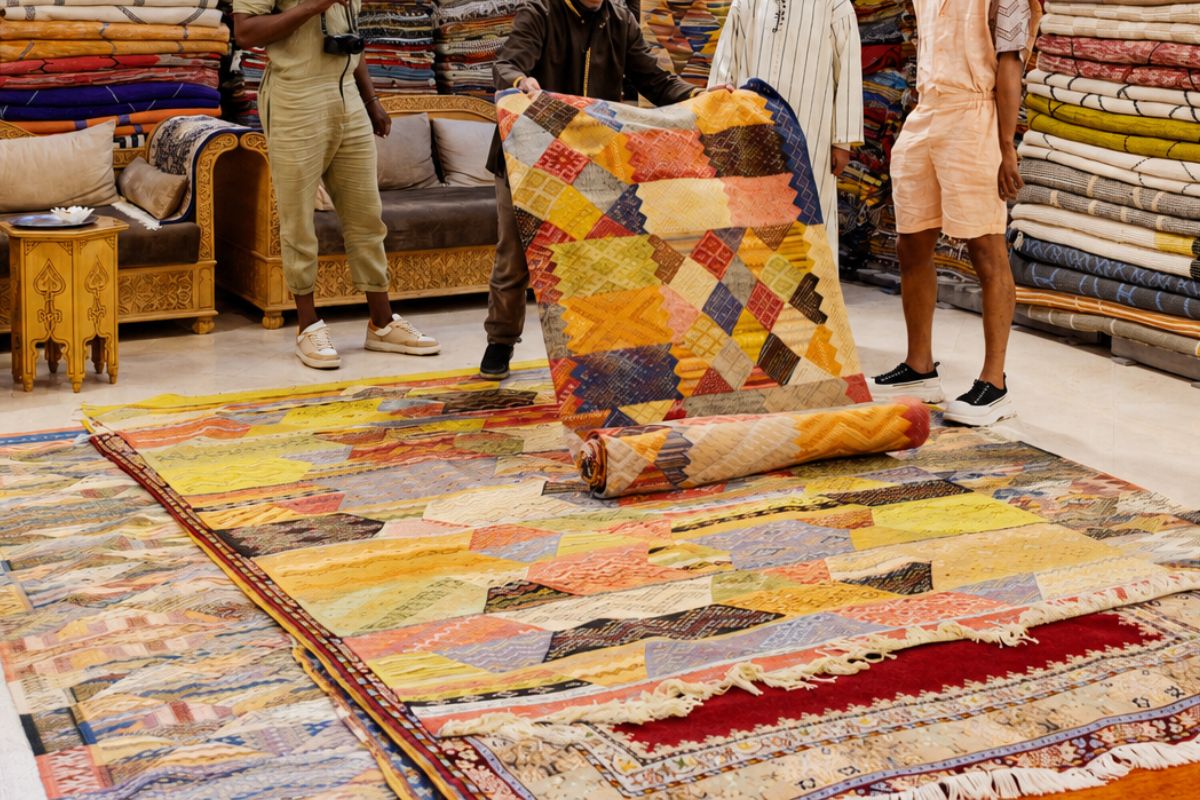
Buying a rug in Marrakech is a long, social, unhurried transaction, not a retail purchase. Expect mint tea, a presentation in which many rugs are unrolled in front of you whether or not you asked, a confident story about each rug's origin and age that nobody can verify, and a negotiation with no fixed starting price. Expect the shipping question to arrive before you have finished deciding. The three things worth settling before you walk in are your budget, whether you will ship, and how you will pay.
What this guide can and cannot tell you
Atlas Rug Guide has never been in a Moroccan souk. Nobody here has bought a rug in Marrakech, handled the stock, or sat through the tea. That matters enough to say at the top rather than in a footnote, because a great deal of the content on this question is written in a first-person voice by people selling tours.
What this page is: a compilation of what travel writers, tour operators and cooperative sources consistently report about the encounter, checked against the documented supply chain covered elsewhere on this site. Where those sources agree, that is noted. Where a piece of advice is folklore repeated without a source, that is noted too.
What this page is not: an account of anyone's visit, a recommendation of any shop, or a promise about what you will pay.
What actually happens, stage by stage
The accounts converge on a fairly consistent sequence.
You are invited in. Often by someone in the alley rather than the shop itself. Entering is not a commitment, and everyone involved knows that, though the social pressure is real and deliberate.
Tea arrives. Refusing is not rude, but accepting is normal and it sets the pace. The pace is the point: the transaction is designed to be slow.
The unrolling. Rug after rug is brought out and thrown open in front of you, frequently far more than you want to see. This is partly showmanship and partly a genuine way of finding out what you respond to. Travel guides consistently warn against showing obvious enthusiasm for one piece, and that advice is sound for a straightforward reason: it tells the seller where your ceiling is.
The story. Each rug arrives with a provenance: a tribe, a region, an age, sometimes a symbolic reading of the motifs. See the next section.
The number. There is no fixed price, and the first figure is an opening position. Negotiating without insulting anyone covers that part properly.
Shipping and payment. Usually raised before you have committed, and usually presented as easy.
The provenance story you will be told
This is the part to prepare for, because it is delivered with total confidence and is almost entirely unverifiable.
You will hear that a rug is from a specific tribe, that it is a specific number of decades old, that the pattern means protection or fertility or a wish for children, and that it was woven by a named person or her grandmother. Some of that may be true. None of it can be checked, and the seller in a city souk is generally several steps removed from whoever wove the rug. The documented chain runs weaver, weekly market, middleman, processing, then retail, as why the same rug costs four times more in a showroom sets out.
Two specific cautions. Age claims should be treated as claims: the aged look can be manufactured in weeks by processes documented by the Anou Cooperative. And symbolic readings assigned to motifs are interpretation rather than settled fact, as this site says wherever the subject comes up. Is my Moroccan rug authentic covers what can and cannot be established.
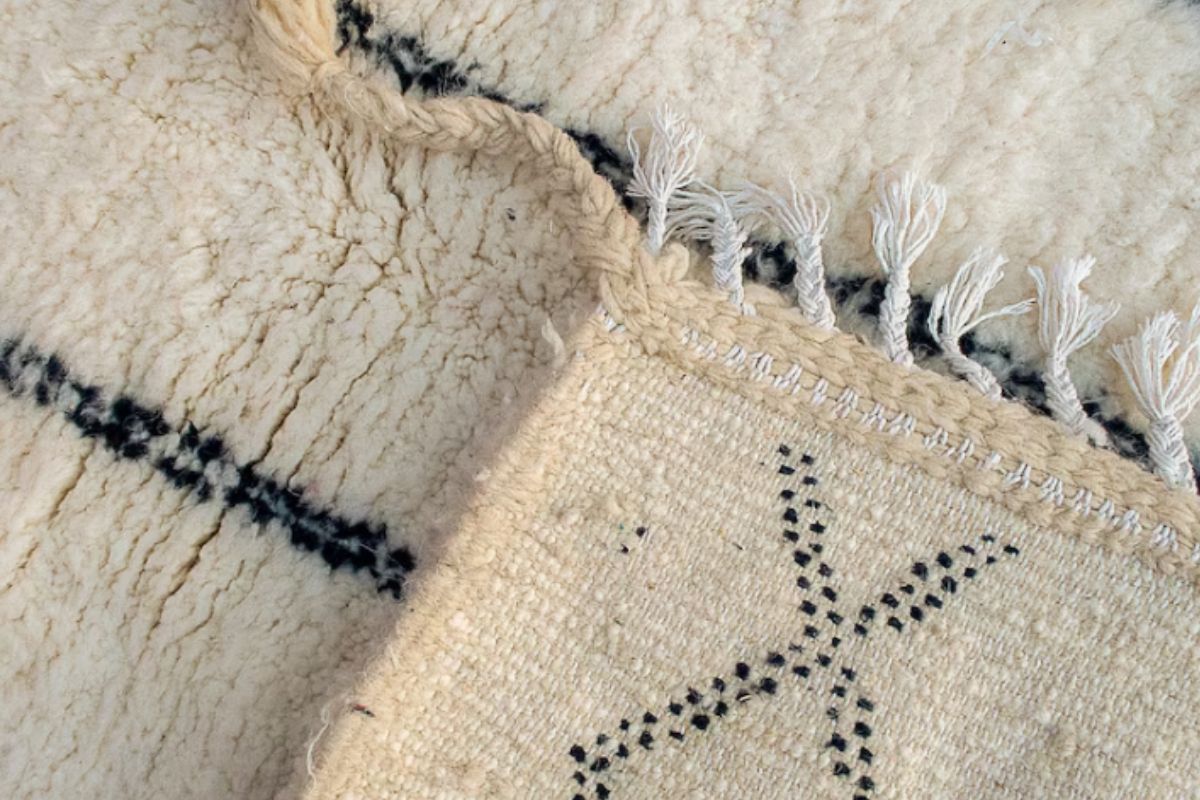
One travel guide found in this research warns specifically that a piece presented as an antique Berber rug can turn out to be factory made. That is the failure mode in one sentence, and the check for it is physical rather than conversational: look at the back.
Paying: keep it traceable
The single most useful discipline is to keep a record that exists outside the shop.
- Prefer a payment method with recourse. A card transaction leaves a trail and may carry protections your bank defines. Cash does not.
- Get a written receipt that describes the rug: dimensions, construction, any age or origin claim the seller made, and the price. If a seller will not put an age claim in writing, that is information.
- Photograph the rug in the shop, including the back and any damage, before it leaves your sight.
- Be cautious with deposits, and know what a deposit commits you to before you hand one over.
- Ask about currency and any card surcharge before agreeing a figure, so the price you agreed is the price that leaves your account.
Rules on carrying and declaring currency, and on importing goods, are set by your own country and by Morocco, and they change. Check your own customs authority rather than relying on advice from this page or from the shop.
Shipping, and the substitution risk
Shipping is where a good day can go wrong, and it is under-covered in the travel content.
The risk is not usually theft, it is substitution: the rug that arrives is not quite the rug you chose. Guarding against it is straightforward and worth doing even though it feels awkward.
- Photograph the exact rug you bought, front and back, with something for scale, before it is rolled.
- Have the receipt describe that specific piece, with measured dimensions rather than a rounded description.
- Ask who is actually shipping it and get the carrier and tracking, rather than a promise.
- Understand who bears the risk in transit and whether it is insured for what you paid.
- Consider carrying it yourself if size allows. Many rugs fold smaller than people expect, and airline baggage is often cheaper and always more certain than freight.
Customs and duty on arrival are your own country's business and no country's rule is universal. Ask your customs authority what applies before you commit, especially on a large purchase.
What to decide before you walk in
- A real number you will not exceed, decided in your own currency, before any tea.
- Whether you are shipping or carrying, because it changes what size you should even look at.
- That you will check the back of every rug you are serious about. It is the one thing in the whole encounter that does not depend on trusting anybody. What the back of the rug shows is a five-minute read that changes what you see.
- That you are allowed to leave. Walking out of a long presentation feels rude and is not. The tea is hospitality and it is also part of the transaction.
- What you would pay if the story were untrue. If that figure is much lower than the asking price, the story is what you are buying.
For the whole set of failure modes see how to buy a Moroccan rug without getting taken, and for a tradition where the organizations behind the weaving are actually documented, Taznakht rugs and the cooperatives behind the name.
FAQ
Is it safe to buy a rug in the Marrakech souk?
The common problems are commercial rather than criminal: paying well above the local range, an unverifiable age or origin story, and substitution during shipping. Keeping payment traceable, photographing the exact piece and getting a written description handle most of it.
Should I buy in Marrakech or somewhere else in Morocco?
Some travel guides suggest smaller market towns are cheaper than the big-city souks. This guide has not verified that and does not recommend specific places to buy.
Will the seller ship my rug home?
Usually yes, and it is normally offered. The risk is substitution rather than theft, so photograph the exact rug front and back, get its measured dimensions on the receipt, and ask for a carrier and tracking rather than a promise.
Can I trust what the seller tells me about the rug's tribe and age?
Treat it as a claim. The seller in a city souk is generally several steps removed from the weaver, and the aged appearance can be produced deliberately in weeks. The construction question is the one you can verify yourself.
Do I have to haggle?
Prices are not fixed and negotiation is expected. There is no correct percentage to open at, and the widely repeated rules about it are not sourced to anything.