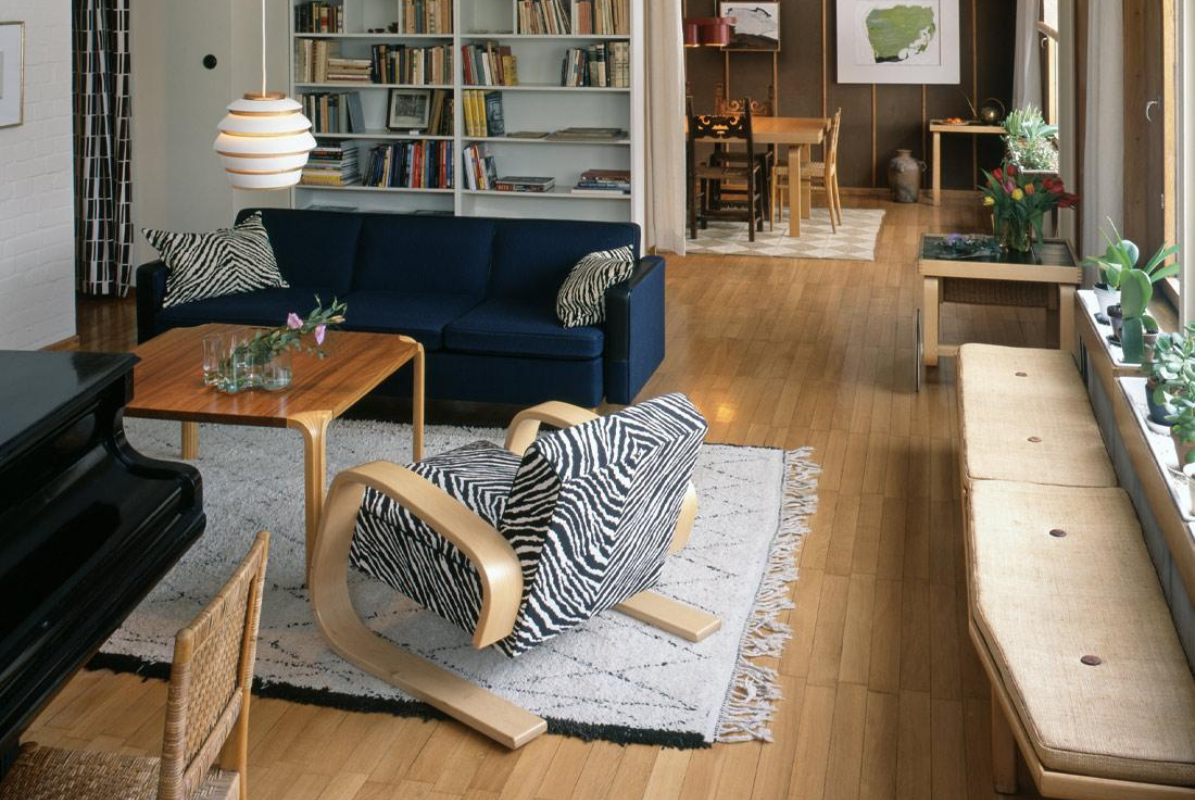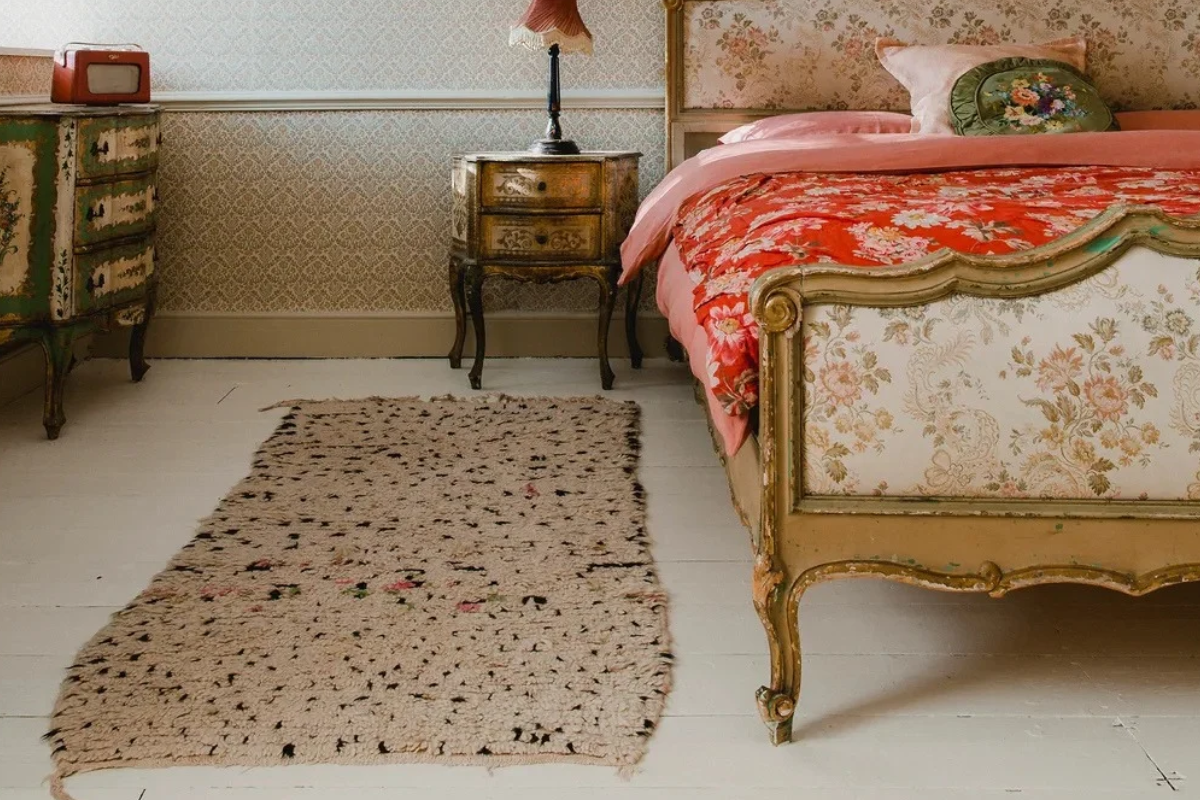
Short answer: for Moroccan rug placement in the bedroom, the choice comes down to three things: the rug's real measured size, how thick its pile is, and how much of the design you are willing to hide. A thick pile rug usually works best beside the bed or run out from under the foot of it, where the pattern stays visible and the bed's weight sits on less of the pile. A flatweave or low pile rug large enough to reach past both sides of the bed can go fully underneath. Measure the actual rug, tape its outline on the floor, and check it against doors and bed legs before you decide.
That is the whole decision in one paragraph. The rest of this guide explains why a hand-woven Moroccan rug does not behave like the standard sizes in most bedroom guides, and covers two things those guides rarely mention: what happens to wool that lives in the dark under a bed, and how a rug sits underfoot at night.
Why a Moroccan Rug Changes the Usual Placement Advice
Most bedroom rug advice assumes a machine-made rug in a catalog size. You match the rug to the bed from a chart, and the numbers line up. A Moroccan rug breaks that assumption in four ways.
The size is whatever the loom and the weaver made. A rug woven by hand comes off the loom at the dimensions that loom, that yarn and that weaver produced. Two rugs sold under the same style name can differ noticeably in length and width, and the edges are rarely perfectly straight.
The pile can be thick and uneven. Middle Atlas pile rugs are known for a deep, soft pile. That is lovely underfoot and awkward under furniture, because bed legs press into it and doors catch on it.
The design is often the point. Many Moroccan rugs carry a central field, an off-center motif or an asymmetry the weaver chose. Push the rug under a bed and the part you paid for may disappear under the mattress.
You usually cannot swap it for the next size up. A one-off hand-knotted piece is not a product line. Whatever you buy is the rug you have to place, so placement starts with the object in front of you rather than a size chart.
Rug Placement in the Bedroom: Three Options for a Moroccan Rug
Each option suits a different kind of rug. This table is the quick version; the sections below explain each one.
| Placement | Suits | Watch out for |
|---|---|---|
| Run out from under the foot of the bed | Most pile rugs, including thick ones | Bed legs pressing dents into the pile |
| Beside the bed (one side or a pair) | Runners, small rugs, statement patterns | Slipping on a hard floor when you step out of bed |
| Fully under the bed | Flatweaves and low pile rugs wide enough to show on both sides | Hidden pattern, and wool left in the dark for years |
Partly under the bed, from the foot
This is the most forgiving placement for a Moroccan pile rug. Lay the rug across the width of the bed and slide it under the lower part of the frame, so the mattress covers only the top portion and the rest runs out toward the foot. Decor guides commonly suggest leaving a visible band of rug on each side of the bed so there is something soft to step onto; how wide that band ends up depends on your rug, which is why the measuring step below matters more than any rule.
The benefit for a thick rug is that only the lower bed legs rest on it. The pile that carries the design stays in the open, where you can see it and where it gets walked on evenly.
Beside the bed
A runner or a small rug on one side of the bed, or a pair on both sides, is the easiest way to live with a rug whose pattern you want to see every day. It also keeps the floor under the bed clear, which makes cleaning there simple. Long, narrow Moroccan pieces suit this well; our guide to Moroccan runner rugs, rounds and odd shapes covers how those shapes come about and what to check before buying one.
Handmade pairs are rarely identical. If symmetry matters to you, compare the actual measurements of both rugs rather than assuming two pieces from the same seller will match.
Fully under the bed
Putting the whole rug under the bed and nightstands works best with a flatweave or a low pile rug, and only if the rug is wide enough to show on both sides and long enough to extend past the foot. A rug that disappears entirely under the bed does very little. For the difference between the two construction types and how each handles weight, see flatweave vs pile rug: which Moroccan style fits.
The trade-off is that most of the rug spends its life in the dark and undisturbed. That matters more than it sounds, and the section on moths below explains why.
Measure the Rug You Have, Not the Listing
Because handmade rugs are irregular, the measurement in a listing is a starting point, not a guarantee. Before you commit to a placement:
- Measure the rug yourself at both ends and through the middle, lengthwise and widthwise. Hand-woven rugs can be slightly wider at one end than the other.
- Measure the bed frame, not the mattress. The frame and legs decide where the rug actually sits.
- Mark the rug's outline on the floor with painter's tape in the position you are considering. Walk around it, open the door, pull out the nightstand drawers.
- Check the walking path from the door to each side of the bed. The edge of a rug should not fall exactly where you put your feet down in the dark.
- Move the tape, not the rug. Try the foot-of-bed position and the beside-the-bed position before you drag a heavy wool rug around the room.
If you are still choosing a rug, take these measurements before you buy. Knowing the space you actually have lets you judge an odd listed size on its own terms, instead of hoping it fits.
Pile Height, Doors and Bed Legs
A deep pile adds height at the floor. Before you settle on a spot, open the bedroom door and any wardrobe doors over the taped outline. If a door would sweep across the rug, a thick pile may catch and drag, which wears the pile and can pull the rug out of position.
Bed legs are the other pressure point. A bed pushes its weight through a few small feet, and on a soft pile those feet leave dents. Wide furniture cups under the legs spread the load. Moving the rug a little every so often, so the same patch is not crushed permanently, also helps. Neither step makes a thick pile rug an ideal under-bed rug; they only reduce the damage if that is where you want it.
What Lives Under a Bed
This is the part most bedroom placement guides skip, and it is the most important one for a wool rug.
The damage to a wool rug from clothes moths is done by their larvae, not the adults. According to the Natural History Museum, London (clothes moths identification guide, read on 2026-09-23), clothes moth larvae feed on keratin, a protein found in natural fibers, and "prefer low light levels and dirty fabrics, such as carpets and rugs."
The area under a bed is exactly that environment: dark, rarely disturbed, and easy to forget. A wool rug fully under a bed can hide an infestation for a long time, because the damaged part is the part you never see. That does not mean a rug under a bed will get moths. It means that if you choose that placement, you are taking on a maintenance job:
- Pull the bed away or lift the rug edge regularly and look at the underside and the covered pile.
- Vacuum the covered section, not just the visible border.
- Look for thin silky webbing, small cases or patches where the pile has gone bare.
If you find signs of activity, our guide to getting rid of carpet moths in a wool rug walks through what to do next and when to bring in a professional.
A foot-of-bed or beside-the-bed placement avoids most of this, simply because more of the rug stays in the light and gets walked on.
Stepping Out of Bed at Night
A bedside rug is the first thing your feet touch when you get up in the dark. On a hard floor, a loose rug can shift under you at exactly the moment you are least alert. This is a real safety consideration, not a styling detail, and it matters most for anyone unsteady on their feet.
A rug pad suited to wool and the floor type, and a placement where the rug edge does not sit in your first step, both reduce the risk. Our guide on how to stop a rug from slipping covers which fixes anchor a rug and which ones can harm the floor or the rug.
Light From the Window
Bedrooms often have a window beside or across from the bed. Direct sun on one part of a rug, day after day, can fade that part while the rest keeps its color, and fading does not reverse. If your chosen placement puts part of the rug in a regular patch of sun, turning the rug around from time to time spreads the exposure more evenly.
A Rug by the Bed Is Not a New Idea
In the places these rugs come from, the line between floor covering and bedding has not always been sharp. The online pages for "The Fabric of Moroccan Life," an exhibition shown at the Smithsonian's National Museum of African Art (confirmed live on 2026-09-23), catalog a Zemmour piece from the Middle Atlas, dated by the museum to the 1950s, as a "rug or blanket (hanbel)." A hanbel is a flatwoven textile, not a pile rug, and the museum's own label does not choose between the two uses.
Many dealer and collector accounts go further and describe thick Middle Atlas pile rugs as sleeping mats and covers against mountain cold. That is widely repeated, but we have not found a museum or academic source that documents it for pile rugs specifically, so treat it as commonly reported rather than settled. These are textiles made by Amazigh women (often called "Berber," a name that comes from outside the communities and that some of them reject) for their own households, in named regions with living traditions. Putting one beside your bed is a different use in a different home. It is worth knowing that the rug was not only ever meant to be looked at.
What This Guide Cannot Tell You
We have not seen your room or your rug. We cannot tell you whether a specific rug is a genuine hand-knotted Moroccan piece, how old it is or what it is worth; a specialist appraiser or conservator who can handle the rug in person is the right person for that. We also do not publish a bed-to-rug size chart, because handmade rugs do not come in chart sizes. The taped outline on your own floor is a better answer than any number we could give you.
Frequently Asked Questions
Should a Moroccan rug go under the bed or beside it?
It depends on the pile and the pattern. A thick pile rug or a rug with a design you want to see usually works best beside the bed or run out from under the foot. A flatweave or low pile rug wide enough to show on both sides can go fully under the bed.
Is it bad to put a wool rug fully under a bed?
It is not harmful in itself, but it creates two risks: bed legs crushing the pile, and clothes moth larvae, which the Natural History Museum says prefer low light. If you place a wool rug fully under a bed, inspect and vacuum the covered part regularly.
How do I know if an odd-sized Moroccan rug will fit my bedroom?
Measure the rug yourself at both ends and the middle, measure the bed frame, and mark the rug's outline on the floor with painter's tape. Open every door over the outline and walk the path to the bed before deciding.
Can I use two different Moroccan rugs on either side of the bed?
Yes. Handmade rugs are rarely identical anyway, so a mismatched pair can look deliberate. If you want a matching look, compare the actual measurements of both rugs before placing them.
Do I need a rug pad for a bedside rug?
On a hard floor, a pad is worth it. A bedside rug takes your first step in the dark, and a pad helps stop it shifting under you. Choose one suited to wool and to your floor type.