Blog

  • Azilal Rugs: The Colorful Berber Rug Explained

    Azilal Rugs: The Colorful Berber Rug Explained

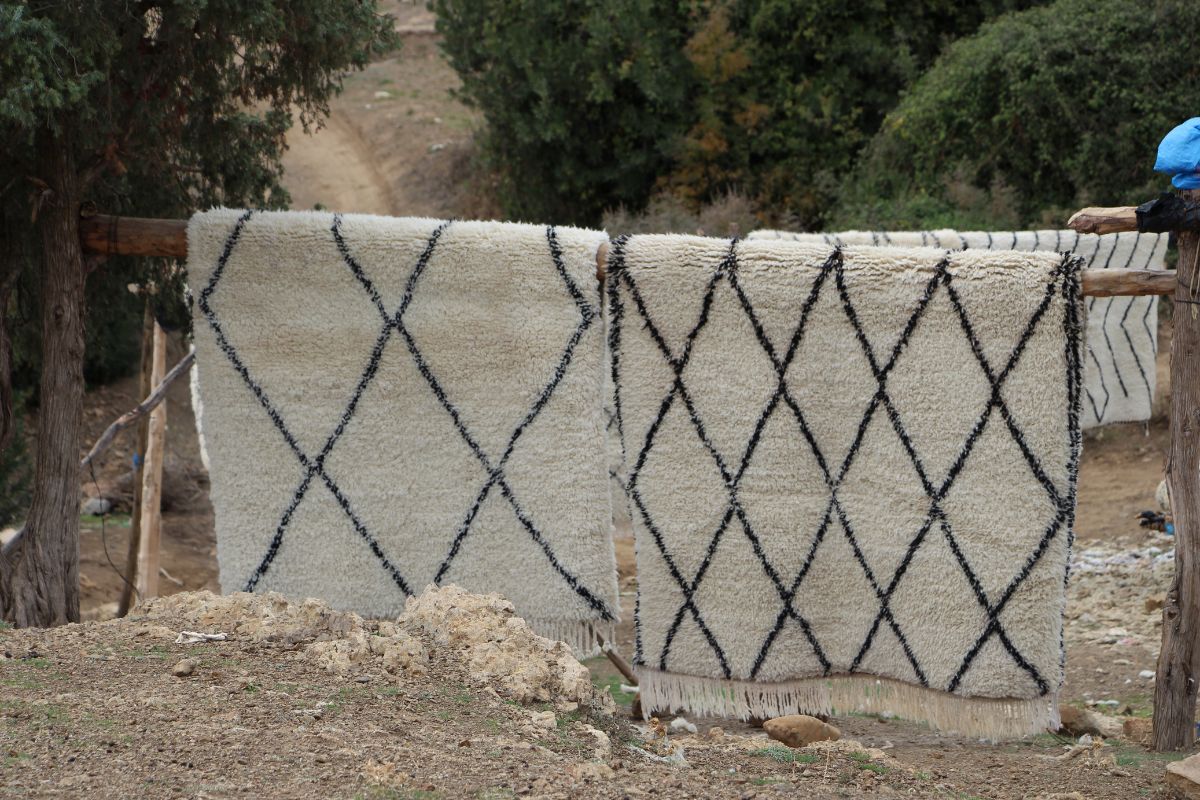
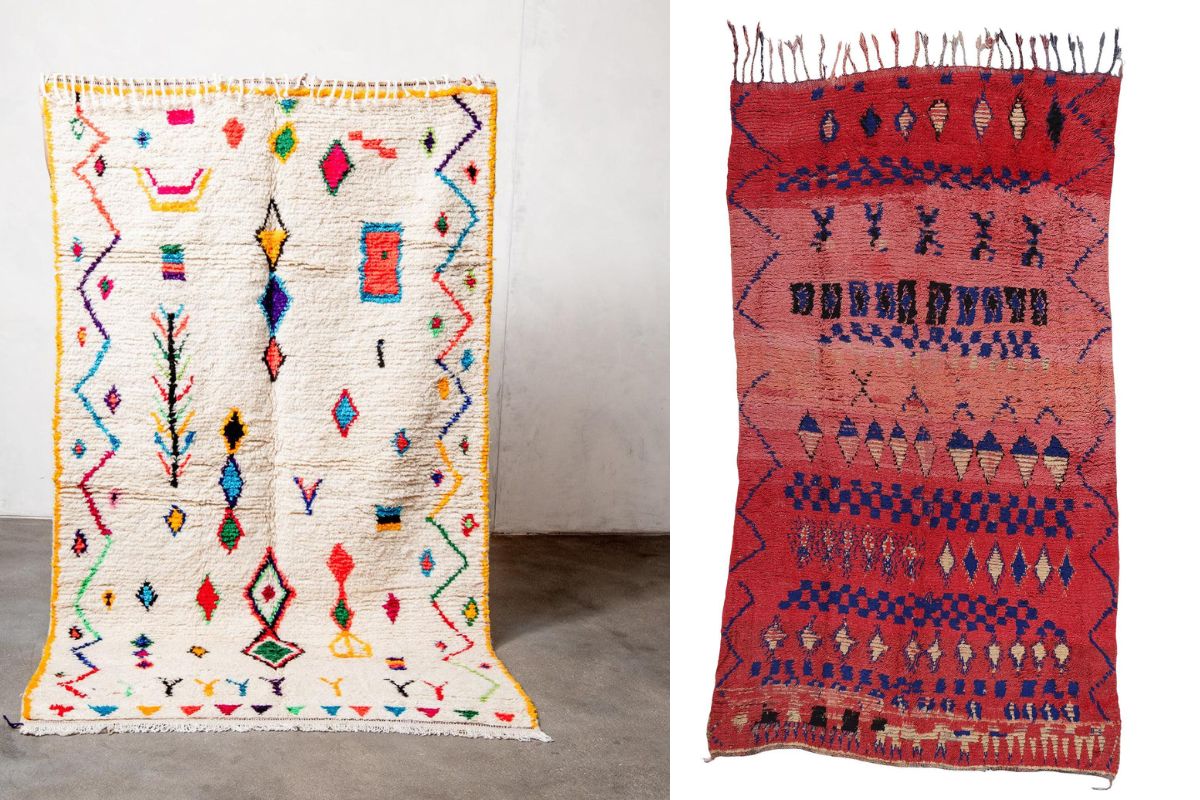
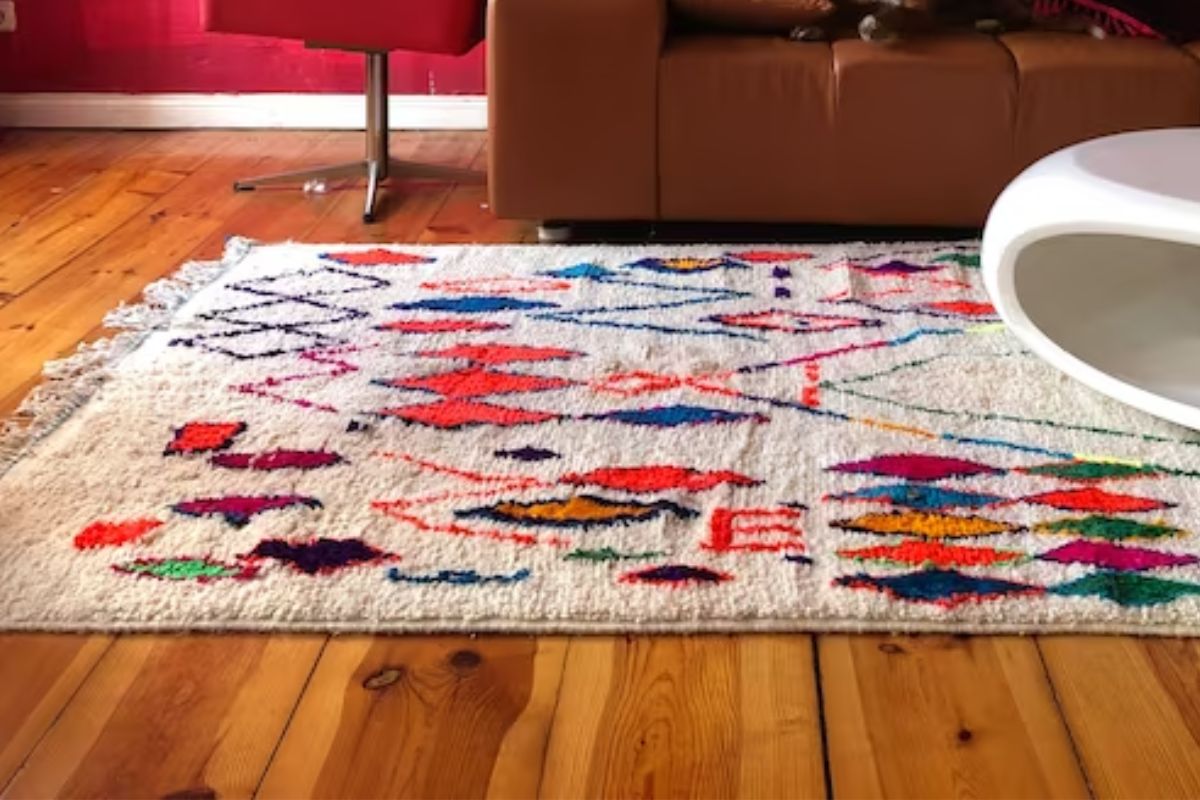
    An Azilal rug is a hand-knotted Berber rug from the Azilal province in Morocco's High Atlas Mountains, built on a natural, undyed cream or ivory wool base and covered with vivid, freeform, abstract patterns. It is the colorful, expressive counterpart to the neutral Beni Ourain: thinner in pile, brighter in palette, and far less bound by fixed tribal templates. Each Azilal is essentially a one-off, improvised by the weaver, so no two are truly alike. If you found a bright, loosely drawn Moroccan rug floating on a cream ground and wondered what it was, it is almost certainly an Azilal.

    The rest of this guide covers where the style comes from, why the designs never repeat, what the rugs are made of, how they differ from the two styles they are most often confused with (Beni Ourain and Boujad), and the honest parts most rug listings leave out. For the wider family this style belongs to, see our complete guide to Moroccan rug styles.

    Where Azilal rugs come from

    Azilal is both a rug style and a real place. The province and town of Azilal sit in the High Atlas Mountains, roughly 100 miles from Marrakech, and the rugs take their name from that region. They are woven by Azilali Berber (Amazigh) communities, and by long tradition the weaving is done by women, with techniques passed down within families.

    Beyond that, the deep history gets murky, and this is a good moment to be honest about it. You will see origin dates for Azilal weaving stated confidently across the web, from a few centuries to "ancient," but there is no firmly documented, agreed-upon start date. What is clear is that the style stayed local and largely unknown to outside collectors until the late twentieth century, when Moroccan tribal rugs found a Western design audience. So the safe, accurate statement is this: Azilal is a regional High Atlas weaving tradition that became internationally collected fairly recently. Precise founding dates are not settled, and any single source that pins one should be read with caution.

    Why no two Azilal rugs match

    This is the trait that defines the style, and it is the one most worth understanding before you buy. Where a Beni Ourain follows a fairly restrained visual template, the Azilal weaver works freehand. The motifs (lines, diamonds, chevrons, ladders, and looser figurative shapes) are arranged from the maker's own imagination rather than a set pattern book. The results are personal, improvised, and often asymmetric.

    The practical consequence: you cannot shop for "the Azilal design," because there isn't one. Two rugs from the same village, the same year, even the same weaver, will not match. Irregular spacing, a color that appears once and never again, a motif that drifts off-center: these are features of the tradition, not flaws or signs of a mistake. If you want a rug that reads as a single artistic object rather than a repeating textile, that improvised quality is the whole appeal. If you want two matching runners, this is the wrong style to hunt for.

    What Azilal rugs are made of

    The ground of an Azilal is typically natural, undyed sheep's wool in cream, ivory, or soft beige. The colored motifs are worked in dyed wool, and often cotton, laid over that light base. Some newer pieces incorporate recycled cotton or mixed fibers for the bright accents, which is part of why modern Azilals can look more saturated than older ones.

    Construction-wise, Azilal rugs are single-knotted, commonly with a cotton warp and wool knots and weft. The pile tends to be lower and the rug lighter and thinner than a plush Beni Ourain. That makes them easier to layer and move, though it also means they feel less cushioned underfoot.

    Azilal vs Beni Ourain: the honest comparison

    These two are the styles buyers most often weigh against each other, because they sit at opposite ends of the same shelf: one neutral, one colorful. Neither is "better." They solve different problems in a room.

    Feature Azilal Beni Ourain
    Region Azilal province, High Atlas Beni Ourain tribes, Middle Atlas
    Palette Cream base with bright, multicolor motifs Cream or ivory base with brown or black lines
    Design Freeform, abstract, improvised Minimalist, geometric, restrained
    Pile Lower and thinner Thick, plush, high pile
    Materials Wool plus cotton, sometimes recycled fiber Typically all wool
    Feeling in a room Playful, artistic, a focal point Calm, neutral, a backdrop

    The short version: choose an Azilal when you want the rug to be the color story in the room, and a Beni Ourain when you want the rug to disappear into a neutral scheme and let everything else stand out. For the full breakdown of the neutral option, see our Beni Ourain rug guide.

    Azilal vs Boujad: the other easy mix-up

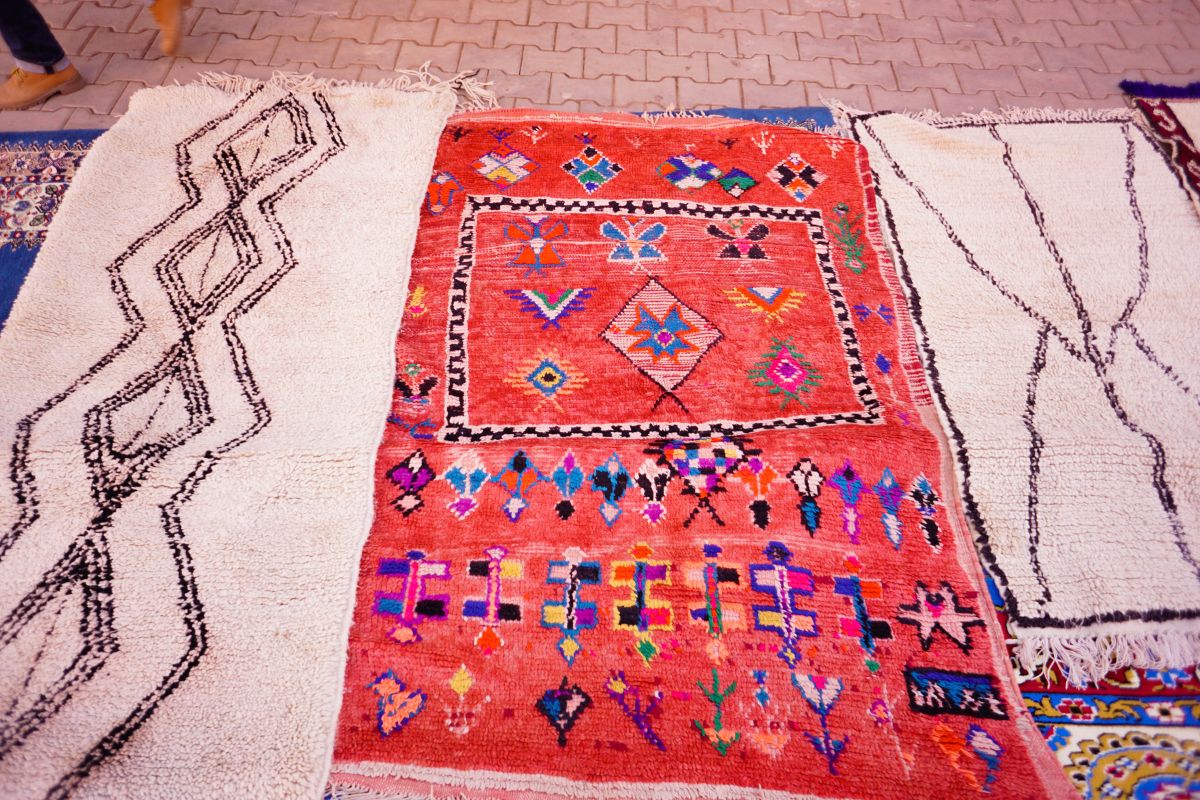
    Boujad is the style most often confused with Azilal once color enters the picture, and telling them apart comes down to one word: space. Boujad rugs are woven in the Middle Atlas near the town of Boujad, by Arab and Arabised Berber communities, and they tend to flood the entire field with saturated color, especially pinks, reds, oranges, and purples. The color fills the rug edge to edge.

    An Azilal does the opposite. It keeps a lot of open cream ground showing, with bright motifs floating on top of it. So a quick tell: if most of the rug is cream with color drawn onto it, you are likely looking at an Azilal; if the whole surface is soaked in warm color, it leans Boujad. Our Boujad rug guide covers that saturated style on its own terms.

    Older Azilal vs newer production

    "Azilal" is not one static look, and the difference between older and newer pieces is real enough to explain rather than blur. Older Azilal rugs lean on natural undyed wool and plant-based dyes, with sparser designs and a more muted, earthy set of accent colors. Many newer pieces are brighter, use more cotton, and may rely on synthetic dyes to hit those electric blues, pinks, and yellows.

    This matters because natural and synthetic dyes age differently. Natural dyes tend to mellow and harmonize over years, softening into the wool. Synthetic dyes are generally stable in a good modern rug, but some can fade or shift over time rather than settle. Neither is automatically "better," but they are not the same thing, and price and expectation should follow the reality of the piece.

    One caution: "vintage" is not a regulated term in the rug trade, and the age of a specific rug is hard to verify from a photo or a listing alone. Treat an age claim as a claim, not a certified fact, and ask what it is based on.

    What the motifs might mean, and why "might" is the right word

    You will find blogs that hand you a tidy dictionary of Azilal symbols, assigning fixed meanings to diamonds, zigzags, and figures. Read those with care. The motifs are commonly described as touching on rural life, motherhood, birth, and protection, and many weavers do work personal or symbolic content into their rugs. But there is no single, universal, decoded code. Meanings vary by weaver, family, and region, and a great deal of it is undocumented or interpreted after the fact.

    So the accurate framing is that Azilal motifs may carry meaning, often personal to the maker, and that specific "this shape always means X" claims should be treated as interpretation rather than settled fact. When a source states a precise symbolic meaning, look for what it is sourced to.

    The part most rug listings leave out

    Here is the honest section a seller has little reason to write. Because the defining traits of an Azilal are loose ("colorful abstract motifs on a light ground"), the label gets applied broadly in the market. A colorful High or Middle Atlas rug that is arguably Boujad-adjacent or a regional blend may still be listed as "Azilal," simply because that name sells. And the words that surround these rugs, including Azilal, vintage, authentic, tribal, and Berber, are not regulated or certified by anyone. The label on a listing is a description, not a guarantee of origin.

    That is not a reason to distrust every rug. It is a reason to buy the rug in front of you rather than the word attached to it: judge the wool, the ground, the knotting, and the look you actually want. Atlas Rug Guide is a reference, not an appraisal or authentication service, and we will not tell you a specific rug is genuine from afar. For a high-stakes purchase, an in-person expert who can handle the piece is the right authority.

    Before you buy or live with one

    A few grounded checks, in plain terms:

    • Feel the wool. Real sheep's wool has a slightly greasy, springy hand and recovers when you press it. A flat, squeaky, or plasticky feel is worth questioning.
    • Look at the ground. A classic Azilal shows a natural, undyed cream or ivory base with color drawn on top, not color everywhere.
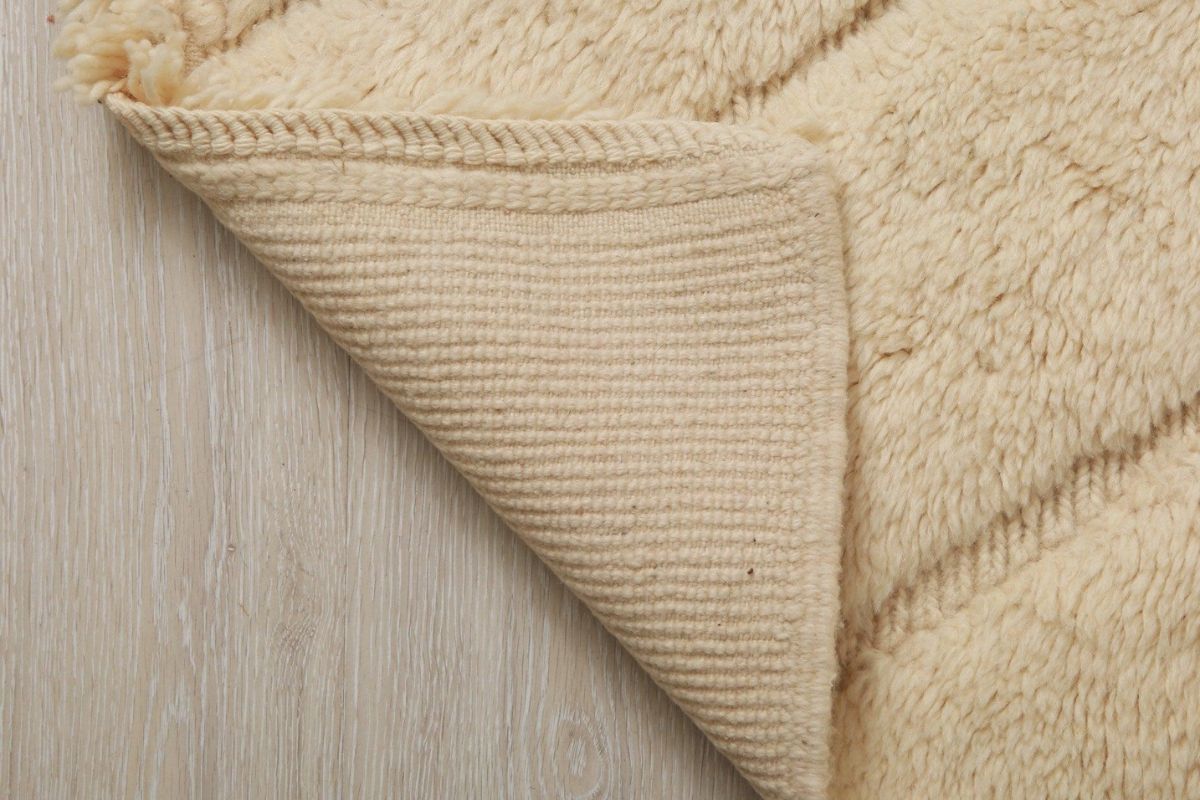
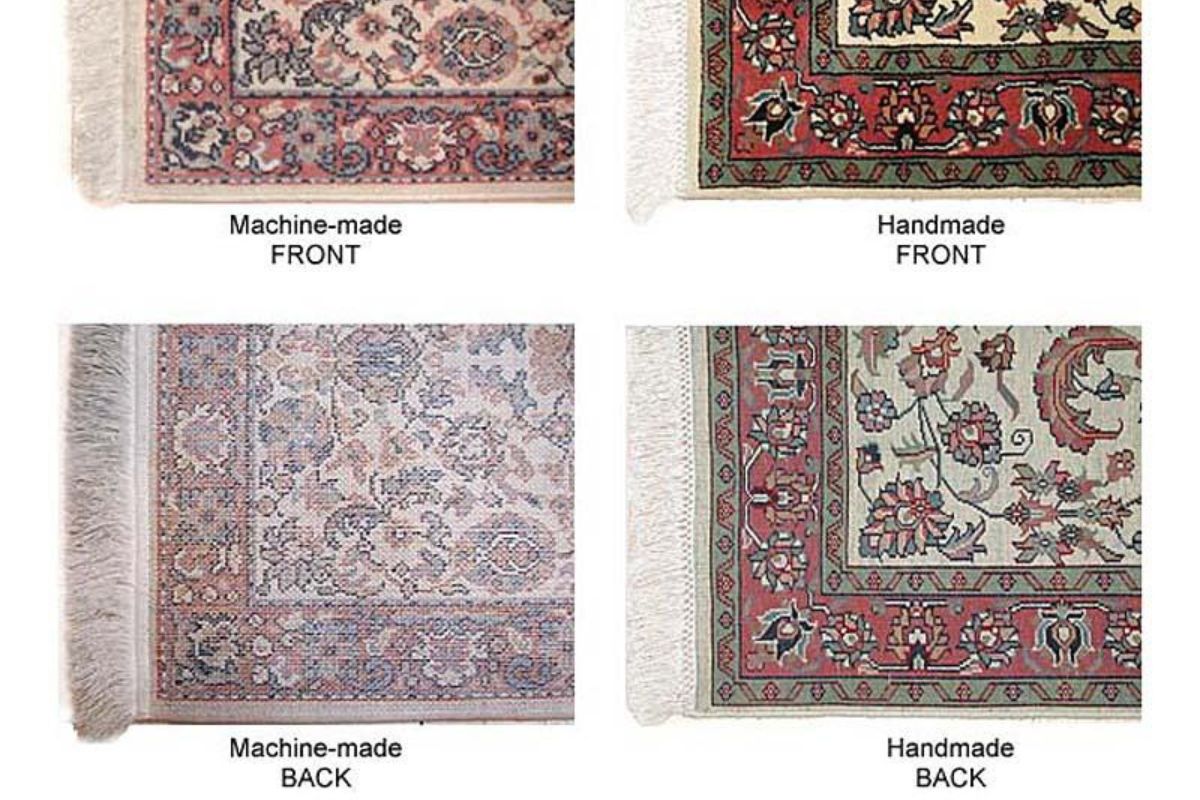
    • Check the back. Hand-knotting shows on the reverse. Ask whether the piece is knotted rather than machine-made or tufted.
    • Ask about dyes and age. A confident seller can tell you natural versus synthetic dye and roughly how old the piece is, and will not oversell what they cannot prove.
    • Expect asymmetry. Irregularity is normal here. Do not treat an off-center motif as a defect.

    In a room, an Azilal earns its keep as a color anchor over neutral floors, and its thinner pile makes it easy to layer over a larger natural rug or a flatweave. Because the palette is already doing the work, it usually looks best with fairly restrained furniture around it.

    FAQ

    Are Azilal rugs handmade?
    Yes. Azilal rugs are hand-knotted, traditionally by women in the Azilal region of the High Atlas, using wool and often cotton. Handwork is why each one is slightly irregular and one of a kind.

    Is an Azilal rug better than a Beni Ourain?
    Neither is better; they are built for different rooms. An Azilal brings color and acts as a focal point, while a Beni Ourain is neutral and recedes into the background. Choose based on whether you want the rug to be the color story or a quiet backdrop.

    Why are Azilal rugs so colorful?
    The style is defined by expressive, improvised design. Weavers work freehand rather than to a fixed template, laying bright dyed wool and cotton over a natural cream base. Newer pieces often look more saturated because they use more cotton and, in some cases, synthetic dyes.

    What are Azilal rugs made of?
    A natural undyed wool ground, with motifs in dyed wool and often cotton. Some newer pieces use recycled cotton or mixed fibers for the bright accents. They are usually knotted with a cotton warp and wool knots.

    How can I tell a real Azilal rug?
    Look for real wool, a natural cream ground with color drawn on top, visible hand-knotting on the back, and honest answers about dyes and age. Keep in mind that "Azilal" is an unregulated market label, so for an important purchase, a hands-on expert appraisal is the only reliable way to confirm origin.
  • Beni Mguild Rug: The Indigo Middle Atlas Style

    Beni Mguild Rug: The Indigo Middle Atlas Style

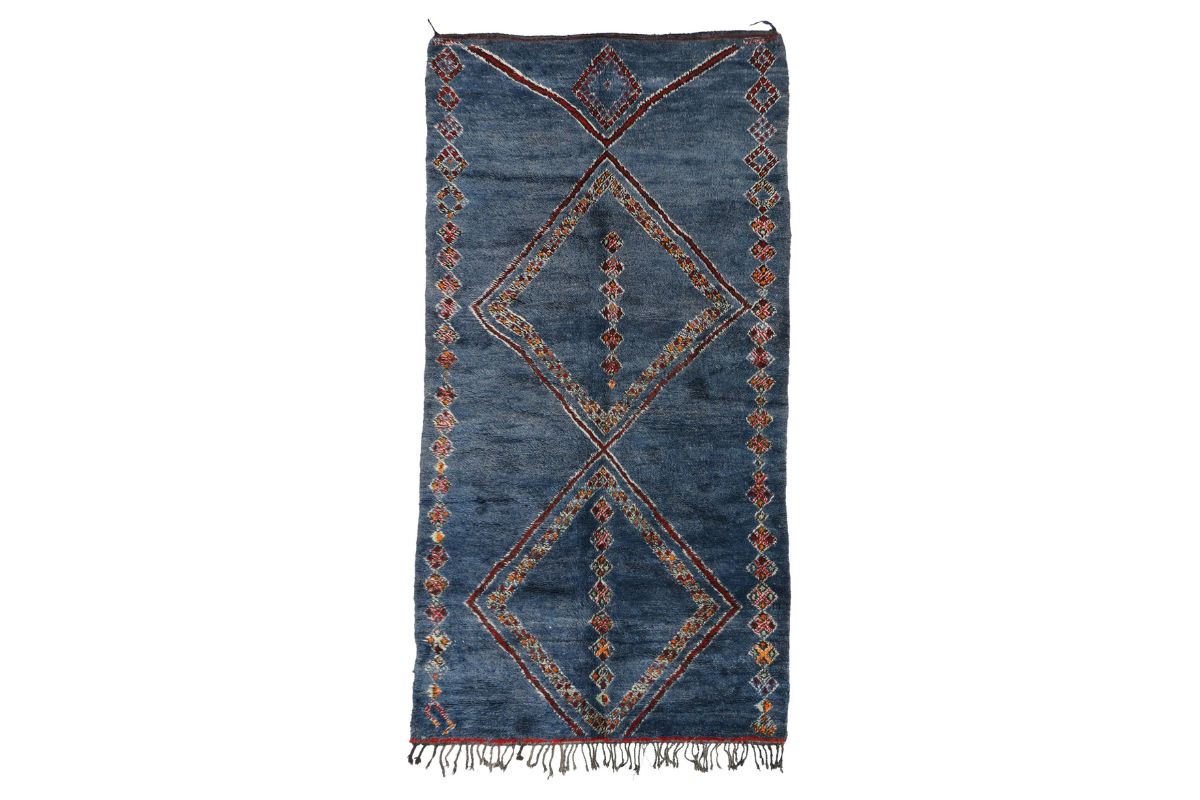
    A Beni Mguild rug is a thick-pile, hand-knotted wool rug from Morocco's Middle Atlas region, built on the same heavy-wool tradition as Beni Ourain and Beni Mrirt but set apart by its color: deep indigo, plum, aubergine, and dark pomegranate-red tones instead of undyed cream. If Beni Ourain is the neutral classic of this family, Beni Mguild is its darker, more saturated relative, and it gets confused with the other two far less on look, and far more on name recognition, since it is the least commercially prominent of the three.

    What makes a rug a Beni Mguild

    The name points to a weaving tradition based in the Middle Atlas, the same broad mountain region that produces Beni Ourain and Beni Mrirt rugs. Sellers commonly attach the name to a specific tribal group, but this guide did not find an independently sourced account of that attribution and will not repeat it as settled fact. What is safely observable is the rug itself: a heavy, thick wool pile, worked in geometric motifs including diamonds, lozenges, zigzags, and herringbone bands, set on a dark, dyed ground rather than the natural undyed cream of Beni Ourain.

    Like its Middle Atlas neighbors, the style is described as originating from a practical need: a thick wool rug that doubled as floor covering and bedding against cold mountain winters. That functional origin is consistent with the whole Middle Atlas wool-rug family and is a reasonable, low-risk description rather than a claim about a specific date or century, which this guide will not invent.

    The look: motifs, pile, and palette

    The palette is what actually distinguishes Beni Mguild at a glance. Where Beni Ourain and Beni Mrirt stay in cream, taupe, and gray, Beni Mguild leans into darker, richer dye tones: indigo blue is the color most associated with the style, alongside plum, aubergine, and deep brick or pomegranate reds. Older pieces in the market are often dominated by indigo specifically, with newer production showing a somewhat wider range of dark tones.

    The motifs sit in the same geometric vocabulary as the rest of Middle Atlas weaving: diamonds and lozenges, zigzag lines, and herringbone bands, worked into a heavy pile that gives the surface real texture and shadow. You will see these rugs described as having an especially deep or high pile in some listings, sometimes with a specific inch measurement attached. This guide could not independently verify any specific pile-height figure, so none is stated here; treat any exact number you see in a listing as the seller's claim, not a confirmed spec.

    How it relates to Beni Ourain and Beni Mrirt

    All three sit in the same family: thick, hand-knotted wool pile from the Middle Atlas, originally made for warmth rather than decoration. The practical difference for a buyer is mostly about color and finish rather than construction:

    Style Palette Pile Best known for
    Beni Ourain Undyed cream with dark line work High, loose, shaggy The neutral, minimalist classic
    Beni Mrirt Similar neutrals, denser weave Lower, tight, velvet-like Marketed as the denser "upgrade"
    Beni Mguild Deep indigo, plum, aubergine, dark red Thick, heavy The dark, saturated option in the same family

    If you want the full profile of either of the other two, see the guides to Beni Ourain and Beni Mrirt, including what actually separates them beyond the unsourced numbers you'll see quoted elsewhere.

    What to look for when judging one

    • Color depth, not brightness. Genuine dark-palette Middle Atlas rugs tend to show some variation and softening in the dye rather than one flat, uniform indigo across the whole field. Total flatness of color can be a sign of a modern reproduction or a synthetic dye batch rather than the older, more irregular look buyers are often seeking.
    • The back of the rug. As with any hand-knotted piece, the back should show individual knots and small irregularities. A mechanically uniform back or a printed/glued backing is not a hand-knotted Middle Atlas rug, regardless of the name on the listing.
    • Weight and pile. A genuinely thick pile carries real weight for its size. A thin, lightweight rug marketed under this name is worth a second look.
    • Ask before you assume "vintage." Dark, deeply saturated tones read as older to many buyers, but color depth alone does not establish age. See our guide on Beni Ourain rugs for the same caution applied to that style, and ask a seller directly for whatever age claim they are making rather than inferring one from color.

    One honest limit, repeated because it matters on every style page here: Atlas Rug Guide is a reference, not an appraisal service, and no article can authenticate a specific rug from a photo or listing. These are questions to ask, not a substitute for an expert's hands-on judgment on a significant purchase.

    For how Beni Mguild sits alongside the rest of the named Moroccan traditions, see the complete guide to Moroccan rug styles.

    FAQ

    What is a Beni Mguild rug?
    A thick-pile, hand-knotted wool rug from Morocco's Middle Atlas, part of the same broad tradition as Beni Ourain and Beni Mrirt, but distinguished by a dark, saturated palette, especially indigo, plum, and aubergine, rather than undyed cream.

    What color are Beni Mguild rugs?
    Deep, dark tones dominate: indigo blue is the color most associated with the style, alongside plum, aubergine, and dark pomegranate or brick reds. This is the main visual difference from the cream-toned Beni Ourain.

    How is a Beni Mguild different from a Beni Ourain rug?
    Both are thick Middle Atlas wool rugs from the same broad tradition, but Beni Ourain stays in undyed cream with sparse dark line work, while Beni Mguild uses a dark, dyed palette. Beni Mrirt sits closer to Beni Ourain in color but is denser and tighter woven.

    Does a dark color mean a Beni Mguild rug is older or more authentic?
    Not on its own. Color depth alone does not establish age, and this guide could not verify the specific age or pile-height figures sometimes quoted in listings. Ask a seller directly for the basis of any age claim rather than inferring one from how dark or faded a rug looks.

    Is "Beni Mguild" a specific tribal name?
    Sellers commonly present it that way, but this guide did not find an independently sourced account of that attribution. Treat it as a style name pointing to a Middle Atlas weaving tradition rather than a confirmed, single tribal attribution.

  • Beni Ourain vs Beni Mrirt: The Real Difference

    Beni Ourain vs Beni Mrirt: The Real Difference

    Beni Ourain and Beni Mrirt rugs feel genuinely different by hand: one is loose, shaggy, and open, the other dense, tight, and closer to velvet. That much is observable and true. What is not true, or at least not verifiable, is the specific pair of numbers that nearly every seller page uses to explain the difference: a knot-per-square-inch figure and a wash-count claim, repeated almost word for word across multiple sites with no source named anywhere. This guide states plainly what can be checked by hand and what cannot be checked at all.

    What actually differs, and this part is real

    Set the numbers aside for a moment, because the physical difference between these two Middle Atlas wool styles does not need a disputed figure to be true.

    • Pile height and openness. Beni Ourain has a higher, looser pile that reads as shaggy and cloud-like. Beni Mrirt is lower and packed tighter, closer to velvet underfoot.
    • Weight for size. A denser weave carries more wool per square foot, so a Beni Mrirt rug typically feels heavier than a Beni Ourain of the same dimensions.
    • Surface texture. Run a hand across both and the difference is immediate: one gives and fluffs under pressure, the other resists and feels compact.
    • Palette. Both stay in the same neutral family, undyed cream, taupe, and gray with sparse dark line work, so color is not a reliable way to tell them apart.

    None of that requires trusting a specific knot count. It is something you, or any buyer, can verify directly with your own hands on the actual rug.

    The KPSI claim, and where it comes from: nowhere anyone names

    Search this comparison and you will run into the same figure again and again: Beni Ourain at roughly 6-8 knots per square inch, Beni Mrirt at roughly 15-18. It shows up on moroccans.us, benisouk.com, berbercreations.com, and atelierbeni.com, phrased differently but landing on close to the same numbers.

    Here is what none of those pages do: cite where the figure came from. No lab measurement, no named textile researcher, no cooperative source, no citation of any kind. A number repeated across four competing sellers' websites in almost the same range looks authoritative, but repetition is not sourcing. It is at least as consistent with one page's figure being copied by the next as with it being independently measured. This guide checked for an independent source and did not find one. That is the honest state of the evidence, and it is worth knowing before you let a specific number justify a specific price.

    None of this means the underlying idea is wrong. A denser weave almost certainly does take more time, more wool, and more labor, and that is a reasonable, structural explanation for why Beni Mrirt tends to cost more. What is not reasonable is treating "15-18 KPSI" as a verified specification rather than a number nobody will source.

    The wash-count claim gets the same treatment

    The second recurring claim is that Beni Mrirt wool is washed several times while Beni Ourain wool is washed only once, offered as the reason Beni Mrirt feels softer and more refined. Same problem as the knot count: it appears across the same cluster of seller sites, and none of them attribute it to a supplier, a cooperative, or any documented process. It may be true of some rugs from some workshops. It is not something this guide can confirm as a defining, category-wide fact, so it is presented here as a claim you will see, not as something you should shop against.

    Why an unsourced number spreads this fast

    It is worth naming, carefully, why this happens rather than just flagging it and moving on. A specific figure is persuasive in a way that "generally denser" is not: "15-18 KPSI" sounds like a spec sheet, and a shopper comparing two rugs wants something that sounds measurable. Once one page states a number with confidence, a competing seller writing about the same comparison has every incentive to state a similar number rather than admit uncertainty, and very little incentive to go find an actual source. That is an observation about how this particular corner of the internet reads, not a claim about any one seller's intent, and it is exactly the kind of pattern an independent guide with nothing to sell is positioned to point out plainly.

    What to do instead of trusting the number

    • Feel the density yourself. Press into the pile near the base. A tighter, more resistant feel with less visible backing between tufts is the real signal, not a number on a listing.
    • Compare weight, not specs. Pick up a corner of each, if you can. The denser rug will feel noticeably heavier for its size.
    • Ask the seller a direct question. "Where does your knot-count figure come from?" is a fair question before a four-figure purchase, and a vague or defensive answer tells you more than the number itself would.
    • Choose by feel and look, not by which number is bigger. A higher knot count is not automatically the "correct" choice. The looser, shaggier Beni Ourain pile is exactly what a lot of buyers want, and it is not a lesser rug for being less dense.

    For the individual style profiles this comparison draws from, see our guides to Beni Ourain and Beni Mrirt. For how both fit into the wider family of named Moroccan styles, see the complete guide to Moroccan rug styles.

    FAQ

    What is the real difference between Beni Ourain and Beni Mrirt rugs?
    Beni Ourain has a higher, looser, shaggier pile. Beni Mrirt is denser and tighter, closer to velvet. Both stay in the same neutral cream-and-dark-line palette. That physical difference is real and checkable by hand.

    Is it true that Beni Mrirt has 15-18 knots per square inch versus 6-8 for Beni Ourain?
    That specific figure is repeated across several seller sites, but none of them cite a source for it, and this guide could not independently verify it. Treat the general idea, denser weave means more labor, as reasonable, and treat the exact numbers as unverified.

    Is Beni Mrirt actually washed more times than Beni Ourain?
    That claim also appears without a named source on the same cluster of seller pages. It may be true of specific workshops, but it is not confirmed as a category-wide fact.

    Does a denser knot count mean a better rug?
    Not automatically. A denser weave generally means more labor and durability, which can justify a higher price, but the looser Beni Ourain texture is a deliberate preference for many buyers, not an inferior version of Beni Mrirt.

    How can I judge rug density without trusting a seller's number?
    Press into the pile near the base and feel how much it resists, and compare the weight of two rugs of similar size. A denser rug will feel heavier and less springy. That is a more reliable signal than any figure printed in a listing.

  • Beni Mrirt Rug: What It Is and Why It Costs More

    Beni Mrirt Rug: What It Is and Why It Costs More

    A Beni Mrirt rug is a hand-knotted wool rug from the Middle Atlas region of Morocco, sold in the market as a denser, more tightly woven, and generally more expensive counterpart to the better-known Beni Ourain. Where Beni Ourain is loose and shaggy, Beni Mrirt is described as tighter and more velvet-like underfoot. Rug sellers commonly attach specific knot-count and washing figures to that comparison. Those figures are repeated across seller sites with no named source and no independent verification, so this guide states the underlying idea (denser weave, more labor, generally higher price) without adopting any seller's numbers as settled fact.

    Atlas Rug Guide sells no rugs and carries no commission on this or any style, so nothing below is written to move you toward the pricier option.

    Where the name comes from

    "Mrirt" is a real, checkable place name: Mrirt is a town in Khenifra Province, in the Béni Mellal-Khénifra region of the Middle Atlas. Rug-seller sites commonly describe the style as woven by a "Mrirt tribe," but none of the pages sampled for this guide cite a source for that specific tribal claim, and this guide will not repeat it as settled. What can be stated plainly is the geography: the name points to a Middle Atlas weaving area, the same broad mountain region that produces Beni Ourain rugs, and the market uses "Beni Mrirt" as a style name for wool rugs associated with that area and its denser weaving tradition. Beyond that, treat any specific tribal attribution you see in a listing as a seller's claim, not a verified fact.

    What to expect: pile, weight, feel

    Where a Beni Ourain reads as open, fluffy, and cloud-like, a Beni Mrirt is described consistently across the market as denser and more compact, with a surface closer to velvet than to loose fur. That comes from a tighter weave and, sellers say, a double-knotting technique rather than a single knot per point. A denser weave uses more wool and more labor per square foot of finished rug, which is the honest, non-numeric version of why Beni Mrirt pieces tend to sell for more than a comparable Beni Ourain.

    The palette stays in the same neutral family as Beni Ourain: creamy whites, warm taupes, and soft grays, often with the same sparse dark geometric line work. If you are looking at a rug loaded with saturated color, you are looking at a different Moroccan style, whatever the listing calls it. This neutral palette is what both Middle Atlas wool styles have in common.

    Beni Mrirt vs. Beni Ourain, at a glance

    Feature Beni Ourain Beni Mrirt
    Pile Higher, shaggier, more open Lower, denser, closer to velvet
    Feel Loose, fluffy, cloud-like Compact, plush, tightly packed
    Knotting Single knot, looser weave Described by sellers as double-knotted, tighter weave
    Palette Undyed cream with dark marks Similar neutrals, sometimes richer taupe/gray
    Market position The familiar, widely available classic Marketed as the denser, pricier upgrade

    Neither pile type is objectively "better." A tighter weave generally means more labor went into the rug, which tends to track with price, but the looser, shaggier Beni Ourain pile is exactly what a lot of buyers are actually shopping for. For the full breakdown of the Beni Ourain side of this comparison, see our Beni Ourain rug guide.

    The numbers you'll see quoted, and why this guide won't repeat them

    Search for Beni Mrirt and you will quickly run into a specific pair of claims, repeated almost word for word across multiple seller sites: a knot-per-square-inch figure for each style (commonly given as roughly 6-8 KPSI for Beni Ourain against 15-18 KPSI for Beni Mrirt), and a claim that Beni Mrirt wool is "washed several times" against Beni Ourain's "washed once."

    Here is the problem: not one of the pages making these claims names where the figures came from, and the exact numbers are not consistent from site to site even when two pages are making the same general point. That pattern, an identical-sounding claim with no shared source and no agreement on the specific number, is exactly what this guide's editorial standard treats as unverified rather than fact. A dedicated comparison article, Beni Ourain vs. Beni Mrirt: what the knot-count claims actually rest on, works through this specific claim in more depth, including why the wash-count story doesn't hold up as stated either. The short version for this page: treat "denser weave, more labor, generally more expensive" as the honest takeaway, and treat any specific KPSI number you see in a listing as a claim to ask about, not a spec to shop against.

    What actually helps you judge one in front of you

    Since the numbers themselves are not reliably sourced, the more useful approach is what you can check directly:

    • Feel the density with your hand. Press your fingers into the pile near the base. A denser weave resists more and shows less visible backing between tufts than a looser one.
    • Turn it over. A hand-knotted rug, whichever style, shows individual knots and small irregularities on the back. A uniform, machine-neat back or a glued backing is not a hand-knotted Middle Atlas rug at all, regardless of what name is on the listing.
    • Compare weight for size. A denser weave carries more wool per square foot, so two rugs of the same dimensions should feel noticeably different in hand.
    • Ask the seller directly where the wool came from, whether the rug is hand-knotted, and what specifically they mean by the knot-count figure they are quoting. A vague or evasive answer to a specific question is worth more than the number itself.

    One honest limit worth repeating: this is a reference guide, not an appraisal service, and no article can authenticate a specific rug from a photo or a listing description. For a significant purchase, weigh these signals alongside your own judgment of the seller, not instead of it.

    Where a Beni Mrirt fits in a room

    Because the palette and general look sit close to Beni Ourain, the styling logic is similar: a neutral base that reads as warm and textural without fighting the rest of the room. The denser pile holds its shape a little better in higher-traffic spots than a looser, shaggier weave, which is one practical (not aesthetic) reason it sometimes gets recommended for busier rooms.

    For how this style relates to the other named Middle Atlas and Atlas traditions, see the complete guide to Moroccan rug styles.

    FAQ

    What is a Beni Mrirt rug?
    A hand-knotted wool rug associated with the Mrirt area of Khenifra Province in Morocco's Middle Atlas, sold in the market as a denser, tighter-woven, and generally pricier counterpart to Beni Ourain.

    Is a Beni Mrirt rug better than a Beni Ourain rug?
    Not objectively. Beni Mrirt is typically denser and more compact, which generally reflects more labor and a higher price, while Beni Ourain's looser, shaggier pile is exactly what many buyers prefer. It comes down to the feel and look you want, not a fixed hierarchy.

    Are the knot-count figures for Beni Mrirt accurate?
    The specific KPSI numbers circulating online (commonly cited as 15-18 for Beni Mrirt versus 6-8 for Beni Ourain) are not sourced on any seller page sampled for this guide, and the exact figures are not consistent between sites. Treat the general idea, a denser weave takes more labor, as reasonable, and treat any specific number as an unverified claim.

    Is "Beni Mrirt" a specific tribe?
    Sellers commonly describe it that way, but none of the pages checked for this guide cite a source for that attribution. What is verifiable is the geography: Mrirt is a town in Khenifra Province in the Middle Atlas. Treat the tribal claim as a seller assertion, not a confirmed fact.

    How can I tell if a Beni Mrirt rug is genuinely hand-knotted?
    Turn it over. A hand-knotted rug shows individual knots and small irregularities on the back, regardless of style name. A perfectly uniform back or a glued backing is a sign of a machine-made piece, not a genuine Middle Atlas weave.

  • Beni Ourain Rug: What It Is and How to Buy One

    Beni Ourain Rug: What It Is and How to Buy One

    A Beni Ourain rug is a handwoven wool rug made by the Beni Ouarain, a confederation of Berber tribes in the Middle Atlas Mountains of Morocco. The classic version has a thick, plush pile of undyed cream or ivory sheep wool, marked with a sparse pattern of dark brown or black geometric lines and diamonds. Because it is knotted by hand, no two are exactly alike, and small irregularities are normal rather than flaws. Today the name is also used loosely for machine-made lookalikes, so knowing what a genuine one actually is matters before you spend real money.

    This guide covers where the style comes from, what a genuine piece feels like, how it differs from the rug it gets confused with most, and the claims floating around the internet that deserve a second look. Atlas Rug Guide does not sell rugs and earns no commission on any purchase, so nothing here is written to steer you toward one seller over another.

    What makes a rug a Beni Ourain

    The name points to people, not just a pattern. The Beni Ouarain (also spelled Beni Ourain) are often described as a confederation of around 17 Berber tribes living in the high country of the northeastern Middle Atlas. Families there wove thick wool rugs for a practical reason first: warmth. At altitudes above 2,000 meters, a heavy wool pile worked as a sleeping mat and a blanket against mountain cold, which is why traditional pieces were often woven large enough for a whole family.

    Three things define the classic look:

    • Undyed wool. The cream, ivory, or soft off-white ground is the natural color of the sheep's wool, not a bleached or dyed finish. Slight variation in tone across the rug is expected because the wool is hand-spun.
    • Sparse geometric marks. Thin dark-brown or black lines form diamonds, lozenges, and irregular grids. The pattern is minimal and asymmetric, not a dense repeating motif.
    • A high, soft pile. Wool from high-altitude sheep tends to be rich in lanolin, which gives the pile its plush, slightly springy feel.

    The exact age of the tradition is not well documented, and you will see confident but conflicting origin dates repeated across seller blogs. Where the history is genuinely uncertain, this guide leaves it uncertain rather than picking a number to sound authoritative.

    What to expect: pile, weight, and feel

    A genuine Beni Ourain is heavy. The dense wool pile gives it real weight for its size, and the surface feels shaggy and open rather than tight and flat. Run your hand across it and you may notice the wool feels slightly oily or waxy; that is natural lanolin, and it is one reason the wool resists dirt and wear.

    Traditional sizing runs long and narrow because the rugs followed the shape of a sleeping space, though pieces made for the export market come in a wide range of dimensions today. Color stays in the neutral family: cream grounds with brown or black line work, sometimes with faint gray. Bright, saturated color is not part of the traditional Beni Ourain vocabulary; a rug loaded with vivid dyes is a different style, or a modern reinterpretation, rather than a classic Beni Ourain.

    Why the look suits modern interiors

    The Beni Ourain became a design icon in the mid-20th century, when modernist architects and designers paired its plain wool ground and graphic lines with clean, minimal rooms. That pairing still works. A neutral high-pile rug adds warmth and texture without competing with the rest of a space, which is why it reads equally at home under mid-century furniture, in a Scandinavian-minimal room, or in a warm neutral "quiet luxury" scheme.

    If you like the palette but want a bit more color or a looser, more painterly pattern, two related Middle Atlas styles are worth comparing before you commit: Azilal rugs, which keep a wool ground but add sparse color and freer motifs, and Boujad rugs, which lean into warm pinks and reds. Our complete guide to Moroccan rug styles lays out how all of these relate.

    Beni Ourain vs Beni Mrirt: the real differences

    The style Beni Ourain gets confused with most is Beni Mrirt, another Middle Atlas wool rug. Several seller pages exist specifically to move shoppers from one to the other, so it helps to see the actual differences plainly:

    Feature Beni Ourain Beni Mrirt
    Pile Higher, shaggier, more open Lower, denser, more velvet-like
    Feel Fluffy, loose, cloud-like Compact, smooth, plush
    Knot density Lower (looser weave) Higher (tighter weave)
    Pattern Minimal lines and diamonds Often bolder, more detailed
    Palette Undyed cream with dark marks Similar neutrals, sometimes richer

    Neither is "better" in the abstract. A denser weave takes more time and wool, which generally tracks with a higher price, but the open, shaggy Beni Ourain pile is exactly what many people want. The right choice depends on the texture and look you are after, not on which one a seller has framed as the upgrade.

    Claims worth being skeptical of

    This is where independent guidance matters most, because a few claims get repeated across the web as settled fact when they are not.

    The burn test does not prove a rug is a genuine Beni Ourain

    Nearly every buying guide online repeats the same "burn test": snip a fiber, hold a flame to it, and judge by how it burns and smells. Real wool chars slowly and smells like burnt hair; synthetic fiber melts, beads up, and smells like plastic. That much is true, and the test can tell you whether a fiber is wool or synthetic.

    Here is what those guides leave out: the burn test only checks fiber content. It cannot tell you where a rug was made, whether it was hand-knotted, or how old it is. A rug can be 100% wool and still be a machine-made copy woven far from the Middle Atlas. Passing a burn test means "this is wool," not "this is a genuine Beni Ourain." Treat it as one small data point, not proof of origin.

    Knot-density numbers are inconsistent, so treat them as a concept, not a spec

    You will also see specific knot-per-square-inch figures quoted for Beni Ourain and Beni Mrirt rugs. The problem is that the exact numbers vary from site to site and are rarely sourced, so it is not sound to treat any single figure as a fixed standard. The underlying idea holds up: a denser, tighter weave takes more labor and more wool, which generally correlates with more value. Use density as a relative sense of quality you can feel with your hand, not as a number to verify a rug against.

    "Beni Ourain" vs "Beni Ourain style": the gap sellers skip

    The single most useful thing to understand before buying is that the market is full of "Beni Ourain style" rugs, and "style" is doing a lot of quiet work in that phrase. A genuine Beni Ourain is handwoven by weavers in the Middle Atlas from local wool. A "Beni Ourain style" or "Beni Ourain inspired" rug is anything that copies the cream-and-diamond look, including machine-made rugs produced in bulk from synthetic or blended fiber anywhere in the world.

    Both can be attractive. But they are not the same object, and they should not carry the same expectations for durability, feel, or value. The look-alike is a product; the genuine article is a handmade textile with real variation baked in.

    Genuine Beni Ourain "Beni Ourain style" lookalike
    Made Hand-knotted by Middle Atlas weavers Often machine-made, mass-produced
    Material Undyed natural sheep wool Frequently synthetic or wool blend
    Variation Slight irregularities throughout Perfectly uniform, repeating
    Back of rug Visible hand-tied knots, uneven Machine-neat, often a printed or glued backing

    A quick note on limits: Atlas Rug Guide is a reference, not an appraisal service, and no article can authenticate a specific rug from a photo or description. The points below help you ask better questions, not replace an expert's hands-on judgment when a purchase is significant.

    What actually helps you judge one in front of you

    • Turn it over. On a hand-knotted rug the back shows the pattern in individual, slightly uneven knots. A print or machine copy often looks suspiciously perfect, or has a separate backing material.
    • Look for honest irregularity. In a genuine piece, lines wobble slightly, diamonds are not identical, and tone shifts a little across the field. Flawless symmetry is a red flag, not a selling point.
    • Feel the wool. Natural wool feels dense and often slightly oily from lanolin, and it has an earthy, not chemical, smell. A strong synthetic odor is a warning sign.
    • Ask direct provenance questions. Where was it woven and by whom? Is the wool natural and undyed? Is it hand-knotted? A confident, specific seller answer is worth more than any single physical test.

    For how a Beni Ourain sits against the other named Moroccan traditions, and where each one is woven, see the wider family of Moroccan rug styles.

    Caring for a Beni Ourain rug

    Wool is forgiving, which is part of the appeal. A few basics keep a genuine piece looking right:

    • Vacuum gently and avoid a hard beater bar on a high pile, which can pull fibers.
    • Blot spills quickly rather than rubbing them in; wool's lanolin helps resist staining if you act fast.
    • Rotate the rug periodically so light and foot traffic wear it evenly.
    • For deep cleaning, use a professional experienced with handmade wool rugs rather than a general carpet-cleaning machine.

    Natural shedding is normal early on and settles over time. It is a property of a real wool pile, not a defect.

    FAQ

    What is a Beni Ourain rug?
    It is a handwoven wool rug from the Beni Ouarain Berber tribes of the Middle Atlas Mountains in Morocco, known for a thick undyed cream or ivory pile marked with sparse dark-brown or black geometric lines and diamonds.

    Are Beni Ourain rugs always cream colored?
    The traditional palette is undyed cream or ivory wool with dark line work, sometimes with faint gray. Brightly colored versions are either a different Moroccan style or a modern reinterpretation, not the classic Beni Ourain look.

    Does the burn test prove a Beni Ourain is authentic?
    No. A burn test can suggest whether a fiber is wool or synthetic, but it cannot confirm where a rug was made, whether it was hand-knotted, or how old it is. A wool rug can still be a machine-made copy.

    What is the difference between Beni Ourain and Beni Mrirt?
    Beni Ourain has a higher, shaggier, more open pile, while Beni Mrirt is denser and more velvet-like from a tighter weave. Both are Middle Atlas wool rugs with similar neutral palettes.

    Why do genuine Beni Ourain rugs look slightly imperfect?
    Because they are made by hand. Small irregularities in the lines, diamonds, and wool tone are expected and are one of the clearest signs a rug was woven by a person rather than a machine.

  • Moroccan Rug Styles: The Complete Guide to Every Type

    Moroccan Rug Styles: The Complete Guide to Every Type

    The four Moroccan rug styles you will run into most often are Beni Ourain, Boucherouite, Azilal, and Boujad, and each one comes from a different part of Morocco with its own look. Beni Ourain rugs are thick cream wool with simple black geometric lines. Boucherouite rugs are bright and busy, woven from recycled fabric scraps rather than pure wool. Azilal rugs have a natural wool background scattered with colorful, freehand motifs. Boujad rugs run warm, in pinks, reds, oranges, and purples. Sort them by material, pile height, and color palette, and the whole category stops feeling like one blurry "Moroccan rug" and starts making sense.

    Here is the fast version before we go deeper.

    Style Region reported Base material Palette Feel underfoot Best for
    Beni Ourain Middle Atlas Natural undyed wool Cream with black or brown lines Thick, plush, high pile Living rooms, bedrooms, cold floors
    Boucherouite Made across Morocco Recycled cloth, cotton, sometimes synthetic scraps Bold, mixed, no fixed palette Thin to medium, uneven Color accents, playrooms, low-traffic spots
    Azilal High Atlas Natural wool ground with dyed wool or cotton motifs Ivory base, bright abstract accents Medium pile Rooms that want art on the floor
    Boujad Central plains near Boujaad Sheep wool Pink, red, orange, purple Low to medium pile Warm, bohemian, layered interiors

    A note on how this guide is written: Atlas Rug Guide does not sell rugs. Almost every other page you will find on this topic is a rug seller's blog, which is fine, but it means the "best" style is usually the one that seller happens to stock. Here, no style is being sold to you. Where a fact is genuinely contested or thinly sourced, this guide says so instead of pretending it is settled.

    What "Moroccan rug" actually means

    "Moroccan rug" is not a single product or a certified category. It is a shorthand for a wide family of hand-weaving traditions practiced by the Indigenous Amazigh (Berber) peoples of Morocco, most of them in and around the Atlas Mountains, where each tribal area developed its own visual language over generations. Amazigh weaving is also found in Algeria and Tunisia, but the largest and most varied production comes from the Moroccan Atlas, as reported by Berber-rug specialists.

    That matters for one practical reason: the style names are descriptive, not regulated. "Beni Ourain," "Azilal," and "Boujad" point to a region or a group of tribes and the general weaving tradition there, not to a stamped, guaranteed grade. Two rugs sold under the same name can look quite different, and origin dates you see repeated online (everything from "a few centuries" to "thousands of years") are rarely sourced and rarely agree. Treat the names as a helpful map, not a certificate.

    Beni Ourain: the cream wool classic

    Beni Ourain is the style most people picture first: a thick, ivory or cream wool pile marked with thin black or dark brown geometric lines, often diamonds or loose lattice patterns. The rugs are made from natural, undyed sheep wool, which is where the soft off-white ground comes from.

    The name refers to the Beni Ourain (also written Beni Ouarain), described by rug specialists as a confederation of Amazigh tribes in the lower Middle Atlas Mountains, in the area between Fez and Taza. The plush, warm pile has a functional origin: these were floor and sleeping coverings made to insulate against hard mountain winters, not decorative objects first. Because the palette is so restrained, Beni Ourain reads as calm and modern, which is why it shows up constantly in minimalist interiors.

    Best use: high-traffic living rooms and bedrooms where you want warmth and a neutral base. For the full breakdown of knots, wool grades, and how vintage pieces differ from new production, see our deep-dive Beni Ourain rug guide.

    Boucherouite: color from recycled cloth

    Boucherouite is the outlier of the group, and the most misunderstood. Instead of wool pile, these rugs are woven from whatever fabric was on hand: strips of old clothing, cotton, fabric scraps, and sometimes nylon or plastic. The name itself comes from a Moroccan Arabic term for a scrap or torn piece of used cloth, which tells you exactly what they are made from.

    That origin is the opposite of luxury. Boucherouite rugs grew out of thrift, made in households where wool was scarce or too valuable to use on the floor, so weavers improvised with textile leftovers. The result is unpredictable: saturated, clashing color, loose or improvised patterns, and a texture that changes across the rug. No two are alike, and there is no "correct" Boucherouite palette.

    Best use: a jolt of color in an otherwise quiet room, kids' spaces, or as a layered accent. Keep them out of the highest-traffic paths, since mixed materials wear less evenly than dense wool. Our Boucherouite rug guide covers materials, washing cautions, and why condition varies so much piece to piece.

    Azilal: the painterly one

    Azilal rugs sit between Beni Ourain's restraint and Boucherouite's chaos. They usually start from a natural, undyed ivory wool ground, then add sparse, freehand motifs in dyed wool or cotton: diamonds, lines, hooks, and abstract shapes that look almost drawn on. The effect is closer to a canvas than a carpet.

    The name comes from the Azilal region, which specialists place in the High Atlas, northeast of Marrakech, on the seam between the High and Middle Atlas. One reported detail worth knowing: Azilal rugs stayed largely off the international market until the late 20th century, which is part of why they feel fresher and less formula-driven than the more commercialized styles. Weavers there are described as using a single knotted line worked between woven rows, a technique passed down among women in the region.

    Best use: a room that wants one expressive, art-like piece without going full rainbow. See the Azilal rug guide for how to read the motifs and tell older pieces from newer, brighter production.

    Boujad: warm tones from the central plains

    Boujad (also spelled Boujaad) rugs are the warm-blooded ones, built on pinks, magentas, reds, oranges, and purples, often layered over each other so the color feels sun-faded and lived-in. They are woven in sheep wool at a low to medium pile.

    The name comes from the town of Boujaad, and here is a genuinely contested point this guide will not paper over: many sources place Boujad production in the central plains at the foothills of the Middle Atlas, while some sellers loosely file these rugs under the Haouz region near Marrakech. The town of Boujaad sits in Morocco's central plains, not in Marrakech, so the "central plains" description is the more precise one. Rug specialists also note these rugs are made by Arab and Arabised Berber tribes, a reminder that Moroccan weaving traditions are not all strictly Amazigh.

    Best use: bohemian and maximalist rooms, or as a warm layer over a neutral floor. The Boujad rug guide goes deeper on the dye story and why mid-century pieces are collected.

    The part sellers skip: handmade versus machine-made imitation

    Here is the section most "types of Moroccan rugs" articles leave out, because most of them are trying to sell you a rug. A large share of "Moroccan rugs" sold online, especially the cheapest ones, are machine-made imitations produced in factories, often outside Morocco, from synthetic fibers designed to mimic the look. They can copy the pattern. They do not copy the construction.

    You do not need a "burn test" or any of the unsourced tricks that circulate online to see the difference. A few honest signals do most of the work:

    • The back. A handmade rug shows individual knots and slightly irregular rows on the reverse. A machine-made one looks mechanically uniform, sometimes with a grid backing or glued layer.
    • Regularity. Handwoven pieces have small imperfections: a line that wobbles, a motif that is not perfectly symmetrical. Flawless, ruler-straight repetition is a machine tell.
    • Edges and fringe. Authentic rugs have hand-finished edges and fringe that is part of the weave, not a separately sewn-on strip.
    • Material and weight. Real wool (or genuine recycled cloth, for Boucherouite) feels denser and warmer than thin synthetic pile.

    One honest limit: photos and words can only take you so far. Atlas Rug Guide is a reference, not an appraisal or authentication service, and no online guide can certify a specific rug you are looking at. For a high-stakes purchase, a hands-on inspection by a specialist beats any checklist, including this one. What this guide can do is stop you from mistaking a mass-produced copy for the tradition it is imitating.

    How to choose a Moroccan rug style for your room

    Skip the "which is best" question, because it depends entirely on your space. Choose by use instead:

    • Want warmth and a calm, neutral base? Beni Ourain. Thick wool, quiet palette, forgiving in busy rooms.
    • Want the floor to be the color? Azilal for an art-like, controlled pop, or Boucherouite if you want maximum, unpredictable energy.
    • Want warm, cozy, lived-in tones? Boujad, especially layered over a plain floor or a larger neutral rug.
    • High-traffic hallway or entry? Favor dense wool pile (Beni Ourain, some Boujad) over thinner recycled-cloth Boucherouite, which wears less evenly.

    Match the pile height to the room too. Thick pile feels great in a bedroom and reads busy in a small office; a lower pile is easier under doors and dining chairs.

    FAQ

    What are the main types of Moroccan rugs?
    The most common named styles are Beni Ourain (thick cream wool with black geometric lines), Boucherouite (bright rugs made from recycled cloth), Azilal (ivory wool grounds with colorful freehand motifs), and Boujad (warm pink, red, and purple tones). Other styles exist, but these four cover most of what people mean by "Moroccan rug."

    What is the difference between Beni Ourain and Azilal rugs?
    Beni Ourain rugs are minimalist: undyed cream wool with a few dark geometric lines. Azilal rugs keep a similar natural wool base but add bright, abstract colored motifs, so they read as more artistic and less neutral. Beni Ourain comes from the Middle Atlas; Azilal comes from the High Atlas region.

    Are Moroccan rugs always handmade?
    Traditionally yes, they are handwoven by Amazigh (Berber) weavers. But many rugs sold as "Moroccan" online are machine-made imitations in synthetic fibers. Check the back for irregular hand knots, look for small imperfections in the pattern, and feel the material to tell a genuine handmade rug from a factory copy.

    What is a Boucherouite rug made of?
    Recycled textiles: strips of old clothing, cotton, fabric scraps, and sometimes synthetic material. The style grew out of thrift, when wool was scarce or too valuable, so weavers used whatever cloth they had. The name itself comes from a Moroccan Arabic word for scrap or torn cloth.

    Why do Boujad rugs vary so much in color?
    Boujad rugs are built on warm dyed wool, and many are vintage pieces where the color has softened over decades, so pinks, reds, and purples layer and fade differently in each rug. Because they are one-of-a-kind handmade pieces, no two share the exact same palette.

  • Azilal vs Boujad Rug: How to Tell Them Apart

    Azilal vs Boujad Rug: How to Tell Them Apart

    Azilal and Boujad are the two Moroccan rug styles most likely to get swapped in a listing, because both break from the neutral cream-and-line look of Beni Ourain and lean into color. The fast test: look at the ground wool and the weight. Azilal starts from a natural, undyed ivory wool base with sparser, more graphic color added on top, and feels lighter. Boujad is fully dyed wool throughout, denser, and heavier in the hand, built on warm pinks, reds, and purples rather than Azilal's more varied palette.

    This guide is a comparison only, sitting alongside the complete guide to Moroccan rug styles. For the full profile of either style on its own, see our dedicated guides to Azilal rugs and Boujad rugs.

    Where each comes from, briefly

    Azilal rugs are associated with the Azilal region in the High Atlas, northeast of Marrakech. Boujad rugs take their name from the town of Boujaad, generally placed in Morocco's central plains at the foothills of the Middle Atlas, though some sellers loosely file them under the Haouz region near Marrakech instead; our Boujad guide covers that discrepancy in more depth. Both are made by Amazigh (Berber) weavers, though Boujad rugs are also attributed by rug specialists to Arab and Arabised Berber tribes in the region, a reminder that Moroccan weaving is not a single uniform tradition.

    Material and construction

    This is the most reliable, checkable difference between the two styles.

    • Azilal starts from a natural, undyed ivory or cream wool ground, with motifs added in dyed wool or cotton worked sparsely across that base. Some sellers describe certain Azilal production as including a synthetic fiber blended in to help stabilize the added color; this guide could not independently confirm how common that is, so treat it as a claim you may see on some listings, not a defining feature of the style as a whole.
    • Boujad is fully wool, dyed throughout rather than left in a natural ground, and is described consistently as denser and heavier than Azilal.

    Feel is the fastest real-world test: an Azilal rug feels lighter and airier, closer to a canvas with color drawn on top of a pale field, while a Boujad rug feels weightier and more saturated all the way through.

    Color and pattern

    Azilal's color sits on top of a mostly ivory field: diamonds, lines, hooks, and abstract shapes worked sparsely, so a lot of the natural undyed wool is still visible between the motifs. The overall effect reads closer to a sketch or a painting than a fully patterned textile.

    Boujad is built from warm, dyed wool throughout, in pinks, magentas, reds, oranges, and purples, often layered so the color reads as sun-faded and lived-in rather than flat. Geometric shapes, including diamonds and triangles, appear, but the ground itself carries color everywhere rather than staying mostly natural.

    Quick-look comparison

    Feature Azilal Boujad
    Region High Atlas Central plains, Middle Atlas foothills
    Ground Natural, undyed ivory wool Fully dyed wool
    Weight/feel Lighter, airier Heavier, denser
    Color placement Sparse motifs on a pale field Color throughout the ground
    Typical palette Ivory base with varied bright accents Pink, magenta, red, orange, purple

    How to tell them apart in a listing photo

    • Check how much natural, undyed wool is visible. If a lot of the pale ground shows through between motifs, that points to Azilal. If the whole surface is saturated with warm color, that points to Boujad.
    • Look at the palette family. Boujad stays specifically in pinks, reds, magentas, and purples. Azilal's color choices are more varied and less tied to one warm family.
    • Ask about weight if you can't feel it. A seller can tell you whether a piece feels light or substantial; Boujad tends to run heavier for a similar size.
    • Don't rely on the listing title alone. Because the styles are visually close and commercially confused, a mislabeled listing is not rare. Use the ground-and-weight test above rather than trusting the name a seller has attached.

    One honest limit: photos flatten texture and weight, the two most reliable signals here, so a photo-only judgment will always be softer than handling the actual rug. For a significant purchase, ask direct questions about the wool base and construction rather than relying on the style name in the title.

    Choosing between them for a room

    Since both styles bring color rather than neutrality, the choice usually comes down to how much of the floor you want that color to cover and how heavy you want the rug to feel. Azilal's lighter weight and pale visible ground make it a reasonable choice if you want a colorful accent that still reads as airy, more like a piece of graphic art on the floor than a dense block of color. Boujad's fuller, heavier saturation suits a room that wants genuine warmth and boldness, functioning closer to a design anchor than an accent. Neither is the more "authentic" choice; they simply solve different visual problems, and a room can reasonably use either depending on what else is already in it.

    FAQ

    What is the easiest way to tell an Azilal rug from a Boujad rug?
    Check the ground. Azilal keeps a lot of natural, undyed ivory wool visible with sparse color added on top. Boujad is fully dyed wool throughout, in warm pinks, reds, and purples, and feels noticeably heavier.

    Are Azilal and Boujad rugs from the same region?
    No. Azilal is associated with the High Atlas, northeast of Marrakech. Boujad is generally placed in the central plains at the foothills of the Middle Atlas, though some sellers describe it differently.

    Which is heavier, Azilal or Boujad?
    Boujad. It is fully wool and dyed throughout, and is consistently described as denser and heavier than Azilal, which keeps a lighter, more open feel from its undyed wool ground.

    Do Azilal rugs contain synthetic fiber?
    Some sellers describe certain Azilal pieces as including a small amount of synthetic fiber to help stabilize added color. This guide could not confirm how widespread that is, so it should be treated as a claim seen on some listings rather than a defining feature of the style.

    Can a listing be mislabeled between the two styles?
    Yes. Because both are colorful, non-neutral Moroccan styles and the names are used loosely in the market, mislabeling happens. Checking the ground wool and weight yourself is more reliable than trusting the title alone.

  • How to Buy a Moroccan Rug Without Getting Taken

    How to Buy a Moroccan Rug Without Getting Taken

    The risks in buying a Moroccan rug are not really about taste. They are about information. Six things go wrong repeatedly: the word "vintage" usually does not mean old, the authenticity tests you have been told to run do not prove what they claim, price is evidence of nothing in either direction, "handmade" covers three different products at three different costs, the knot count on the tag is the wrong metric for this category, and nobody in the transaction tells you what the weaver was paid. This guide covers each one.

    Why this site can say this and a rug shop cannot

    Atlas Rug Guide sells no rugs. That is the only reason this page exists, because almost every other page answering this question belongs to someone with inventory. On the searches run for this guide in August 2026, page one for buying advice was made up of rug sellers and travel-affiliate blogs almost end to end.

    A seller can be honest and many are. But there are things a seller structurally cannot tell you, because saying them costs a sale: that the faded look you are paying a premium for was probably manufactured, that the low price you were warned about is what the weaver actually received, or that the test you are performing on their shop floor settles nothing. This guide has nothing to lose by saying all three.

    It also means this site has limits, and they are stated at the bottom of the page rather than buried.

    Failure one: "vintage" is not a statement about age

    In the rug trade generally, "vintage" conventionally describes something roughly thirty to eighty years old, with "antique" starting somewhere around eighty or a hundred. Dealers and rug lexicons broadly agree on that vocabulary, and several of them note it is not perfectly standardized. What none of them mention is that no authority enforces it.

    In the Moroccan market specifically, the word has come loose from age altogether and now mostly describes a look: muted, faded, softened color. The Anou Cooperative, a weaver-owned organization in Morocco, put it flatly in a blog post of 14 December 2020: "Moroccan vintage rugs don't really exist," at least not in the volume and at the prices the online market offers them. Genuinely old pieces are collector items and do not appear by the hundred on Etsy at accessible prices.

    That gap between what the word implies and what it delivers is where a lot of money goes. What "vintage" actually means on a listing works through the vocabulary and what a seller can genuinely prove.

    Failure two: the tests do not prove what they claim

    Two of the buying guides on page one tell readers to hold a lighter to a fiber and report that pure wool "will not light." Wool is harder to ignite than most synthetics, which is a large part of why it is used in carpets. It is not fireproof. A buyer who expects nothing to happen, sees a flame, and concludes "fake" has been misled by the advice, not by the rug.

    The burn test answers one narrow question under controlled conditions, whether a fiber is protein or plastic, and it answers none of the questions a Moroccan rug buyer actually has: age, region, hand-knotted or not, or whether the piece was chemically treated. It is also an open flame applied to a textile that may not be yours yet.

    The same applies to the color rules ("if the red is hot as a tomato it is machine dyed") and to rubbing a damp cloth on the pile. The burn test and other tests that prove less than claimed goes through each one.

    Failure three: price is evidence of nothing

    "If it seems too cheap, it is a fake" is one of the most repeated lines in this niche, and it is worth noticing who benefits from it. It is a claim made almost entirely by people quoting the higher price.

    The documented economics run the other way. AFP reporting from December 2024, carried by outlets including Business Recorder, described weavers in southern Morocco traveling to a weekly market to sell rugs to middlemen who set the prices, with a large rug going for around 250 dirhams, roughly 24 US dollars at the time of that reporting. Ijja Benchri, a sixty-year-old weaver from Taznakht quoted in that reporting, said she had no choice but to accept what intermediaries offered. A single carpet took her two to four weeks.

    So a low price somewhere in the chain is a documented fact about this trade, not proof of a counterfeit. A high price, equally, proves nothing about age or origin. Price tells you about the seller's position in the chain and very little about the object. Taznakht rugs and the cooperatives behind the name covers the organizations set up to change that.

    Failure four: "handmade" is three different products

    This is the one check on this list that you can genuinely settle yourself, in a shop, in about ten seconds, without trusting anybody.

    Hand-knotted rugs are built knot by knot on a loom, and the back shows the pattern in individual tied knots with visible irregularity. Machine-made rugs have a uniform, printed-looking back, usually a serged edge, and a fringe sewn on as a separate flap. Hand-tufted rugs are the category most buyers do not know exists: they are made by hand, sold at hand-made prices, and held together by a glued canvas backing rather than by knots.

    Fold a corner over and look at where the pile meets the foundation. What the back of the rug shows explains what you are looking at in each case, and why the fringe test is less reliable than it is usually presented.

    Failure five: the number on the tag is the wrong number

    Knots per square inch is a real measurement and a legitimate one, in the tradition it comes from. It predicts how fine a pattern a weave can resolve, which is why it matters for detailed curvilinear Persian designs. Even dealer explainers on the subject concede that a higher figure does not mean a better rug.

    Moroccan pile rugs are geometric, sparse, and often deliberately open. The metric that measures pattern fineness has been imported into a category whose designs do not depend on it. When this guide looked for the source of the one Moroccan knot-count figure that circulates widely, the Beni Ourain and Beni Mrirt comparison, it found the same numbers repeated across four competing sellers with no citation behind any of them. What KPSI does and does not tell you sets out the whole case.

    Failure six: nobody mentions the weaver

    The last failure is not a trick played on the buyer. It is an omission, and it is the one that explains most of the others.

    Anou's December 2020 post describes artisans earning as little as five dirham a day for the weaving, and receiving nothing at all for the chemical processing afterward that raises the resale price. The same post describes what that processing involves: dirt and sun, a one-to-one water and bleach solution, sulfur-heavy chemicals to speed things up, and rugs blow torched to force color fading. A follow-up post of 3 September 2021 adds that chemicals of this kind have been banned by US rug-washing facilities since the 1980s after causing lung complications in workers, and that streams in the Khenifra region now run with brine and are no longer potable.

    If you want to know why a "vintage" rug can be both cheap and everywhere, that is the answer. How new rugs are made to look old covers it in full, and why a new rug smells of chemicals covers what you might notice at home.

    The rest of this cluster, in the order you will need it

    The six failures above are the shape of the problem. These pages are the detail, grouped by where you are in the process.

    Working out what you are looking at: is my Moroccan rug authentic, what the back of the rug shows, judging wool quality without a lab, natural or synthetic dye, and why bleeding proves nothing, what KPSI does and does not tell you, and the burn test and other tests that prove less than claimed.

    The age question: what "vintage" actually means on a listing and how new rugs are made to look old.

    What it should cost: what actually drives a Moroccan rug's price and why the same rug costs four times more in a showroom.

    Buying in person: buying a rug in the Marrakech souk and negotiating without insulting anyone.

    Buying remotely: buying a Moroccan rug online and reading an Etsy or 1stDibs listing properly.

    Getting it home: shipping a rug home from Morocco, customs, duty and declared value, and antique rugs and Morocco's export permit rule.

    When it goes wrong: rug scams: substitution, fake shipping and the "avoid customs" offer and returns and recourse.

    Before you talk to anybody: twelve questions worth asking any rug seller.

    And once it is yours: how to care for a Moroccan wool rug, because a rug you chose well and then wash with the wrong product is a rug you have damaged yourself.

    What to do instead

    • Ask what the seller can prove, not what they believe. Age, tribe and region are the claims most confidently asserted and least often documented. A seller who says "I do not know how old this is" is being straight with you.
    • Settle the construction question yourself. It is the one answer you do not need anybody's word for.
    • Treat the look as a look. If you like a faded rug, buy the faded rug. Just do not pay an age premium for it.
    • Ask where it was made and who made it. Named regions and named cooperatives exist. Vagueness is a signal.
    • Get the claims in writing before you pay, especially if you are buying online or abroad.
    • Buy for the room, not for the story. The story is the part most likely to be untrue.

    What this site will not do for you

    This guide cannot authenticate your rug. Nobody can do that from a photograph, a description, or a web page, and this site has handled none of the pieces it writes about. It also will not value your rug or tell you what to pay.

    For a specific object, you need someone with it in their hands and no stake in the sale: an independent appraiser, a textile conservator, or a rug-cleaning professional who does not sell rugs. What this site can do is tell you which questions are answerable, which are not, and who is selling you confidence they do not have.

    Start with the complete guide to Moroccan rug styles if you are still working out what you are looking at, or how to identify a Moroccan rug from a photo if you have a picture and a question.

    FAQ

    What is the single biggest mistake buyers make?
    Paying an age premium for a look that was manufactured. "Vintage" in the Moroccan market usually describes faded color rather than documented age, and the fading is often the result of chemical washing rather than time.

    Is a cheap Moroccan rug automatically fake?
    No. AFP's December 2024 reporting described weavers selling large rugs to middlemen for around 250 dirhams. Low prices exist in this trade as a documented fact about how the chain works, so price alone proves nothing in either direction.

    Can I test a rug myself in a shop?
    You can settle the construction question by looking at the back and the point where the pile meets the foundation. You cannot settle age, region or tribe that way, and no test you can perform in a shop will settle them either.

    Should I buy from a cooperative instead of a dealer?
    Named cooperatives exist and publish what they pay their members, which is more than most of the chain does. This site does not recommend or rank individual sellers, and has no affiliate relationship with any of them.

    Does this site sell rugs or earn commission on them?
    No. It carries no affiliate links and sells nothing, which is the reason it can say the things on this page.

  • Is My Moroccan Rug Authentic? The Four Questions

    Is My Moroccan Rug Authentic? The Four Questions

    "Authentic" is doing the work of four different questions, and they do not have the same answer. Is it wool or synthetic? Is it hand-knotted, hand-tufted or machine-made? Was it made in Morocco? And is it as old, and from the tribe or region, the seller says? The second question you can settle yourself, reliably, by looking at the back. The first you can partly settle. The third is a documentation question. The fourth, the one buyers care about most, generally cannot be answered by eye at all, and this guide will not pretend otherwise.

    Why the word needs splitting up

    Every result on page one for this question in August 2026 was a rug seller, and they mostly answer it as one question with a checklist: irregular weave, knots visible on the back, wool feel, a label saying Morocco. Run that checklist and you get a yes or a no, which feels satisfying and is misleading.

    The trouble is that a rug can pass every item on that list and still not be what the listing says. A hand-knotted wool rug woven in Morocco last year is authentic by all four checks except the one that carried the price, which was the claim that it is a fifty-year-old Beni Ourain. Splitting the word into its four questions is the only way to see which one you are actually asking.

    Question one: is it wool?

    Real wool has a particular feel: warm, slightly uneven, with a springiness that comes back when you press it. Synthetic pile tends to feel more uniform and can have a faint slickness. Wool also holds dirt differently and does not shine under direct light the way many synthetics do.

    None of that is proof. Good synthetics imitate wool well, and blends exist specifically to complicate this. The test most often recommended, holding a flame to a fiber, is less conclusive than its reputation suggests and is covered separately in the burn test and other tests that prove less than claimed.

    If the fiber content genuinely matters to your purchase, the honest answer is that a laboratory fiber test settles it and nothing you do in a shop does. That is a small cost against a four-figure rug, and no seller will object to it if their description is accurate.

    Question two: how was it made? This is the reliable one

    This is the one check on this site that does not depend on trusting anybody, and it is worth learning properly.

    Turn the rug over. A hand-knotted rug shows its pattern on the back in individual knots, with visible small irregularities in the rows, because a person tied every one of them. A machine-made rug shows a flat, uniform, almost printed-looking back, usually with a serged edge and a fringe attached as a separate stitched flap. A hand-tufted rug shows neither: it shows a canvas or scrim backing glued over the whole underside, hiding the structure entirely.

    That third category is the one that catches people. Hand-tufted rugs are genuinely made by hand, sold at prices close to hand-knotted, and are a different product with a different lifespan. What the back of the rug shows walks through each of the three.

    Question three: was it made in Morocco?

    This is mostly a paperwork question, and it is weaker than sellers present it.

    A label saying "Made in Morocco" is a claim printed by whoever printed the label. Several seller pages found in this research treat the label as decisive, and one asserts that rugs certified by the Moroccan government must be handmade, knotted and one hundred percent sheep's wool. That page names no certification scheme, no issuing authority and no document, and this guide could not verify it. Treat it as a seller's claim rather than a fact about Moroccan law.

    What is more useful than a label is specificity. A seller who can name the region, the town or the cooperative, and who answers follow-up questions consistently, is telling you something. A seller whose provenance story is a general appeal to tribal tradition is telling you very little. Named cooperatives with public accounts of their work do exist, and Taznakht rugs and the cooperatives behind the name is an example of what documented provenance actually looks like.

    Question four: is it as old, and as tribal, as the listing says?

    This is where the money is and where the evidence runs out.

    Age cannot be read off a rug by eye. Fading, softness, and wear all look like time, and all of them can be produced deliberately in weeks. The processes are documented by the Anou Cooperative, a weaver-owned organization in Morocco, which described in a post of 14 December 2020 how new rugs are covered in dirt and walked on, laid in the sun, washed in a one-to-one water and bleach solution, and in some cases blow torched to force color fading. Their summary of the market was blunt: "Moroccan vintage rugs don't really exist." How new rugs are made to look old covers that account in detail.

    Tribal attribution has a related problem. Style names in this trade describe recognizable weaving conventions from real places, but a confident claim that one specific rug was woven by one specific group, at one specific time, is normally an inference from the rug's appearance rather than a documented fact about its history. When a seller states it as certainty, that certainty is theirs, not the evidence's.

    So the honest position: a seller can prove very little about age or origin, and the fact that they sound sure is not evidence.

    What a certificate of authenticity is worth

    It is worth exactly the reputation of whoever signed it, and no more. There is no independent registry of Moroccan rugs, no serial numbering, and no third-party body that verifies a shop's claim about a piece it is selling.

    A certificate issued by the seller certifies that the seller says so. That is not worthless, because a written claim is easier to act on than a verbal one if the rug turns out to be misdescribed, but it is not verification. Read it as a warranty rather than as evidence, and check what it actually commits the seller to.

    What this site cannot do, and who can

    Atlas Rug Guide does not authenticate individual rugs. It cannot, and it will not try. This site has handled none of the pieces it writes about, and a photograph cannot carry the information the question needs. Anybody offering to authenticate your rug from an image is selling you confidence rather than a finding.

    For a specific object there are people who can help, and the useful ones have no stake in the sale: an independent appraiser, a textile conservator, a museum textile department for a genuinely old piece, or a rug-cleaning professional who does not deal in rugs. If you are still working out what style you are looking at rather than whether it is genuine, start with how to identify a Moroccan rug from a photo or the complete guide to Moroccan rug styles, and see how to buy a Moroccan rug without getting taken for the wider set of risks.

    FAQ

    Can you tell me if my rug is authentic from a photo?
    No. This site does not authenticate individual rugs and no photograph carries enough information to do it. For a specific piece, use an independent appraiser or a textile conservator who does not sell rugs.

    Does a "Made in Morocco" label prove a rug is authentic?
    It proves a label was printed. It is worth more when the seller can also name a region, town or cooperative and answer follow-up questions consistently.

    What is the most reliable check I can do myself?
    Look at the back. Hand-knotted shows individual knots and small irregularities, machine-made looks uniform with a stitched-on fringe, and hand-tufted has a glued canvas backing covering the structure.

    Is a certificate of authenticity meaningful?
    It is a written claim by the seller, not independent verification. There is no third-party registry for Moroccan rugs. Treat it as a warranty and read what it commits them to.

    Can anyone prove how old a Moroccan rug is?
    Rarely, and not by eye. Fading and wear can be produced deliberately in weeks, and the processes are documented. Age claims in this market should be treated as claims unless there is real provenance behind them.

  • Handmade vs Machine-Made Rug: Read the Back

    Handmade vs Machine-Made Rug: Read the Back

    Turn the rug over and you are looking for one thing: whether you can see the structure. A hand-knotted rug shows its pattern on the back in individual tied knots with small irregularities in the rows. A machine-made rug shows a flat, uniform, printed-looking back, usually with a serged edge and a fringe stitched on as a separate flap. A hand-tufted rug shows neither, because a glued canvas backing covers the underside completely. Three categories, not two, and the third is the one most buyers have never heard of.

    Why this is the one check worth learning

    Almost every question about a Moroccan rug ends in somebody's word against nobody's evidence. Age, tribe, region, wool grade: all of them depend on a seller's claim or on an inference from appearance.

    Construction is different. It is a physical fact about the object, it is visible, and it does not require trusting the person selling it. That makes it the highest-value check a buyer can learn, and it takes about ten seconds once you know what you are looking at.

    It is also the check with the clearest financial consequence. The gap between a hand-knotted rug and a hand-tufted one is substantial, both in what it cost to make and in how long it will last, and the two are routinely sold in the same shops to the same buyers.

    Hand-knotted: the structure is the rug

    In a hand-knotted rug, the pile is tied onto the warp threads knot by knot. There is no adhesive anywhere. The knots are the thing holding the rug together, which is why the back of a hand-knotted rug is a legible object rather than a covering.

    What you should see: the design repeated on the back, slightly softer and less crisp than on the front, made up of individual points of color. Look closely and each of those points is a knot. Look along a row and you will see it wander a little, because the rows were tied by a person over weeks or months and no person is a machine.

    That irregularity is the signal. Not damage, not sloppiness, just the evidence of hand work. In Moroccan pile rugs the knotting is often relatively open and the pile relatively high, which can make the back look sparse compared with a fine Persian weave. That is normal for the category and not a defect. What KPSI does and does not tell you explains why density means something different here.

    Hand-tufted: the category most buyers do not know exists

    A hand-tufted rug is made by punching yarn through a fabric backing with a tufting gun. It is hand work, genuinely, and it is skilled. But the loops are not knotted to anything. They are held in place by a layer of latex adhesive spread across the back, and then a second canvas or scrim backing is glued over that to hide it.

    So when you turn a hand-tufted rug over, you do not see the design at all. You see plain cloth. That is the tell, and it is unmistakable once you know to look for it.

    Two consequences worth knowing. First, the adhesive has a working life, and when it degrades the rug sheds and the backing can separate, which is not something a hand-knotted rug does. Second, that adhesive is why some new rugs smell strongly of rubber or glue. If a rug you were told was hand-knotted arrives smelling of chemicals, the smell itself is telling you something about the construction, which why a new rug smells of chemicals goes into.

    Machine-made: uniformity is the tell

    A power loom produces a back that looks manufactured, because it is. The pattern is there, but it is perfectly regular. The rows do not wander. The color changes are exact. There is often a visible grid or a stiff, tight weave structure, and the edges are usually serged, meaning wrapped in yarn by a machine rather than finished by hand.

    The other reliable sign is the underside feel: machine-made backs are frequently stiffer and flatter, sometimes with a light backing applied for stability.

    None of this makes a machine-made rug a bad object. It is a legitimate product with an honest use, and if a consistent size, a lower price, or a rug you are not afraid of matters more to you than hand work, it is a sensible purchase. The problem is only when it is sold as something else. This site covers hand-knotted and handwoven traditions, so a machine-made "Moroccan-style" rug is a design reference rather than a piece from those traditions.

    The fringe test, and where it fails

    The most repeated advice on this topic is to check the fringe: on a hand-knotted rug the fringe is the warp threads of the foundation, emerging from the body of the rug, while on a machine-made rug it is sewn on afterward.

    That is broadly true and it is a useful first look. Tug gently at a few strands. Fringe that is part of the structure resists as part of the whole rug. Fringe stitched onto a flap of backing moves as a separate piece, and you can often see the seam where it is attached.

    But it fails in three ways. Fringes get worn and replaced, so a genuine old rug can end up with a sewn-on replacement fringe. Some hand-knotted rugs are finished with the warps turned under rather than left as fringe. And many Moroccan flatweaves finish differently again, with braided or knotted ends that are part of the weaving but do not look like classic Persian fringe. Flatweave or pile: which Moroccan style suits your room covers those construction differences.

    So use the fringe as a hint and the back as the answer.

    What this check settles, and what it does not

    It settles construction. That is a real thing to have settled, and it is the fact most directly tied to what the rug cost to make and how long it will last.

    It does not tell you where the rug was made, how old it is, whether the wool is good, whether the dyes are natural, or whether the piece was chemically treated to look aged. A rug can be unambiguously hand-knotted and still be six months old and sold as vintage. Those questions are covered in is my Moroccan rug authentic and in the wider guide to buying a Moroccan rug.

    One practical note for buying online: ask for a photograph of the back. A seller with a hand-knotted rug has no reason to refuse, and a listing with twelve styled photographs and none of the underside is worth a question.

    FAQ

    What is the difference between hand-knotted and hand-tufted?
    Hand-knotted pile is tied onto the foundation knot by knot and needs no adhesive. Hand-tufted pile is punched through a backing and held in place with latex glue, then covered with a second backing. The back tells you which: knots and pattern for one, plain glued cloth for the other.

    Is a hand-tufted rug a fake?
    No. It is a genuine handmade product, just a different and less durable one than hand-knotted, with a different cost of production. The problem is when it is described or priced as hand-knotted.

    Why does the back of my Moroccan rug look sparse compared to a Persian rug?
    Moroccan pile rugs are often more openly knotted with a higher pile, and their designs are geometric rather than finely curvilinear. Lower knot density is normal for the category rather than a sign of poor quality.

    Can I check the fringe instead of the back?
    Use it as a first hint. Fringes get replaced, some hand-knotted rugs have no fringe at all, and Moroccan flatweaves finish their ends differently. The back is the reliable answer.

    Does this check tell me if my rug is old?
    No. Construction and age are separate questions, and nothing about the back reveals when the rug was made.